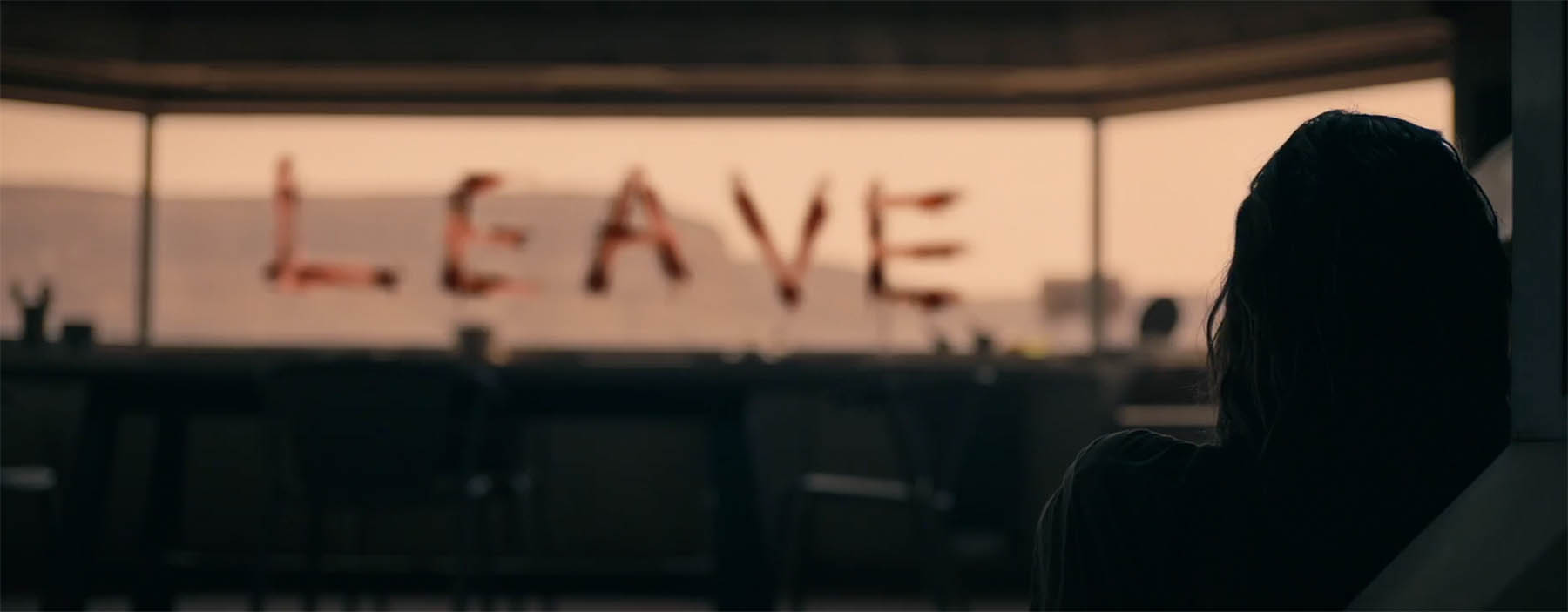
The settlement in writer/director Wyatt Rockefeller’s feature debut may be on Mars, but it’s his measured treatment of the colony’s constant dangers that allow the story to transcend any specific time and place.
Ilsa (Sofia Boutella), Reza (Jonny Lee Miller) and young Remmy (The Florida Project’s Brooklynn Prince) appear to be the only family on a barren Martian settlement, but then they wake to a giant “LEAVE” written on their front window and the questions begin to stack up.
Why is Jerry (Ismael Cruz Cordova) staking a claim to their place? What happened to all the other colonists, and how many others are out there lurking, maybe plotting to attack?
And what caused them all to leave Earth in the first place?
Rockefeller is not at all interested in easy answers, instead employing some first-rate performances and stellar production design to evoke a more universal statement on human nature, and more specifically, the often desperate and consistently overlooked role of women in nation building.
It’s a theme given an effective horror treatment in The Wind three years ago, and while the science fiction elements in Settlers are well-played, they’re also subtle enough to never upstage the character studies at work.
We see the first two acts of the film through young Remmy’s eyes, carefully observing the adults around her and making friends with a dog-like robot she calls “Steve.” Prince delivers a wonderfully tender performance, enabling us to feel Remmy sizing up her future choices with each passing day.
The film’s final act jumps ahead ten years, when a now teenage Remmy (the awesomely named Nell Tiger Free from GoT) is nearing the day she’ll be forced to make those hard choices. Jerry has become an even bigger presence in her life, and Cordova flexes an impressive ability to keep you guessing about Jerry’s true nature until late in the game.
If you lean toward tidy endings wrapped in unmistakable red bows, you’ll find none of those in Settlers. You will find an engrossing tale careful to leave plenty of opportunities for filling in the blank spaces.
Follow where it leads, and you’ll glimpse a future that’s inviting you to rethink the past. And the present.
The great thing about filmmaker Quentin Dupieux is that you
always know what you’re in for and you definitely never know what you’re in
for.
The point of Mandibles, essentially, is that you can never rely on anyone to do a single, simple thing correctly. Manu (Grégoire Ludig, Keep an Eye Out) — homeless at the moment — promises to deliver a suitcase in the trunk of his car from Michel-Michel to Point B. He needs to get it there by noon. Can he be trusted to do that one thing?
Of course he can!
He cannot.
There are the extenuating circumstances of the giant housefly that’s already in the trunk. We could get into what happens with the fly, but it’s not going to make any real sense, so why ruin it? Dupieux films work best when you just go with it.
That’s what Manu does. He and best friend Jean-Gab (David Marsais) take opportunities as they come, remain open to possibilities, and just enjoy their friendship. And their new, giant housefly.
The relatively streamlined plot delivers a fresh change of pace for the filmmaker—not that you could call any Dupieux film stale. But in pairing back the complications and convolutions, the writer/director has crafted maybe his most audience-friendly film to date. Mandibles certainly delivers the filmmaker’s most audience-friendly characters.
Ludig frustrates and charms in equal measure as the doofus Manu, and he and Marsais share an easy chemistry that suggests a lot of miles on this friendship. Here is the filmmaker’s most delightful surprise—a lack of cynicism or existential dread that leaves just an airy, almost sweet, wildly ridiculous comedy.
None of this has anything to do with a jawbone, but the title will become clear if you pay close attention.
In April of 2013, Joe Bell explained his walking trek from
Le Grand, Oregon to New York City. He was doing something. Those who watch
bullying and do nothing about it are as guilty as the bullies themselves.
It makes sense, then, that Reinaldo Marcus Green’s film Joe Bell is more interested in what Joe did and did not do when confronted with his son’s bullying than it is in the bullying and victimization themselves. Because the truth is, this walk is as much a penance as anything.
Mark Wahlberg plays Joe, volatile but loving husband and
father just trying to fly under the radar and still accept, as best he can, his
oldest son Jadin’s (Reid Miller) sexual orientation. Joe’s a blue-collar guy in
a blue-collar town, and neither Wahlberg nor writers Diana Ossana and Larry
McMurtry (both of Brokeback Mountain) let him completely off the hook
for the misery Jadin faces.
Wahlberg performs admirably as a man who’s trying and
failing, but the breakout here is Miller. Warm, bright and brimming with life, Miller’s
work the highlight of the film, although Green puts together a solid ensemble
including a heartbreakingly understated Connie Britton.
Though an early film contrivance threatens to sink things
before they can even really swim, the film eventually finds its lonesome way,
more or less. The examination here is culpability, and it’s uncomfortable,
messy terrain.
Wahlberg’s performance is raw and emotional. He lets the
character struggle, sometimes sinking under the weight of loss and culpability,
sometimes accepting the easy balm of celebrity in lieu of real change. His interactions
with Britton offer the most complex and satisfying suggestions that Green and team
recognize the wide and shattering reach of this kind of trauma.
The film Green builds around Wahlberg never stoops toward
easy epiphanies or patronizing catharsis. There is a simmering anger and barely
checked pain beneath the surface of this narrative, and no cliched structure or
manipulative storytelling gimmicks can entirely cage that.
In the end, Joe Bell does break through the contrivance of familiar storytelling because this story doesn’t fit neatly or cheerily into that package.
Raise your hand if you’ve ever had a crush on Val Kilmer.
I can’t be the only one.
Eighties heartthrob turned Hollywood prick turned reliable character
actor turned working actor turned Mark Twain, Kilmer has seen his ups and
downs. The thing is, he recorded all of them, too. And now directors Ting Poo
and Leo Scott—both primarily known as editors—piece together material from the
thousands of hours of video Kilmer has compiled in his 40-odd years in the
industry.
The result oscillates between self-indulgence and raw nerve,
but it’s never less than intriguing.
Yes, there are behind-the-scenes moments from Top Gun,
pieces from the contentious Island of Dr. Moreau set, Batman Forever
clips and bits of Doors footage. But the film is most relevant when
Kilmer interacts with his son Jack, who also narrates from pages written by his
dad.
Kilmer can’t do his own voiceover because of his fight with
throat cancer, which left him with a tracheostomy that makes speech difficult. The
battle has taken a lot out of him physically in much the way different battles throughout
his career has taken a lot out of him financially. Poo, Scott and Kilmer never
hide those battle scars, and yet their film never feels exploitative or reality
TV-esque.
Much of that has to do with Kilmer’s indominable spirit and
generous nature. Though a costly divorce and what amounts to fraud perpetrated by
his own father left Kilmer strapped for cash, his outlook on both his ex-wife
and his dad are entirely positive. And what he has to say about selling
autographs to pay his bills becomes perhaps the most moving moment in a fairly
emotional film.
At just under two hours the film seems a tad long. There are times when Val feels self-indulgent, but how could it not? We’re here to watch the actor come back then come back again then, dressed as Mark Twain for his shockingly successful one-man show Citizen Twain, make yet another comeback.
In Val, Jack Kilmer quotes his father quoting Twain: Don’t part with your illusions. When they are gone you may still exist, but you have ceased to live. It’s an apt metaphor for a documentary about life and acting, and a springboard for another surprising comeback.
All the Streets Are Silent: The Convergence of Hip Hop and Skateboarding (1987-1997)
by Christie Robb
Jeremy Elkin and Dana Brown’s documentary explores the origins
of what is now a mainstream aesthetic born from two distinct 90s New York City
subcultures—graffiti artists/skateboarders and hip hop.
Tracing the ancestry, briefly, to NYC artists Andy Warhol
and Jean-Michel Basquiat, the film credits the convergence of the movements to
the prescience of the club management department at Club Mars, a multistory
nightclub in the Meatpacking District.
In the early 90s, Mars had a weekly hip hop party that
started in the basement and attracted a broad swath of NYC street culture. The
bouncers let the skate kids in, even if they were all gross and sweaty and not
dressed up. Their streetstyle was cool. And the cross-pollination began.
Out of this came:
Phat Farm, the first hip hop clothing line
Zoo York, the first skateboard brand out of New
York
The Stretch Armstrong and Bobbito Show, an
underground hip hop radio show that introduced Biggie Smalls, Jay Z, Busta
Rhymes, and the Wu-Tang Clan (among many others)
The independent movie KIDS, featuring the debut
performances of Leo Fitzpatrick, Chloe Sevigny, and Rosario Dawson
The Supreme skateboarding lifestyle brand
The Zoo Mixtape video, with a hip hop soundtrack
As the film reminds us, skateboarding is now an Olympic
event and a $2 billion per year industry and hip hop surpassed rock recently as
the dominant music genre.
Elkin and Brown stuff their documentary full of interviews from the people who were part of the scene in the 90s like Kid Capri, Stretch Armstrong, Bobbito Garcia, and Mike Carroll. Archival footage was supplied by Eli Morgan Gesner, who had the presence of mind to shoot video of the skateboarders doing tricks and the rappers trying out rhymes. This grounds the film in the visual aesthetic of the period while the original score by hip hop producer Large Professor provides the aural vibe.
It all comes to resemble video scrapbook of the baby years of what’s become a mainstream aesthetic. And, while I’d prefer more coverage of the gradual gentrification of the aesthetic from an outsider scene to a branded “lifestyle,” that’s not really the project here. As a nonfiction narrative looking back on all the individuals and circumstances who mixed together in 90s downtown NYC, All the Streets Are Silent is pretty fly.
With a title like Danny. Legend. God. you might
expect a movie that’s, well, legendary. Unfortunately, writer/director Yavor
Petkov delivers something far more banal with his first feature film.
A film crew follows city councilor, Danny (Dimo Alexiev),
for a documentary series about money laundering. However, Danny lets them know
they won’t be following any kind of script; they’re making “big cinema.” The three-person
team gets more than they bargained for as Danny takes them deeper into his shady
world.
Danny is a big fish in a little pond, and along with his heavy, Tanko (Emil Kamenov), spends a lot of his time finding ways to impress his importance upon the film crew. Danny’s godson (Borislav Markovski) tags along for a few of his exploits, and it’s a credit to young Markovski that he’s one of the most interesting characters to watch despite having zero lines of dialogue.
But this points to the film’s biggest problem – the lead. For Danny, you need a character who is both repulsive, yet irresistible. Alexiev’s Danny is repulsive, but there is nothing about him – or the film – that compels you to watch. Too much here feels like we’re waiting for something to happen.
There are several scenes in the car that attempt to heighten the tension of being trapped with someone like Danny, but it doesn’t work. No one wants to be in the car with Danny – not the film crew nor the audience. We’re not watching a car crash, but a traffic jam.
There are a few side characters who turn up for a scene or
two that help move the film along. Danny’s irritated wife, the documentary
producer, and an old flame play off Alexiev with conviction. Seeing Danny from
their points of view help sell him as someone dangerous.
As Danny’s more sinister nature begins to reveal itself, the
documentary soundman (James Ryan Babson) becomes more uncomfortable with the
things they record. He insists “we’re complicit!” but within the context of the
film, it’s either an overreaction or a heavy-handed commentary on our societal
tendency to sit back and watch while our politicians play fast and loose with
the rules.
The movie wants us to wake up and find ourselves uncomfortable with those we put into office, but in the context of the real world, Danny isn’t nearly as disturbing as some of the actual people holding power right now.
Early on, plenty in the Shudder original Kandisha is going to remind you of Candyman. The filmmakers wisely address this early as well, and then move right along with a brisk and bloody realization of a Moroccan vendetta born from centuries-old roots.
On summer break from school, teen best friends Amélie (Mathilde Lamusse), Bintou (Suzy Bemba) and Morjana (Samarcande Saadi) are busy practicing their graffiti art in a dilapidated building. Peeling back some rotting drywall, Amélie spots a spray-painted tag of “Kandisha,” and Morjana recounts the legend.
In 16th century Morocco, Kandisha fought the Portuguese occupation that took her husband’s life. She even managed to kill six enemy occupiers before being caught, tortured, and killed.
Now, she roams the netherworld as a half-beast walking upright on hooves, waiting for a summons that will require her to slay six men before returning to her eternal unrest.
And how do you summon Kandisha? You look in the mirror and say her name five times.
“Like in the movies?”
Yes, girls, just like in the movies.
Writers/directors Alexandre Bustillo and Julien Maury (the unforgettable Inside) are smart enough to take what we’re thinking and make it organic. We instantly relate to the girls’ scoffing, which helps make us feel connected to the journey that will make them believers.
Once Amélie conjures Kandisha to avenge an assault, it’s a trip that doesn’t waste much time getting down to business. There’s no trace of the silly humor Bustillo and Maury added to Inside, but their penchant for grandiose bloodletting is front and center as Kandisha begins counting to six.
The girls turn to an Imam for help reversing the curse, a narrative thread that ultimately provides more than just monstrous thrills. It’s also the chance for international audiences – especially in America – to see Islam depicted as a source for salvation instead of the stereotypical terrorist breeding ground.
If you’re going back to the well of Bloody Mary and Candyman, the water gets finer via each original filter. Kandisha adds a fresh cultural and female-specific lens to a bloody, take-no-prisoners approach that does much to overcome the tale’s familiar building blocks.
Broadcasting—TV, radio, podcasts—offer plentiful opportunities for horror. You have the good broadcasts, where an important message is being delivered to the right people: The Fog, I Am Legend, A Quiet Place Part II, Texas Chainsaw Massacre 2. And, of course, there are the evil broadcasts: Lords of Salem, Trick or Treat, The Cleansing Hour.
There are also two (well, three really)N utterly brilliant films with very particular broadcasts that are difficult to come by. We narrowed the list to broadcasts aimed at as many people as can be affected, and for that reason alone we’ve left off Poltergeist and Ring/Ringu.
So here are the five best ways horror filmmakers found to wreak havoc over the airwaves.
5. They Live (1988)
More SciFi and action than horror, still John Carpenter’s vision of an elite class using tech to mollify and control the population of the US was eerily prescient. And horrifying.
At the time, though, it was just plain entertaining in a way that married Carpenter’s own iconic Escape from New York vibe with the SciFi horror miniseries of the day, V.
But mainly, it’s Rowdy Roddy Piper chewing bubble gum, and the 6 1/2 minute fight scene between Piper and undeniable badass Keith David that make this film as fun to watch today as it was when it was released.
4. Halloween III: Season of the Witch (1982)
Man, people did not like this movie when it came out. After two massive blockbusters kicking off the franchise, somebody decided to make a Halloween movie without Michael Myers. It would go on to be one of the most beloved cult movies of all time.
Is the storyline confused? Well, its mythology—Celts and Stonehenge and shamrocks and Halloween masks and blah blah blah—but the point is Tom Atkins, isn’t it? Plus the main plot points: kids wear the masks, they watch the commercial, they hear that creepy jingle, and their heads effing melt.
Now that’s showbusiness.
3. The Signal (2007)
A transmission – a hypnotic frequency – broadcasting over TV, cell and landline telephones has driven the good folks of the city of Terminus crazy. David Bruckner, Dan Bush and Jacob Gentry created a film in three segments, or transmissions.
Transmission 1 introduces our lover heroes as well as the chaos. Can Mya (Anessa Ramsey) and Ben (Justin Welborn) remain sane, reunite and outrun the insanity?
Transmission 2 takes a deeply, darkly funny turn as we pick up on the illogical logic of a houseful of folks believing themselves not to have “the crazy.” The final transmission brings us full circle.
The movie capitalizes on the audience’s inability to know for certain who’s OK and who’s dangerous. Here’s what we do know, thanks to The Signal: duct tape is a powerful tool, bug spray is lethal, and crazy people can sure take a beating.
2. Pontypool (2008)
Canadian director Bruce McDonald’s shock jock horror film is best appreciated as a metaphor on journalistic responsibility and the damage that words can do. Radio air personality and general pot-stirrer Grant Mazzy (Stephen McHattie) finds himself kicked out of yet another large market and licking his wounds in the small time – Pontypool, Ontario, to be exact. But he’s about to find himself at the epicenter of a national emergency.
McDonald uses sound design and the cramped, claustrophobic space of the radio studio to wondrous effect as Mazzy and his producers broadcast through some kind of zombie epidemic, with Mazzy goosing on the mayhem in the name of good radio. As he listens to callers describe the action, and then be eaten up within it, the veteran McHattie compels attention while McDonald tweaks tensions.
Shut up or die is the tagline for the film. Fitting, as it turns out that what’s poisoning the throng, turning them into mindless, violent zombies, are the very words spewing at them. It’s a clever premise effectively executed, and while McDonald owes debts all around to previous efforts, his vision is unique enough to stand out and relevant enough to leave an impression.
1. Videodrome (1983)
Videodrome was the last true horror and truly Canadian film in David Conenberg’s arsenal, and it shows an evolution in his preoccupations with body horror, media, and technology as well as his progress as a filmmaker.
James Woods plays sleazy TV programmer Max Renn, who pirates a program he believes is being taped in Malaysia – a snuff show, where people are slowly tortured to death in front of viewers’ eyes. But it turns out to be more than he’d bargained for. Corporate greed, zealot conspiracy, medical manipulation all come together in this hallucinatory insanity that could only make sense with Cronenberg at the wheel.
Deborah Harry co-stars, and Woods shoulders his abundant screen time quite well. What? James Woods plays a sleaze ball? Get out! Still, he does a great job with it. But the real star is Cronenberg, who explores his own personal obsessions, dragging us willingly down the rabbit hole with him. Long live the new flesh!
A quick plot synopsis of co-writer/director Michael Sarnoski’s
Pig suggests a very specific image. Nicolas Cage plays a hermetic
truffle hunter whose beloved pig is kidnapped. He uses his particular set of
skills to find her.
You are almost undoubtedly thinking this is John Wick,
swapping Cage for Keanu and a pig for a puppy.
Nope.
This touching film—a tale of love, loss, authenticity and a good meal— is essentially the anti-John Wick. And we are better for it.
Cage’s legacy will rightfully be of an unhinged and singular
talent—and also an actor who never turns down a gig. But every decade or so the
stars align and Cage gets to stretch, he gets to underact. He hasn’t delivered
as nuanced or thoughtful a performance since David Gordon Green’s 2013 film Joe.
Lurking, silent and disheveled, his character hitches a ride with the only soul who contacts him regularly, Amir (Alex Wolff, Hereditary), the slick wholesaler who takes his truffles off his hands each Wednesday.
As the two climb the ladder of potential kidnappers, from other outdoorsy truffle hunters to middlemen to chefs and higher still, Sarnoski mimics the beats of a vengeance thriller like John Wick or Taken, but he does this only to subvert expectations. It turns out, when your only real goal is to retrieve something beloved and lost to you, bloodshed doesn’t rank high in your thoughts.
A uniformly strong supporting cast and their priceless reactions to Cage’s vagabond presence not only illuminate the pretension Sarnoski hopes to call attention to in Portland’s high-end restaurant culture. They give the actor the chance to react.
Cage is almost always the center of attention in every film.
It’s tough to look away from him because you’re afraid you’ll miss some insane
grimace or wild gesture, but also because filmmakers love him and never pull
away. Sarnoski asks you to wait for it. He gives Cage time to pause, breathe,
and deliver his most authentic performance in ages.
I guarantee the folks to my left at this screening were here for Cage Uncaged! ™ Hopefully they appreciated the fact that they didn’t get it.