Tag Archives: independent film

Desperately Seeking…

Hunter Gatherer

by Rachel Willis

Writer/director Joshua Locy has crafted a unique, poignant drama with Hunter Gatherer.

The film succeeds in part due to Andre Royo’s stunning portrayal of Ashley, a man recently released from prison who wants to re-establish himself in his former girlfriend’s life. Fully inhabiting his character, Royo has chemistry with everyone he shares the screen with. His chemistry with George Sample III is especially winning – Sample’s Jeremy/“Germs” as the straight man to Royo’s boisterous Ashley.

Sample brings a sweetness to his character – especially apparent in Jeremy’s interactions with Dr. Merton (Jeannetta Arnette), a doctor involved in the medical science research for which Jeremy is a paid volunteer.

The film’s subtle comedy is quirky, but it works well alongside the more dramatic moments. A scene in which Ashley searches for a backpack could be mundane, but is enlivened by the funny interaction with the store clerk. The comedy is necessary, as the film quietly moves toward darker moments.

Though Ashley appears the eternal optimist, it’s clear as the film moves forward he is struggling to find his way – a depression lurks underneath the surface. Ashley jokes to hide the pain he feels as he tries to find connections with the people in his life.

It would be remiss not to mention Kellee Stewart’s noteworthy performance as Nat, the woman with whom Ashley spends most of his time. Her character’s sensitivity is much needed in Ashley’s life, but he takes her for granted as he continues to focus on rekindling his relationship with his ex, Linda (Ashley Wilkerson).

As a directorial debut, Locy’s film is not without problems, but as a moving character study, this is a film that will stick with viewers for its touching take on love and friendship.

Verdict-4-0-Stars

Her

Elle

by Hope Madden

Elle is a flummoxing, aggravating, possibly masterful piece of filmmaking that will leave you reeling.

A misanthropic tale with a complex – even befuddling – moral core, the film explores the aftermath of a brutal rape.

It opens – before we even see an image – on the sounds of the assault. Michele Leblanc (a beyond-magnificent Isabelle Huppert), a prosperous video game developer, is being attacked by a masked figure who’s broken in.

No matter what you expect to happen next, the only thing you can predict is that clichés will be upended.

The storyline offers an almost endless look at complicated gender politics, systemic misogyny and rape culture. As Michele goads the mostly-male team working on the firm’s latest beta game that the tentacle penetration of a medieval maiden is not orgasmic enough, the film further complicates – well – everything.

Another element tangling the viewing experience is the fact that the creative team behind the film is entirely male: director Paul Verhoeven, novelist Philippe Djian, and screenwriter David Burke – who, interestingly, specializes in true-life horror films, often succeeding in humanizing the serial killer (Dahmer, Gacy).

To articulate the film’s frustrating turns would be to give away far more than is appropriate. Suffice it to say, the deeply flawed heroine makes baffling choices in a story chastising a culture that promotes rape while simultaneously encouraging rape fantasy.

Or does it?

Verhoeven’s resume may taint this perception. A provocateur always, his latest effort is his most dialed down and intelligent. And yet, this same director managed to turn a Holocaust interrogation into a scene from Flashdance in his 2016 film Black Book.

There is basically nothing he cannot reframe to objectify women – and yet, there is not one sexual act in this film that is played for titillation.

It is quite possible that Huppert is the entire reason Elle works – and God help me, it does.

Huppert understands this character’s damaging backstory – information allowed the audience in slow bursts – and captures the icy resilience it instilled. Her Michele is a restrained narcissist, a pragmatic survivor at odds with expectations – unlikeable but hard to root against. Above all things, she is unpredictable, but in Huppert’s hands, every decision – no matter how bizarre or offensive – feels utterly natural.

I cannot imagine this film surviving without Huppert in the lead role, but with her as the central conundrum in Verhoeven’s indecipherable set of intentions, Elle leaves a mark.

Verdict-3-5-Stars

American Gothic

The Eyes of My Mother

by Hope Madden

The Eyes of My Mother will remind you of many other films, and yet there truly is no film quite like this one.

First time feature writer/director Nicolas Pesce, with a hell of an assist from cinematographer Zach Kuperstein, casts an eerie spell of lonesome bucolic horror.

Shot in ideal-for-the-project black and white, an Act 1 event could come from any number of horror films. A mother looks out her window to see her young daughter, playing alone in the front lawn, talking with a stranger. There is something clearly wrong with the stranger, and things take a bad turn. But for Pesce, this simple, well-worn set-up offers endless unexplored possibilities. Because this bad man doesn’t realize that the isolated farm family he’s come to harm is very comfortable with dissection.

His film is told in three parts. Part 1, with the stranger, sees the young Francisca (Olivia Bond) finding her role in her family. It changes after the stranger’s visit.

Parts 2 and 3 catch up with the family quite a few years later. The now-grown Francisca (Kika Magalhaes) takes some extreme measures to end her loneliness.

There is much power in dropping an audience into a lived-in world – the less we know, the better. Pesce understands this in the same way Tobe Hooper did with The Texas Chainsaw Massacre, and though The Eyes of My Mother lacks the cynicism, satire and power tools of Hooper’s farmhouse classic, it treads some similar ground.

Where Eyes differs most dramatically from other films is in its restraint. The action is mostly off-screen, leaving us with the sounds of horror and the quiet clean-up of its aftermath to tell us more than we really want to know.

As retrained as it is, The Eyes of My Mother hardly lacks in sensual experience. Stunning, gorgeously lit frames are matched with garish sound editing.

Kuperstein’s cinematography is sometimes almost Malick-like. Pesce focuses that camera on nearly silent moments full of traumatic images. He creates dissonance between the peaceful, idyllic scenes and the pinpoint imagery, the horrifying sounds.

The quiet amplifies Francisca’s isolation. The sounds amplify something else entirely.

Though Eyes of My Mother is reminiscent of several Seventies horrors, its muted telling exposes a patience rarely found in the genre. Pesce repays you for your patience.

Verdict-4-0-Stars

Unfair and Unbalanced

Christine

by Hope Madden

There’s a moment in Christine – Antonio Campos’s clinical character study of ‘70s on-air reporter Christine Chubbuck – when a violently depressed Christine chastises her mother’s parenting. Had she been a better parent, maybe Christine would understand how the world worked.

There is such honest, bewildered frustration in that moment. With that single thought, a career-best Rebecca Hall exposes Chubbuck’s isolated, lonely, crippled soul.

We’re invited to join the stormy decline of Chubbuck’s life. An awkward, severe professional at odds with the era’s sensationalistic news trends, Chubbuck clashes with her Sarasota station’s news manager (Tracy Letts) and pines for its handsome anchor (Michael C. Hall).

Chubbuck’s professional frustrations and personal isolation come to a head simultaneously. Thanks to Hall’s meticulous performance, what we can see is that the emotionally brittle, deeply depressed Chubbuck hasn’t the resilience to contend with it.

Hall’s body language, her gait, her facial expressions and her speech amplify her character’s growing turmoil. It’s a creeping darkness that grows to be almost unbearable before bursting into an eye-of-the-storm calm that’s even eerier for its realism.

Though Craig Shilowich’s screenplay leans too heavily on frustrated spinsterisms as a handy excuse for Chubbuck’s behavior, and Campos’s direction intentionally keeps Christine at arm’s length, Hall’s harrowing turn guarantees that Christine Chubbuck makes an impression.

Campos’s disturbing 2012 horror Simon Killer remained intentionally distant as well – a provocative approach that suited the mystery of the titular sociopath. Here, though, it feels too chilly, almost heartless.

That seems inappropriate, because neither Chubbuck nor those she left behind were heartless. In fact, one of the great successes in Hall’s performance is her ability to personify Chubbuck’s amazingly off-putting, alienating behavior while simultaneously pointing out that most of us are only a few social misjudgments away from pariah status ourselves.

Inevitably, the film feels like a 110-minute prelude to Chubbuck’s infamous on-air suicide, and that’s where Campos and Shilowich’s weaknesses show. What was at the heart of Chubbuck’s final display – institutional sexism, unending loneliness, mental illness, professional integrity, irony?

The filmmakers showed a great deal while exploring very little, but thanks to a performance likely to be remembered come awards season, Rebecca Hall makes sure Chubbuck’s struggle resonates.

Verdict-3-5-Stars

Hard Knock Life

No Pay, Nudity

by Hope Madden

Director (Ohio’s own) Lee Wilkof and screenwriter Ethan Sandler tap into years of collective wisdom from the inside to create a bittersweet, in-the-know glimpse at the near-thankless life of the workaday actor.

Gabriel Byrne, low key but excellent, is Lester Rosenthal – or Lawrence Rose, as the old playbill would have read. He’s having a hell of a time, as his longtime friend Hershel (Nathan Lane) explains to us via narration.

He’s a New York actor. An aging one whose dog just died, who hasn’t worked too steadily since that soap opera killed him off a few years back, who whiles away his days with similarly stagnant thesps in the Actors’ Equity Lounge, who may be willing to accept the role as King Lear’s Fool – in Dayton.

A mash note to the beleaguered actor in it for the long haul, No Pay, Nudity hits more often than it misses. The filmmakers possess a clear, lived-in knowledge of this world, this life. The yarn they spin is as empathetic as it is frustrated, and Byrne effortlessly embodies this embittered, wearied soul.

The premise is a bit slight and the resolution a tad rushed, but Wilkof and company make up for most of that with insight and affection to spare.

Verdict-3-0-Stars

https://www.youtube.com/watch?v=toO8g8fgtP4

Shiver and Sing

Gimme Danger

by Hope Madden

Quick, who said this: “I went to Detroit with a tab of mescaline and a shovel.”

Who but Iggy Pop?

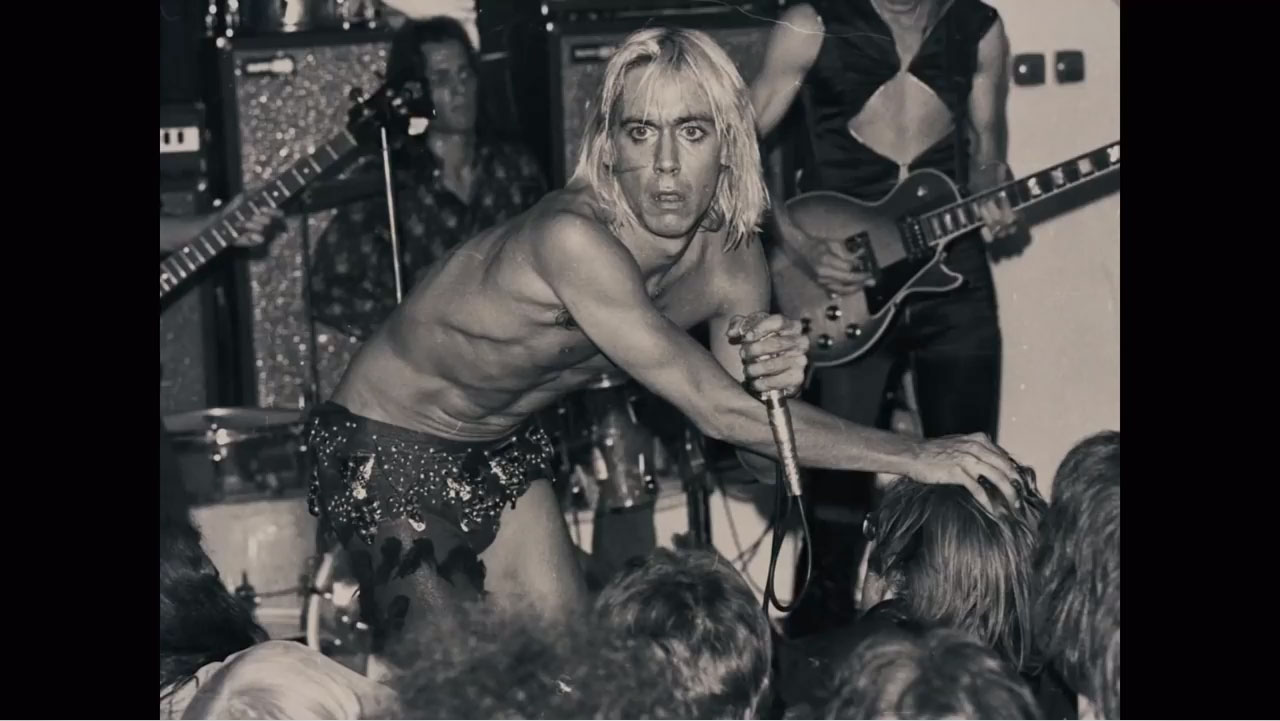
Effortlessly odd and forever fascinating, Pop and his band, the seminal punks The Stooges, are the subject of Jim Jarmusch’s new documentary, Gimme Danger.

Rock docs forever champion their subjects, frequently making a case for someone’s misunderstood and underappreciated genius. The fact that this kind of treatment could possibly be needed for arguably the first ever punk band, a group who influenced The Ramones, The Sex Pistols, David Bowie and dozens of others – well, it’s just disheartening, isn’t it?

While the story – from Ann Arbor trailer park to punk stardom to Ann Arbor trailer park – fits with the traditional “Behind the Music” approach, it’s never wise to expect the expected with Jarmusch.

Sure, the filmmaker pieces together vintage Stooges performances with interviews, but Gimme Danger is awash in the kind of wry cinematic mastery that has become Jarmusch’s trademark. Interviews with Pop take place in his home, the singer sometimes perched on a golden throne bedecked by skulls, sometimes barefoot in the laundry room in front of a washer/dryer set.

Likewise, on-again, off-again Stooge guitarist James Williamson sits through his interviews, guitar in hand, in a public men’s room.

Why? Why not?

Jarmusch has always brought an unusual perspective to his films, and The Stooges are an unusual subject. The pairing works, and for all Jarmusch’s droll use of animation, Three Stooges bits and vintage advertising as backdrop to Stooge insanity, his own affection and respect for the band is always evident.

Indeed, very early in the film, he proclaims The Stooges, “The greatest rock and roll band of all time.”

Jim Jarmusch is a native Ohioan who loves The Stooges.

Oh my God – we have so much in common!

His relationship with Pop goes back decades, since the singer co-starred in Jarmusch’s Dead Man and an early Coffee and Cigarettes short. In both, Pop (billed here as Jim Osterberg as Iggy Pop) haunts and bewilders with his sinewy frame and enormous eyes.

Oddly enough, Gimme Danger neglects some of the more jarring and lurid details of the Pop life. Jarmusch remains reverent throughout the film, focusing exclusively on The Stooges’ musical history. Almost quizzically missing is detail of Pop and crew’s self-destructive behavior, Pop’s infamous stage antics, or any mention of his solo musical or dramatic career.

Nope, Jarmusch wants you to realize that the world’s first punk band – as infamous record scout Danny Fields notes – reinvented music as we know it.

Truth.

Verdict-4-0-Stars

https://www.youtube.com/watch?v=WJhABiPQ4AU

Portraits and Landscapes

Certain Women

by Hope Madden

Writer/director Kelly Reichardt sees something extraordinary in the simple daily struggle of ordinary people. Her latest film, Certain Women, again observes with genuine interest the (mostly) routine choices and sacrifices that quietly shape lives.

Weaving together three separate tales, each with just a whisper of a connection to the next, she tells of the isolation and disappointments coloring the lives of certain small town women.

Laura Dern stands out, exasperated but compassionate, as a rural Montana lawyer contending with a confused and obstinate client (Jared Harris, wonderful). Their story crescendos with uncharacteristic (for Reichardt) drama, but even here, the intimacy and understatement highlight something far more human than the tale itself predicts.

Reichardt regular Michelle Williams leads the second story, one full of understated moments echoing with regret and longing. The third, starring Kristen Stewart as a new lawyer teaching a class and Lily Gladstone as the desperately lonely ranch hand she befriends, is the most hushed and heartbreaking.

Stewart, who’s been so strong in recent roles (Clouds of Sils Maria, Still Alice, Equals), falls back a bit on her trademark angst, but Gladstone’s aching loneliness balances it out.

It isn’t simply the characters, beautifully wrought as they are, that carry these loosely braided tales. Reichardt’s eloquently captured Montana landscape, lovely but hard, both informs and reflects each of the leads.

She’s working again with regular collaborator, cinematographer Christopher Blauvelt, and together they let the rugged landscape speak as loudly, or as quietly, as the cast.

Few filmmakers – if any – can create such texture in a film. Reichardt rushes nothing, letting every scene breathe, every performance matter. There’s no shorthand here, and viewers thirsting for clear-cut drama and momentum may be uncomfortable with her choices. But those familiar with her work – Meek’s Cutoff (2010) and Wendy and Lucy (2008), in particular – will embrace the quiet intimacy of the portraits.

Verdict-4-0-Stars

Halloween Countdown, Day 24: Possession

Possession (1981)

Speaking of sex and monsters – wait, were we? – have you seen Possession? WTF is going on there?

Andrzej Zulawski – writer/director/Czech – created this wild ride with doppelgangers, private investigators, ominous government (or are they?) agencies, and curious sexual appetites. It’s more precisely fantasy than horror, but it strikes me as David Cronenberg meets David Lynch, which is a pairing I can get behind.

Sam Neill plays Mark. Mark has just left his job – a mysterious position with some kind of lab. He’s being offered a lot of money to stay, but he needs to go home. We don’t know why.

Back at home, he greets his genuinely adorable son Bob (Michael Hogben). I love that his name is Bob. Bob – it’s so normal, and yet feels so unusual for a small child. Mark’s wife Anna (Isabelle Adjani) is also at home with Bob. There’s nothing normal about Anna.

Mark and Anna’s relationship boasts an intentional artificiality- a queasying sexuality- that makes it hard to root for either of them as their marriage deteriorates. Anna, it seems, is in love with someone else. Is it the sexually open – really, really open – Heinrich? Is it a bloody, mollusk-like monster? Is Mark boning Anna’s mean friend with a cast on her leg? Does Bob’s kindergarten teacher bear an unreasonable resemblance to Anna? Is anyone caring properly for Bob?

These questions and more go basically unanswered in a deviant, summary-defying, fantastical bit of filmmaking that mocks the idiocy, even insanity of obsession and boasts a handful of weirdly excellent performances. And sex with a bloody mollusk-like monster.

Listen weekly to MaddWolf’s horror podcast FRIGHT CLUB. Do it!

A Movie that Gives Your Heart a Hug

A Man Called Ove

by Christie Robb

There’s a concept in the northern countries of Europe that helps the people there combat the rigors of the long, frigid, winter nights. It’s called gemütlichkeit in German, hygee in Danish, and mysig in Swedish and loosely translates as “cozy.” But it’s not just a sitting in front of a crackling fire, blanket on lap, warm drink in hand kind of physical cozy. The concept encompasses emotional coziness—friendliness, peace of mind, social acceptance. The Swedish film A Man Called Ove, exudes mysig.

It’s the story of a cantankerous old widower who has recently been counseled out of his 40+ year job. His life has shrunk to the point where his days are spent patrolling his neighborhood enforcing homeowners’ association rules, yelling about where dogs can answer the call of nature, and tossing junk at stray cats. His plan is to wrap up the loose ends of his existence, and then join his wife by taking his own life. But the plan is delayed by the young family that moves into the house across the street, running into his mailbox in the process.

And you probably know where the movie is going to go from there. You’ve seen versions of this story before: Dr. Seuss’ How the Grinch Stole Christmas!, Up, St. Vincent, etc. Crabby old guy softened by the connections made with a youngster. But that doesn’t make Ove any less charming.

In Hannes Holm’s adaptation of Fredrik Backman’s bestselling novel, Rolf Lassgård manages to make even the angriest, most nihilistic version of Ove seen in the first portion of the film somehow likable despite his rudeness. And, in flashback sequences that occur each time Ove attempts suicide, his life story is fleshed out, revealing past events that have contributed to his current demeanor. This makes his subsequent, often bumbling, attempts at increased connection more poignant. And the family that provides a catalyst for his change is helmed by the fantastic Parvaneh (Bahar Pars)—friendly, decent, very pregnant, and taker of absolutely zero-shit from anyone.

It’s the kind of movie that makes you appreciate the beauty in the small details in life, the mysig: a well-cared-for green plant perched in front of a frosty window, a child’s drawing, neighbors that know your name and wave to you from across the street, a car ride with your dad. It’s the kind of movie that you’ll appreciate as the temperature dips, the dark comes creeping ever earlier, and the sky takes on the appearance of soiled sidewalk. It’s the kind of movie that might be best enjoyed with a small group of good friends and a warm beverage.

Verdict-4-5-Stars

Otis, Plug It In

Henry: Portrait of a Serial Killer

by Hope Madden

Unlike any film of its time – horror or otherwise – Henry: Portrait of a Serial Killer depicts an unforgivingly realistic portrayal of evil. A deeply disturbing Michael Rooker plays serial killer Henry (based on real-life murderer Henry Lee Lucas). We follow him through his humdrum days of stalking and then dispatching his prey, until he finds his own unwholesome kind of family in the form of prison buddy Otis (Tom Towles) and Otis’s sister Becky (Tracy Arnold).

Director John McNaughton’s picture offers a uniquely unemotional telling – no swelling strings to warn us danger is afoot and no hero to speak of to balance the ugliness. He confuses viewers because the characters you identify with are evil. Even when you think you might be seeing this to understand the origins of the ugliness, he pulls the rug out from under you again by creating an untrustworthy narrative voice. His film is so nonjudgmental, so flatly unemotional, that it’s honestly hard to watch.

What’s diabolically fascinating, though, is the workaday, white trash camaraderie of the psychopath relationship in this film, and the grey areas where one crazy killer feels the other has crossed some line of decency.

Rooker’s performance unsettles to the bone, flashing glimpses of an almost sympathetic beast now and again, but there’s never a question that he will do the worst things every time, more out of boredom than anything.

Re-released in time for its 30th anniversary with a 4K scan and restoration from its original 16mm camera negatives, Henry now boasts an even grittier, more unseemly quality. The world McNaughton invites you into feels even more alien and yet lived-in – a world you never imagined existed, but one that feels so authentic you’ll truly believe it does.

This is horror. You should see this.

Verdict-4-5-Stars