Tag Archives: independent film

Shop ’til you Drop

Personal Shopper

by Hope Madden

Kristin Stewart is an acquired taste. In the last few years, though, she’s shown in a handful of indies that she has some talent. Not a great deal of range, but some definite talent.

That shone most brightly in writer/director Olivier Assayas’s 2014 film Clouds of Sils Maria.

In that film, Stewart played the put-upon personal assistant to a demanding celebrity. Assayas places Stewart in a similar position but with wildly differing themes for his latest, Personal Shopper.

Stewart plays Maureen, an introverted American in Paris. By day, Maureen darts around Paris and even trains to London to pick up fancy-schmancies for her A-lister boss to wear to this red carpet or that fashion show.

By night, though, Maureen wanders the empty rooms of her deceased twin brother Lewis’s old house. Both siblings possessed the gifts of a medium, and Maureen wants to contact Lewis.

It’s a ghost story of sorts, with a bit of a mystery thrown in for good measure, but what Personal Shopper really offers is an exploration of isolation, alienation and identity in the digital age.

Maureen is almost always almost alone. As the film opens, her friend drops her off at Lewis’s old house and Maureen asks, “You’re not staying?”

No, she is not. It’s just Maureen in this old house and her desire to connect with someone.

Likewise, Maureen periodically Skypes with her boyfriend, on some kind of IT assignment halfway across the globe. And she is always just missing the celebrity she shops for. Maureen’s solitary existence is a series of near-connections.

Assayas explores this most fully with an anxiety-inducing texting relationship with an unknown contact – a plot device that attempts to drive the themes and storyline forward. But, as is often the case with this filmmaker, ambiguities and curiosities are more important than closure or action.

Aside from an unfortunate run-in with CGI, the film barely registers as horror and impatient genre fans are likely to be disappointed. But for a lonesome comment on modern times – or for proof that Kristin Stewart can actually act – it’s not bad.

Verdict-3-0-Stars

Maniac Baby on Board

Prevenge

by Hope Madden

Anybody with any sense at all is afraid of pregnant women.

I myself all but pushed a man down a flight of stairs while I was pregnant, and still don’t see the problem with it.

With unassuming mastery, Alice Lowe pushes that concept to its breaking point with her wickedly funny directorial debut, Prevenge.

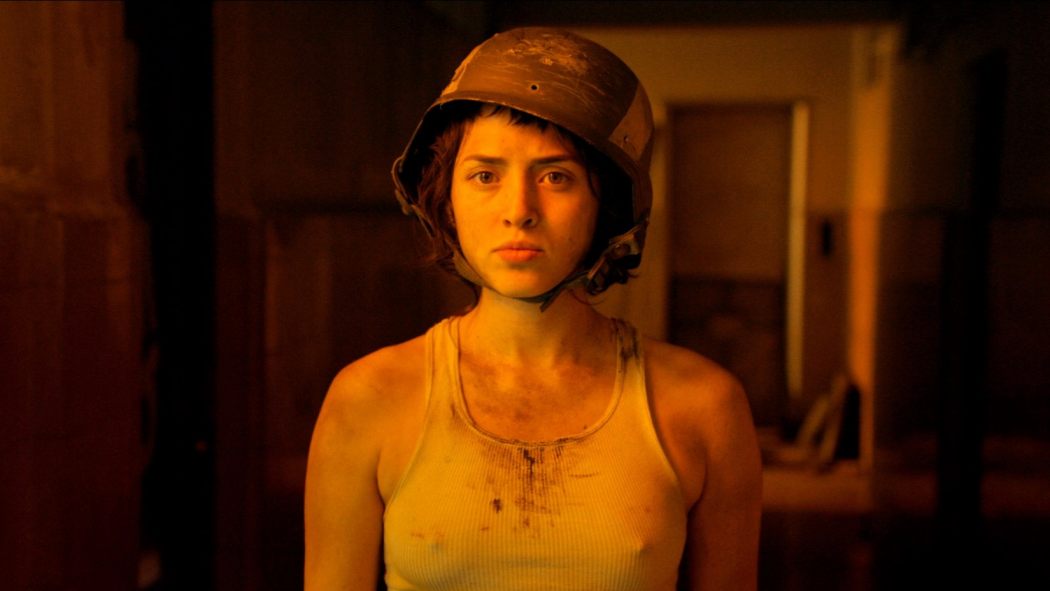
Lowe plays Ruth. Grieving, single and pregnant, Ruth believes her unborn daughter rather insists that she kill a bunch of people.

With her characteristically dry, oh-so-British humor, Lowe exposes awkward moments of human interaction and then forces you to stare at them until they become gigglingly unbearable.

Why such bloodlust from Ruth’s baby? Lowe, who also wrote the script, divulges just as much as you need to know when the opportunity arises. At first, there’s just the macabre fun of watching the seemingly ordinary mum pick off an unsuspecting exotic pet salesman.

And then on to the saddest, most pathetic 70s-loving disco club DJ of all time.

With each new victim we learn a bit more backstory and a little more about Ruth, who’s on a path that’s funny, bloody and just touching enough to leave a mark.

Lowe’s blackly comic timing as an actor is well proven, particularly in Ben Wheatley’s 2012 gem Sightseers, which she also co-penned. Wheatley’s picture predicted Lowe’s ability to zero in on anxieties around social awkwardness and exploit them for all their squirm-worthy horror and comedic worth, as well.

She ably showcases these skills and more in Prevenge, this time mining larger themes of grief and pre-partum depression with a weary authenticity. (Lowe, like her character Ruth, was 7 months pregnant during filming.)

Rarely gory (DJ Dan does get it pretty good, though), the film barely registers as horror, but as a comedy it treads some dark territory. It does so with authority, good will, subversive insight and a laugh.

It’s a thin plot requiring the ability to suspend disbelief, but it also announces a very fresh voice in horror.

Verdict-3-5-Stars

Schwarzenegger’s Aftermath Premieres at Gateway

He said he would be back, and he is – onscreen, anyway. Open fan of Columbus Arnold Schwarzenegger stars in Aftermath, a movie filmed and set in central Ohio.

Based on the real-life mid-air collision of Danish airplanes in 2002, recast as an American disaster, the film follows the merging paths of a grieving father (Schwarzenegger) and the air traffic controller he holds responsible (Scoot McNairy).

Greater Columbus Film Commission and Gateway Film Center celebrate the release with a premier this Friday, April 7. Local cast and crewmembers will share the excitement, which begins with a mixer at the film center at 7:30 pm and a screening at 9.

Schwarzenegger delivers one of his best performances in a role that contrasts with the type that made him an icon. He’s thoughtful and understated in a film draped in a haze of sadness and regret.

He’s joined onscreen by Columbus native Maggie Grace in a film written by Javier Gullon (Enemy), produced by Darren Aronofsky (Black Swan, The Wrestler), and directed by Elliot Lester (Nightingale).

Add to that cameos by former Mayor Mike Coleman and shout outs to local media Sunny 95 and Channel 6 – not to mention locations you’re sure to recognize – and the whole thing feels just darn homey.

Tickets for this special opening night event are $15 each ($5 for myGFC members).

Standard showtimes and pricing also available at www.gatewayfilmcenter.org.

God Save the Queen

Queen of the Desert

by Hope Madden

How many period romances set against the crumbling of the Ottoman empire must I endure in one month?

Current tally: 2, and Werner Herzog’s Queen of the Desert is the least endurable.

I had been cautiously optimistic about Herzog’s biopic on Gertrude Bell. Nicole Kidman (rarely a bad idea) stars as Bell, a British writer/traveler/scientist/spy who helped shape British policy on the Middle East.

Herzog + Kidman = reason for optimism.

Unfortunately, that math doesn’t really work out.

I’m not going to lie, I had no idea who Gertrude Bell was before I saw this film. Ten seconds on google and I found out that she was an absolutely fascinating human being. It’s crazy. She explored everywhere, climbed everything, learned new languages, informed culture and politics, wrote about all of it, had torrid affairs, never married, and determined the boundaries of modern day Iraq. All in the early 1900s.

That should have been a hell of a movie.

Unfortunately, director Herzog cannot tell this woman’s wildly unconventional story without framing her in the most conventional way possible. She exists exclusively in terms of her relationships – or the absence of a relationship – with men.

We’ll lay that at the foot of Herzog the director, but this God-awful dialog? That’s on Herzog the writer.

Kidman, almost tragic in her earnest commitment to this part, manages to wrestle Herzog’s humorless and hackneyed prose into submission. But Lord, James Franco cannot.

The plotting is no better than the concept or dialog.

Scene after needless scene shows Kidman in the office of one man or another, announcing her plans to do something they don’t need to know about, only to suffer their indignant rebuffs. She responds with obstinate will. Cut to Kidman doing whatever it was those men told her she couldn’t do.

Repeat ad nauseum.

This woman hand-drew the border between Iraq and Jordan – in a time when women couldn’t vote in England. That alone could be unpacked and considered from about 30 different perspectives. There are so many things worth knowing about Gertrude Bell, but all I really learned from Queen of the Desert is that she was, “a woman without her man.”

That’s a real line of dialog. Good God.

Verdict-1-5-Stars

https://www.youtube.com/watch?v=zdGKbxJHPkk

Killing Time at Work

The Belko Experiment

by Hope Madden

Back in 2005, Aussie director Greg McLean made a name for himself with the brutal but brilliant Wolf Creek. A year later, writer James Gunn would make his feature debut behind the camera with the underseen and wonderful creature feature Slither. (You may know him better for a little something called Guardians of the Galaxy.)

Regardless of whether you do or do not know these two, the fact that they worked together on the new horror The Belko Experiment meant one thing to me: hoo-effing-ray!

There’s the ripe premise: office workers hear over a loud speaker that they have a few minutes to kill two people or the unseen speaker (a royal we) will kill 4. Things escalate. People go a little nuts. It’s Darwinism at its most microcosmic.

Plus McLean and Gunn have assembled a fine cast full of excellent character actors: Tony Goldwyn, John C. McKinley, James Gallagher, Michael Rooker and Gregg Henry, among others.

So what went so blandly, forgettably wrong?

The biggest surprise in The Belko Experiment is the utter absence of surprises. Each actor plays exactly who you’d expect him or her to play. Their Stanford Prison Experiment meets Lord of the Flies exercise turns people into exactly what you’d expect them to turn into.

There’s not even a single inventive death scene to distract you from the fact that you had really high expectations because you totally love these filmmakers and now you’re just wasting yet another lovely evening a darkened movie theater.

Sigh.

Verdict-2-5-Stars

https://www.youtube.com/watch?v=qZNfwayNLL0

Lonely is the Night

Dark Night

by Hope Madden

An eerie soundtrack echoing with alienation and longing pairs with a roaming camera in search of human connection. With these and little more filmmaker Tim Sutton creates the loose and lonesome architecture for Dark Night.

His film glimpses disparate lives that will eventually meet and, in some cases, end in a bland suburban movie theater.

Sutton bases this prelude to a massacre around a fictional copycat shooting. With no help from exposition, he builds an unsettling dread as we and the camera so dispassionately watch each character.

This anxiety grows as we realize one of these people will eventually act on the same urge that pushed James Eagan Holmes to open fire, killing 10 and wounding 20 more in an Aurora, Colorado screening of The Dark Night Rises in 2012.

The focus remains splintered, meandering from one character to the next – an Iraq veteran struggling with PTSD, a video game obsessed teen, a selfie-compulsive would-be model, a skate kid tellingly dying his hair orange. The only discernible commonality – aside from the lifeless landscape of their suburban digs – is personal alienation.

As their stories begin to coalesce, you’re asked to guess who will become the shooter. You understand that there will be an incident and instinctively begin to distinguish potential culprits from likely victims. It’s a sort of whodunit in reverse.

Sutton’s interest is in our preconceived notions as well as possible inspirations for this particular brand of American mayhem.

The filmmaker creates a drowsy cadence – clearly reminiscent of Gus Van Sant’s own meditation on mass shootings, Elephant – pulling each thread tighter and tighter as the climax draws near.

Much of the power in Sutton’s film comes not from imagery but absence. Dark Night is adamantly bloodless. You know what is coming, feel the weight of its inevitability. What’s the use in seeing it?

Dark Night becomes a lyrical American nightmare, although at times its pursuit of authenticity feels more like cinematic sleight of hand. Characters begin to feel like red herrings, undercutting the basic, flawed humanity Sutton offered each one early in the film.

Still, between Hélène Louvart’s fluid camerawork, Maica Armata’s doleful score, naturalistic performances from an ensemble of newcomers and Sutton’s hypnotic structure is a potent vision of the damage of disconnection.

Verdict-3-5-Stars

Strangers on a Trainwreck

Julieta

by Hope Madden

Pedro Almodovar brings his two most marked filmmaking styles – the one submerged in the world of women (Volver, for instance), the later of a more Hitchockian note (The Skin I Live In) – and pulls them together in his latest effort, Julieta.

The titular heroine, played at different ages by Emma Suárez and Adriana Ugarte, has a shameful secret – or two. As the film opens, Julieta (Suárez) is packing to leave Madrid for Portugal with her boyfriend, Lorenzo (Darío Grandinetti). But a chance encounter with a childhood friend of her daughter’s convinces Julieta to drop Lorenzo and stay in Madrid, moving instead to the old building where she’d lived for years with her daughter.

We then switch to the story of the younger Julieta (Ugarte), and Almodovar gets all Strangers on a Train with us – even to the point of eventually mentioning the novels of Patricia Highsmith, writer at the core of that Hitchcock classic.

Suárez capably maneuvers Julieta’s emotional landscape. She’s a woman pretending to be fine, keeping her true nature from those around her and attempting to hide it from herself. The performance is haunted, edged with remorse.

Ugarte stumbles, though. It doesn’t help that she and Suárez look so little alike, or that the flashback storyline is designed to be a thriller – an ill-fitting choice for the material.

Almodovar built the screenplay on three inter-connected shorts by Canadian writer Alice Munro, layering her words with an urgent score, suggesting dangerous thrills, and dialog-heavy close ups that feel more like daytime drama.

For all the clashing colors, discordant images and creepy housekeepers, Hitchcock and Munro just don’t fit together well.

Munro’s writing tends to lull you with quite unveilings. Julieta may be Almodovar’s attempt to spice that up by way of homage, score and framing, but it feels like a trick. His direction leads us to believe we’re watching some thriller wrought with dangerous secrets. We are not. This chicanery undercuts the power of Munro’s meditation on guilt while it all but guarantees the dissatisfaction of a misled audience.

The final result, though often gorgeous and compelling, is a bit of thematic chaos that doesn’t work.

Verdict-2-5-Stars

Meat is Meat

We Are the Flesh

by Hope Madden

Are you squeamish?

This is actually the first question my friend was asked in an interview for an internship with a meat packing plant, but it’s also a good piece of self-reflection before you sit down to We Are the Flesh.

First time feature writer/director Emiliano Rocha Minter announces his presence with authority – and a lot of body fluids – in this carnal horror show.

A hellish vision if ever there was one, the film opens on a filthy man with a lot of packing tape. He’s taking different types of nastiness, taping it inside a plastic drum to ferment, and eventually turning it into a drink or a drug. Hard to tell – loud drum banging follows, as well as hallucinations and really, really deep sleep.

During that sleep we meet two siblings, a teenaged brother and sister who’ve stumbled into the abandoned building where the hermit lives.

What happens next? What doesn’t?! Incest, cannibalism, a lot of shared body fluids of every manner, rape, maybe some necrophilia – depending on your perspective – a lot of stuff, none of it pleasant.

Minter has created a fever dream as close to hell as anything we’ve seen since last year’s Turkish nightmare Baskin.

Had Minter not found an anchor for the overwhelmingly lurid imagery, his movie would have felt like little more than self-indulgent horror porn (like literally horror and porn).

Noé Hernández conjures a goblin-like image, his unblinking eyes and demonic grin permanent fixtures as he mentors his teenage charges in his repellant ways. The boy he’s dubbed Skeletor (Diego Gamaleil) resists, though his consistently surprising sister (María Evoli) is less inhibited.

There’s little chance you’ll watch this film in its entirety without diverting your eyes – whether your concern is the problematic sexuality or just the onslaught of viscous secretions, the screen is a slurry of shit you don’t really want to see.

What opens as a post-apocalyptic hellscape eventually morphs into a social comment on Mexico City’s disposable population, which is both the film’s strength and its weakness.

Unfortunately, though Minter’s movie boasts deeply unnerving ideas and compelling performances, in light of other Mexican filmmakers making social commentaries – Jorge Michel Grau’s brilliant 2010 We Are What We Are, in particular – We Are the Flesh comes up slightly lacking.

Verdict-3-0-Stars


https://www.youtube.com/watch?v=BnTY6q7bt78

Mothers and Son

20th Century Women

by Hope Madden

Has it been six years since Mike Mills explored father/son relationships and the coming of middle age with Beginners? Insightful, emotionally complex and kind, the film marked Mills as not only a director of substance, but a writer with integrity and wit.

Not that it could have predicted 20th Century Women.

What a joyous conundrum this film is. Set in 1979, the film looks on as Jamie (Lucas Jade Zumann) maneuvers the troubles of adolescence, societal sea change and his loving if enigmatic mother, Dorothea (Annette Bening).

Too practical and pragmatic for the women of 1979, too independent and wise for her own generation, Dorothea is a woman without a timestamp. It gives her a gravitational pull, drawing the fierce and the unusual to her like satellites.

Those in her orbit – besides her pubescent son – are punk artist Abbie (Greta Gerwig), troubled teen Julie (Elle Fanning), and misplaced hippie William (Billy Crudup).

The cast is uniformly terrific, but Bening is a spectacle. A collector of friends, she’s still a solitary figure, one who looks on the relationships and complications in her life with a strange remove – almost like an anthropologist.

Dorothea is, from her son’s point of view, unknowable. Bening more than manages to embody that frustrating reality of a parent whose behavior seems entirely natural and yet almost alien. And she does it with such charm and humor.

Perhaps the biggest surprise in 20th Century Women is the humor – the film, like life, is peppered with laugh out loud moments that help make even the barely endurable pain of adolescence enjoyable.

Mills falls back at times on a punk rock undercurrent that creates a wonderful energy as well as a thoughtful theme for the time in history and in Jamie’s life. As Abbie puts it, the chaos of punk is comforting because it’s about, “When your passion is bigger than the tools you have to deal with it.”

It’s a line that’s almost too perfect, as this cast is almost too perfect. This seems to be the quiet wonder of Mike Mills: he puts his own complicated, insightful and emotionally generous writing into the hands of genuine talent.

Good call.

Verdict-4-0-Stars

The Wheels on the Bus

Paterson

by Hope Madden

Simplicity, tempo, pattern – to some, this alone constitutes poetry.

To Jim Jarmusch, perhaps.

Jarmusch’s second film in a year – after his wonderful Stooges documentary Gimme Danger – is a quieter effort. Paterson marks the days of a New Jersey bus driver, a man named Paterson (Adam Driver) driving in the town of Paterson.

He lives a life of routine: up around 6 to work on a poem while he eats his Cheerios, then a walk to work where he scribbles a bit more before starting his route, then a break for lunch where he returns to his poem, then home for dinner with his wife Laura (Golshifteh Farahani). After dinner he walks his dog to a corner bar where he stops for a beer, then to bed and back at it around 6 the next morning.

Paterson’s wife is more of an explosion of creativity that counters his disciplined artistry.

Paterson loves his wife, finds comfort and beauty in his routine. Above all, he observes, often finding grace in moments so quiet they might be overlooked by someone less still.

Jarmusch’s film is as measured, as calm and composed as its hero.

A languid pace tends to be an earmark of the auteur’s work, but with Paterson Jarnusch has left behind much of his iconic quirkiness in favor of clear-eyed if lyrical normalcy. Ordinariness is celebrated – elevated, even.

Through the character’s eyes we get to notice patterns and repetitions, seeing them as something more than coincidence or design, but a mystery deserving our interest.

Driver delivers a near perfect performance with a tough character. Paterson reveals nearly nothing of himself, preferring to direct attention back at his surroundings. Only through his poems – often scribbled across the screen and read in voiceover – do we get a sense of his inner self. But Driver’s expressions convey an enormous amount of information – about his meals, his relationship with his dog, his joy, fear and heartache.

Through Paterson, Jarmusch seems to memorialize an unplugged life – the kind that allows the mental quietness required for this type of meditative art.

There are elements of the film that feel appropriately unexplained, and others that simply come off as undercooked. And there are always those audience members who will itch for more – more drama, more action, more something. Those people may not be Paterson’s intended audience. Poetry often requires more patience to fully appreciate.

Verdict-3-5-Stars