The Spine of the Night is a rotoscope-animated feature that presents a pseudo-H. P. Lovecraft story of humanity’s cosmic insignificance in the visual style of a higher-budget He-Man cartoon.
The film is mostly the backstory of a formidable, almost-naked, swamp queen who has trekked up the face of a mountain. She’s come to swap tales with a Guardian sworn to protect humanity from confronting its own vulnerability in the face of a vast and indifferent universe.
He’s guarding a blue flower that makes folks trip balls and contemplate the cosmic void. But a seed got away from him and floated to the fertile earth of the swamp. With the knowledge of the void comes magic power.
And humanity’s quest for this power has caused no end of trouble.
Like Lovecraft’s stories, the Spine of the Night has a slow, dreamy pace. The art style pays homage to the otherworldly and provocative covers of vintage pulp fantasy/horror novels, but with a welcome understanding that not all women are proportioned like Barbie dolls, and with more diversity in the race/ethnicity of its characters.
The theme of humanity’s fragility is underscored in the movie’s violence. Skin parts and limbs break off with the ease of a tortilla chip placed under the pressure of a slightly viscous dip. Viscera are just waiting to pop out of the body’s private cavities like trick snakes in a can of faux potato chips. People are cleaved in half.
Writer/directors Philip Gelatt and Morgan Galen King have assembled a roster of voice talent that helps bring the characters to life. Is there a better choice to play a badass swamp queen who is impervious to frostbite than Lucy Lawless? I don’t think so. Joining Lawless are Richard Grant as the Guardian, Joe Manganiello as the beefy soldier Mongrel, Betty Gabriel as a warrior-librarian, and Patton Oswalt as the whiny and entitled Lord Pyrantin.
As a child of the eighties, I was left feeling swaddled in nostalgia by Spine of the Night, wanting to pair it with some cozy PJs and a bowl of sugary cereal.
Friends to the end – that’s the whole idea when horror filmmakers tackle friendship, isn’t it? Can they be trusted? Who will sacrifice what, and will it be worth it? Or are they both evil? Horror cinema has an excellent run of best friends in movies, but we’re looking at movies specifically about that friendship. Movies like Shaun of the Dead and Jennifer’s Body. (Both brilliant, but not on the list. We know! There are a lot of great ones!) So let’s get to it!
5. Bedevilled (2010)
Cheol-soo Jang’s first feature film bears witnesses not only to some horrific deeds, but to an amazingly confident new filmmaker who knows how to sidestep expectations, turn the screw, and offer surprising insight in a genre that doesn’t always generate that kind of thoughtfulness.
The film opens as beautiful if cold Hae-won (Sung-won Ji) witnesses a crime and chooses not to involve herself. She takes a (somewhat involuntary) vacation on the remote island where she grew up, to find her childhood friend Bok-nam (Young-hee Seo). On the isolated, backward island – though Hae-won is treated to rest and nurturing by her adoring friend – Bok-nam’s life is about as far from ideal as possible.
Jang captures the rugged, isolated beauty of the island and offsets both ideas with his leads – one, an elegant and pristine beauty, the other a rough-hewn image – and sees two sides of the same humanity. This is a morality tale, but it’s also a brutal but sympathetic (and seriously bloody) comeuppance. Jang does not leave off where you think he might, instead crafting a compelling and satisfying whole that will stick with you.
4. Tragedy Girls (2017)
Heathers meets Scream in the savvy horror-comedy that mines social media culture to truly entertaining effect.
Besties Sadie (Brianna Hildebrand) and McKayla (Alexandra Shipp) are looking for more followers to improve their brand, and they have been doing a lot of research to make their content more compelling. The Tragedy Girls plumb their small Ohio town’s surprising death toll with more insight than the local police seem to have. Where do they get their knowledge?
Provocative.
Hildebrand and Shipp (both X-Men; Hildebrand was the moody Negasonic in Deadpool while Shipp plays young Storm in the franchise proper) nail their characters’ natural narcissism. Is it just the expectedly shallow, self-centeredness of the teenage years, or are they sociopaths? Who can tell these days?
3. Tucker & Dale vs Evil (2010)
Horror cinema’s most common and terrifying villain may not be the vampire or even the zombie, but the hillbilly. The generous, giddy Tucker and Dale vs. Evil lampoons that dread with good-natured humor and a couple of rubes you can root for.
In the tradition of Shaun of the Dead, T&DVE lovingly sends up a familiar subgenre with insightful, self-referential humor, upending expectations by taking the point of view of the presumably villainous hicks. And it happens to be hilarious.
Two backwoods best buds (an endearing Tyler Labine and Alan Tudyk) head to their mountain cabin for a weekend of fishing. En route, they meet some college kids on their own camping adventure. A comedy of errors, misunderstandings and subsequent, escalating violence follows as the kids misinterpret every move Tucker and Dale make.
T&DVE offers enough spirit and charm to overcome most weaknesses. Inspired performances and sharp writing make it certainly the most fun participant in the You Got a Purty Mouth class of film.
2. Let the Right One In (2008)
In 2008, Sweden’s Let the Right One In emerged as an original, stylish thriller – and the best vampire flicks in years. A spooky coming-of-age tale populated by outcasts in the bleakest, coldest imaginable environment, the film breaks hearts and bleeds victims in equal measure.
Kare Hedebrant‘s Oskar with a blond Prince Valiant cut needs a friend. he finds one in the odd new girl (an outstanding Lina Leandersson) in his shabby apartment complex. She, as it turns out, needs him even more.
This is a coming-of-age film full of life lessons and adult choices, told with a tremendous atmosphere of melancholy, tainted innocence, and isolation. Plus the best swimming pool carnage scene ever.
The unsettling scene is so uniquely handled, not just for horrifying effect (which it certainly achieves), but to reinforce the two main characters, their bond, and their roles. It’s beautiful, like the strangely lovely film itself.
1. They Look Like People (2015)
Christian (Evan Dumouchel) is killing it. He’s benching 250 now, looks mussed but handsome as he excels at work, and he’s even gotten up the nerve to ask out his smokin’ hot boss. On his way home from work to change for that date he runs into his best friend from childhood, Wyatt (MacLeod Andrews), who’s looking a little worse for wear. Christian doesn’t care. With just a second’s reluctance, Christian invites him in – to his apartment, his date, and his life.
But there is something seriously wrong with Wyatt.
Writer/director Perry Blackshear’s film nimbly treads the same ground as the wonderful Frailty and the damn near perfect Take Shelter in that he uses sympathetic characters and realistic situations to blur the line between mental illness and the supernatural.
Wyatt believes there is a coming demonic war and he’s gone to rescue his one true friend. Andrews is sweetly convincing as the shell shocked young man unsure as to whether his head is full of bad wiring, or whether his ex-fiance has demon fever.
The real star here, though, is Dumouchel, whose character arc shames you for your immediate assessment. Blackshear examines love – true, lifelong friendship – in a way that has maybe never been explored as authentically in a horror film before. It’s this genuineness, this abiding tenderness Christian and Wyatt have for each other, that makes the film so moving and, simultaneously, so deeply scary.
Sometimes a title really hits you, like Bingo Hell.
Maybe because the idea of playing this game makes me lose the will to live.
Co-writer/director Gigi Saul Guerrero has a slightly
different use for the image of folks hunched over their boards hoping to win
something from the community chest. A veteran of the horror short film,
Guerrero pulls together conflicted thoughts about gentrification and
neighborhood loyalty, poverty and affluence, and the sketchy influence of
organized gambling for her first feature.
Speaking of veterans, Adriana Barraza — reliable as ever — leads the film as Lupita, the aging but spunky heart of her community, Oak Springs. She doesn’t dig gentrification. Watching members of her community take the cash and bail because they don’t have the cash to pay newly exorbitant rents doesn’t break her heart, it fuels her rage.
Lupita is a spitfire and Barraza’s relish with her outbursts
drives the film’s energetic, campy outrage. Bingo Hell has social
commentary to spare, but it’s not preaching. It’s attacking.
Guerrero’s film, part of Amazon Prime’s 2021 Welcome to the
Blumhouse program, doesn’t oversimplify causes and solutions. Still, it
delivers its recommendations as more of a blunt instrument than a surgical
tool.
It is much fun to watch Barraza and other mature actors (L.
Scott Caldwell, Grover Coulson, Clayton Landey) inhabit characters with agency
and some degree of complexity, but it’s Richard Brake who offers Barraza the
best sparring partner. Effortlessly sinister, the underappreciated character
actor delivers another memorable baddie.
With characters to root for, violence to spare, and a healthy acceptance of chaos, Bingo Hell is pretty fun.
Horror filmmakers have long focused their preoccupations with mortality o the act of death itself, perhaps what happens afterward. But there are those whose real worry is quite the opposite – rather than leaving a beautiful young corpse, it’s the idea of the long, slow death of aging. Here are our favorite movies on the horrors of aging – but first, a little PSA on a movie of our own!
Obstacle Corpse
We also used our latest episode to announce our own movie!
After she gets an invite to a mysterious pro-am obstacle course race, unprepared teen Sunny enters with her goofy best friend, Ezra, in a last-chance shot at proving herself to her survivalist dad. But when bloody bedlam breaks out and the pros start murdering their “plus-ones,” Sunny must finally find her killer instinct before she and Ezra end up coming in dead last.
Please help us reach the finish line and support a woman-led, smart horror comedy!
A fear of aging hangs over this film and story, but not simply of impending death but of the ravages of sin, guilt and shame. Due to some magical mystery, the beautiful young man never ages, although a painting of him not only shows his true age, it shows every ugly thing he’s ever done. As Gray stalks London indulging in debauchery, treachery and all things foul, his painting grows more and more grotesque.
We knew there would be a Dorian Gray somewhere in this list, but we’d originally planned to go with Oliver Parker’s 2009 film Dorian Gray starring Ben Barnes, Colin Firth and Rebecca Hall, mainly because it’s far more of a horror film than the 1945 film from Albert Lewin.
But upon rewatch, there was something so gorgeously unsettling in the way this film avoids specificity. That, and George Sanders, who was better at playing a cad than any actor of his time. Clearly the onscreen personification of source writer Oscar Wilde, Sanders gets all the best lines and delivers the film’s unnerving themes perfectly.
4. Daughters of Darkness (1971)
It was also pretty clear that we’d have to choose a vampire film for the list, as those tales are so very often about the lengths a body will go to fend off aging. It could have been Fright Night, it almost was The Hunger, but in the end we are lured by our favorite Countess Bathory tale, Harry Kümel’s languid classic Daughters of Darkness.
It’s a film about indulgence and drowsy lustfulness, and Delphine Seyrig is perfection as the Countess who drains others to keep her youth.
Seyrig’s performance lends the villain a tragic loveliness that makes her the most endearing figure in the film. Everybody else feels mildly unpleasant, a sinister bunch who seem to be hiding things. The husband, in particular, is a suspicious figure, and a bit peculiar. Kind of a dick, really – and Bathory, for one, has no time for dicks.
3. Something Wicked This Way Comes (1983)
Even though we just talked about this one when we covered librarians in horror, we couldn’t leave it off this list. The Ray Bradbury classic, penned for the screen by the author and directed by Jack Clayton (The Innocents), the movie uses notalgia to its benefit because its very purpose is to seduce those longing for their lost youth.
The movie’s greatest strength, though, is the casting of its true hero, Jason Robards as librarian Charles Halloway, and its villain, Jonathan Pryce as Mr. Dark. (The entire adult cast is amazing, actually.) These two veterans go toe to toe in one scene, where Mr. Dark’s evil and Halloway’s goodness are on full display. It’s the kind of scene talented actors must crave, and these to make the most of it.
2. The Taking of Deborah Logan (2014)
Horror filmmakers look at aging in a very specific way. Brilliant movies like Natalie Erika James’sRelic and Bryan Bertino’s The Dark and the Wicked saw it through the eyes of those who are watching their own ugly future.
Adam Robitel’s Alzheimer’s horror does the same. Its horror is less muted, though, and it works as well as it does because of a fantastic performance from Jill Larson as the aging, vulnerable, terrifying Deborah.
Anne Ramsay is nearly her equal, playing Deborah’s daughter who allows a student documentary crew in to make a movie aimed at raising awareness around the disease. What they find is a sometimes clunky but never ineffective metaphor for watching the person who has loved you more than anyone on earth turn into a demon.
1. Bubba Ho-Tep (2002)
Who wants to see Bruce Campbell play Elvis Presley?! We do.
Director Don Coscarelli (Phantasm) brings Joe R. Lansdale’s short story to the screen to depict the horror and sadness of aging, although its done with such humor that the film is impossible not to love.
Elvis never died, he swapped places with an impersonator who died and ever since then he’s been stuck living someone else’s life. And now he’s been stuck in this low-rent old folks home where his only real friend is a guy who believes he’s JFK (Ossie Davis). Obviously, when they realize that the recent spate of patient deaths is due to a mummy sucking the life from people through their assholes, who’d believe these knuckleheads?
The script is great and Coscarelli knows exactly how to make the most of budgetary limitations. The entire cast soars, but Campbell and Davis have such incredible chemistry that the film delivers not just laughs, message, and some scares but genuine tenderness.
You know how sometimes in an obstacle race everyone starts trying to kill you? Sunny sure does.
Hope Needs Your Help to Make Her Feature Debut!
We all want more good horror comedies. And we want more women-led films. Here’s your chance to have both. Join us in bringing Hope Madden’s debut feature film, the hilarious dasher-slasher Obstacle Corpse, to the big screen. Contribute, and you’ll help Hope make her dreams a reality, be part of a close-knit team making a difference in genre film, and get a smart horror comedy with laughs and kills all the way to the finish line.
A Story to Die For …
Obstacle Corpse is the tale of lovably cranky teen Sunny and her quest to prove her mettle to her dad (and, ultimately, herself) in an obstacle course race that goes totally f*cking insane. Like, The Warriors meets Saw insane. It’s muddy. It’s bloody. It puts the laugh in slaughter. And it’s surprisingly sweet and uplifting … in an off-kilter way.
… and a Creator Worth Supporting
Hope Madden is a celebrated writer, director, film critic, indie film champion and half of the film brand Maddwolf (along with George Wolf). She’s been preparing all her life to write and direct her debut feature film. Now, she’s ready to take all she’s learned writing optioned screenplays, directing award-winning short films and dissecting horror movies on the critically-acclaimed Fright Club podcast, and create a gut-busting horror comedy with heart (and plenty of other organs). All she needs to do it is … you!
The Synopsis
Raised in a rah-rah survivalist family, Sunny was always more into books than backpacking as a clan. But she’s tired of disappointing her old man and getting his beard trimmings for Christmas every year (don’t ask). So she sets out to prove herself once and for all in the invite-only Guts and Glory obstacle course race, where she and her goofball friend Ezra will run alongside some past winners and hopefully show Whitey his daughter can take care of herself.
But all is not as it seems, and soon Sunny realizes she and Ezra are in waaay over their heads, having stumbled into a Most Dangerous Game situation put on by some rich Illuminati wanna-bes. As murderous maniacs begin slaughtering the other “plus-ones” on the course’s twisted obstacles, Sunny must finally spark her survival instinct, or she, Ezra and all the other prey will be coming in — you guessed it — dead last.
With Your Help, We’re Ready to Run
We’ve already been working tirelessly for a year to make sure Obstacle Corpse will be made and that you’ll be proud of it. We’ve invested our own money to seed the production. The script is written, revised and locked. We’ve identified and secured locations. We have a talented above-the-line team with feature-producing experience already in place. We’ve lined up in-kind trades for essentials to reduce cost. We’ve even had initial discussions with distributors.
Now, to make Obstacle Corpse a reality, we need your help. We’re seeking participation from the genre film family totaling $30,000 to directly support production and post-production:
Cast, including a face familiar to horror fans
Crew, including investing in Columbus-based positions
Special effects
Obstacle construction
Editing, sound design and color correction
Deliverables for distributor
No film production is risk-free, but we’ve done everything we can to give ourselves the very best shot of finishing, delivering and distributing Obstacle Corpse. Our intent is to make this film, whether fully funded or not. The level of scale we can achieve, and the degree to which we can bring Hope’s full vision to life? That’s what you get to control!
Rewards Movie Fans Will Love
Because we’re filmmakers and crowdfunding supporters too, we took a different tack on perks. Our goal is to engage and reward the community we love while ensuring most contributions pass through directly to the cost of the film — instead of getting diverted to pay for expensive tchotchke. So we’ve designed the perks for Obstacle Corpse to create memories, insider experiences, a sense of membership and ownership, and even the chance to kick-start your own filmmaking career with the help of our expert team.
On Your Mark. Get Set. Give!
Ready to join the race team and help make Obstacle Corpse? Here’s how to run your leg of the course. First, give what you can and enjoy the sweet perks of being part of the OC family. Next, follow us on social to hear about every development. And finally, share this campaign and brag about your good taste on every channel.
We’ve all felt a little trapped lately. But the pandemic was
completely different depending on your situation. Were you trapped and utterly
alone, like Bo Burnham? Because that seemed sad and reflective, funny and
inspirational and wildly successful. (See Inside if you haven’t.)
Or were you trapped with your family?
We Need to Do Something is a parable about being stuck
for a long time with the people you know
best and were probably sick of in the first place. The world outside your doors
offers a high possibility of death, but the world inside might be even worse.
Parable is a strong word. We Need to Do Something is
a nightmare.
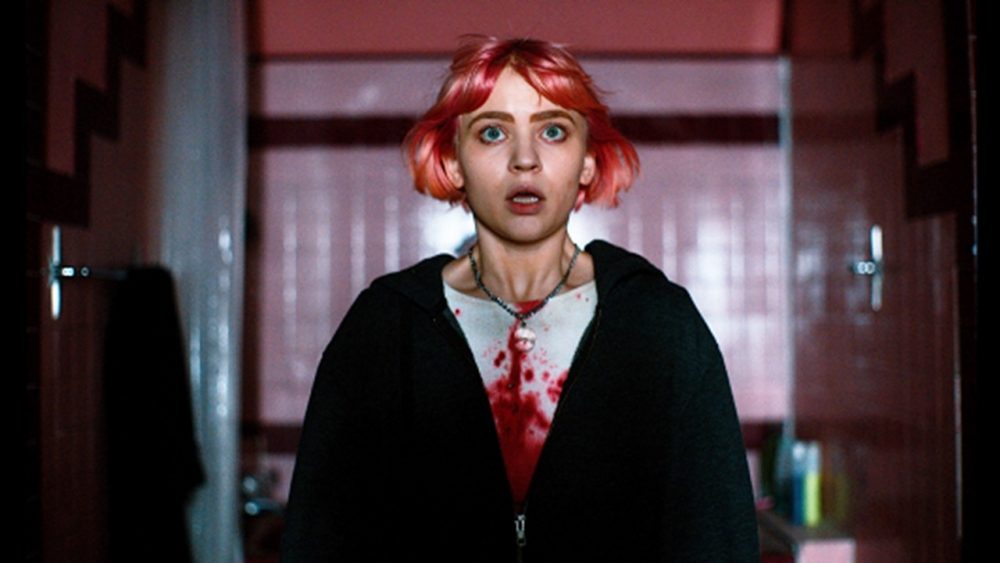
Mel (Sierra McCormick, The Vast of Night) made it
home from her friend’s house just in time to miss the tornado. Her mom (Vinessa
Shaw) ushers everyone —Mel, her little brother Bobby (John James Cronin) and
their dad (Pat Healy) — into the safest room in the house, the bathroom. Here
they will wait out the storm.
The storm damages the house, and they are pinned in. Days go
by. Why hasn’t anyone come for them? Why is their dad such a dick? What are
those noises outside the door?
Director Sean King O’Grady, working from the screenplay Max Booth III adapted from his own novella, mixes claustrophobic dread and adolescent angst with few enough contrivances that he never loses your interest.
Hints dropped early in the story come to hideous life later
on (as ugly secrets sometimes do at things like family holidays and vacations
or when you’re stuck for a long time in the bathroom). And though the “theater
of the mind” component, piquing interest in what exactly lay outside that door,
could be stronger, the performances are enough to keep your attention.
Healy, in particular, delivers a characteristically unpleasant
performances, feeling very much like a trapped rat.
The hallucinogenic subplot about guilt and trauma and adolescent experimentation with pink goth suggests that the more time you spend with your parents, the more overwhelmed you’ll be by nameless shame and guilt. That feels right.
There’s no real story here. The whole film is essentially Act 2: no catalyst, no resolution. That doesn’t make for a deeply satisfying story, but it does feel a lot like the pandemic.
The intersection of corporate greed and evil incarnate feels like a match made in cinematic heaven (I know, I know). While the idea itself is teeming with possibilities, the execution in director Peter Szewcyck’s Behemoth leaves a lot to be desired.
Joshua Riverton (Josh Eisenberg) was once a top sales rep for a massive chemical company. When his daughter became mysteriously ill, Joshua believed his employer to be responsible and became an outspoken whistleblower. As his daughter gets sicker, Joshua’s need for answers intensifies into obsession. After a chaotic altercation with his former employer, Dr. Luis Woeland (Paul Statman), an injured Joshua is forced to hide out in a seedy motel with two friends and a captive Woeland. As the night progresses, Joshua begins to lose his grip on reality and question whether his horrific visions are in his head or caused by the malevolent Woeland.
First thing’s first: Behemoth is a mess. Szewcyck and co-writer Derrick Ligas’s script erratically bounces back and forth between corporate thriller and demonic sfx extravaganza at a moment’s notice. The problem is that the movie doesn’t do either sub-genre very well. The thriller side is preachy in a “college freshman discovering politics for the first time” kind of way, but lacks subtext surrounding corporate America.
The horror elements aren’t any stronger. There’s a notable attempt to create interesting creatures throughout the film, but the dodgy effects work does more harm than good. The creatures have interesting designs and might have worked if made practically, but as they are, these digital counterparts look silly and don’t fit within the film’s more serious tone.
As flimsy as the material itself is, the acting isn’t any better. The majority of the cast delivers the script’s clumsy dialogue with a mix of histrionics and forced exasperation. Chemistry is wholly absent between the main trio. Only Statman knows how to handle the material he’s working with. He walks an impressive line between corporate sleaze and evil minion with grace.
Behemoth makes a noble attempt at infusing a standard-ish creature feature with timely real-world issues. However, the weak script and subpar acting never allow the film to live up to its aspirations.
The Night House rests on a trusted horror foundation that’s adorned with several stylishly creepy fixtures. But it’s a terrific lead performance from Rebecca Hall that becomes the support beam preventing total collapse.
Hall plays Beth, a New York teacher still reeling from the recent death of her husband Owen (Evan Jonigkeit). As Beth drifts through her impressive lakefront house trying to adjust, new discoveries bring unexpected questions about her late husband’s outside interests.
Though Beth’s neighbor (Vondie Curtis-Hall, always a pleasure) and best friend (Sarah Goldberg) both warn her not to fill the void in her life with “something dark,” the dark keeps calling. The more Beth digs into things Owen left behind, the more signs point to an unsettling secret life, and to the possibility that Owen may not have entirely moved on.
Director David Bruckner (The Ritual, The Signal) and screenwriters Ben Collins and Luke Piotrowski (Super Dark Times) each have resumes showing impressive results within limited budgets. Stepping up a bit in class, their metaphor for the fog of grief and depression is familiar but well-crafted, with soft-pedaled jump scares and effectively spooky visuals.
Bruckner fuels the standard what’s real/what’s-in-her-head questions with some nifty camera tricks that make the house come eerily alive with forced perspectives and Dali-esque illusions.
As solid as the film’s construction may be, it falls on Hall to make sure the reveals waiting in the third act land with more emotion than silliness.
She’s more than up to the task. Early on, Beth’s sustained grief, and her indignation toward everyone who’s not Owen, carries an authenticity that gets us squarely behind Beth’s personal journey. And that pays dividends once the film relies on our belief in what Beth believes. Thanks to Hall, we end up buying in.
Looking ahead to 2022, Bruckner, Collins and Piotkowski will team up again for the Hellraiser reboot. That means that while there’s enough in The Night House to satisfy horror fans today, there’s also plenty here to get us hopeful about the future.
They’re powerful, beautiful, but not necessarily benevolent. Horror filmmakers have made great use of the heavenly hosts. Sometimes they arrive to protect us. Sometimes they don’t. Here are our five favorite horror films to bring heaven to earth.
5. The Exorcist III (1990)
Yes, this movie made the list based on a single scene. But that scene is so good! Fabio is an angel, wings and all. Patrick Ewing is the angel of death! There’s a quick glimpse of a young Samuel L. Jackson, and George C. Scott chooses a strangely upbeat delivery for the line, “I’m so sorry you were murdered, Thomas. I miss you.”
It’s a dream sequence, a foreboding scene in which Kinderman (Scott) meanders through a holding station between life and afterlife. The piece is weird, a bit gruesome and gorgeous. Its tone and look differ wildly from the rest of the film, but incredible nonetheless.
4. He Never Died (2015)
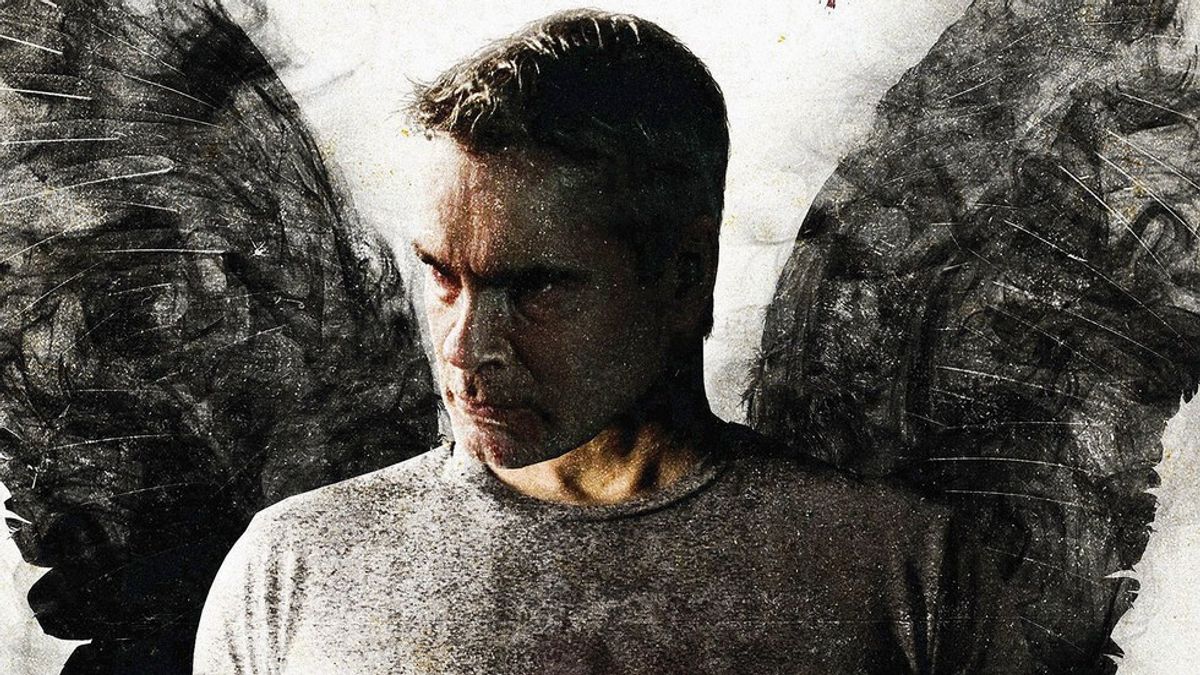
With a funny shuffle step and a blank stare, Henry Rollins announces Jack, anti-hero of the noir/horror mash-up He Never Died, as an odd sort.
Jack, you see, has kind of always been here. The “here” in question at the moment is a dodgy one-bedroom, walking distance from the diner where he eats and the church where he plays bingo. An exciting existence, no doubt, but this mindlessness is disturbed by a series of events: an unexpected visit, a needed ally with an unfortunate bookie run-in, and a possible love connection with a waitress.
From the word go, He Never Died teems with deadpan humor and unexpected irony. Casting Rollins in the lead, for instance, suggests something the film actively avoids: energy. The star never seethes, and even his rare hollers are muted, less full of anger than primal necessity.
3. The Prophecy (1995)
Writer/director Gregory Widen’s fascinating story about a war in heaven over God’s spoiled little meat puppets was a wild, innovative concept with a breathtaking cast: Christopher Walken, Virginia Madsen, Viggo Mortensen, Eric Stoltz, Elias Koteas, Adam Goldberg, Amanda Plummer.
So, is it on Widen that the movie is kind of terrible?
Terrible in an incredibly fun and watchable way, though. Somehow the unusually talent-stacked cast doesn’t feel wasted as much as it does weirdly placed.
There is no question this film belongs to Christopher Walken as the angel Gabriel. (Why are filmmakers so willing to believe Gabe will turn evil?) His natural weirdness and uncanny comic timing make the film more memorable than it deserves to be, but when it comes to sinister, Viggo Mortensen cuts quite a figure as Lucifer. Don’t forget, he was an angel, too.
2. Frailty (2001)
Back in 1980, Bill “We’re toast! Game over!” Paxton directed the short music video Fish Heads. Triumph enough, you say? Correct. But in 2001 he took a stab at directing the quietly disturbing supernatural thriller Frailty, with equally excellent results.
Paxton stars as a widowed, bucolic country dad awakened one night by an angel – or a bright light shining off the angel on top of a trophy on his ramshackle bedroom bookcase. Whichever – he understands now that he and his sons have been called by God to kill demons.
Dread mounts as Paxton drags out the ambiguity over whether this man is insane, and his therefore good-hearted but wrong-headed behavior profoundly damaging his boys. Or could he really be chosen, and his sons likewise marked by God?
Brent Hanley’s sly screenplay evokes such nostalgic familiarity – down to a Dukes of Hazzard reference – and Paxton’s direction makes you feel entirely comfortable in these common surroundings. Then the two of them upend everything – repeatedly – until it’s as if they’ve challenged your expectations, biases, and your own childhood to boot.
1. A Dark Song (2016)
Writer/director Liam Gavin also begins his story by dropping us breathless and drowning in a mother’s grief. Sophia (Catherine Walker) will do anything at all just to hear her 6-year-old son’s voice again. She will readily commit to whatever pain, discomfort or horror required of her by the occultist (Steve Oram) who will perform the ritual to make it happen.
Anything except the forgiveness ritual.
What Gavin and his small but committed cast create is a shattering but wonderful character study. Walker never stoops to sentimentality, which is likely what makes the climax of the film so heartbreaking and wonderful.
Filmmakers David Charbonier and Justin Powell know how to do
a lot with a little.
Earlier this year Shudder premiered their tightly packaged
little horror story, The
Djinn—very nearly a one-man, one-set show. Their latest to hit Shudder,
The Boy Behind the Door, is slightly more expansive. A cast of about
five knocks around one big, old farmhouse in the middle of an isolated, wooded
area.
Two of those five are Bobby (Lonnie Chavis) and Kevin (Ezra
Dewey, The Djinn), best friends who were kidnapped on their way to a
little league game. Bobby wakes up in the trunk of a car without Kevin. He
breaks free and makes his way clear of the house, but he can hear Kevin’s
terrified cries and he circles back to try and save him.
The filmmakers leave it to Bobby’s sleuthing—and yours–to
figure out what’s going on and how to end it. They make tremendous use of the
hallways, floors and doors throughout their set, plus a well-placed wristwatch unnervingly
ups the ante in a way the audience understands but Bobby does not.
There are times when the writing here hits too hard. I’m not
sure the boys have to say they’ll always stick together quite so often; their
actions speak to that. But the conundrums the filmmakers throw at Bobby as he
tries to figure out what’s going on and how to get to his friend are
believable.
More importantly, Chavis handles them with honest, childlike
panic and courage. His performance would be enough to carry the film, but the
adults around him offer supremely creepy turns.
Dewey’s less effective in this than he was in The Djinn, but it’s not enough to sink the film. The movie’s solid structure, paired with Charbonier and Powell’s gift for dropping clues and following up on threads make for a satisfying but never lurid horror show.