Tag Archives: horror movies

Cabin of Curiosities

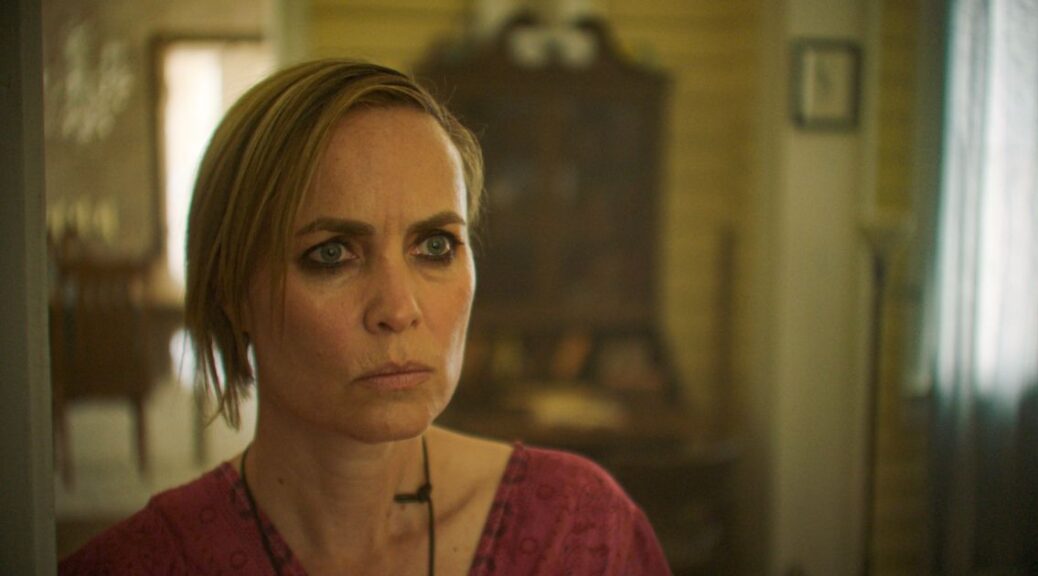
A Wounded Fawn

by Hope Madden

In 2019, Travis Stevens directed his first feature, Girl on the Third Floor, a haunted house film in which the house is the protagonist. It not only looked amazing, but the unusual POV shots did more than break up the monotony of a film set almost exclusively inside one building. Those peculiar shots gave the impression of the house’s own point of view – a fresh and beguiling choice.

Stevens’s 2021 film Jakob’s Wife waded more successfully into feminist territory, benefitted from brilliant, veteran performances, and turned out to be one of the best horror shows of the year. In many ways, the filmmaker’s latest, A Wounded Fawn, picks up where those left off – which does not mean you’ll see where it’s heading.

Josh Ruben is Bruce. Marshall Taylor Thurman is the giant Red Owl Bruce sees, a manifestation of that part of Bruce that compels him to murder women. The next in line seems to be Meredith (Sarah Lind). After finally getting past the trauma of a long-term abusive relationship, Meredith is taking a leap with a nice new guy, heading for an intimate weekend at his cabin.

This sort of sounds like Donnie Darko meets about 100 movies you’ve seen, but it is not. Not at all. Bruce bids on high-end art at auctions, Meredith curates a museum, and Stevens’s film is awash in the most gorgeous, surreal imagery – odes to Leonora Carrington, among others. And, like the POV shots from Girl on the Third Floor, these visual choices do more than give the movie its peculiar and effective look.

At the center of Bruce’s personal journey is a sculpture he stole from his last victim, a piece depicting the Furies attacking Orestes, who was driven mad by their torture for his crimes against his mother. It’s a great visual, an excellent metaphor for a serial killer comeuppance movie. It’s also an excellent reminder that art has a millennia-long history of depicting women’s vengeance upon toxic men – in case anyone is tired of this “woke” trend.

Lind more than convinces in the character’s tricky spot of being open to new romance and guarding against red flags. We’ve seen Ruben play the nice guy who’s not really as nice as he thinks, but his sinister streak and sincere narcissism here are startling.

The film does an about-face at nearly its halfway mark, not only changing from Bruce’s perspective to Meredith’s, but evolving from straightforward narrative to something hallucinatory and fascinating.

The final image – unblinking, lengthy, horrible and fantastic – cements A Wounded Fawn as an audacious success.

Insidious

Soft & Quiet

by Rachel Willis

The idea that the kindergarten teacher at your child’s school might be a member of an Aryan group is terrifying enough, but writer/director Beth de Araújo takes that idea even further in her first full-length feature, Soft & Quiet.

The kindergarten teacher, Emily (Stefanie Estes), is our focus as we watch her leave school one afternoon to attend a meeting of like-minded women. Right from the beginning, it’s clear Stefanie is unlikeable. She coerces a young boy into confronting a janitor over mopping the floor, painting it to the child’s mom as teaching him to be empowered.

From this uncomfortable moment, the movie takes us further into discomfort as we follow Emily in real time as her evening progresses. Giving away anything more would remove the tension that is slowly built as the movie moves from unsettling to disturbing to terrifying.

Telling a story in real time takes a truly talented editor, and Lindsay Armstrong nails it. Her cut is seamless, and it helps deepen the tension. The editing work keeps you in the moment, showing how quickly mob mentality can take over – especially if the group in question feels threatened (even when the threat actually comes from the group in question).

Most of the time, the cinematography complements the writing and editing. But on occasion, it feels like we’re watching a found footage film, which detracts slightly from the tension. While there are many moments filmed to unsettle, at other times it removes us from the moment. However, these minor faults are easily overlooked.

The acting throughout is perfect. Every woman feels like someone you might know. From the pregnant Stormfront member to the woman living paycheck-to-paycheck, each actor brings a realism that lends to the dread we feel as we follow the group.

Though we follow Emily, it’s impossible to feel any sympathy for her. She is at times coerced into action and other times the leader of the pack. What she chooses to do is horrifying, and her responses to the events don’t evoke understanding.

There are several themes running in the film, but all of them work together to paint a picture that isn’t hard to envision.   It’s easy to imagine women like these among us. That’s the scariest part of all.

Ain’t That a Shame

Prey for the Devil

by Hope Madden

Shame preys on Catholic girls. It’s guilt that does us in. Just when you think there can be no new or relevant approach to exorcism horror, director Daniel Stamm picks that scab.

Jacqueline Byers is Sister Ann, and she wants to be an exorcist. She attends to patients/inmates/victims as a nurse in a prestigious, centuries-old facility for exorcism in Boston. She also sneaks into classes where no woman is welcome, until Father Quinn (Colin Salmon) notices her unusual connection to some of the afflicted.

Is the church ready for a little feminism?

Wait, the Catholic church?

Prey for the Devil scores points in understated ways. Virginia Madsen’s psychologist dismisses the rite and believes Ann suffers from unresolved trauma. This is treated as something to consider rather than as a narrative device representing good or evil. In the world created by writers Robert Zappia, Todd R. Jones and Earl Richey Jones, science and religion are equally helpful and problematic. It’s often fascinating the way the film respects and undermines simultaneously.

On the whole, exorcism films fall into two categories. One: religion is fake and Catholicism, in particular, is so steeped in misdeeds and debauchery that it may as well kneel to Satan. Two: faith is the only hope. Prey for the Devil suggests a more nuanced approach.

The film’s strengths are its moments of outright feminism because they feel informed rather than flippant. They’re also a bit muted by an acceptance of the “working from within the system” failure.

The other failure is the horror itself, and Stamm should know better. His 2008 gem The Last Exorcism is a standout in the sub-genre (and one of the welcome features where there’s nary a priest on the screen). The horror was inventive, primal and it packed an emotional punch.

A PG13 film, Prey for the Devil suffers from lack of imagination. If you’ve seen one crab walk you’ve seen them all, and Stamm doesn’t deliver a single unique moment of horror in 93 minutes.  

But he knows that nothing takes down a Catholic girl faster than a lifetime of guilt and shame. That metaphor fits a tale of an irredeemable soul better than any I’ve seen, and a little slap of feminism is probably the only thing that can help.

Chicas Malas

Piggy (Cerdita)

by Hope Madden

Mean girls are a fixture in cinema, from Mean Girls to Carrie, Heathers to Jawbreaker to Napoleon Dynamite and countless others. Why is that? It’s because we like to see mean girls taken down.

Writer/director Carlota Pereda wants to challenge that base instinct. But first, she is going to make you hate Maca (Claudia Salas), Roci (Camille Aguilar) and Claudia (Irene Ferreiro). In one tiny Spanish town, the three girls make Sara’s (Laura Galán, remarkable) life utterly miserable. Like worse than Carrie White’s.

And though Sarah’s relationship with her mother (Carmen Machi) is a rose garden compared to the one Carrie shares with her wacko mom, things could be better. Sarah’s mom veers from unobservant to dismissive to defensive. Even when she’s trying to be helpful, that aid comes with a heaping dose of insensitivity.   

But it’s those pretty, skinny high school girls whose contempt nearly kills Sarah. In a scene that’s difficult to forget, cruelty blossoms into something brutal and horrifying as Sarah tries to take advantage of a nearly empty swimming pool.

Traumatized by the afternoon, a dazed Sara makes a choice that she will wrestle with for the balance of the film. Pereda doesn’t present a simple, single reason for what Sarah does. Or, more to the point, does not do.

In this scene and all others, the filmmaker complicates every trope, all the one-dimensional victim/hero/villain ideas this genre and others feast on. Redemption doesn’t come easily to anyone. Pereda also seamlessly blends themes and ideas from across the genre, upending expectations but never skimping on brutal, visceral horror.

Much of that horror would feel unearned were it not for substantial performances from every member of the cast. But Sarah is the most complicated character by far, and Galán performance is a reckoning. She’s utterly silent for long stretches, Sarah trying to make herself invisible. It’s in those still moments that Galán shines most fiercely.

Piggy is a tough watch, there’s no doubt. It’s also a ferocious and stunning piece of horror cinema.

Which Witch

Two Witches

by Tori Hanes

From first-time feature director Pierre Tsigaridis, Two Witches follows the familial inheritance of witch powers from grandmother to granddaughter, sparing no gory detail while examining the pair’s reign of terror. From eating babies to sexual satanism, Two Witches straps horror fans in and puts a cement block on the gas.

The first of two chapters starts without a bang- in fact, it fully embraces the mundane horror tropes of the past: haunted, creepy entity only visible to the hauntee, overly skeptical boyfriend, goofy nonbeliever friends. It dutifully, albeit spookily, hits the key beats of any witchy tale. If the film had stayed on this trajectory, the review would likely end here. 

Thankfully, Tsigaridis veered off course. The second chapter highlights the newly christened witch granddaughter (Rebekah Kennedy) and spins into a freshly horrifying tale, chalk to the brim with overt and delicious camp. Whether the film took the first chapter to find its footing or whether the sharp turn into camp was purposeful by Tsigaridis is unclear, but one thing is obvious: the first and second chapter feel almost like entirely different films.

Is the presence of two tonally different chapters in one movie jarring? Yes, a bit. Is it the best choice to create a continuous flowing narrative and feel? No, probably not. Is it interesting and largely unseen in the horror genre? Definitely. 

A struggle unique to this dramatic shift of tone is performance evaluation. Due to their largely different styles, holding performances to a consistent level is nearly impossible. While pregnant Sarah (Belle Adams) of the first chapter plays the disturbed victim well, witch Masha (Kennedy) delivers her newfound inheritance with intriguing camp in the second chapter. The two performances could not feel further from each other, though they both hold the title of protagonist for their respective stories. This confusion in differing performances inherently elicits an opinion of uncertainty from audiences. Unfortunately, ambivalence and uncertainty are perhaps the worst reactions a film’s protagonists could garner. 

For the most adrenaline-seeking among us, Two Witches has enough genuine scares to smooth over the narrative bumps. For the rest, the winding story may lead you off course. If audiences can embrace the uniqueness of the camp, however, it may be a welcomed detour.

Mommy Dearest

After She Died

by Rachel Willis

I always expect a certain level of weird when watching an Australian horror film, and writer/director Jack Dignan’s After She Died doesn’t disappoint in that regard. 

When Jen’s (Liliana de la Rosa) Mom, Isabel (Vanessa Madrid), dies, it’s not very long before Dad (Paul Talbot) is introducing his new girlfriend, Florence. As if it’s not bad enough that dad’s moved on so quickly, Flo turns out to be the mirror image of Isabel.

Finding out your dad is dating your dead mom’s look-alike would be disturbing enough, but the film adds extra levels of horror: bleeding eyes, a landscape ravaged by fire, a man (possibly demon) in an animal mask. Dignan keeps you off-balance with these layers of mystery.

The problem is the level of confusion that comes with each new piece of this puzzle. It keeps you from sinking into the story. Any tension that could be built through Jen’s reaction to Dad’s disturbing choice of girlfriend is erased as more alarming images haunt the screen. Confusion can be scary, but only if done right. Otherwise, it becomes frustrating.

Thankfully, there’s little time to wonder too long about too much.

However, additional problems crop up with the introduction of too many characters and too many threads. Some characters serve little to no purpose. Storylines are introduced but unconvincingly explored. It all serves to further distract and frustrate.

Visual horror is the film’s strongest feature. The fires that burn off and on in the background add extra unease, and a few scenes send shivers down the spine. Dignan’s understated enough with gore to keep you from looking away. His approach is effective, never overboard.

Unfortunately, he can’t match imagery with an equally unsettling story. It’s clear Dignan wanted to tell a broader tale, one with far-reaching repercussions, but the elements don’t add up to a satisfying whole.

It’s disappointing because After She Died had the makings of an intriguing tale about the price to be paid when a loved one is buried in ground that’s gone sour.

Dangerous Method

Devil’s Workshop

by Hope Madden

I hate to admit this, but my first thought upon screening Devil’s Workshop was that we don’t need another low budget exorcism movie – or worse yet, another ghost hunter demonologist movie. I am pleased to report that writer/director Chris von Hoffmann’s latest horror offering is not “just another” anything.

The premise seems garden variety enough. Struggling actor Clayton (Timothy Granaderos, Who Invited Them) auditions for the part of a demonologist in a new low-budget indie. His competition, Donald (Emile Hirsch), is a social climbing douche who gets whatever he wants. To sharpen his edge for the callback, Clayton hires a real demonologist to train him for the performance.

That demonologist is played by Radha Mitchell, who’s both wonderful and evidence that von Hoffman has something unusual up his sleeve.

The filmmaker cuts between earnest, insecure Clayton undertaking his eerily authentic preparation, and narcissist Donald, preparing in his own way. As von Hoffman does this, he comments on the main theme of his film: a knowing, sly analogy of the process of acting, from ridiculous to pretentious to dangerous.

What emerges is a cheeky, cynical but not hateful application of the mantras and exercises meant to break an actor down and open them up to the demons that will create a better performance.

Two things are necessary for Devil’s Workshop to pull this off: stellar acting (or the metaphor falls apart) and genuine horror (or the metaphor overwhelms the story).

The acting is stellar, beginning with Mitchell. Her giggles and offhanded terms of endearment, hand gestures and facial expressions create an elusive character. Granaderos, so impressive as the sinister partygoer in Who Invited Them, adopts a wide-eyed insecurity that suits von Hoffman’s style.

Rather than drawing our eye to the speaker, von Hoffman’s camera lingers on the listener. The choice captures Clayton’s discomfort, sometimes for a troubling length of time, creating unease.

The horror does well enough for nearly long enough. A couple of times it’s effective, but it never rises to true scares. Worse still, the payoff doesn’t land. In the end, von Hoffman’s insiders-view of the dangers in submitting entirely to a part falls just short of success.

Under the Influencer

Sissy

by Hope Madden

Horror is especially preoccupied with the doppelganger nature of social media – how you can lose yourself in the make-believe world of the “you” you present online. Co-writers/co-directors Hannah Barlow and Kane Senes dig into that duality with their Aussie horror, Sissy.

Sissy – or as she’d rather be called now that she’s a grown up, Cecilia (Aishe Dee) – feels blessed. Thanks to her 200k followers and the products she gets paid to work into her videos, she has a fulfilling life. She is loved. She is enough. She is doing her best.

Maybe she’s not really doing that well, actually. She even hides when she spies her childhood BFF at the grocery store, but Emma (Barlow, who also stars) sees her anyway. She even invites Cecilia to tonight’s big bachelorette party, and tomorrow’s drive out to the country for a weekend-long celebration!

If you’ve seen Bodies Bodies Bodies or, indeed, any horror movie, you know that second part is not going to go well for everyone. Like Halina Reijn’s gruesome comedy, Sissy plays around with genre expectations and spotlights the ins and outs of Gen Z.

Dee works wonders as a woman trying to practice what she preaches, earn from what she practices, and find fulfillment in online followers when friends IRL are less welcoming. The cast that surrounds her is universally strong, each one manipulating the sly, darkly funny script to shock and delight.

Barlow and Senes never entirely abandon the old-fashioned slasher, either. Sissy delivers starling gore FX that feel simultaneously in keeping with the black comedy and somehow too disturbing to fit. Well done!

The filmmakers tease the new terrain of a world populated with virtual personalities. Who’s the good guy? Who isn’t? Is anybody? Sissy doesn’t break new ground here, but thanks to a knowing script and a lead performance that sells itself, you’ll enjoy the show.

Your Friends and Neighbors

Speak No Evil

by Hope Madden

There’s little as uncomfortable as a good horror of manners—like a comedy of manners, but the social discomfort makes way for grim, horrifying death. Michael Haneke did it best with Funny Games (either version). Just last month, Shudder released the lighter but no less bloody Who Invited Them.

Denmark comes knocking with co-writer/director Christian Tafdrup’s Speak No Evil, a terribly polite tale of Danes and Dutchmen that veers slowly but relentlessly toward something sinister.

Bjørn (Morten Burian) is facing a crisis of masculinity. He’s too polite to articulate it, which only exacerbates that strangling sensation.

It’s a testament to Burian’s performance that he remains sympathetic throughout the film, however selfish and weak his actions. Playing his wife, Sidsel Siem Koch easily embodies the proper but awkward and easily cowed Louise.

Their adversaries? The good-looking, fun-loving, demonstrative Dutch couple Patrick (Fedja van Huêt) and Karin (Karina Smulders). The two families — each with a youngster in tow — run into each other on holiday and become pals. Sometime later, when Bjørn & Louise receive a postcard inviting their family to visit, Bjørn is anxious to go.

It takes some quiet, polite maneuvering, but before long, he, Louise and little Agnes (Liva Forsberg) are face to face with their hosts and the escalating tension grows almost unendurable. Speak No Evil quickly becomes a sociological experiment that questions our tendency to act against our own instincts, side with the cool kids, and lose who we are.

Van Huêt ably maneuvers Patrick’s manipulations, his about-faces, and his indefatigable charisma.

Sune Kølster’s score works deliriously against cinematographer Erik Molberg Hansen’s beautiful images to create dissonance (again, in much the same way Haneke did, but if you’re going to copy someone, he’s as good a place to start as any).

Tafdrup’s script, co-written with Mads Tafdrup, is sneaky in the way it treads on social anxiety, etiquette, politeness. You see how easily gaslighting alters the trajectory of a conversation, the course of action.

There is a resignation that feels unearned, even contemptuous. But actions throughout are believable enough, each couple’s interactions authentic enough, and the tensions palpable enough to forgive slight lapses. Speak No Evil is a grim trip, but there is no question that it’s well made.

Fright Club: Satanists in Horror

It’s time to sift through that bountiful gift that is satanic horror. So many movies! So many black masses! So many purple robes, goat’s heads, high priests!! So many, indeed, that we had to leave off a ton of really great movies, so even though they didn’t make the final list, be sure to check out Ready or Not, Brotherhood of Satan, Race with the Devil, Blood on Satan’s Claw, Prince of Darkness, House of the Devil, The Sentinel, The Devil Rides Out, and the brilliant short film Born Again.

5. The Day of the Beast (1995)

Funny, startling and wildly irreverent, Alex de la Iglesia’s dip into Satanism is a giddy experience. It’s not just great Satanism horror, it’s an excellent Christmas movie!

A priest, a Satanist and a charlatan comb the city of Madrid on Christmas Eve in search of the birth ritual of the Antichrist. Their hijinx are feverish and frantic in a transgressively funny horror tale.

Gleefully gory mayhem suits the outlandish performances, together driving one of the gruesome auteur’s very best.

4. Angel Heart (1987)

In Angel Heart, director Alan Parker develops a steamy atmosphere as we follow private dick Harold Angel (Mickey Rourke) through the bowels of New Orleans in search of information on missing crooner Johnny Favorite.

Rourke’s work is key to the film’s unseemly feel. Angel’s sympathetic and full of a disheveled charm. You’re sorry for him even as you know he’s outmatched and probably undeserving of your pity. He knows it, too, and that’s what makes the performance so strong.

Plus there’s the sheer diabolical presence of an understated Robert DeNiro. His well-manicured and articulate Louis Cyphre perfectly balances Rourke’s handsome slob, and both fit beautifully into this sultry version of 1955.

Deceptively bloody, unusually classy, effortlessly creepy, Angel Heart stays under your skin. Maybe it’s the casual evil, the lurid atmosphere. Maybe it’s De Niro’s understated menace, with those long nails and that hardboiled egg.

3. The Blackcoat’s Daughter (2015)

Winter break approaches at a Catholic New England boarding school. Snow piles up outside, the buildings empty, yet Kat (Kiernan Shipka) and Rose (Lucy Boynton) remain. One has tricked her parents for an extra day with her townie boyfriend. One remains under more mysterious circumstances.

Things in writer/director Oz Perkins’s The Blackcoat’s Daughter quietly unravel from there – although quiet is not precisely the word for it. There is a stillness to the chilly, empty halls. But thanks to the filmmaker’s brother Elvis, whose disquieting score fills these empty spaces with buzzing, whispering white noise, a sinister atmosphere is born.

Perkins repays your patience and attention. There are loads of sinister little clues to find.

2. Rosemary’s Baby (1968)

Rosemary’s Baby remains a disturbing, elegant, and fascinating tale, and Mia Farrow’s embodiment of defenselessness joins forces with William Fraker’s skillful camerawork to cast a spell. Along with Repulsion (1965) and The Tenant (1976), Rosemary’s Baby is part of Polanski’s “apartment trilogy” – disturbing films of tension and horror in which metropolitan life and nosey neighbors conspire to drive a person mad.

Working from Ira Levin’s novel, Polanski takes all the glamour out of Satanism – with a huge assist from Ruth Gordon, who won an Oscar for her turn as the highly rouged busybody Minnie Castevet. By now we all know what happens to poor Rosemary Woodhouse, but back in’69, thanks much to Mia Farrow’s vulnerable performance, the film boiled over with paranoid tension. Was poor, pregnant Rosemary losing it, or was she utterly helpless and in evil hands?

1. The Witch (2015)

The unerring authenticity of The Witch made it the most unnerving horror film in years.

Every opportunity writer/director Roger Eggers has to make an obvious choice he discards, though not a single move feels inauthentic. Rather, every detail – whether lurid or mundane – feels peculiarly at home here. Even the most supernatural elements in the film feel appallingly true because of the reality of this world, much of which is owed to journals and documents of the time, from which Eggers pulled complete sections of dialog.

As frenzy and paranoia feed on ignorance and helplessness, tensions balloon to bursting. You are trapped as this family is trapped in an inescapable mess, where man’s overanxious attempt to purge himself absolutely of his capacity for sin only opens him up to the true evil lurking, as it always is, in the woods.