Screening Room: Book Club: The Next Chapter, BlackBerry, Hypnotic, Still: A Michael J. Fox Movie, The Mother & More
by Hope Madden
Following three increasingly competent features (Easier with Practice, C.O.G., The Stanford Prison Experiment), filmmaker Kyle Patrick Alvarez moved into episodic television. His return to feature length feels a bit more like TV than film, but Crater marks new territory for Alvarez in family entertainment.
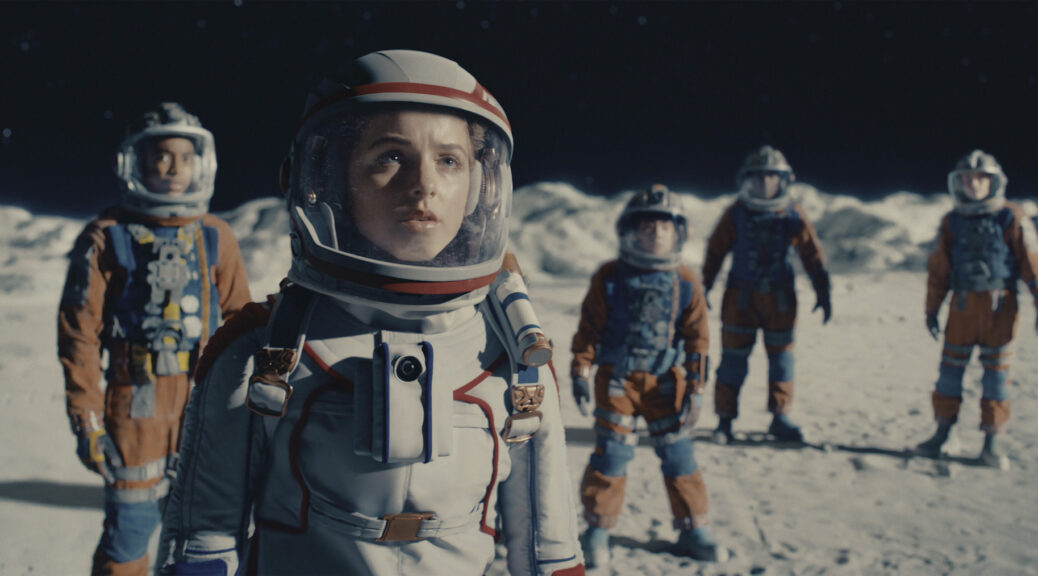
The Disney+ feature, written by John Griffin (also mainly TV), follows a quintet of adolescents on a joyride across the moon.
The effortlessly charming Mckenna Grace (Ghostbusters: Afterlife) is the new kid on the helium mining colony. Caleb (Isaiah Russell-Bailey) and his buddies need her to help them break into the basement garage so they can hotwire a rover and take it to the “crater” Isaiah’s dad was always talking about. They never expected her to want to go with them.
The film’s anticapitalism message (ironic coming from Disney) is welcome, as we commiserate with the five children of miners – each with no future outside of mining, except for Isaiah. When Isaiah’s father died in the mine, the insurance money bought his now-orphaned son a ticket off this rock.
But first, the kids go on an epic adventure that will change their lives.
It feels about as pre-packaged as it sounds, very Goonies or Stand By Me, but slicker, tidier and without the soul. Grace has proven to be nothing but an authentic talent since toddlerhood, really announcing her skill in 2017’s Gifted. But she’s given no real opportunity to create a character here.
Her co-stars struggle even more. Russell-Bailey can’t dig deep enough to manage the life-altering grief or rage a kid in his position would face, but at least his backstory is unveiled slowly. Isaiah’s best friend (Billy Barratt) just announces his trauma, then stares doe-eyed at both Grace and Russell-Bailey for the balance of the film. This isn’t a knock on the performance as much as it is the script and direction.
Crater cobbles together a lot of cliched ideas but can’t find any depth to explore. Instead Alvarez delivers a superficial and forgettable road trip movie in space.

by Hope Madden
It was 1995. We’d already had a sense of the unique talent that is Parker Posey because of her drill sergeant character in Dazed and Confused, but we were not yet in love with her. Writer/director Daisy von Scherler Mayer’s Party Girl would change that.
Von Schlerler Mayer’s slight story trails a twentysomething in NYC whose only real skill is partying and looking fantastic. Mary (Posey) is busted throwing a rent party (the purpose of the party is to make enough money to pay rent) and has to turn to her only family – librarian godmother Judy (Sasha von Scherler, the director’s mother) – to bail her out. The condition: Mary has to get a real job. Preferably clerking in the library.
It’s a fairly straightforward “fish out of water” story, the type where the fish realizes dry land (that is, becoming a librarian) is really the way to go. Kind of a cross between Breakfast at Tiffany’s and Desperately Seeking Susan with essentially none of the plot of either, Party Girl skims the surface of extended adolescence.
There are romantic entanglements and an assortment of hip friends on the fringe. And, of course, the clash between downtown style and library shushing. Von Schlerler Mayer’s ensemble delivers charmingly superficial and oblivious characters, and the climax is never really in doubt. So why has this film stood up for almost thirty years?
Parker Posey, duh.
There was no turning back after this film. Posey owns this character, her insecurity and confidence, vulnerability and insensitivity. She carves out a personality that can carry the whole film, even though the film itself offers little in return. Posey radiates goofy charm that’s infectious enough to keep you drawn to Mary’s dilemma, however vapid it is.
Party Girl is a frothy, forgettable good time, but Posey turned out to be a keeper.

by Hope Madden
I understand and respect that there is an audience for Book Club: The Next Chapter. I see the draw in watching characters in their Seventies – vital, beautiful, rich women, who have men that adore them exactly as they are, and healthy, supportive friends who are always ready for an adventure. May we all have such a third act.
It’s a lovely fantasy. But it’s a bad movie.
Back in 2018, director Bill Holderman introduced us to a quartet of lifelong friends whose monthly book club turned a little ribald when Viv (Jane Fonda) recommended 50 Shades of Grey. Everybody got horny, one marriage was saved, and four remarkable talents got to spend 90 harmless if uninspired minutes onscreen together.
Fast forward five years and one Covid lockdown and the besties are finally able to host their monthly meetup in person again. Just in time, too, because Viv is engaged! So Carol (Mary Steenburgen), Diane (Diane Keaton) and Sharon (Candice Bergen) decide a bachelorette trip to Italy is in order. Madcap!
The stakes are low and the wine is flowing, the police stations and jail cells are remarkably clean and free from riffraff, the comedy is broad and the life lessons are frequent but not too painful. Consequences are entirely nonexistent, but that’s because this is a fantasy. It’s a geriatric Sex and the City episode.
Holderman, writing again with Erin Simms, mercifully avoids jokes made at the expense of the characters. We laugh with them more often than we laugh at them. Holderman and his film respect these mature characters, which is a nice change of pace.
And, of course, Keaton, Bergen, Steenburgen and Fonda can act. They’re not asked to for this particular film, but we’re aware that they have the capacity. Fonda has two Oscars, Steenburgen and Keaton have one apiece, and bringing up the rear, Bergen has a nomination. And the best Book Club: The Next Chapter can think to do with them is have them model wedding dresses.
At least they’re not in a wing eating competition, I guess. And that’s actually where Holderman deserves praise, because he’s not making a great movie. He’s not even making a very good movie. But he’s making a movie for a target audience, and it’s a group of people who’ve lived through enough drama and trauma, cynicism and tragedy. That’s not what they want. They want a fantasy where there are no money issues, no health issues, all their friends are alive and well and still with them, and romance abounds.
Holderman has a club for that.
by Hope Madden
Zoe (Lily James) is having trouble pitching her next documentary. The execs want something upbeat, so she spitballs about her childhood friend, Kazim (Shazad Latif), who’s decided to let his Pakistani parents arrange a marriage for him. Why doesn’t Zoe follow him through all the steps of marrying a stranger?
What will they call this documentary? Meet the Parents…First? My Big Fat Arranged Wedding?
They go with: Love, Contractually.
That’s actually a great nod, since Emma Thompson is in this movie. (And aside from the ’93 Tina Turner biopic, there is also a 2013 documentary called What’s Love Got to Do with It by Rohena Gera that follows eight people in India who’ve decided on arranged marriage. From what I can tell, this movie has no direct relation to that except that everyone is having trouble coming up with an original title.)
Thompson, by the way, is a hoot as Zoe’s mum because she’s a remarkable performer who elevates everything she’s in.
What’s Love… treads similar themes as Michael Showalter’s 2017 The Big Sick. It does not live up to that comparison, but what could? That film was brilliant, touching, authentic and hilarious. This one is safe.
Both films expose the conflict between falling in love and living up to a family’s expectations. WLGTDWI goes one step further by also watching Zoe’s struggle over whether to settle or live up to her own expectations of love.
Kazim’s choice stems from the fact that he’s not sure he even believes in love, or in “in love”, and he’s weary from trying. Meanwhile, Zoe sees herself as a fairy tale princess who can’t find the kind of love she feels she’s been promised. So, she repeatedly makes terrible, often drunken decisions that she immediately regrets in her search for her handsome prince.
There’s also a very big question about what to do with well-meaning but overbearing parents who continue to pressure you well into your thirties. And that’s a lot for one movie to cover. Director Shekhar Kapur (Elizabeth, Elizabeth: The Golden Age) keeps it warm – there really are no villains here – while Jemima Khan’s script offers messy, human characters you can identify with.
The point is, marry your best friend. Which is good advice, and Latif and James have a wonderful, lived-in friendship, but no real chemistry. The film does what it can to resolve the issues it raises, but that last gasp “will they or won’t they” felt more like “do I really want them to?”

by Hope Madden and George Wolf
Even if James Gunn had forgotten that his Guardians of the Galaxy formula was plenty familiar, the way Dungeons and Dragons just repackaged it would serve as a winning reminder.
So for the finale of the Guardians trilogy, writer/director Gunn smartly adds some unexpected layers to the good-natured humor and superhero action.
How unexpected? Well, if you had existential tumult and Return of the Jedi homages on your bingo card, congratulations to you. But if you figured Peter Quill (Chris Pratt) as the catalyst, think again.
Gunn wants us to know that this whole story has been Rocket’s all along.
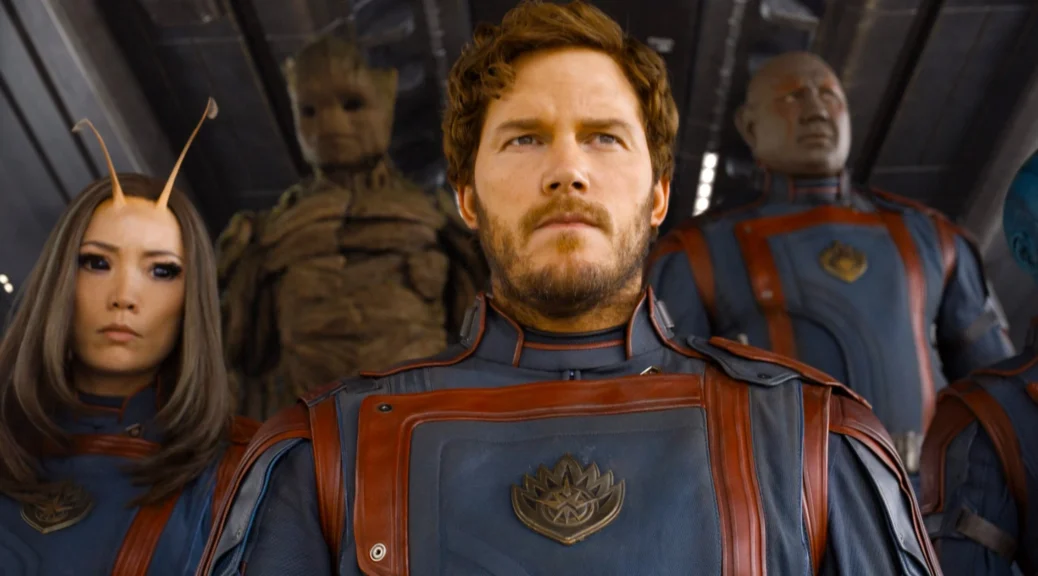
Peter is indeed still hurting from losing Gamora (Zoe Saldana) to memory loss, but it’s a threat to the life of Rocket (voice of Bradley Cooper) that gets him back with Drax (Dave Bautista), Nebula (Karen Gillan), Groot (voice of Vin Diesel) and Mantis (Pom Klementieff) – with yes, help from Gamora – for one last ride.
The mission? Stop the “High Evolutionary” (Chukwudi Iwuji) on his quest to program evolution until perfection is achieved. The themes are heady, with both echoes of the past and callouts to the current “burn it all down” crowd, but Gunn still finds plenty of room for goofy laughs, warm camaraderie, and real heart.
Plus, mean Gamora is so much more fun than righteous Gamora. Drax and Mantis continue to be a joyous mismatch of besties and Gillen’s deadpan delivery is maybe more funny in this episode than any other.
Gunn’s MCU sendoff retains his trademark mischievous humor and fondness for raucous violence. The action sequences here match anything Gunn has done previously, while Rocket’s origin story packs Volume 3 with an unexpected emotional wallop.
When Gunn joined the MCU for 2014’s first GoG episode, he made his silly mastery of the blockbuster known. With ruffian charm, Rocket and the gang deliver deeper, more believably touching chemistry now than they did then. Volume 3 is a fitting, emotional, madcap swan song.
Ghosts! Maybe the first ever scary idea in all of history, the first thing to haunt our dreams. To give us the word haunt. Ghosts have been a staple of horror for as long as there was such a thing, so it was with great difficulty that we narrowed down our five favorite ghosts in horror movies.
We welcome director George Popov back to the podcast to run down the whole list. Keep up to date on his Sideworld documentary series and grab the cool merch we talk about by visiting sideworld.co.uk and following them on Twitter @Sideworld._UK, Facebook @SideworldUK and Instagram @sideworld_uk.
The Devil’s Backbone unravels a spectral mystery during Spain’s civil war. The son of a fallen comrade finds himself in an isolated orphanage that has its own troubles to deal with, now that the war is coming to a close and the facility’s staff sympathized with the wrong side. That leaves few resources to help him with a bully, a sadistic handyman, or the ghost of a little boy he keeps seeing.
Backbone is a slow burn as interested in atmosphere and character development as it is in the tragedy of a generation of war orphans. This is ripe ground for a haunted tale, and writer/director Guillermo del Toro’s achievement is both contextually beautiful – war, ghost stories, religion and communism being equally incomprehensible to a pack of lonely boys – and elegantly filmed.
Plus the ghost looks awesome. Del Toro would go on to create some of cinema’s more memorable creatures, and much of that genius was predicted in the singular image of a drowned boy, bloody water droplets floating about him, his insides as vivid as his out.
Touching, political, brutal, savvy, and deeply spooky, Backbone separates del Toro from the pack of horror filmmakers and predicts his own potential as a director of substance.
Director James Watkins was fresh off his underseen, wickedly frightening Eden Lake. Screenwriter Jane Goldman (working from Susan Hill’s novel) had recently written the films Kick-Ass and X-Men: First Class, both of which are awesome. And star Daniel Radcliffe had done something or other that people remembered…
I’d have been worried that Radcliffe chose another supernatural adventure as his first big, post-Hogwarts adventure were it not for the filmmaking team putting the flick together. Goldman’s witty intelligence and Watkins’s sense of what scares us coalesce beautifully in this eerie little nightmare.
A remake of a beloved if rarely shown BBC film, the big screen version is a spooky blast of a ghost story. It makes savvy use of old haunted house tropes, updating them quite successfully, and its patient pace and slow reveal leads to more of a wallop than you usually find in such a gothic tale. Glimpses, movements, shadows—all are filmed to keep your eyes darting around the screen, your neck craned for a better look. It’s classic haunted house direction and misdirection laced with more modern scares.
Yuya Ozeki was 5 years old when his melancholy, cherubic little face first appeared in Takashi Shimizu’s Ju-On: The Grudge. He’d reprise his role as Toshio in Shimizu’s Japanese sequel as well as his English language remake of the original.
Ozeki’s presence onscreen is the perfect combination of adorable and terrifying. He sticks around this one hours, makes a mess, runs his little feet all over the place, sometimes meows.
The real gut punch of The Grudge series is that the ghosts are inescapable. You are doomed from the moment you set foot in Toshio and Kakayo’s home. It’s a way that the film perverts expectations of the gothic tale, and that corruption of something elegant is no more perfectly encapsulated than in the guide of little Toshio.
Writer/director Alejandro Amenábar casts a spell that recalls The Innocents in his 2001 ghost story The Others. It’s 1945 on a small isle off Britain, and the brittle mistress of the house (Nicole Kidman) wakes screaming. She has reason to be weary. Her husband has still not returned from the war, her servants have up and vanished, and her two children, Anna and Nicholas, have a deathly photosensitivity: sunlight or bright light could kill them.
The new staff – Mrs. Mills (Fionnula Flanagan), Mr. Tuttle (Eric Sykes) and Lydia (Elaine Cassidy) – is here to help. Amenábar uses these three beautiful performances as a way to talk to Kidman’s harried mum as well as the audience. Flanagan, in particular, is brilliant.
What unspools is a beautifully constructed film using slow reveal techniques to upend traditional ghost story tropes, unveiling the mystery in a unique and moving way.
Have we talked about this movie before? As is true with The Others, The Shining offers a smorgasbord of ghosts to choose from: Lloyd the bartender, the little Grady sisters, the old lady in the bathtub, the guy in the bear suit. But we settled on Grady because he may come across like the help, but don’t let that fool you. Grady’s the one in charge.
In one of the greatest single scenes in a horror film – and one that contains no murder at all – Delbert quietly clarifies the power structure at work for Mr. Torrence.
Stanley Kubrick’s camera is, per usual, meticulous in creating an atmosphere that mirrors this shift in power. Jack Nicholson’s transformation from smug to obedient is glorious. But it’s longtime character actor Philip Stone who nails the terrifying nuance that amounts to the most pivotal moment in Kubrick’s masterpiece.
by Hope Madden
There’s reason to cheer for David Lowery’s latest effort for Disney, Peter Pan & Wendy. First of all, there’s Lowery’s vision.
In the hands of the Green Knight director, Neverland has never looked so gorgeous. He finds ways to exploit the wonder, beauty and danger of this adventureland in a way that fits his lilting retelling.
For the script, Lowery reteams with longtime producer Toby Halbrooks, who co-wrote the director’s previous Disney outing, Pete’s Dragon. Both of Lowery’s films for the Mouse only draw attention to the fact that the Ghost Story, Ain’t Them Bodies Saints and The Old Man and the Gun filmmaker possesses no sense of irony, cynicism or fatalism. He seems weirdly perfect for family films.
And, like Jon Favreau’s wonderful The Jungle Book, Lowery draws inspiration not only from the original text, but also from Disney’s classic animated version. Snippets of songs from the 1953 musical are woven throughout, enough to give parents and grandparents some nostalgic feels.
But do we need or want another Peter Pan story? Beasts of the Southern Wild director Benh Zeitlin couldn’t find an audience for his 2020 bayou adaptation, Wendy. No one went to see Joe Wright’s star studded, Hugh Jackman led 2015 musical, Pan. Maybe a more traditional telling is in order? One that weighs the humanity as heavily as the whimsy?
Jude Law’s Hook offers surprising pathos. Never the campy pirate you may have come to expect, Hook is resigned to evil, his own pain a tender nerve just below the surface. It’s a dastardly but tender performance that gives the film a broken heart.
At his side, Jim Gaffigan’s Smee – pretty ideal casting, although the character is underused. Ever Anderson offers a substantial Wendy Darling, and the Lost Boys are not necessarily boys but they are mischievously charming. The problem is Peter.
Alexander Molony, thought cute as can be, is surprisingly lifeless in the lead. His highs don’t feel highs nor his lows low. His performance is neither cartoonish nor realistic.
The character itself gets a bit lost in the adaptation, which holds focus on Wendy’s arc far more than Peter’s story, and Lowery doesn’t seem entirely sure where Peter fits into all this. It’s one of the more ingenious elements of J.M. Barrie’s novel – Peter Pan is not the hero or the villain, he’s more the iconic fool whose lack of arc helps those around him find their own. But Lowery loses his footing when he focuses on Peter, and though his adventure is truly beautiful, it feels a little unfocused and possibly unnecessary.