Tag Archives: Hope Madden

Halloween Countdown, Day 29: Nosferatu

Nosferatu (1922)

Best vampire ever. Not the seductive, European aristocrat, cloaked and mysterious, oh no. With Count Orlock, filmmaker F. W. Murnau explores something more repellant, casting an actor who resembles an albino naked mole rat.

Given that Murnau equates the film’s vampire-related deaths with the plague, this vermin-like image fits well. But more than that, thanks to a peculiarly perfect performance by Max Schreck, Murnau mines the carnality of the vampire myth for revulsion and fear rather than eroticism.

Famously, the film was meant to be the first Dracula movie, but Murnau could not work out an agreement with Bram Stoker’s estate (who later sued, and all copies of the film were nearly lost). He changed a handful of things in an attempt to avoid the eventual lawsuit and filmed anyway. Names are changed (Harker is now Hutter, Dracula is Orlock, etc.), and details are altered, but the story remains largely – well, criminally – the same.

The genius move is the spindly, bald hunchback for a vampire – why, he’s almost a European Monty Burns! Murnau’s mastery behind the camera – particularly his ability to capture the vampire’s shadow – made the film a breathtaking horror show at the time. But don’t discount this as dusty history.

Sure, the silent film style of acting appears nothing short of quaint today, and the Dracula tale has been told too, too often at this point. But Max Schreck is a freak, and in his bony, clawlike hands, Count Orlock remains the greatest vampire ever undone by a sinless maiden.

Listen weekly to MaddWolf’s horror podcast FRIGHT CLUB. Do it!

https://www.youtube.com/watch?v=sk70lSUqaM8
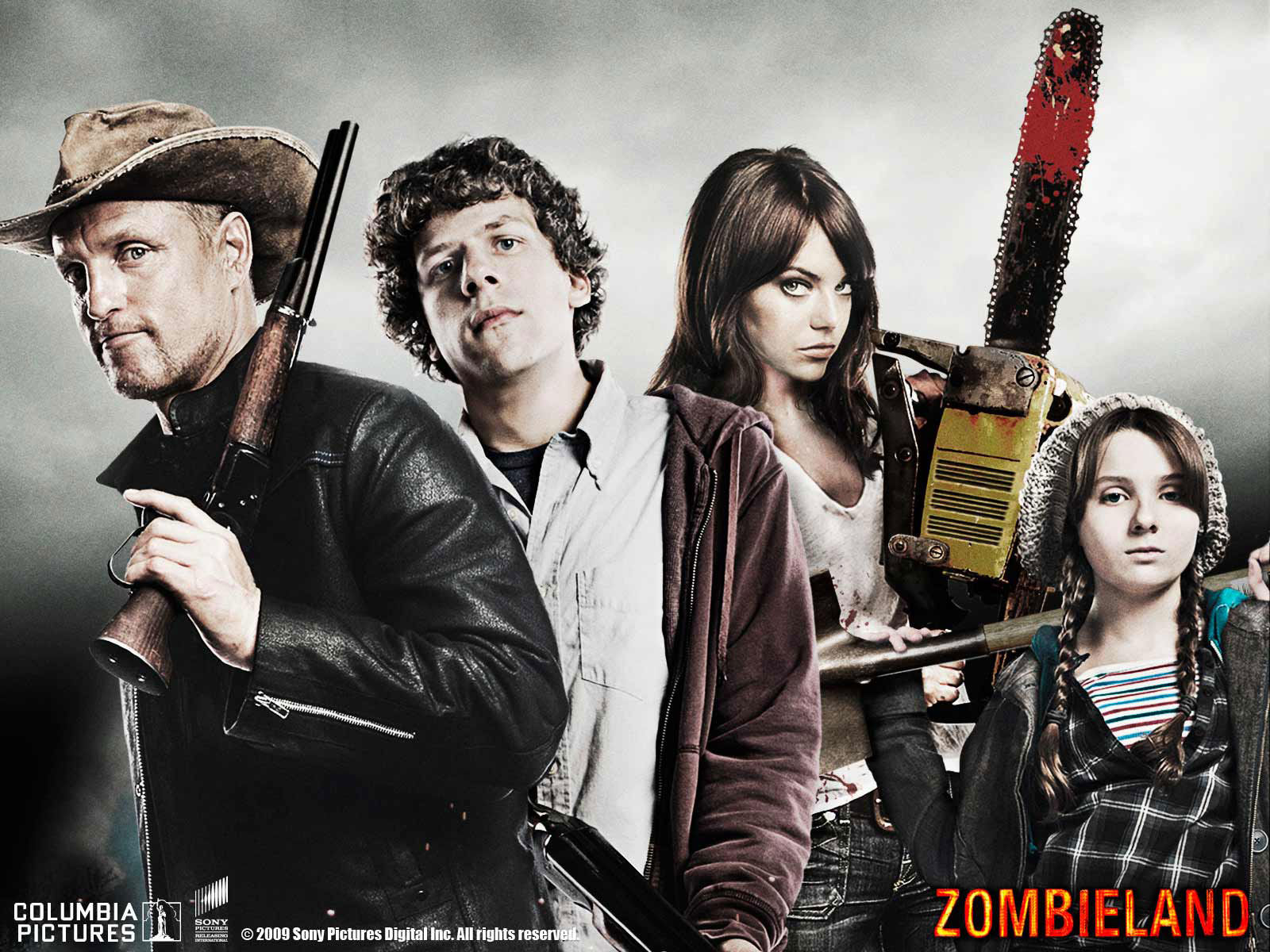
Halloween Countdown, Day 28: Zombieland

Zombieland (2009)

Zombieland is quite possibly the perfect movie. Just when Shaun of the Dead convinced me that those Limey Brits had create the best-ever zombie romantic comedy, it turns out they’d only created the most British zombie romantic comedy. The Yank counterpart is even better, and with this amount of artillery, it’s certainly a more American vision.

Let’s start with the effervescently clever writing. Rhett Reese and Paul Wernick take the tried-and-true zombiepocalypse premise and sprint with it in totally new and awesome directions.

And the cameo. I cannot imagine a better one. I mean that. I’m not sure a walk on by Jesus himself could have brought me more joy.

That’s not true. Plus, in zombie movie?! How awesome would that have been?!

The performances kick ass, also. Thank you Rubin Fleischer for respecting each character enough to allow them a good balance of stupid mistakes, solid decisions and laughs.

Jesse Eisenberg anchors the film with an inspired narration and an endearing dork characterization. Yes, we’ve seen him dork before. One dork nearly won him an Oscar. Still, this is one of his finer dorks.

But Woody Harrelson owns this film. His gun toting, Twinkie loving, Willie Nelson singing, Dale Earnhart number wearing redneck ranks among the greatest horror heroes ever.

I give you, a trip to a loud and well-lit amusement park is not a recommendation Max Brooks would make during the zombiepocalypse. Still, you’ve got to admit it’s a gloriously filmed piece of action horror cinema.

Listen weekly to MaddWolf’s horror podcast FRIGHT CLUB. Do it!

Portraits and Landscapes

Certain Women

by Hope Madden

Writer/director Kelly Reichardt sees something extraordinary in the simple daily struggle of ordinary people. Her latest film, Certain Women, again observes with genuine interest the (mostly) routine choices and sacrifices that quietly shape lives.

Weaving together three separate tales, each with just a whisper of a connection to the next, she tells of the isolation and disappointments coloring the lives of certain small town women.

Laura Dern stands out, exasperated but compassionate, as a rural Montana lawyer contending with a confused and obstinate client (Jared Harris, wonderful). Their story crescendos with uncharacteristic (for Reichardt) drama, but even here, the intimacy and understatement highlight something far more human than the tale itself predicts.

Reichardt regular Michelle Williams leads the second story, one full of understated moments echoing with regret and longing. The third, starring Kristen Stewart as a new lawyer teaching a class and Lily Gladstone as the desperately lonely ranch hand she befriends, is the most hushed and heartbreaking.

Stewart, who’s been so strong in recent roles (Clouds of Sils Maria, Still Alice, Equals), falls back a bit on her trademark angst, but Gladstone’s aching loneliness balances it out.

It isn’t simply the characters, beautifully wrought as they are, that carry these loosely braided tales. Reichardt’s eloquently captured Montana landscape, lovely but hard, both informs and reflects each of the leads.

She’s working again with regular collaborator, cinematographer Christopher Blauvelt, and together they let the rugged landscape speak as loudly, or as quietly, as the cast.

Few filmmakers – if any – can create such texture in a film. Reichardt rushes nothing, letting every scene breathe, every performance matter. There’s no shorthand here, and viewers thirsting for clear-cut drama and momentum may be uncomfortable with her choices. But those familiar with her work – Meek’s Cutoff (2010) and Wendy and Lucy (2008), in particular – will embrace the quiet intimacy of the portraits.

Verdict-4-0-Stars

Der Samurai

Der Samurai (2014)

Writer/director Till Kleinert’s atmospheric Der Samurai blends Grimm Brother ideas with Samurai legend to tell a story that borders on the familiar but manages always to surprise.

Jakob, an entirely unintimidating police officer in a remote German berg, has been charged with eliminating the wolf that’s frightening villagers. Moved by compassion or longing, Jakob can’t quite make himself accomplish his task – a fact that villagers and his commanding officer find predictably soft. But a chance encounter with a wild-eyed stranger wearing a dress and carrying a samurai sword clarifies that the wolf is probably not the villagers’ – or Jakob’s – biggest problem.

Pit Bukowski cuts a peculiar but creepy figure as the Samurai – kind of a cross between Iggy Pop and Ted Levine (The Silence of the Lambs’s Buffalo Bill). His raw sexuality offers the perfect counterpoint to the repressed Jakob (Michel Diercks). As their cat and mouse game gains momentum, it appears the Samurai is here to upend all of Jakob’s inhibitions by eliminating anyone keeping him from embracing to his primal urges – getting “rid of the blockage once and for all.”

That’s what the sword is for.

Kleinert’s sneaky camera builds tension in every scene, and the film’s magnificent sound design echoes with Jakob’s isolation as well as that of the village itself. And though much of the imagery is connected in a way to familiar fairy tales or horror movies, the understated approach gives it all a naturalism that is unsettling.

Not that Kleinert’s content to take a naturalistic path all the way through. His tale has roots in old Germanic folklore, so the director peppers the film with enough magical realism to evoke that dreamy – in this case, nightmarish – childhood logic.

It’s a beautiful film about embracing or forever suppressing your inner monster, but this is no ordinary Jekyll and Hyde retread. Kleinert’s vision is steeped in sexuality and sexual identity, giving it a fascinating relevance often missing in this style of horror film.

The film pulls you along with a “Will he or won’t he? Is he or isn’t he?” kind of tension, and at times you’ll fear that you’ve figured out a plot twist in advance, but Kleinert is never that obvious. Though the resolution is not as surefooted as the rest of his film, the overall effort is a uniquely memorable affair.

Listen to MaddWolf’s horror podcast FRIGHT CLUB. Do it!

Halloween Countdown, Day 25: The Shining

The Shining

It’s isolated, it’s haunted, you’re trapped, but somehow nothing feels derivative and you’re never able to predict what happens next. It’s Stanley Kubrick’s masterpiece rendition of Stephen King’s The Shining.

Though critics were mixed at the time of the film’s release, and both Kubrick and co-star Shelley Duvall were nominated for Razzies, much of the world’s negative response had to do with a needless affection for the source material. Kubrick and co-scriptor Diane Johnson use King’s novel as little more than an outline, and the film is better for it.

A study in atmospheric tension, Kubrick’s vision of the Torrance family collapse at the Overlook Hotel is both visually and aurally meticulous. It opens with that stunning helicopter shot, following Jack Torrance’s little yellow Beetle up the mountainside, the ominous score announcing a foreboding that  the film never shakes.

The hypnotic, innocent sound of Danny Torrance’s Big Wheel against the weirdly phallic patterns of the hotel carpet tells so much – about the size of the place, about the monotony of the existence, about hidden perversity. The sound is so lulling that its abrupt ceasing becomes a signal of spookiness afoot.

Duvall terrifies in that she is so visibly terrified. She may be “somewhat more resourceful” than Mr. Grady and his cohorts imagined, but she is a bit of a simpleton. Her gangly, Joey Ramone looks – so boney and homely – are shot to elongate what’s already too long, making her seem like a vision of death.

Let’s not forget Jack.

Nicholson outdoes himself. His early, veiled contempt blossoms into pure homicidal mania, and there’s something so wonderful about watching Nicholson slowly lose his mind. Between writer’s block, isolation, ghosts, alcohol withdrawal, midlife crisis, and “a momentary loss of muscular coordination,” the playfully sadistic creature lurking inside this husband and father emerges.

What image stays with you most? The two creepy little girls? The blood pouring out of the elevator? The impressive afro in the velvet painting above Scatman Crothers’s bed? That freaky guy in the bear suit? Whatever the answer, thanks be to Kubrick’s deviant yet tidy imagination.

And, if you’re in the mood for a double feature, check out last year’s Room 237. As it explores various interpretations of Kubrick’s vision that vary in wackiness, it cements the effect The Shining still has on pop culture.

Speaking of.. if you’ve never seen The Simpsons take on it, The Shinning, you gotta remedy that.


http://www.youtube.com/watch?v=jOh8vWjHA9Q

Halloween Countdown, Day 24: Possession

Possession (1981)

Speaking of sex and monsters – wait, were we? – have you seen Possession? WTF is going on there?

Andrzej Zulawski – writer/director/Czech – created this wild ride with doppelgangers, private investigators, ominous government (or are they?) agencies, and curious sexual appetites. It’s more precisely fantasy than horror, but it strikes me as David Cronenberg meets David Lynch, which is a pairing I can get behind.

Sam Neill plays Mark. Mark has just left his job – a mysterious position with some kind of lab. He’s being offered a lot of money to stay, but he needs to go home. We don’t know why.

Back at home, he greets his genuinely adorable son Bob (Michael Hogben). I love that his name is Bob. Bob – it’s so normal, and yet feels so unusual for a small child. Mark’s wife Anna (Isabelle Adjani) is also at home with Bob. There’s nothing normal about Anna.

Mark and Anna’s relationship boasts an intentional artificiality- a queasying sexuality- that makes it hard to root for either of them as their marriage deteriorates. Anna, it seems, is in love with someone else. Is it the sexually open – really, really open – Heinrich? Is it a bloody, mollusk-like monster? Is Mark boning Anna’s mean friend with a cast on her leg? Does Bob’s kindergarten teacher bear an unreasonable resemblance to Anna? Is anyone caring properly for Bob?

These questions and more go basically unanswered in a deviant, summary-defying, fantastical bit of filmmaking that mocks the idiocy, even insanity of obsession and boasts a handful of weirdly excellent performances. And sex with a bloody mollusk-like monster.

Listen weekly to MaddWolf’s horror podcast FRIGHT CLUB. Do it!

Halloween Countdown, Day 23: Only Lovers Left Alive

Only Lovers Left Alive (2013)

Vampires again! Can’t we just give it a rest already?

I hear ya, but before you write them off completely, let Only Lovers Left Alive renew your faith in the genre’s possibilities.

Leave it to visionary writer/director Jim Jarmusch to concoct the perfect antidote to the pop culture onslaught of romantic teenage blood drinkers. OLLA is a delicious black comedy, oozing with sharp wit and hipster attitude.

Great lead performances don’t hurt, either, and Jarmusch gets them from Tom Hilddleston and Tilda Swinton as Adam and Eve (perfect!), a vampire couple rekindling their centuries-old romance against the picturesque backdrop of…Detroit.

I’m not going to lie, they had me at Swinton/Hiddleston/Jarmusch/vampires, but it’s such a treat to find the end result only exceeds expectations.

Not since the David Bowie/Catherine Deneuve pairing in The Hunger has there been such perfectly vampiric casting. Swinton and Hiddleston, already two of the most consistently excellent actors around, deliver cooly detached, underplayed performances, wearing the world- weariness of their characters in uniquely contrasting ways.

The less you know about the lifestyles of Adam and Eve, the better, and the plot consists mainly of consequences from a surprise visit by Eve’s sister Ava (Mia Wasikowska). But Jarmusch, as he often does, creates a setting that is totally engrossing, full of fluid beauty and wicked humor.

His camera lingers in dark corners and high ceilings, swimming in waves of sublime production design, evocative music and mood lighting that is subtle perfection. This is a master class in style and atmosphere, conjuring up a dark world you’re just geeked to spend time in.

There is substance to accent all the style. The film moseys toward its perfect finale, casually waxing Goth philosophic about soul mates and finding your joy.

Ironically, Jarmusch treats the possibility of nightwalkers among us more realistically than any vampire flick in recent memory. And in the process, has some wry fun with how the whole thing went south.

Talk about finding our joy.

Listen weekly to MaddWolf’s horror podcast FRIGHT CLUB. Do it!

Bringing Your Work Home

Ouija: Origin of Evil

by Hope Madden

It’s a rare thing for a sequel to better its predecessor. It helps when the bar is not particularly high in the first place.

Such is the case for Ouija: Origin of Evil. A prequel to the 2014 by-the-numbers spook flick Ouija, the new iteration takes us back to a stylish 1965 where a struggling widow (Elizabeth Reaser) tries to eek out a living as a fortune teller.

Though her goal is noble – she just wants to bring peace to the grieving – her gig is a scam. Worse still, she enlists the help of her 9 and 16-year-old daughters. But when she brings a Ouija board home to liven up the act, her youngest turns out to be the real medium.

This is not a great film. It is, however, not half bad.

Director Mike Flanagan (Absentia, Hush), who co-wrote with Jeff Howard, has proven that he can mine even familiar territory for chills. His casting certainly doesn’t hurt.

Rather than relying on fresh faced teens to carry a supernatural slasher, he turns to seasoned actors – Reaser and Henry Thomas (that’s right – Elliot!) – to ground the fantastical elements with understated but believable performances.

The important roles, though, are the kids. Annalise Basso – so strong in Flanagan’s middling Oculus – again nails a performance as a normal kid living through extraordinary circumstances.

Lulu Wilson plays the wee spiritualist Doris, and though she occasionally slips into something too cloying, for the most part she handles her part with a nice balance of innocence and eeriness.

Flanagan wisely picks up enough from the previous film for this origins story to make it a proper standalone effort. He does get a bit heavy handed with the tiresome FX (is anyone still undone by a crab walking pre-adolescent at this point?), but for 2/3 of the film his approach is more measured. He lets the appealing performances and family dynamic do most of the heavy lifting.

Elements that weaker filmmakers would have hit hard Flanagan allows to linger, to become intriguing rather than damning.

As has been the case throughout his career, he can’t quite close the deal. Though never terrifying and rarely fresh, Origin of Evil still brings enough era-specific nods and spook house moments to be a fun seasonal escape – but never more than that.

Verdict-2-5-Stars

Halloween Countdown, Day 22: Housebound

Housebound (2014)

You need to see Housebound.

Funny and scary, smartly written and confidently directed as to take full advantage of both, this is a film that makes few missteps and thoroughly entertains from beginning to end.

Gerard Johnstone writes and directs, though his brightest accomplishment may be casting because Morgana O’Reilly’s unflinching performance holds every moment of nuttiness together with brilliance.

O’Reilly plays Kylie, a bit of a bad seed who’s been remanded to her mother’s custody for 8 months of house arrest after a recent spate of bad luck involving an ATM and a boyfriend who’s not too accurate with a sledge hammer.

Unfortunately, the old homestead, it seems, is haunted. Almost against her will, she, her hilariously chatty mum (Rima Te Wiata) and her deeply endearing probation officer (Glen-Paul Waru) try to puzzle out the murder mystery at the heart of the haunting. Lunacy follows.

Kylie’s disdain for every single person and event in this film is beautifully animated – O’Reilly constantly looks as if she’s just smelled something foul. But her expressions also share those fleeting moments of regret that make her utterly, admirably human.

Good horror comedies are hard to come by, but Johnstone manages the tonal shifts magnificently. You’re nervous, you’re scared, you’re laughing, you’re hiding your face, you’re screaming – sometimes all at once. And everything leads up to a third act that couldn’t deliver better.

The film is so much fun it all but begs to be seen with a group.

Listen weekly to MaddWolf’s horror podcast FRIGHT CLUB. Do it!

https://www.youtube.com/watch?v=BT1KcYiPb4I

Time to Stop Reaching

Jack Reacher: Never Go Back

by Hope Madden

Who is Jack Reacher?

“The guy you didn’t count on.”

Or, the guy spewing some tired, tired lines.

Four years ago Tom Cruise pissed off Lee Child fans when he put on the rumpled jeans and tee of the 6’5” drifter with mad military skills. In the serviceable thriller Jack Reacher, Cruise’s character puzzled through a homicide set up with the help of an inappropriately dressed defense lawyer.

Nowadays, though, maybe Jack is subconsciously looking to settle down. He meanders back to DC to talk with the Major who is now in command of his old post – the overtly fierce Samantha Turner (Cobie Smulders). Sparks?

Well, there might have been except Major Turner’s been incarcerated, there’s a highly trained sociopath with an alpha complex and a fancy pair of leather gloves, and an at-risk teen is in need of guidance.

The action’s far less interestingly choreographed, the humor is nonexistent, the villain is far blander (it was Werner Herzog last go-round, for lord’s sake!).

With the right combination of vulnerability, brattiness and savvy, Danika Yarosh provides the rare bright spot as the wayward teen. Smulder’s indignant badass is all but intolerable. Meanwhile, Cruise seems paralyzed as he tries to relay confused and conflicted paternal tendencies.

Edward Zwick’s stale direction isn’t helping. The closest thing to panache comes by way of the now de rigueur chase across urban rooftops. Yawn.

Still, Zwick’s greater crime may be the screenplay he co-wrote with Richard Wenk and Marshall Herskovitz, adapted from the Child novel. There is a difference between streamlining text and discarding character development, plot movement and sense. You spend 30% of the film thinking, “Well, that was certainly convenient.”

Incompetent plotting, weak catch phrases and a shocking lack of chemistry among any and all actors will keep a project from succeeding. Hopefully everyone involved – including the audience – can leave the film and never go back.

Verdict-2-0-Stars

