It’s a languid Italian summer circa 1983 and everything is just so ripe.
Call Me by Your Name, the coming-of-age drama from Luca Guadagnino (I Am Love, A Bigger Splash), swoons. Precocious seventeen-year-old Elio (an utterly astonishing Timothée Chalamet) is surrounded with luscious fruit from the trees, lovely girls from the village, books and music to fill the hours spent with his parents (Amira Casar, Michael Stuhlbarg) in the rural villa where they research Greco-Roman culture.
Then their seasonal research assistant Oliver (Armie Hammer) arrives.
Awash in sensuality, Guadagnino’s love story is unafraid to explore, circling Oliver and Elio as they irritate each other, then test each other, and finally submit to and fully embrace their feelings for one another. Theirs is a remarkable dance, intimately told and flawlessly performed.
Enough cannot be said for Chalamet’s work. He is astonishingly in control of this character, and were that not the case, the age difference between the two characters (Oliver is meant to be 24, though Hammer is 31 which makes the gap seem more disturbing) would have left things feeling too predatory.
Hammer has never been better. Though the young Chalamet’s performance is Oscar-caliber, Hammer matches him step for step, creating a character both vulnerable and authoritative.
A standout in a solid ensemble, Stuhlbarg, looking almost alarmingly like Robin Williams, brings a quiet tenderness to the proceedings, a tone he elevates in a late-film monologue that could not have been delivered with more compassion or love. It’s breathtaking, perfectly punctuating the themes of acceptance and self-acceptance that permeate the film.
But even before Hammer or Chalamet can seduce you, Sayombhu Mukdeeprom does, lensing a feast for the senses. Together he and Guadagnino immerse you in this heady love story, developing a dreamy cadence and alluring palette that invites you to taste.
I brought you into this world, I can take you out of it.
It’s a joke, of course, an idle threat. Right?
Maybe so, but deep down, it does speak to the unspeakable tumult of emotions and desires that come with parenting. Wisely, a humorous tumult is exactly the approach writer/director Brian Taylor brings to his horror comedy Mom and Dad.
Horror films have been coming up with excuses to exorcise our forbidden desire to kill our own children for decades, mostly with little-seen cult films like It’s Alive or The Children or Cooties. In those films, the children themselves become monsters and the adults have no choice, you see.
Taylor (co-director of the Crank series) has a different take. In what is basically a long and very bloody metaphor for a mid-life crisis, parents the world over simply give in to an unspecified but urgent need to kill their own offspring.
It’s an epidemic picture, a zombie film without the zombies. Which doesn’t sound that funny, I’ll grant you, but Taylor and a game cast indulge in many of the same family tensions that fuel most sitcoms. They just take it one or two or three demented steps further.
So why do you want to see it? Because of the unhinged Nicolas Cage. Not just any Nic Cage—the kind who can convincingly sing the Hokey Pokey while demolishing furniture with a sledge hammer.
This is one of those Nic Cage roles: Face/Off meets Wild at Heart meets Vampire’s Kiss. He’s weird, he’s explosive and he is clearly enjoying himself.
Selma Blair lands the unenviable role of sharing the screen with Cage, but she doesn’t try to match him as much as keep him focused: they do have a job to accomplish, you know. The result is a fascinating picture of marital teamwork, actually. Good for them.
Taylor’s frantic pace and hiccupping camera mirror Cage’s lunatic energy, and clever writing toys with our expectations while delivering a surprisingly transgressive film.
Others have done it better. (I’m looking at you, Babadook.) But this may be the most amusing way to spend 90 minutes watching people try to murder their own children.
A couple of middling horror movies are available this week in home entertainment. Well, one is middling—nothing amazing, but better than expected. The other is a colossal waste of talent in a jumbled mess of a nonsensical plot. Oof!
Russian documentarian Dmitrii Kalashnikov has gathered dashcam footage and assembled it into something fresh, wild and intriguing.
Dashcams are apparently ubiquitous across Russia and Kalashnikov pulls together a smattering of amazing clips to create an image that’s both universal and deeply Russian. If you worry that you’ll basically be viewing a barrage of YouTube clips, don’t.
This is a thoughtfully made, smartly paced movie—evidence of a filmmaker with style and authority. Kalashnikov creates a fascinating rhythm, expertly flanking longer pieces with thematic montages.
In the lengthier bits we’re privy to the conversation in the car, or maybe the sound of the radio. Both serve to heighten the bat-shit effect of what’s happening onscreen. And while the unbelievably appropriate talk-radio conversation being subtitles onscreen while road rage ensues in front of the windshield is inspired, it’s the often deadpan reactions of drivers that elevate the viewing.
Montages offer bursts of linked images, usually set to a jaunty Russian polka or some other weirdly whimsical piece. Sets of clips focused on natural disasters or animals or pedestrians punctuate the longer drives, allowing Kalashnikov to quicken the pace periodically and maintain an energetic cadence.
The film also has heart. This is not Faces of Death. There is carnage for sure, but don’t expect a grim bloodbath. Kalashnikov is more interested in the amazing, the weird, the insane—comets crashing, bears running in traffic, a guy with an ax.
For all its lunacy, The Road Movie is not a novelty or a trifle. It’s a rock-solid documentary, well-paced and informative. And it is nuts.
I know what you’re thinking. Sex and death—that could be literally any film in the genre. Aaah, yes, but we’re not talking metaphorically or even loosely connected. Sure, the quickest way onto Michael Meyers’s or Jason Voorhees’s kill list is by having sex, but that’s not immediate enough. Let’s disregard the middle man, lose the pause, and go right to the horror films where sex and death are immediately, gorily and irreversibly linked.
Happy Valentine’s Day, by the way!
5. Killer Condom (1996)
A Troma-distributed splatter/horror/comedy, Killer Condom is an enormous amount of fun. This is a German film—German actors delivering lines in German—but it’s set in NYC. You can tell because of the frequent shots of someone opening a New York Times newspaper machine.
Luigi Mackeroni (Udo Samel) is the grizzled NYC detective who longs for the good old days in Sicily. In German. He’s assigned to a crime scene in a seedy Time Square motel he knows too well, where it appears that women just keep biting off men’s penises.
Or do they?
This film is refreshingly gay, to start with, as nearly every major character in the film is a homosexual. The run-of-the-mill way this is handled is admirable, even when it is used for cheap laughs. (Babette, I’m looking at you).
It’s fun. It’s funny. It’s gory and wrong-headed and entertaining from start to finish. Who’d have guessed?
4. Teeth (2007)
Of all the films built on the hysteria of impending womanhood, few are as specific as Teeth, a film in which a pubescent discovers a sharp set where teeth ought not be. This is a dark comedy and social satire that is uncomfortable to watch no matter your gender, although I imagine it may be a bit rougher on men.
Treading on the dread of coming-of-age and turning male-oriented horror clichés on ear, Teeth uses the metaphor implicit in vagina dentata—a myth originated to bespeak the fear of castration—to craft a parable about the dangers as well as the power of sexual awakening.
Written and directed by artist (and Ohioan!) Roy Lichtenstein’s son Mitchell, Teeth boasts an irreverent if symbol-heavy script with a strong and believable lead performance (Jess Weixler).
Weixler’s evolution from naïveté to shock to guilt to empowerment never ceases to captivate, but the story itself settles for something more conventional and predictable than what the shockingly original first two acts suggest.
3. Trouble Every Day (2001)
Backed by a plaintive, spooky soundtrack by Tindersticks, Clair Denis’s metaphorical erotic horror examines gender roles, sex and hunger. Denis is one of France’s more awarded and appreciated auteurs, so a one-time voyage into horror should not be dismissed.
A newlywed American couple head to Paris, ostensibly to honeymoon, but Shane (Vincent Gallo) is really there to re-establish connection with old colleagues Coré (Béatrice Dalle) and her husband, Léo (Alex Descas). The three scientists once participated in an experiment, and Shane needs to find them.
The film is a startling work of biologic-horror, but its existential riffs on intimacy, dominance and violence—common fare in the genre—are clearer-headed and more disturbing here than in anything else that swims the same murky waters.
https://www.youtube.com/watch?v=oz5VlZc8tC4
2. Raw (2016)
What you’ll find in first-time filmmaker Julia Ducournau’s Raw is a thoughtful coming-of-age tale. And meat.
A college freshman and vegetarian from a meat-free family, Justine (Garance Marillier) objects to the hazing ritual of eating a piece of raw meat. But once she submits to peer pressure and tastes that taboo, her appetite is awakened and it will take more and more dangerous, self-destructive acts to indulge her blood lust.
The film often feels like a cross between Trouble Every Day and Anatomy. The latter, a German film from 2000, follows a prudish med student dealing with carnage and peer pressure. In the former, France’s Claire Denis directs a troubling parable combining sexual desire and cannibalism.
Ducournau has her cagey way with the same themes that populate any coming-of-age story – pressure to conform, peer pressure generally, societal order and sexual hysteria. Here all take on a sly, macabre humor that’s both refreshing and unsettling.
1. It Follows (2014)
It Follows is yet another coming-of-age tale, one that mines a primal terror. Moments after a sexual encounter with a new boyfriend, Jay (Maika Monroe) discovers that she is cursed. He has passed on some kind of entity – a demonic menace that will follow her until it either kills her or she passes it on to someone else the same way she got it.
Yes, it’s the STD or horror movies, but don’t let that dissuade you. Mitchell understands the anxiety of adolescence and he has not simply crafted yet another cautionary tale about premarital sex.
Mitchell has captured that fleeting yet dragging moment between childhood and adulthood and given the lurking dread of that time of life a powerful image. There is something that lies just beyond the innocence of youth. You feel it in every frame and begin to look out for it, walking toward you at a consistent pace, long before the characters have begun to check the periphery themselves.
Mitchell’s provocatively murky subtext is rich with symbolism but never overwhelmed by it. His capacity to draw an audience into this environment, this horror, is impeccable, and the result is a lingering sense of unease that will have you checking the perimeter for a while to come.
Like Man Bites Dog meets The Last Horror Movie, Strawberry Flavored Plastic attempts to document the behavior of a serial killer.
Not to be mistaken for found footage, the film itself is the result of several months’ worth of documentary footage shot principally by Errol (Nicholas Urda) and Ellis (Andres Montejo), two filmmakers eager to finally make a movie.
They believe they’re following a recently-released felon back into society, but in fact, Noel (Aidan Bristow) is a serial killer.
Do they keep filming?
Strawberry Flavored Plastic revolves around a clever conceit, one that’s easy to overlook if you don’t pay attention. But first time feature filmmaker Colin Bemis shows faith in an audience that’s paying attention.
Though the dialog often feels like wildly overwritten musings on the art of filmmaking and the nature of psychosis, the film cleverly creates a reason for the stilt and Bristow handles the script and the focus of the film well.
The actor creates a frightening, volcanic and surprisingly sympathetic central figure for the film. His is a clever, twisty performance nimbly balancing the conflicting purposes his character embodies.
Urda has a tougher time with the the dialog. As he waxes philosophical on the mercenary nature of the documentarian and the limits of complicity, his delivery too often sounds more like film school pretentions.
Aside from a handful of security camera images that beg POV questions, Bemis’s visual style is a great strength of the film. Rarely betraying the film’s shoestring budget, a nice variation of styles helps to fuel the picture’s momentum. More than that, the use of psycho-held camera manages, with smooth, clean precision, to better articulate the main character.
Made for barely 13K, Strawberry Flavored Plastic not only commands your attention, it announces an intriguing new filmmaker worth watching.
Strawberry Flavored Plastic is available on Amazon January 23.
Heavy hitters this week: Oscar contenders and people who just hit hard. We talk through The Post, The Commuter, Jane and what’s new in home entertainment.
In 2014, Jaume Collet-Serra directed Non-Stop, a Liam Neeson thriller that saw the down-on-his-luck Irishman with a particular set of skills trapped on a speeding vehicle with a killer, a mystery, and an outside force looking to pin some wrongdoing on him.
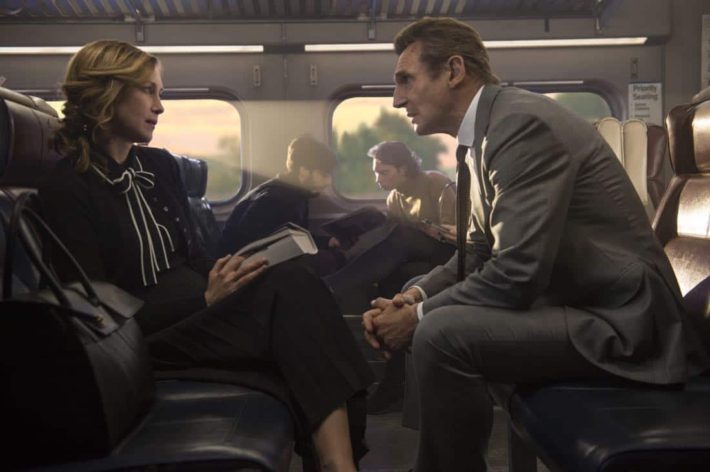
In 2018, Jaume Collet-Serra directed The Commuter. Same movie. Train this time.
This go-round, happily married devoted father Michael MacCauley (Neeson) gets chatted up by the lovely and mysterious Joanna (Vera Farmiga) as he heads home on his nightly commute. She poses a question: would you do one little thing—something you are uniquely qualified to do—if it landed you 100k and you had no idea of the consequences?
Well, it’s not a game and next thing you know he’s dragging his lanky frame up and down the train cars trying to find a mysterious person with a mysterious bag before his family is nabbed or someone else gets killed.
How many times do we have to see this movie? We get it, Neeson is not a man to be messed with. He’s savvy, noble and he can take a punch.
Farmiga’s always a welcome sight, plus Sam Neill and Patrick Wilson contribute as they can. But mainly it’s just you, Neeson and a host of stereotypes trying to test your mystery-solving skills but not your patience.
At its best, The Commuter is a B-movie popcorn-munching ode to the forgotten middle class good guy. At its worst, a boldly predictable waste of talent littered with plot holes and weak CGI.
It is Oscar season, people, and we have a big story to tell. Assemble the heavy hitters!
Spielberg – check.
Tom Hanks – check.
Where do you go from there when you’re making the Big Important Film? The one with potential blockbuster legs?
Correct: Meryl Streep.
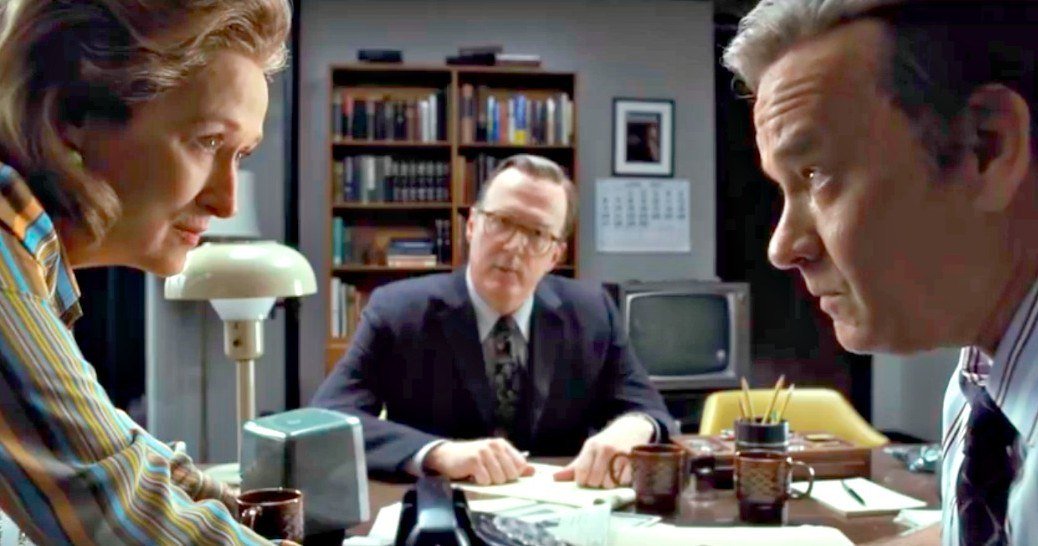
It is official: The Post has it all, beginning with the almost-too-relevant story of a newspaper casting off its personal associations to hold the government accountable by sharing actual news with citizens of the United States and the world.
“If we live in a world where the government tells us what we can and cannot print,” says Ben Bradlee by way of Tom Hanks, “the Washington Post has already ceased to exist.”
The year is 1971. The New York Times has just published parts of the Pentagon Papers, a decades-long study that proves the government lied for years about what was happening in Vietnam. The Washington Post wants desperately to be seen as one of the big news outlets, so they’re working to publish similar content of their own when Nixon decides it’s in his purview to suppress the freedom of the press.
A timely reminder of the struggle to maintain an informed public, Spielberg’s latest is also a testament to Post publisher Kay Graham (Streep). The film offers an insightful image of her difficult road and her courageous actions.
Like Spotlight, also co-written by Post co-scribe Josh Singer (writing here with Liz Hannah), this story encapsulates a watershed moment in journalism. No, not the struggle for a free press. The introduction of profit into the mix. Part of the film’s tension comes from the fact that the Pentagon Papers became available at the same time that the Post was being made public, which introduces yet another powerful contributor toward determining what is and is not deemed appropriate news: money.
It’s a lot to tackle, but naturally, Spielberg has it all well in hand and he doesn’t limit his spectacular casting to Streep and Hanks. Look for great ensemble performances from Tracy Letts, Bob Odenkirk, Bradley Whitford, Sarah Paulson, Bruce Greenwood and about 30 others.
Spielberg’s passion and polish come together here as an expertly crafted rallying cry. He’s preaching to the choir, but he preaches so well.
Nasty weather getting you down? Nothing cheers a body up like a clown! That’s right, It comes home this week, along with some other bits of middling entertainment from 2017. Wouldn’t it all go so well with popcorn? Pop pop pop pop pop…