Tag Archives: Hope Madden

This Isn’t Radio Clash

Radioflash

by Hope Madden

See the solution, not the problem.

That’s the mantra young Reese (Brighton Sharbino) repeats as she tries to find her way free of an ultra-realistic virtual reality exercise. Back at home, with her multiple screens in front of her, she has a tough time getting that game out of her head, even when her dad (Dominic Monaghan) calls her down for burgers on the dinner table and vinyl on the turntable .

Radioflash is the latest in a tedious line of films to point out that we—our youngsters, in particular—are dangerously reliant on technology, to the point that they barely know how to live day to day in the real world. I mean, what would Reese do if a nuclear pulse took out the power in half the country?

Let’s find out.

Being solution oriented, she heads to Grampa’s (Will Patton) shed. As luck would have it, the first book she grabs falls open to the page defining a radioflash. And though there’s no reason on earth to believe this is anything other than a garden variety black out, Reese somehow intuits 1) it is, indeed, a radioflash, and 2) how to get Grampy’s old CB radio up and running via a car battery.

Oh, the conveniences just come scattershot like that through the rest of the film, which is less a journey and more a series of “and then this happens, and then this happens, and then this happens.”

This is not a film that has a high opinion of  humanity. Sure, neither did Cormac McCarthy, but I think he saw civilization surviving more than a single day before his post-apocalyptic nightmare The Road had us eating each other. Not so, writer/director Ben McPherson. Outright cannibalism may be a few days off, but inside of 24 hours he expects to see looting, murder, kidnapping and worse.

Wait, what’s worse than  looting, murder and kidnapping?

Mountain people.

“Only two kinds of mountain people,” says wizened and doomed good Samaritan Farmer Glenn. “Those chasing a dream, and those that’s being chased.”

Guess whose hands solution-oriented Reese falls into? Here’s an actual piece of dialog, to help you decide.

“Ain’t no finer meat than bear.”

Yes, Reese finds herself with the meanest lot of white trash this side of Wrong Turn.

But Radioflash is not a horror movie. (It’s not a Clash song, either, but damn if I can get that tune out of my head.) It’s a lazy hero’s quest adventure flick where the hero learns little and isn’t given much chance to become a hero.

Redacted

The Report

by Hope Madden

Admit it. Own up to it. Hold yourself accountable. Then our country can move on.

Oh right, also, I saw The Report this week.

For his clear-eyed reminder of what post 9/11 America was like, writer/director Scott Z. Burns takes a page from Adam McKay’s book of outrage, leaving both tongue and cheek behind.

Daniel Jones (Adam Driver, who is having one hell of a year) is a Senate staffer working for Dianne Feinstein (Annette Bening, eerily good). He’s been tasked with investigating the CIA’s post 9/11 “enhanced interrogation” tactics.

Among the heads of the CIA are Thomas Eastman (Michael C. Hall) and John Brennan (Ted Levine).

That Burns cast two actors known best for playing serial killers as CIA leaders is slyly hilarious and indicative of the contempt the filmmaker has for those responsible for this shameful page in US history.

The Report brims with rage, justifiably so, but Burns never stoops to melodrama, rarely even preaches. Much of his ire is delivered via Driver’s sullen stare. Driver is characteristically amazing. Though his performance is largely internal, it spills over with the ache and anger of a citizen who loves his country and cannot believe what he sees happening.

The entire cast—and it’s a big one—impresses, from bewildered CIA staff to opportunists looking to cash in, from battered inmates to White House Chief of Staff. With limited screen time, each performer establishes a character, not a cardboard villain or hero, and the contribution elevates the entire film.

Burns’s script stumbles periodically over exposition, but given the sheer volume of information he covers, it’s a fault that’s easy to forgive. Somehow he manages to contain in just under two hours what Daniels himself couldn’t fit inside 7000 pages.

Importantly, though the film does look to enlighten us on the corruption, greed and fearmongering that led the US to such sadistic measures, Burns wisely leans more heavily on a larger theme of admission and oversight as the only steps toward regaining self-respect and the respect of the world.

Timely.

I Don’t Want to Go Out – Week of November 11

Tons of movies to fill your “I forgot how cold and crappy fall could be” hours. Some of these movies are great. Some of them are crap. We are here to help you tell the difference.

Click the film title to link to the full review.

The Farewell

Midnight Traveler

The Peanut Butter Falcon

Good Boys

47 Meters Down: Uncaged

https://www.youtube.com/watch?v=AvXjx8SZbv8

Brian Banks

Primal

After the Wedding

What’s Up, Doc?

Doctor Sleep

by Hope Madden and George Wolf

The Shining was always going to be a hard act to follow, even for Stephen King.

But as soon as King revisited the horror with Doctor Sleep, the bigger challenge instantly fell to whomever was tasked with bringing it to the screen.

That would be writer/director Mike Flanagan, who’s trying on two pairs of pretty big shoes. His vision will not only be judged next to one of the most iconic horror films of all time, but also by the source author who famously doesn’t like that film.

While Doctor Sleep does often feel as if Flanagan is trying to serve two (or more) masters, it ultimately finds enough common ground to become an effective, if only mildly frightening return trip.

After surviving the attempted redrum, adult Dan Torrence (Ewan McGregor) is struggling to stay clean and sober. He’s quietly earning his chips, and is even enjoying a long distance “shine” relationship with the teenaged Abra (Kyliegh Curran).

But Abra and her unusually advanced gifts have also attracted the attention of Rose the Hat (Rebecca Ferguson, sweetly menacing) and her cult of undead travelers. Similarly gifted, Rose and her band seek out young shiners, feeding on their powers to remain immortal.

Flanagan breaks the spooky spell to dive into terror in a truly unnerving sequence between Ferguson’s gang and a shiny little baseball player (Jacob Tremblay). Effectively gritty and hard to shake, it is the one moment the film fully embraces its horror lineage.

Reportedly, Flanagan had to convince King that it is Kubrick’s version of The Shining that reigns in popular culture (as it should), and that their new film should reflect that. Smart move, as is the choice to hit you early with lookalike actors in those famous roles from 1980.

Is it jarring seeing new faces as young Danny, Wendy, Dick Halloran and more? Yes it is, but as the film unfolds you see Flanagan had little choice but to go that route, and better to get comfy with it by the time Dan is back among the ghosts of the Overlook hotel.

King has made it clear he needed more emotional connection to his characters than Kubrick’s film provided. McGregor helps bridge that gap, finding a childlike quality beneath the ugly, protective layers that have kept Danny Torrence from dealing with a horrific past.

Flanagan (Oculus, Hush, Before I Wake, Gerald’s Game) stumbles most when he relies on awkward (and in some cases, needless) exposition to clarify and articulate answers. Kubrick was stingy in that regard, which was one of The Shining‘s great strengths. Questions are scary, answers seldom are.

Whatever the film’s setbacks and faults, it is good fun getting back to the Overlook and catching the many Shining callbacks (including a cameo from Danny Lloyd, the original Danny Torrence). Flanagan’s vision does suffer by comparison, but how could it not? Give him credit for ignoring that fact and diving in, leaving no question that he’s as eager to see what’s around each corner as we are.

Doctor Sleep can’t match the claustrophobic nature or the vision of cold, creeping dread Kubrick developed. This film often tries too hard to please—not a phrase you’d associate with the 1980 film. The result is a movie that never seems to truly find its own voice.

It’s no masterpiece, but check in and you’ll find a satisfying, generally spooky time.

Uncaged

Primal

by Hope Madden

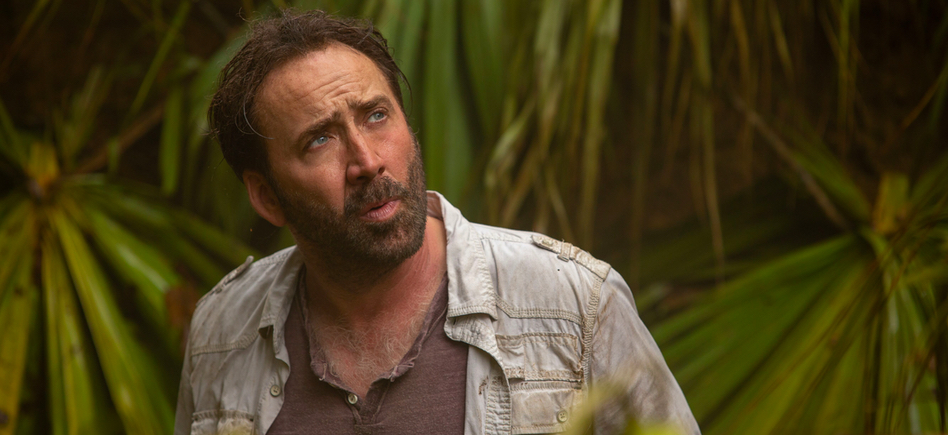
The first question to ask when evaluating any new Nicolas Cage movie: Insanity, inanity or a bit of both?

Primal looks like it could be a good balance. Stunt man turned director Nick Powell puts Cage, playing authority hating big game hunter Frank Walsh, on a cargo ship headed from South America toward the States. Walsh’s cargo: some parrots, a couple of venomous snakes, some angry monkeys, and one mass of unconvincing CGI he’s calling a white jaguar.

That Gameboy-quality big cat is not the only predator on board. US Marshalls load chained madman Richard Loffler (Kevin Durand), headed for the US to stand trial for crimes against humanity.

Why a ship instead of an airplane? Why this particular ship? Why is this kid on board instead of in school? Why is Famke Janssen (that is Famke Janssen, right?) on board?

Details!

I will not ridicule a child. I will not ridicule sad—nay, tragic—plastic surgery, either.

Onward!

Powell and writer Richard Leder slap together concepts from Die Hard, Rambo, The Silence of the Lambs, Snakes on a Plane, Aliens—and don’t forget Life of Pi. The result is dumber than the sum of its parts.

Primal contains an awful lot of stupid, but the sound is so muddy it’s hard to catch much dialog. At least we have that small mercy to be thankful for.

Is Cage good? No, not really. His inner crazy is set on simmer and Leder’s dialog is far too weak to offer Cage many options for little burst of weirdness. Cage’s chemistry with Janssen is nonexistent. There are also far too many stretches between bad CGI – I mean, white jag sightings.

It’s a ludicrous mess, but not quite ludicrous enough to make it fun. What could have been most enjoyable as insane winds up being mainly inane.

https://www.youtube.com/watch?v=DDs3csIRCWw

I Don’t Want to Go Out

Bunches of movies available for couch watching this week, most of them worthy of exactly that. Here is the scoop.

Click the film title for the full reviews.

Scary Stories to Tell in the Dark

The Kitchen

Hobbs & Shaw

Ophelia (DVD)

Paradise Hills

Fright Club Bonus: Elvira!

Who doesn’t love bonus content? Well, hopefully you do because here it is! We had the chance to talk with Elvira, and we dug into the most vital of topics: How cool is Pee-wee, what’s her go-to Halloween costume, and why did she have to call riot police?

Those answers and more in our special bonus Fright Club!

Screening Room: Terminator: Dark Fate, Parasite, Jojo Rabbit, Harriet, Greener Grass, Where’s My Roy Cohn:, Girl on the 3rd Floor

Many Mansions

Parasite

by Hope Madden and George Wolf

We’ve said it many times, but since there may still be people who haven’t heard, we’ll say it again. If Joon-ho Bong makes a film, you should see it.

Today, make it Parasite.

The film’s opening act introduces the Kim family, folding pizza boxes in a squalid basement apartment in Seoul and scrambling from room to room in search of free WiFi after the neighboring business locked theirs down with a password.

In a single scene the film appears to articulate its title and define its central characters, but the Kims are not who you think they are. In fact, every time you think you’ve pinned this film down—who’s doing what to whom, who is or is not a parasite—you learn it was an impeccably executed sleight of hand.

Longtime Bong collaborator Kang-ho Song (Memory of a Murder, The Host, Snowpiercer) anchors the film with an endearing and slippery performance. Kim patriarch, he is simultaneously beloved head of the household and family stooge. Watching Song manipulate his character’s slide from bottom to top to bottom again without ever losing his humanity—or the flaws that go along with humanity—is amazing. It’s a stunningly subtle and powerful performance.

He’s nearly matched by Yeo-jeong Jo as the righteously oblivious Mrs. Park, who spends her days in constant search for an empty validation that comes from every new indulgence for her children.

When young Kim Ki-woo ( Woo-sik Choi from Train to Busan and Bong’s last film, Okja) is able to convince Mrs. Park he’s a suitable English tutor for her daughter Da-hye (Ji-so Jung), the Kim and Park families become connected in one of the few ways afforded by the social order: master and servant.

Methodically, the rest of the Kim clan gains employment from Mr. Park (Sun-kyun Lee) through the systematic feeding of the Parks’ ego and privilege. And then just when you think Bong’s metaphoric title is merely surface deep, a succession of delicious power shifts begins to emerge.

Think the simmering rage of Joker with a completely new set of face paint.

As the Kims insinuate themselves into the daily lives of the very wealthy Parks, Bong expands and deepens a story full of surprising tenderness, consistent laughter and wise commentary on not only the capitalist economy, but the infecting nature of money.

Bong, as both director and co-writer, dangles multiple narrative threads, weaving them so skillfully throughout the film’s various layers that even when you can guess where they’ll intersect, the effect is no less enlightening.

Filming in an ultra-wide aspect ratio allows Bong to give his characters and themes a solid visual anchor. In single frames, he’s able to embrace the complexities of a large family dynamic while also articulating the detailed contrasts evident in the worlds of the haves and have nots.

Parasite tells us to make no plans, as a plan can only go wrong.

Ignore that, and make plans to see this brilliantly mischievous, head-swimmingly satisfying dive down the rabbit hole of space between the classes.