Tag Archives: Hope Madden

Home Away from Home

The Rental

by Hope Madden

Dave Franco has made a movie. James Franco’s younger, less creepy brother has been a welcome, smiling face in films since his teens. Directing his first feature, he sidesteps the more obvious choice of a comedy – given his background – and instead delivers a tense horror about jealousy, deteriorating relationships, and the dangers of Airbnb.

Dan Stevens stars as Charlie, handsome and successful older brother of Josh (Jeremy Allen White). As if Josh doesn’t have enough to live up to, his beloved and brilliant girlfriend Mina (Sheila Vand) is Charlie’s work partner and the two just really click.

Together Mina and Charlie land a big deal. To celebrate, they and their significant others—Josh, plus Charlie’s wife Michelle (Alison Brie, Franco’s real life wife)—rent a gorgeous, off the grid place for a weekend getaway.

If you’re thinking this is an incredibly common premise jazzed up with a couple of impressive actors, you are correct. But there’s a lot to be said for a good cast.

All four convey a lived-in chemistry that gives the relationship conflicts more resonance. Brie and White, in particular, deliver believable warmth as big sister-in-law/little brother-in-law. Both are dealing with some jealousy, each lending support and guidance to the other. Secondary characters in indie horror are rarely given this kind of opportunity to breathe, but drawing the audience into these relationships benefits the tensions Franco is working to create.

Stevens and Vand work wonders as the morally conflicted central characters. Vand (exquisite in A Girl Walks Home Alone at Night—see it!) blends righteous indignation with guilty conscience. This helps her build believable motives for what could, in lesser hands, feel like conveniently poor decision making.

Liberal guilt, entitlement, questionable morality and selfishness rarely come packaged as sympathetically as Charlie, but Stevens is a solid character actor and here he creates a nicely complex character.

Rounding out the small ensemble, the always welcome Toby Huss also finds layers in a character that could easily have been one note.

So, performances are solid and Franco delivers a decent sleight of hand by Act 3. The film feels imbalanced by then, though, as if it wasn’t until  the 11th hour that Franco decided this was a horror movie. There’s enough suffering in the final reel to clarify The Rental’s genre, but that doesn’t mean it entirely works.

Fright Club: Best First Half of 2020

You know what, 2020 is just going to be remembered as its own horror story. I mean, filmmakers have a lot of competition if they think they can scare us more than real life right now. Still, we’ve seen a decent batch of horror: Blood Quantum, The Droving, Time Out of Space, The Hunt and more. What more, you ask? Well, we’ll tell you. Here are our favorite horror films of the first half of 2020.

5. The Invisible Man

Instead of the existential ponderings that generally underscore cinematic Invisible Man retellings, writer/director Leigh Whannell uses this story to examine sexual politics, abuse, control and agency.

It’s a laudable aim, but the reason it works is casting.

Whannell’s script is smart, with much needed upgrades to the invisibility formula as well as the havoc wrought. But the success of The Invisible Man is almost entirely shouldered by Elisabeth Moss, who nails every moment of oppressed Cecilia Kass’s arc.

At its core, The Invisible Man is an entertaining B-movie horror propped up by contrivance. Whannell’s aim is to give the story new relevance, and thanks to Moss, his aim is true.

4. The Other Lamb

The first step toward freedom is telling your own story.

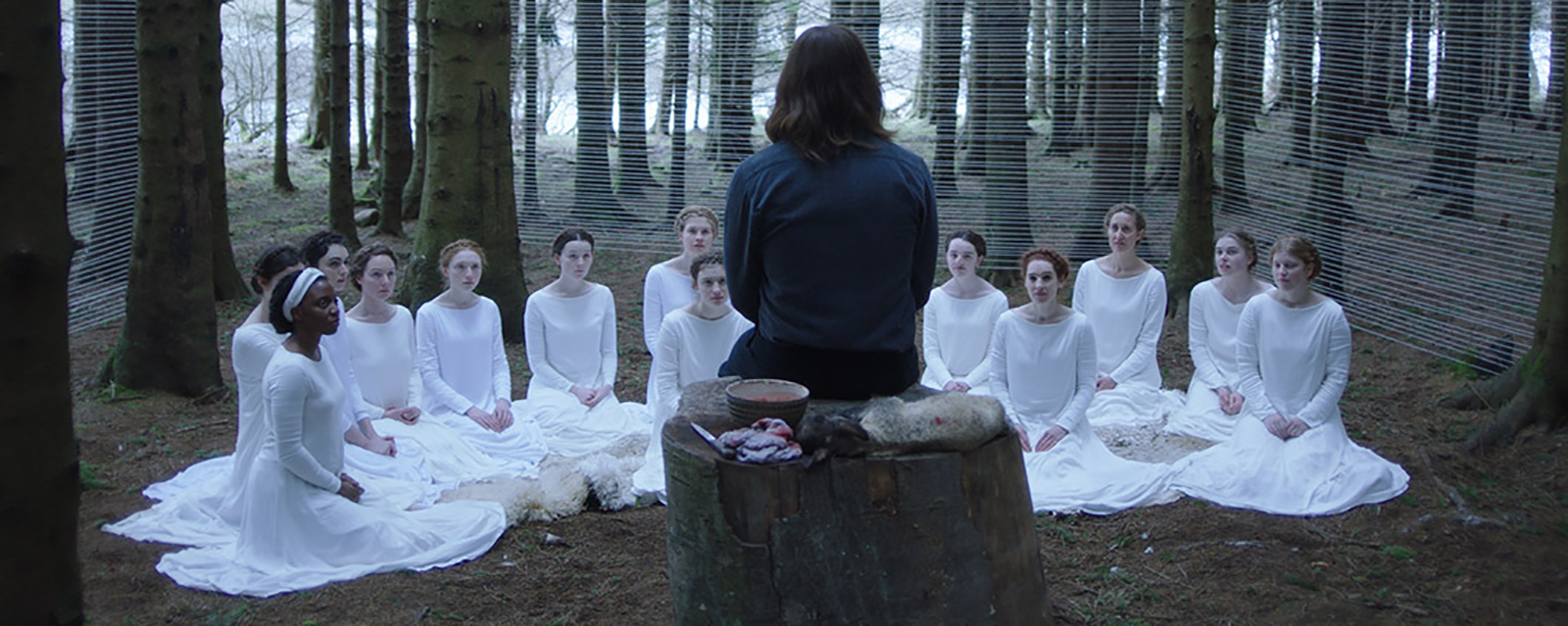
Writer C.S. McMullen and director Malgorzata Szumowska tell this one really well. Between McMullen’s outrage and the macabre lyricism of Szumowska’s camera, The Other Lamb offers a dark, angry and satisfying coming-of-age tale.

Selah’s (Raffey Cassity) first period and her commune’s migration to a new and more isolated Eden offer the tale some structure. Like many a horror film, The Other Lamb occupies itself with burgeoning womanhood, the end of innocence. Unlike most others in the genre, Szumowska’s film depicts this as a time of finding your own power.

The Other Lamb does not simply suggest you question authority. It demands that you do far more than that, and do it for your own good.

3. Gretel & Hansel

Sophia Lillis (IT) narrates and stars as Gretel, the center of this coming of age story—reasonable, given the change of billing suggested by the film’s title. The witch may still have a tasty meal on her mind, but this is less a cautionary tale than it is a metaphor for agency over obligation.

Alice Krige and her cheekbones strike the perfect mixture of menace and mentorship, while Sammy Leakey’s little Hansel manages to be both adorable and tiresome, as is required for the story to work.

Perkins continues to impress with his talent for visual storytelling and Galo Olivares’s cinematography heightens the film’s folkloric atmosphere.

There’s no escaping this spell. The whole affair feels like an intriguing dream.

2. The Lodge

Several Fiala and Veronika Franz follow up their creepy Goodnight Mommy with this “white death” horror that sees a future stepmom having a tough time getting to know the kids during a weeklong, snowbound cabin retreat. Riley Keough is riding an impressive run of performances and her work here is slippery and wonderful. As the unwanted new member in the family, she’s sympathetic but also brittle.

Jaeden Martell, a kid who has yet to deliver a less than impressive turn, is the human heartbeat at the center of the mystery in the cabin. His tenderness gives the film a quiet, pleading tragedy. Whether he’s comforting his grieving little sister or begging Grace (Keough) to come in from the snow, his performance aches and you ache with him.

There’s no denying the mounting dread the filmmakers create, and the three central performances are uniquely effective. Thanks to the actors’ commitment and the filmmakers’ skill in atmospheric horror, the movie grips you, makes you cold and uncomfortable, and ends with a memorable slap.

1. Swallow

Putting a relevant twist on the classic “horrific mother” trope, writer/director Carlo Mirabella-Davis uses the rare eating disorder pica to anchor his exploration of gender dynamics and, in particular, control.

Where Mirabella-Davis’s talent for building tension and framing scenes drive the narrative, it’s Bennett’s performance that elevates the film. Serving as executive producer as well as star, Haley Bennett transforms over the course of the film.

When things finally burst, director and star shake off the traditional storytelling, the Yellow Wallpaper or Awakening or even Safe. The filmmaker’s vision and imagery come full circle with a bold conclusion worthy of Bennett’s performance.

Living Deliciously

First Cow

by Hope Madden

Kelly Reichardt films tell a story, but not in the traditional Hollywood sense. She draws you into an alien environment, unveils universal humanity and shows you something about yourself, about us. There’s usually a story buried in there somewhere. In this case, it’s about two outsiders in 19th Century Oregon who find friendship.

And a cow.

Cookie (John Magaro) is a gentle soul, not properly built for the fur trade. (You saw The Revenant, right?) He’s a baker at heart, not that he gets to do much baking on a trapping expedition with hungry, volatile, hunt-weary men.

He holds no value for these men, and has nothing in common with them. But somehow he sees a kinship with the naked Chinese man he stumbles upon as he forages for mushrooms in the woods.

It’s sweet and sad the way Cookie and King-Lu (Orion Lee) fall into a relationship. King-Lu has ambitions. He opens Cookie’s eyes to opportunities he’d never had the courage to consider. Through these characters Reichardt demonstrates how fragile, lovely and heartbreaking hope can be.

Working again with regular collaborator Jonathan Raymond, whose novel the two adapted, Reichardt keeps you pulling for her heroes. The narrative lulls you with understated conversations and observations while the meticulously captured natural beauty onscreen beguiles. Within that, we see the potential of a young country through the eyes of Americans determining the dream.

Reichardt explores loneliness in all her films, the sense that we are each simply and inevitably alone, though we struggle against it regardless. This exploration isn’t hurried. It breathes. She emphasizes the longing for connection in every quiet moment with her characteristic use of lighting, the way she frames nature and the naturalistic performances she draws from Lee and Magaro.

William Tyler’s lonesome score offers something both mournful and tender, which is fitting. Although these men’s very existence in this place testifies to hardy ambition, Reichardt lingers on moments of gentle camaraderie.

When Kelly Reichardt tells a story, she breaks your heart. She does it slowly and quietly, but it’s broken nonetheless.

Battle Scars

Ghosts of War

by Hope Madden

Here’s the thing about horror movies in 2020: they have to one up 2020. This year itself is such a horror show, it’s hard for cinema to keep up.

Writer/director Eric Bress (The Butterfly Effect) does what he can with the supernatural war tale, Ghosts of War.

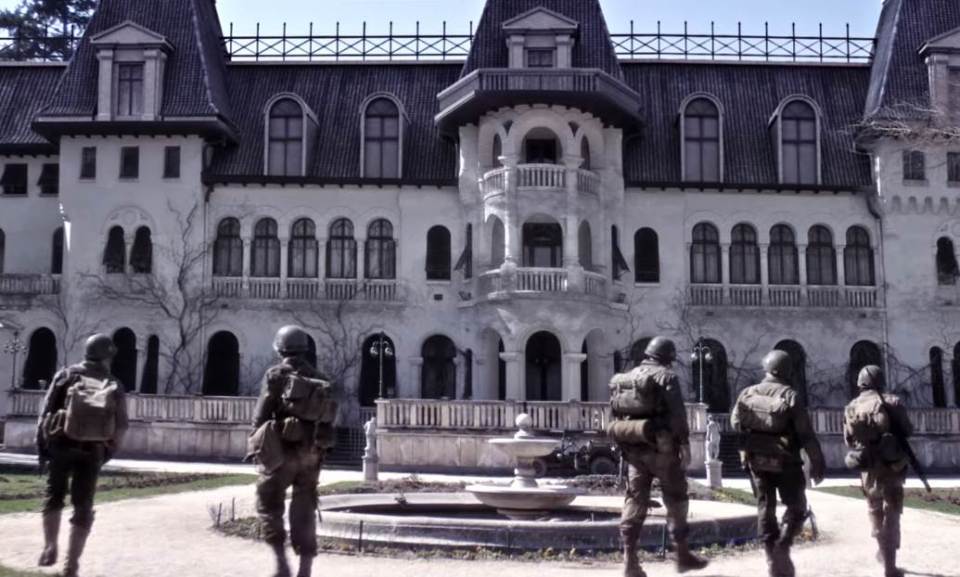
Five WWII soldiers are ordered to hold tight in a French mansion circa 1944. It’s an isolated estate, once a Nazi stronghold. Terrible things happened there, and even though the surroundings suggest luxury, the mission may be the most dangerous the platoon has ever faced.

It reminds me of that time earlier this year when COVID trapped a Bolivian orchestra inside a haunted German castle surrounded by wolves.

So the film has that to compete with. Of course, the other thing Ghosts of War has going against it is the surprisingly engaging and unfortunately underseen Overlord, a WWII horror show that drops us alongside a handful of soldiers into war torn France just in time to find zombies.

Very little is more fun than Nazi zombies.

But Bress isn’t interested in zombies. Instead, he explores the madness that weighs on men who’ve done the unthinkable by trapping them in a situation where they must face their demons.

Kyle Gallner delivers an appropriately haunted performance as one of the soldiers—each of whom Bress characterizes with quick, shorthand ideas: the nut job (Gallner), the smartypants (Pitch Perfect’s Skylar Astin), the hero (Theo Rossi), the big talker (Alan Ritchson), the leader who’s in over his head (Brenton Thwaites).

Gallner and Astin are the only cast members given the opportunity to differentiate themselves from the pack as the platoon stumbles upon evidence of the haunting. Bress and his ensemble stumble here, rarely developing any real dread, infrequently even delivering the jumps their quick cut scares attempt.

Ghosts of War makes an effort to say something meaningful. That message is waylaid by confused second act plotting and a third act reveal that feels far more lurid and opportunistic than it does resonant or haunting.

Bress tries to take advantage of the audience’s preconceived notions in order to subvert expectations, but he doesn’t have as much to say as he thinks.

Generational Terror

Relic

by Hope Madden

Many a film has used a building—a haunted house, for instance—to represent the mental state of a character. From Shirley Jackson to Stephen King to Daniel Kehlmann, writers have lured us into perfectly lovely structures only to hold us inside, our ugly thoughts manifesting as danger, our madness creating a labyrinthine, Escher-esque trap.

Such is the case for Relic, a compassionate but clear-eyed look at a different type of hereditary horror.

Edna (Robyn Nevin) has been missing for at least three days. Her daughter Kay (Emily Mortimer) and her granddaughter Sam (Bella Heathcote) move into Edna’s place to keep an eye out for her while local police investigate.

And then, there she is, and it’s entirely likely she never even left the house.

Well, that can’t be—unless there’s something seriously weird about this house.

Co-writer/director Natalie Erika James keeps her metaphor right at the surface of the film. That keeps Relic from ever truly terrifying, honestly. There’s no simultaneous pull that something supernatural is afoot. But the sense of dread takes on a whole new tenor, and the film’s horror is honest as it hits on an emotional level.

Nevin does an admirable job with Edna, creating a fully dimensional character, one who’s tough enough that when she becomes vulnerable, it comes as a jolt.

Mortimer and Heathcote strike a believable love/disappointment/blame balance and the emotional tug of war among the three women rings sadly true.

There’s not a lot of depth to this story. Relic isn’t hiding its themes—there are no subplots or red herrings, and the a-ha moments that allow Sam and Kay to piece together the mystery of Gram’s troubles feel almost perfunctory.

But James doesn’t shy away from the ugliness, guilt, anger or grief that fuel relationships tied up in this particularly painful genealogical horror. With its evocative analogy, Relic shows us what we are really afraid of, and it isn’t ghosts.

Unforgiving

The Outpost

by Hope Madden

Films concerning the US’s two decade war in Afghanistan have not managed to find much of an audience. I’m not sure Summer 2020—the year we welcomed meth gators as a needed distraction from our own personal hell—will improve those odds.

And yet, director Rod Lurie’s The Outpost bravely ventures to the streaming environment this week to remind us that a solid, understated war movie can still thrill.

The ensemble piece features Caleb Landry Jones and Scott Eastwood as two sides of a coin. Eastwood’s Staff Sgt. Clint (that’s right) Romesha is a born leader with quiet dignity, grit and a mind for strategy. Cynical of the Army’s “frat boy” culture, Jones’s Staff Sgt. Ty Carter doesn’t quite fit in.

Where doesn’t he fit in? A sitting duck army outpost situated at the basin of surrounding mountains where Taliban forces travel, watch and shoot.

Screenwriter Eric Johnson’s bread and butter has been teaming with Paul Tamasy to create the cinematic presentation of a true story. They nearly won an Oscar for Johnson’s first foray into feature length screenplays, David O’ Russell’s powerful The Fighter (with Scott Silver).

The duo join forces again, this time adapting Jake Tapper’s investigative book concerning one extraordinary battle in our war in Afghanistan.

Understatement works in the film’s favor, Lurie favoring overlapping dialog and naturalistic settings to bombast and a leading score. In fact, much of the film plays without a score, a refreshing change that gives The Outpost a grittier, more realistic feel that serves it well. Because truth be told, a true tale that delivers this amount of sheer will, courage, perseverance and spirit is undermined by flapping flags and swelling strings. Lurie’s restraint says, “This is really what happened. Can you effing believe that?!”

That’s not to say The Outpost eliminates every cowboy moment. Indeed, this may be the first role in which Eastwood makes the most of his famous last name, clearly channeling his father in a performance punctuated by controlled, hushed rage and squinting blue eyes.

But Caleb Landry Jones, as remarkable and versatile actor as you will find, is the broken soul of this film. Jones does “haunted” in a way that makes every other performance feel like a performance.

Together Lurie, his writers and his cast sidestep clichés, delivering instead a clear-eyed look at bravery, failure, and the cost of war.