Tag Archives: entertainment

Fright Club: The Law

The Law figures heavily in horror films. Most of them depict crimes. Bloody, bloody crimes. So, in many cases, the authorities must be brought in. And there are some outstanding genre films depicting a law enforcement officer as hero—Jaws and Slither spring to mind. They are also villains as often as bumbling side characters (we’re looking at you Inside and Last House on the Left).

Today we want to celebrate the films that dive into the police work, that focus squarely on The Law and its investigators. And, again, bloody, bloody crimes.

6. Baskin (2015)

Welcome to hell! Turkish filmmaker Can Evrenol invites you to follow a 5-man police squad into the netherworld, where eye patches are all the rage, pregnancy lasts well under the traditional 40 weeks, and you don’t want to displease Daddy.

The serpentine sequencing of events evokes a dream logic that gives the film an inescapable atmosphere of dread, creepily underscored by its urgent synth score. Evrenol’s imagery is morbidly amazing. Much of it only glimpsed, most of it left unarticulated, but all of it becomes that much more disturbing for its lack of clarity.

The further along the squad gets, the more often you’ll look in horror at something off in a corner, that sneaking WTF? query developing along with your upset stomach.

The central figures in this nightmare are one eye-patch wearing helper who enjoys tossing his or her hair over one shoulder, and the breathtaking father figure played by Mehmet Cerrahoglu. There is no one quite like him.

Cerrahoglu’s remarkable presence authenticates the hellscape. Evrenol’s imaginative set design and wise lighting choices envelope Cerrahoglu, his writhing followers, and his victims in a bloody horror like little else in cinema.

5. Se7en

Serpentine and dark as the sin it depicts, David Fincher’s Se7en marked him as a director willing to work your subconscious and take you to unseemly places. The film compares the strict and merciless justice of an old school God with the rotting corpse of NYC police work as two homicide detectives – one a grizzled veteran (Morgan Freeman), one a hot headed rookie (Brad Pitt) – try to keep up.

Fincher shrouds the mystery in some of the most memorably horrific images set to film. Who can forget that first victim, facedown in his spaghetti? How about Lust? “Get it off me! Get it off me!”

Let’s not even discuss Sloth. Still trying to recover from that, and the film came out in 1995.

Great performances and sleight of hand keep the story itself breathless as you work toward the now legendary climax.

What’s in the box?!!!

4. The Wailing

“Why are you troubled,” Jesus asked, “and why do doubts arise in your hearts? Look at my hands and my feet. It is I myself. Touch me and see — for a spirit does not have flesh and bones, as you see I have.”

Though the true meaning of this quote won’t take hold until the final act, it presents many questions. Is this film supernatural? Demonic? Or, given the corporeal nature of the quote, is it rooted in the human flesh?

Yes.

That’s what makes the quote so perfect. Writer/director Hong-jin Na meshes everything together in this bucolic horror where superstition and religion blend. The film echoes with misery, as the title suggests. The filmmaker throws every grisly thing at you – zombies, pustules, demonic possession, police procedural, multiple homicides – and yet keeps it all slippery with overt comedy.

3. I Saw the Devil (2010)

Min-sik Choi (Oldboy) plays a predator who picks on the wrong guy’s fiancé.

That grieving fiancé is a police investigator played by Byung-hun Lee (The Magnificent Seven), whose restrained emotion and elegant good looks perfectly offset Choi’s disheveled explosion of sadistic rage, and we spend 2+ hours witnessing their wildly gruesome game of cat and mouse.

Director Jee-woon Kim (A Tale of Two Sisters) breathes new life into the serial killer formula. With the help of two strong leads, he upends the old “if I want to catch evil, I must become evil” cliché. What they’ve created is a percussively violent horror show that transcends its gory content to tell a fascinating, if repellant, tale.

Beneath the grisly violence of this unwholesome bloodletting is an undercurrent of honest human pathos – not just sadism, but sadness, anger, and the most weirdly dark humor.

If you can see past the outrageously violent images onscreen, you might notice some really fine acting and nimble storytelling lurking inside this bloodbath.

2. Big Bad Wolves (2013)

A mixture of disturbing fairy tale and ugly reality, Israel’s Big Bad Wolves takes you places you really don’t want to go, but damn if it doesn’t keep you mesmerized every minute.

The particularly vulgar slaughter of several little girls sets events in motion. One teacher is suspected. One cop is driven. One father suffers from grief-stricken mania. It’s going to get really ugly.

Filmmakers Aharon Keshales and Navot Papushado (Rabies) implicate everyone, audience included. They create intentional parallels among the three men, pointing to the hypocrisy of the chase and making accusations all around of a taste for the intoxicating bloodlust that comes from dominating a weaker person.

Their taut and twisty script keeps surprises coming, but it’s the humor that’s most unexpected. Handled with dark, dry grace by Lior Ashkenazi (the cop) and Tzahi Grad (the father) – not to mention Doval’e Glickman (the grandfather) – this script elicits shamefaced but magnetic interest. You cannot look away, even when the blowtorch comes out. And God help you, it’s hard not to laugh now and again.

1. The Silence of the Lambs (1991)

It’s to director Jonathan Demme’s credit that Silence made that leap from lurid exploitation to art. His masterful composition of muted colors and tense but understated score, his visual focus on the characters rather than their actions, and his subtle but powerful use of camera elevate this story above its exploitative trappings. Of course, the performances didn’t hurt.

Hannibal Lecter ranks as one of cinema’s scariest villains, and that accomplishment owes everything to Anthony Hopkins’s performance. It’s his eerie calm, his measured speaking, his superior grin that give Lecter power. Everything about his performance reminds the viewer that this man is smarter than you and he’ll use that for dangerous ends.

Demme makes sure it’s Lecter that gets under our skin in the way he creates a parallel between Lecter and FBI investigator Clarice Starling (Jodie Foster). It’s Clarice we’re all meant to identify with, and yet Demme suggests that she and Lecter share some similarities, which means that maybe we share some, too.


Of a Feather

Birds of Passage

by Hope Madden

It’s difficult to imagine a fresh cartel story, a novel approach to the rise-and-fall arc of a self-made kingpin. And though scene after scene of Birds of Passage recalls that familiar structure, reminding you of what’s to come, you have never seen a film quite like this.

To begin with, directors Cristina Gallego and Ciro Guerra set this narco-thriller and its tale of the corrupting lure of luxury deep inside Colombia’s indigenous Wayuu culture. And though anyone who’s seen Scarface can guess how tides may turn for Rapayet (Jose Acosta), the entrepreneur at the heart of this saga, the tragic difference in this film is the way the same insidious rot destined to eat Rapayet alive also seeps into and destroys the Wayuu culture itself.

Spanning twenty years, Birds of Passage opens with Rapayet participating in a ritual, beautiful and peculiar. He proposes, but his gift is inappropriate – it’s a luxury, a thing. He’s already begun to lose touch with his roots, and yet he is determined to earn the dowry and his bride, Zaida (Natalia Reyes).

Rapayet straddles two existences, never truly fitting into either. He’s the bridge for the two ecosystems to meet, but Acosta’s performance is intriguing. Hardly the ambitious firebrand who builds an empire, he’s quiet and perhaps even weak, bringing an end to his culture accidentally, like an infected animal who doesn’t know what he’s brought home with him.

David Gallego’s cinematography renders an absurdly beautiful desolation, colors splashing and popping against bleached sandy neutrals. Naturalistic performances from the entire cast aid in the film’s authentic feeling, but the poetry of the directors’ use of long shots and the singing voiceover give Birds of Passage the tone of folklore.

It’s a fitting balance —the story itself being both intimate and epic. Like Guerra’s Oscar-nominated Embrace the Serpent, this film again examines the moment when an indigenous people watch the death of their culture in favor of something more globally acknowledged and yet clearly inferior.

I Don’t Want to Go Out—Week of March 11

Man, remember the boon of movies released for home viewing last week?! Well, don’t get greedy, I guess. This week contains a fun little psycho-sexual thriller plus two bloated SciFi blunders. Here is the skinny.

Click the film title for the full review.

Piercing

Fantastic Beasts: The Crimes of Grindewald

Mortal Engines

Screening Room: Captain Marvel, Apollo 11, Hole in the Ground, I’m Not Here

Big week in theaters and crowded week in home entertainment. In this week’s Screening Room we talk (spoiler free!) about Captain Marvel, Apollo 11, The Hole in the Ground and I’m Not Here. Then we hit the lobby to give you a sense of what’s worth your while in home video.


Listen to the full podcast HERE.

Visions of the Past

I’m Not Here

by Brandon Thomas

Loss, regret and redemption permeate people’s lives. We all have those things we wish we could “do over” — a life mulligan, if you will. It’s a universal fantasy that binds us together as human beings. This idea of redemption, or at least the understanding of one’s mistakes, is right at the muddled heart of I’m Not Here.

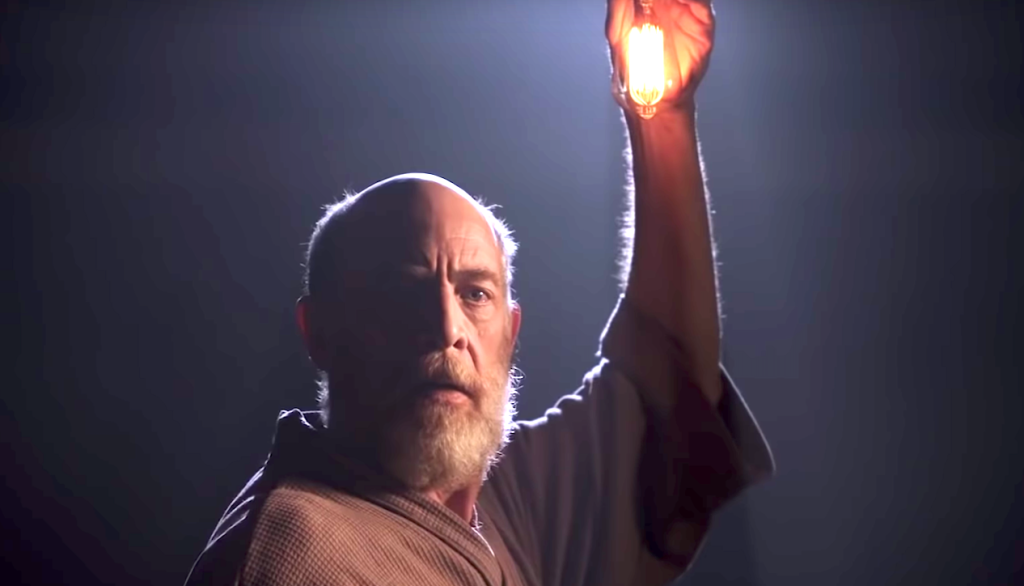
Steven (J.K. Simmons) is a shell of a man. He drinks too much, lives in squalor and has distanced himself from his remaining family. Through a rotating series of flashbacks, we’re introduced to Steven as a boy dealing with the complexities of his parents’ divorce, and also as a young man (Sebastian Stan) who has just started to make his own life-altering missteps. For present-day Steven, a phone call delivering upsetting news brings all of his past trauma to the surface.

I’m Not Here is frustrating. Its cast is more than capable of knocking this kind of material out of the park, but they are hobbled by a poor script and weak direction. Simmons fares best as his segments are solo and allow him to channel the intensity that’s he’s so well known for. The rest of the cast, including Stan, Maika Monroe and Mandy Moore, get bogged down by the cliche-ridden script. The lack of subtlety, especially in the flashback segments, undermines the emotional wallop of grief and loss that director Michelle Schumacher is trying to convey.

Schumacher’s handling of the material is scattershot. The present day scenes involving Simmons show a confidence that isn’t replicated in the flashbacks. The present day material has a more natural flow that lets the audience settle into Steven’s world of loneliness and self-pity. The darkness of his home mirrors the darkness of his life. On the other hand, the flashbacks offer hazy, overlit scenes that wouldn’t be out of place on CBS’s prime time schedule.

Casting Steven as the ultimate Unreliable Narrator is perhaps I’m Not Here’s greatest strength. His unwillingness to come to terms with his choices have clouded his memories with excuses. Steven’s memories cast him as a victim with only slivers of truth peeking through.

I’m Not Here has the foundation for a complex look at how tragedy and grief shape us, but it doesn’t have the follow-through. This one is not worth remembering.

https://youtu.be/sYDwdCdXCOM

Swallowed Whole

The Hole in the Ground

by Hope Madden

About a month ago the film The Prodigy came out, and promptly disappeared. Lee Cronin’s Irish horror The Hole in the Ground treads similar territory: a mother looks at her young son and wonders with terror who it is she sees.

Where Prodigy took the path most ludicrous, Cronin mines a parent’s disappointment, grief, loneliness and alienation for more poignant results.

Sara (Seána Kerslake), along with her bib overalls and young son Chris (James Quinn Markey), are finding it a little tough to settle into their new home in a very rural town. Chris misses his dad. Sara is having some life-at-the-crossroads anxiety.

Then a creepy neighbor, a massive sink hole (looks a bit like the sarlacc pit) and Ireland’s incredibly creepy folk music get inside her head and things really fall apart.

I grew up listening to nothing but Irish music. If you don’t think it’s creepy, you aren’t listening properly.

In execution, The Hole in the Ground is less The Prodigy and more of a cross between the masterpiece of maternal grief, The Babadook, and another Irish horror of changelings and woodland spirits, The Hallow. (Plus a surprise third act inspiration I won’t mention for fear of spoilers.)

You look at your child one day and don’t recognize him or her. It’s a natural internal tension and a scab horror movies like to pick. Kids go through phases, your anxiety is reflected in their behavior, and suddenly you don’t really like what you see. You miss the cuter, littler version. Or in this case, you fear that inside your beautiful, sweet son lurks the same abusive monster as his father.

Cronin’s subtext never threatens his story, but instead informs the dread and guilt that pervade every scene. Performances are quite solid and the way folklore – in tale and in song – is woven through the story creates a hypnotic effect.

If you’re a horror fan looking to celebrate the season, here’s a more authentic way to do it than watching Leprechaun for the 15th time.

I Don’t Want to Go Out—Week of March 4

Dayumm there are a lot of movies available for home viewing this week! Oscar winners, foreign gems, underseen treasures, underappreciated family films, and also Aquaman. So much! Let us help you sort through it all.

Click the film title for the full review.

The Favourite

https://www.youtube.com/watch?v=rJl36o_tq_c

Thunder Road

Burning

Free Solo

Ben Is Back

Vox Lux

Aquaman

Creed II

Green Book

Instant Family

Screening Room: Greta, A Madea Family Funeral

Captain Marvel is still a week out, which makes for a pretty quiet weekend at the box office. Join us as we run down the highs and lows: Greta, A Madea Family Funeral plus all that’s fit to watch in new home entertainment.


Listen to the full podcast HERE.

A Friend in Need

Greta

by Hope Madden

Greta is a mess, and I don’t just mean the character.

In fact, I’m not sure the character is a mess at all, no matter how she hopes to fool you. Played by the inimitable Isabelle Huppert, the titular friend in need is, in fact, a crackpot. She’s a force to be reckoned with, and poor, wholesome Frances (Chloe Grace Moretz) doesn’t seem up to the reckoning.

A Midwestern transplant still grieving the loss of her mother, Frances lives in an irredeemably perfect New York apartment with her debutante bestie (Maika Monroe), but she feels a little untethered in the big city without her mom to call.

Enter Greta, the lonely older woman whose handbag Frances finds on the subway train and returns.

Director Neil Jordan hasn’t shot a feature since his underappreciated 2012 vampire fantasy, Byzantium. Here he shares writing duties with Ray Wright, who’s made a career of outright reboots and overt reworkings.

Like maybe Fatal Attraction with mommy issues.

There are elements to appreciate about Greta. Huppert is superb, her performance becoming more unhinged and eventually comical in that Nic Cage sort of way. Her time onscreen is creepy fun.

Moretz’s fresh-faced grief convinces for a while, and Monroe excels in an absolutely thankless role.

So what’s the problem? Well, number one, are we really afraid of this tiny, frail old lady?

No. We are not. Jesus, push her down already. I get it, you’re polite, but come on. I’m Midwestern and I’d have knocked her under a NYC taxi by now.

The terror is so unreasonable and yet so earnestly conveyed that scenes meant to be tense are comedic, and once you start laughing it’s hard to stop.

In fact, the sound of your own guffaws might distract you from the film’s truly breathtaking leaps of logic. It often feels as if whole reels were chunked out of this film and replaced with unconnected scenes from a private detective TV drama—one in which Stephen Rea’s dialog is inexplicably and unconvincingly dubbed.

What on earth?!

Well, par for the course with this film. It opens strong, develops well and relies on Huppert’s supernatural presence to create palpable tension before going entirely off the rails.

I Don’t Want to Go Out—Week of February 25

The best animated film of 2018 swings into your living room this week, along with (if you’re smart) an instant cult classic. Other biggies of 2018 make their way home this week, so let us help you sort this out.

Click the title for the full review.

Spider-Man: Into the Spider-Verse

Border

Ralph Breaks the Internet

Mary Queen of Scots

The Possession of Hannah Grace