Unwanted Guests

Under the Shadow

by Hope Madden

A few years back, Aussie filmmaker Jennifer Kent unleashed the brilliant and devastating single parent nightmare, The Babadook. As much subtext as text, the film vibrated with the anxiety of a parent torn between resentment and the powerful fear that something demonic might harm her only child.

Fast forward two years, and first-time feature filmmaker, Iranian Babak Anvari, treads familiar ground yet manages to shift focus entirely and create the profound and unsettling Under the Shadow.

Here the social commentary sits even closer to the surface. The tale is set in Tehran circa 1988, at the height of the Iran/Iraq war and just a few years into the “Cultural Revolution” that enforced fundamentalist ideologies.

Shideh (a fearless Narges Rashidi) has been banned from returning to medical school because of her pre-war political leanings. Her husband, a practicing physician, is serving his yearly medical duty with the troops. This leaves Shideh and their young daughter Dorsa (Avin Manshadi) alone in their apartment as missiles rain on Tehran.

What begins as a domestic drama suitable for fellow Iranian filmmaker Asghar Farhadi (A Separation) turns slowly into something else entirely as Anvari dips into the horror trope toolbox to shake up our expectations with familiar devices.

When a dud missile plants itself in the roof of the building (shades of del Toro’s Devil’s Backbone), Dora starts talking to a secret friend. Maybe the friend would be a better mommy.

Frazzled, impatient, judged and constrained from all sides, Shideh’s nerve is hit with this threat. And as external and internal anxieties build, she’s no longer sure what she’s seeing, what she’s thinking, or what the hell to do about it.

The fact that this menacing presence – a djinn, or wind spirit – takes the shape of a flapping, floating burka is no random choice. Shideh’s failure in this moment will determine her daughter’s entire future.

Anvari casts the political climate meticulously, as forces beyond Shideh’s control – some supernatural, some cultural, all dangerous – surround her.

Though the strength of the cultural context sometimes undercuts the spookiness of the ghost story being told, Under the Shadow builds a strong case for itself as a horror film. Bursts of creepy imagery punctuate the increasingly tense atmosphere. It’s here that Anvari’s film is most effective, as you realize Shideh is better off dealing with ghouls than turning to neighbors or authorities for help.

Verdict-4-0-Stars

Zombie Eat World

The Night Eats the World

by Hope Madden

People like to make lists. For some people, it’s a bucket list. Some like to keep track of the celebrities they are allowed to sleep with if the opportunity arises. Not me.

Years ago I put together my zombie survival team. And though I know plenty of people with varied and worthy skills, making my team mainly came down to two things. Are you smart? Are you quiet? Because it is the introverts of the world who will survive the zombie apocalypse.

Director Dominique Rocher’s unusually titled The Night Eats the World understands this.

Sam (Anders Danielsen Lie) reluctantly stops by his ex’s party to collect his things. It is a loud, raucous event and Sam is in no mood. He stands moping alone until finally he wanders into a quiet back office, locks the door to the partygoers and waits.

By morning, Sam may be the only living human left in Paris.

The majority of the film quietly follows Sam through the apartment building as he fortifies his position, spends his time, survives. It’s a pleasantly pragmatic approach to the zombie film, although it asks many of the same questions Romero asked in Dawn of the Dead.

In fact, TNETW sometimes bears an amazing resemblance to the underseen German zombie flick Rammbock: Berlin Undead. (It’s great. You should see it.)

There’s a lot going on here that’s fresh, though. Rarely is a zombie film this introspective or a horror hero this thoughtful. More than that, though, Rocher’s horror is a meditation on loneliness.

Not only is that an unusual topic for horror, it’s delivered with the kind of touching restraint that’s almost inconceivable in this genre.

Danielsen Lie, in what nearly amounts to a one-man-show, never lets you down and never feels showy. Sam is a man who is maybe too at home with the situation in a film that quietly asks, just what has to happen before a true introvert longs for human companionship?

That’s why they’ll outlast us. It’ll just be a few dozen socially uncomfortable loners skilled at closing themselves off from the chaos around them. Plus Keith Richards.

Blood on the Tracks

Saint Frances

by Hope Madden

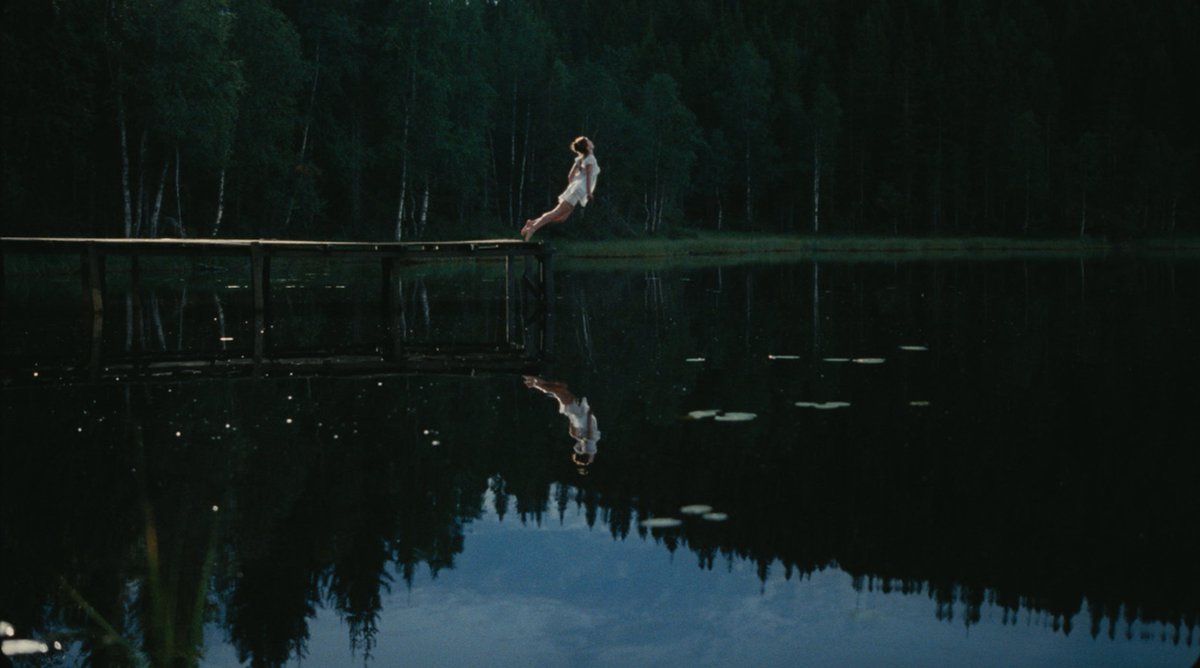
Candid. Messy. Bloody, even. There are a number of adjectives you could use to describe Saint Francis, an indie dramedy from director Alex Thompson and writer/star Kelly O’Sullivan. Precious is not one of them.

That fact in itself is maybe victory enough given that the film concerns a lost, underachieving millennial (“I’m on the cusp!”) who finds her way with the help of the 5-year-old (Ramona Edith Williams, unreasonably cute) she nannies over the summer.

That could have been a recipe for precocious, heartstring-tugging disaster. I can say without reservation that Saint Frances is not that. There’s definitely too much menstrual blood and abortion humor, first of all.

For the bulk of the film, Bridget (O’Sullivan) is a terrible person, a selfish fuck up, which makes Saint Frances groundbreaking in its own way. It’s so uncommon, the Peter Pan effect as embodied by a female. They always make us Wendys.

O’Sullivan’s version is never the uproarious riot of Amy Schumer’s Trainwreck, or the introspective yet raucous Obvious Child. And while comparisons to those two crowd pleasing genre busters are clear, Saint Frances really is its own beast—one that abandons formula in favor of often unpleasant reality and a sometimes delightful mean streak.

O’Sullivan—both as writer and as lead—brings a kind of deadpan wisdom to the already well-worn idea of directionless adult forced to face adulthood by a spunky youngster. Part of the film’s glory is its very untidiness, both structural and visual.

Thompson, showing solid instincts with his feature debut, does cave once or twice to overt convention (let’s call it “the juice box montage”), and the unstoppably supportive Jace (Max Lipchitz) is less a character than he is a vehicle for growth.

Still, for raw, sloppy honesty, you’re not likely to find a better candidate.

St. Pat’s Movie Ideas

Okay, so we can’t go out to get our Irish on this year. Here are some great ideas for celebrating at home!

Song of the Sea (2014)

This Academy Award nominated watercolored dream mixes modern day with Irish folklore to spin the yarn of a wee selkie and the brother who begrudgingly loves her. Magical, sweet, charming and funny, it’s a treat parents will enjoy at least as much as their kids. It should have won the Oscar.

The Secret of the Kells (2009)

Pair it with director Tomm Moore’s first Oscar nominee, the gorgeous Celtic poem The Secret of Kells. Moore’s talent for blending everyday challenges with ancient magic is again at work as we shadow young Brendan through the riotous color and animated details of the enchanted forest outside the medieval abby where he lives. It’s another visually stunning bit of animation that’s as compelling to adults as it is to children.

Knuckle (2011)

James Quinn McDonagh cuts an enigmatic presence through the bloody world of Irish Traveler bare knuckle “fairfights” in Ian Palmer’s documentary Knuckle. The unbeaten pride of the Quinn McDonaghs, James takes on challengers from the feuding Joyce clan. Unfortunately, each win quells the action only briefly, as family members’ chest thumping and boasting reignite the feud, and another challenge is made. Palmer aims to illustrate the culture that fuels rather than overcomes its grudges, due in equal measure to unchecked bravado and finance (wagers bring in fast money for the winning clan). Filming for more than a decade, Palmer uncovers something insightful about the Traveler culture, and perhaps about masculinity or warmongering at its most basic.

The Guard (2011)

Then to a lighthearted look at drugs and crime on the Emerald Isle. Writer/director John Michael McDonagh assembles a dream cast anchored by the ever-reliable Brendan Gleeson to wryly articulate a tale of underestimation and police corruption in this very Irish take on the buddy cop movie. Through Gleeson, McDonagh shares a dark, philosophical yet silly humor, crafts almost slapstick action, and offers a view of hired guns as workaday folk. The Guard is a celebration of tart Irish humor and character; the actual plot merely provides the playground for the fun.

https://www.youtube.com/watch?v=tKU_9PlNomk

Calvary (2014)

McDonagh and Gleeson return three years later in Calvary. The endlessly wonderful Gleeson plays Fr. Michael, a dry-witted but deeply decent priest who has a week to get his affairs in order while a parishoner plans to kill him. Sumptuously filmed and gorgeously written, boasting as much world-weary humor as genuine insight, it’s an amazing film and a performance that should not be missed.

Once (2006)

You can’t celebrate St. Pat’s without some music. In Once, an Irish street musician fixes vacuums by day and dreams of heading to London in search of a recording contract. His unpredictable relationship with a Czech immigrant becomes the needed catalyst. Writer/director John Carney creates a lovely working man’s Dublin in a film blessed with sparkling performances from heretofore unknown leads Glen Hansard and Marketa Irglova. Their chemistry and their music are the heart of the film. This immensely charming slice of life picture, superbly crafted with tender realism, also boasts an honest, understated screenplay, and undoubtedly the best soundtrack of 2006.

https://www.youtube.com/watch?v=FWJIylZ8VyM

The Commitments (1991)

Jimmy Rabbitte intends to manage the greatest soul band in the world, so he hand crafts The Commitments, a Dublin-based, all white, blue collar soul band the likes of which Ireland has never seen. (The band includes Hansard again, much younger and with a magnificent ‘fro.) Alan Parker’s “behind the music” style tale of the rise and fall of a band is as charming, energetic and great sounding a way to spend St. Patrick’s Day as you will find.

Fright Club: Bad Doctors in Horror

As we salute the tireless work of our great doctors and health care workers during this uneasy time, Fright Club looks at our favorite “bad doctors” in horror!

5. Herbert West, Re-Animator (1985)

Stuart Gordon’s Re-Animator reinvigorated the Frankenstein storyline in a decade glutted with vampire films. Based, as so many fantasy/horror films are, on the work of H. P. Lovecraft, Re-Animator boasts a good mix of comedy and horror, some highly subversive ideas, and one really outstanding villain.

Jeffrey Combs, with his intense gaze and pout, his ability to mix comic timing with epic self righteousness without turning to caricature, carries the film beginning to end. His Dr. Herbert West has developed a day-glo serum that reanimates dead tissue, but a minor foul up with his experimentations – some might call it murder – sees him taking his studies to the New England medical school Miskatonic University. There he rents a room and basement laboratory from handsome med student Dan Caine (Bruce Abbott).

They’re not just evil scientists. They’re also really bad doctors.

Re-Animator is fresh. It’s funny and shocking, and though most performances are flat at best, those that are strong more than make up for it. First-time director Gordon’s effort is superb. He glories in the macabre fun of his scenes, pushing envelopes and dumping gallons of blood and gore. He balances anxiety with comedy, mines scenes for all they have to give, and takes you places you haven’t been.

4. Beverly and Elliot Mantle, Dead Ringers, (1988)

This film is about separation anxiety, with the effortlessly melancholy Jeremy Irons playing a set of gynecologist twins on a downward spiral. Writer/director David Cronenberg doesn’t consider this a horror film at all. Truth is, because the twin brothers facing emotional and mental collapse are gynecologists, Cronenberg is wrong.

Take, for instance, the scene with the middle aged woman in stirrups, camera on her face, which is distorted with discomfort. Irons’s back is to the screen, her bare foot to his left side. Clicking noises distract you as the doctor works away. We pan right to a tray displaying the now-clearly-unstable doctor’s set of hand-fashioned medical instruments. Yikes.

Irons is brilliant, bringing such flair and, eventually, childlike charm to the performances you feel almost grateful. The film’s pace is slow and its horror subtle, but the uncomfortable moments are peculiarly, artfully Cronenberg.

https://www.youtube.com/watch?v=zhPeVnz0NvI

2. Dr. Heiter, The Human Centipede (First Sequence) (2009)

After a handful of middling Dutch comedies, Tom Six stumbled upon inspiration – 100% medically accurate inspiration. Yes, we mean the Human Centipede. Just the First Sequence makes the list, though.

For a lot of viewers, the Human Centipede films are needlessly gory and over-the-top with no real merit. But for some, Six is onto something. His first effort uses a very traditional horror storyline – two pretty American girls have a vehicular break down and find peril – and takes that plot in an unusual direction. But where most horror filmmakers would finish their work as the victims wake up and find themselves sewn together, mouth to anus, this is actually where Six almost begins.

Although the film mines something primal about being helpless in the hands of surgeons and doctors, it’s Dieter Laser and his committed, insane performance that elevates this film. That and your own unholy desire to see what happens to the newly conjoined tourists.

https://www.youtube.com/watch?v=tPBdEa5tjR4

2. Dr. Genessier, Eyes Without a Face (1960)

The formula behind this film has been stolen and reformulated for dozens of lurid, low-brow exploitation films since 1960. In each, there is a mad doctor who sees his experiments as being of a higher order than the lowly lives they ruin; the doctor is assisted by a loyal, often non-traditionally attractive (some might say handsome) nurse; there are nubile young women who will soon be victimized, as well as a cellar full of the already victimized. But somehow, in this originator of that particular line of horror, the plot works seamlessly.

An awful lot of that success lies in the remarkable performances. Pierre Brasseur, as the stoic surgeon torn by guilt and weighed down by insecurities about his particular genius, brings a believable, subtle egomania to the part seldom seen in a mad scientist role.

Still, the power in the film is in the striking visuals that are the trademark of giant French filmmaker Georges Franju. His particular genius in this film gave us the elegantly haunting image of Dr. Genessier’s daughter Christiane (Edith Scob). Her graceful, waiflike presence haunts the entire film and elevates those final scenes to something wickedly sublime.

1. Hannibal Lecter, The Silence of the Lambs (1991)

Who else but Hannibal the Cannibal?

Anthony Hopkins’s eerie calm, his measured speaking, his superior grin give Lecter power. Everything about his performance reminds the viewer that this man is smarter than you and he’ll use that for dangerous ends. He’s toying with you. You’re a fly in his web – and what he will do to you hits at our most primal fear, because we are, after all, all part of a food chain.

When Your Game’s on Ice

Goon

by George Wolf (originally published 4/12/2012 in The Other Paper)

It’s rude, it’s crude, it’s vulgar, crass and brutal. And I enjoyed the hell out of Goon.

Should Mom be worried?

It’s also a sports movie, full of all the usual cliches. Credit the sheer joy of the filmmakers, then, for the way it entertains its way right through them. These guys are childish, sure, but they’re also funny, and smart enough to celebrate their sport with a reckless abandon that becomes infectious.

The script, based on a book about the exploits of former hockey enforcer Doug Smith, comes courtesy of Evan Goldberg (co-writer of Superbad) and Jay Baruchel (star of She’s Out of My League). It follows the heroic rise of lovable Doug Glatt (Seann William Scott, from the American Pie series), a bar bouncer whose face-punching skills earn him a new career as a minor league “goon.”

Doug’s an outcast in his well-to-do family, and a bit of a simpleton with a gentle soul, at least until it’s go time. Scott, who’s made a living being funny and likable regardless of the material, breaks out of his “Stifler” persona with a fine performance. He’s most effective when opposite Liev Schreiber, menacingly good as an aging goon on the way out.

Throw in able support from Alison Pill as Doug’s possible girlfriend, and Sons of Anarchy‘s Kim Coates as the coach, and there’s some actual acting to be found here among all the dick jokes and flying teeth.

Goldberg, Baruchel and director Michael Dowse revel in the locker room antics and on-ice brutality. Through it all, they’re also sly enough to cast a satirical glance in the direction of the “fighting is ruining the sport” crowd.

Maybe nothing can replace the Hanson Brothers and their suitcase full of toys from Slap Shot, but Goon gives a new generation a bawdy hockey flick to call its own.

Saturday Screamer: Carriers

Carriers (2009)

by Hope Madden

Chris Pine plays against type in this 2009 pandemic horror currently streaming on most platforms including Netflix.

Pine plays Brian, a hardened young man who believes he may be immune to the virus that has decimated the global population. But, just to be safe, he chalks his survival up to a handful of rules he keeps. He also enforces these rules with three fellow survivors: his girlfriend Bobby (Piper Perabo), his little brother Dany (Lou Taylor Pucci), and Danny’s friend Kate (Emily VanCamp).

Following Brian’s rules to the letter (or else), the four cross the country in search of the childhood vacation destination the boys feel sure is a safe, quiet place to ride out the apocalypse.

Writers/directors/brothers David and Alex Pastor tread some familiar territory here, but their even-handed approach and ear for authentic relationships make for an involving and ultimately moving horror. Character behaviors rarely challenge believability, and the performances suit characters who’ve been dealing with this problem and with each other longer than the audience is aware.

There’s a natural pull between Danny and Bobby: the desire to just survive and the dread of surviving alone, a reluctance to do the wrong thing and yet an even stronger reluctance to wind up the sole survivor.

Character relationships have a real lived-in quality, which gives the film an emotional heft you may not be ready for. Pine, in particular, excels in a role quite unlike those he’s more famous for.

The body horror is effective, but it’s not the real source of horror.

As in all outbreak/infestation/apocalyptic flicks from the earliest Romero to the upcoming Quiet Place 2, this film understands that desperate humans are at least as dangerous as the cause of the pandemic. Interestingly, run-ins with other survivors, both the good and the bad kind, are played in Carriers with a real mixture of terror and sympathy. It’s one of the many reasons that the film delivers a harder emotional punch than you might be expecting.

Hope Madden and George Wolf … get it?