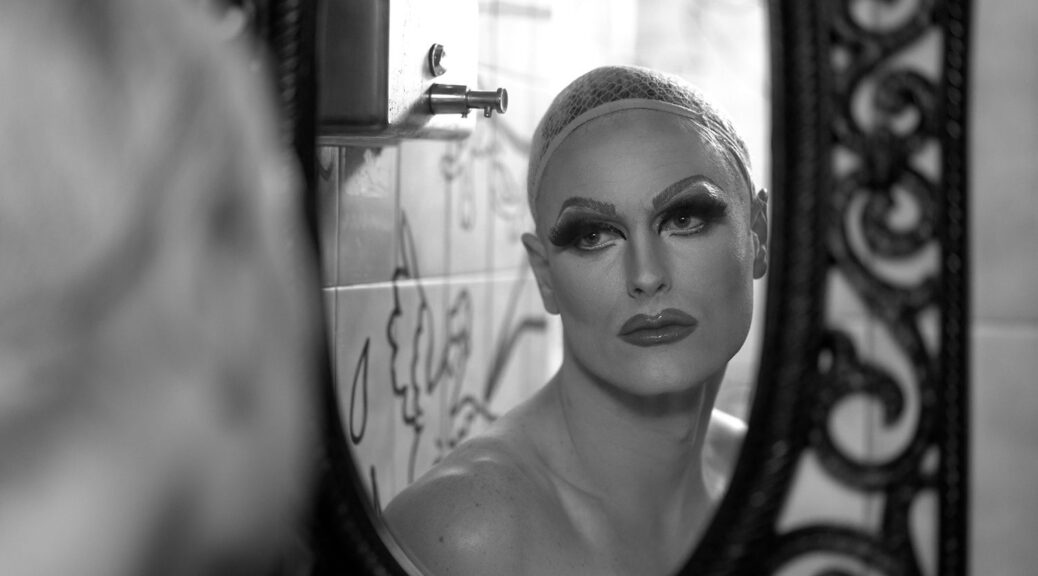
Judy (Todd Flaherty) and his partner Chrissy (Wyatt Fenner) are co-stars of an underwhelming New York drag act. Then, Chrissy up and quits and moves to the hinterlands of Philadelphia to make a go of it with his on-again-off-again long-distance boyfriend Shawn, leaving behind the remains of a humdrum double act.
Judy, still ambitious, but now 30 and feeling out of step with the young, struggles to choreograph the next act in their life.
Judy is obsessed with nostalgia and the vintage glamor of old Hollywood, so it’s fitting that the film itself is beautifully shot in black and white and scored in a mix of old standards and jazz. The dialogue often harkens back to the fast-talking banter of old screwball comedies, updated with modern slang, a lot more cursing, and the occasional references to douching.
Written, directed, edited, produced by AND starting Flaherty, there’s a real emotional depth to this one. Flaherty and Fenner manage to convey the complex layers of a long-term and somewhat complicated friendship.
Avoiding the heteronormative tropes of typical romantic movies, this one feels like part rom-com, part coming-of age while offering a novel take on a love story.
An encounter with a wild blue grouper sends 8-year-old Abby on a lifelong mission to understand, and save, the ocean ecosystem in writer/director Robert Connolly’s feature, Blueback.
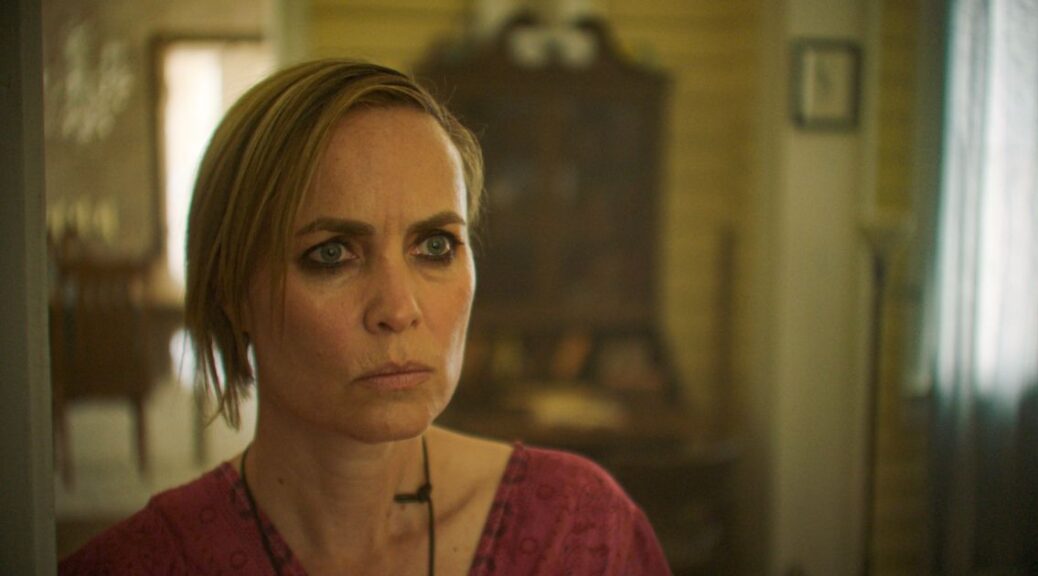
We follow Abby through three stages of her life. The first – and shortest – at age 8 is precociously played by Ariel Donoghue. Teenage Abby, played by Isla Fogg, is who we spend the most time with as she reconciles her love of the ocean with her mom, Dora’s (Radha Mitchell), overt activism. A contemporary framing story follows the adult Abby (Mia Wasikowska) as a marine biologist who returns home after Dora (the older version portrayed by Elizabeth Alexander) suffers a stroke.
On paper, this seems like a lot to contend with, but Connolly handles each stage well, ping-ponging primarily from adult Abby and teenage Abby with a skillful touch. There’s never any confusion as to where we are in time, as both Fogg and Wasikowska cement us with the character (as do Mitchell and Alexander with Dora). Both depictions are so strong as to convince us that we’re watching the same woman across time.
The movie’s biggest problem is overstuffing the scenes of teenage Abby’s life, leaving too little time for both the framing story, and the fish that gives the film its name. Though Eric Bana is a fine actor, his character Macka feels extraneous. There are other characters with whom our time is better spent.
Because we spend so little time with the grouper, there’s never the sense that we’re connecting with an animal in the way other films showcase the human-animal bond. It’s possible it’s simply hard to make a girl and her fish land the same way as a boy and his dog, though I imagine those who saw My Octopus Teacher might beg to differ.
Despite the film’s tendency to take on a little too much regarding its worldbuilding, it’s still an effective exploration of family and community, and how we relate to the natural world. There are those who seek to exploit it for everything it’s worth, while others wish to preserve it for future generations.
There’s a sense that for each piece of the world we lose, more than we can ever imagine is lost along with it. Abby and Dora hope to preserve that which connects us to something bigger than ourselves. The theme is always one worth repeating, and Blueback adds a unique perspective to the mix.
One of the most criminally underseen horror treasures of the 2000s has been restored and re-released, and you really should take advantage.
A paranoid fantasy about the link between progress and emasculation, Calvaire sees a timid singer stuck in the wilds of Belgium after his van breaks down.
Writer/director Fabrice Du Welz’s script scares up the darkest imaginable humor. If David Lynch had directed Deliverance in French, the concoction might have resembled Calvaire. As sweet, shy singer Marc (a pitch-perfect Laurent Lucas) awaits aid, he begins to recognize the hell he’s stumbled into. Unfortunately for Marc, salvation’s even worse.
The whole film boasts an uneasy, “What next?” quality. It also provides a European image of a terror that’s plagued American filmmakers for generations: the more we embrace progress, the further we get from that primal hunter/gatherer who knew how to survive.
Du Welz animates more ably than most our collective revulsion over the idea that we’ve evolved into something incapable of unaided survival –the weaker species, so to speak. Certainly, John Boorman’s Deliverance (the Uncle Daddy of all backwoods survival pics) understood the fear of emasculation that fuels this particular dread, but Du Welz picks that scab more effectively than any filmmaker since.
His film is a profoundly uncomfortable, deeply disturbing, unsettlingly humorous freakshow that must be seen to be believed.
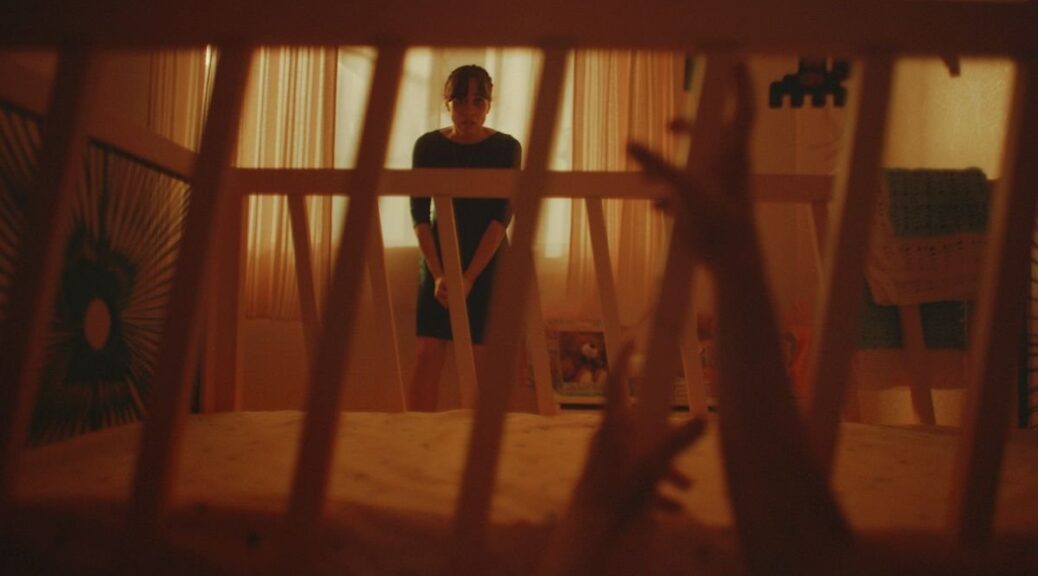
As Huesera: The Bone Woman opens, women climb the 640 steps leading to the world’s largest statue of the Virgin of Guadalupe, located in Ocuilan, Mexico. Valeria (Natalia Solián) and her mother are among the pilgrims, their goal: a blessing leading to Valeria’s fruitful womb.
As writer/director Michelle Garza Cervera’s camera pulls back and back and back, suddenly the 108’ virgin looms like a serene-faced golden Godzilla above a woman who no longer looks so certain about her prayer.
It’s a confident opening to the entirely assured feature debut from Cervera. Her maternal nightmare is bright and decisive, pulling in common genre tropes only long enough to grant entrance to the territory of a central metaphor before casting them aside for something sinister, honest and honestly terrifying.
While it toes certain familiar ground – the gaslighting of Rosemary’s Baby, for instance – what sets Huesera apart from other maternal horror is its deliberate untidiness. Cervera refuses to embrace the good mother/bad mother dichotomy and disregards the common cinematic journey of convincing a woman that all she really wants is to be a mom.
There’s complexity and subtlety in the various relationships as well, elevating the material above standard horror fare. Valeria has real, joyous chemistry with husband Raúl (Alfonso Dosal). And if he’s weak in the face of his mother’s wishes, Valeria is hardly standing up to her own mother or sister. The ways in which we all dodge family conflict feed into the writing, helping ground the larger metaphor in reality.
Solián’s performance weaves effortlessly and authentically from one family dynamic to the next, each presenting only opportunities to submit, to accept or to be ostracized and rejected. Huesera’s metaphor is brave and timely. Brave not only because of its LGBTQ themes but because of its motherhood themes. It’s a melancholy and necessary look at what you give up, what you kill.
“What can we do that we are not already doing? Do we have a duty, a responsibility as individuals, to do something? Anything? And how do we know what to do?”
These words from Jan Karski, reluctant World War II hero and Holocaust witness, transcend the specific horrors Karski struggled with. They mean as much today as they did decades ago, and that’s just one reason Derek Goldman and Jeff Hutchens’s film Remember This strikes such a chord.
The other reason is David Strathairn. In a stirring performance, Strathairn brings Karski to life and he does it essentially on his own. Remember This is a one-man-show, a filmed stage play written by Goldman and colleague Clark Young, but co-directed by longtime cinematographer Hutchens (who also serves as DP). The combination brings a cinematic quality to the intimacy of the stage. But again, all of this is just support work, helping Strathairn compel your undivided, often teary attention for the full runtime.
The writing here is crisp and urgent and Strathairn delivers it beautifully. There’s nothing showy in his performance, and the unassuming delivery often lands harder than it would have with more drama.
Remembering attending mass and doing as his mother told him as a boy, “I was a good boy.” Recalling his pride to serve Poland and his befuddlement at the blitzkrieg: “Poland lost the war in 20 minutes.”
The poignant understatement serves an important purpose, because there’s no hint of exaggeration or drama or self-indulgence as the actor shares Karski’s recollections of the war, of the death camp, of his inability to persuade the leaders of the Allied forces that their immediate intervention was the only thing standing between Polish Jews and complete annihilation.
“Governments have no soul.”
Hutchens’s camera is subtle but its fluidity in orchestration with lighting, Roc Lee’s sound design, and Strathairn’s movement keep the film from ever feeling stagnant or stage bound. The final result is surprisingly unsentimental, Lee’s subtle score never overwhelming the delicate performance.
Strathairn talks, a broken figure filmed in stark, lovely black and white, and we learn what apathy and inaction can cause. It’s a heartbreaking lesson worth remembering.
“My faith tells me that the second original sin has been committed by humanity through commission or omission or self-imposed ignorance or insensitivity, self-interest, hypocrisy, heartless rationalization, or outright denial. This sin will haunt humanity to the end of time. It haunts me now. And I want it to be so.”
Writer/director Michael Jacobs is best known for producing TV shows that speak to teens: My Two Dads, Boy Meets World, and Girl Meets World. But just seconds after what feels like the longest pre-film credits in the history of cinema, his feature film Maybe I Do makes certain we know this is not that.
The romantic dramedy enlists four truly great veteran talents to take a peek at romance, love, and existential angst in your sixties.
Grace (Diane Keaton, who executive produces) can’t help but notice Sam (William H. Macy), who’s sobbing at a foreign film as he dumps M&Ms into his popcorn tub. She reaches out to him because he “seems distressed.” He assumes that, as she is also alone at a movie, she, too, is distressed.
She admits she is, but honestly, there’s nothing wrong with going alone to the movies. I’m saying that, not Diane.
Anyway, they bond. Meanwhile, Richard Gere and Susan Sarandon quietly out-hot each other. And across town, young Michelle (Emma Roberts) questions an uncertain future with Allen (Luke Bracey).
So, the film offers three different vignettes of couples talking, arguing, and ruminating about love until worlds collide in the most obvious and contrived way possible. The sheer volume of cliches at work here could drown out almost anything of value, but how do you dismiss a film starring Macy, Keaton, Sarandon and Gere? Even the tritest dollops of wisdom sound charming and/or wizened coming from one of these four.
Gere and Macy together are a particularly tender treat, and while I applaud the actors and the opportunity the film allows, this scene best articulates the movie’s most nagging weakness. The whole film is sad for successful men who are dissatisfied with how their lives turned out. No one on earth is less pitiable than a successful middle-aged white man and his angst over what he hasn’t accomplished. But Gere and Macy almost make it work.
The second biggest problem is that the film hits traditional romance so hard. The act that has Michelle rethinking her relationship with Allen should be a red flag, an end to the relationship. Instead, it becomes a “marry me or it’s over” ultimatum. No. No! And then the whole film, one brimming with wildly unhappy marrieds, intends to prove to us all that you just have to go ahead and take the leap with someone who publically humiliated you to make sure they didn’t have to commit to you.
No.
Maybe I Do is unabashedly romantic, deeply traditional, well-meaning and tired. So tired. But at least you get to see four tremendous actors riff off each other for 90 minutes.
If you’re hoping that Nazi werewolves are a kind of new villain, like the Nazi zombies that have been popular for the last decade, you may be disappointed in Burial. Rather than a horror tale of the supernatural sort, writer/director Ben Parker spins a WWII thriller more interested in the cancerous effect of a cult of personality.
So, less fun but probably more relevant.
It’s Christmas Day, London, 1991 and Anna Marshall (Harriet Walter) is watching Mikhail Gorbachev announce his resignation as President of USSR. Suddenly, she faces a home invader. The shaven headed thug (David Alexander) has come in search of information (and probably blood and terror). He believes she can confirm his deepest, most sacred belief: Hitler did not commit suicide but survived WWII.
Why would Anna know? Because she’s really Brana Vasilyeva (Charlotte Vega), and during the war she was a Soviet intelligence officer.
Quickly, we’re whisked to the spring of 1945. Brana and a small platoon of Russians are tasked with bringing Hitler’s body directly to Stalin because “Russians like to look their enemy in the eye.” That’s all fine and good until the platoon runs afoul of the “werewolves” — Nazis trained in guerilla warfare, who were unsuccessful as soldiers but pretty effective as terrorists.
The two groups come to a head just outside a small Polish village, where local Lukasz (Tom Felton) chooses between two villainous sides, deciding to help Brana and team in a standoff.
Parker’s film is never showy or lurid in the way you might expect from a movie carting Hitler’s carcass around. It’s an understated effort more interested in kicking around how toxic hateful leaders can be once they strike a chord with like-minded populations willing—eager, even—to dominate and victimize to prove how special they are.
Brana wants less to show Stalin the corpse than to end Hitler’s legacy. Given her holiday guest, that didn’t work.
There’s a lovely mixture of melancholy and fire that inform both Walter and Vega’s performances. Barry Ward, playing Russian soldier Tor, adds depth to the group but all performances are solid.
The language — English throughout with random bits of Russian, German and Polish — pulls you out of the cinematic fantasy. But Parker’s spare use of violence ensures that it makes an impression when it does show up.
The story frame works less well. Plus, I wanted real werewolves. But still, Burial is an effective piece of historical fiction.
Shinzô Katayama learned from the best, filling the role of Second Unit Director on Bong Joon Ho’s startling Mother. He applies much of that film’s family drama/murder mystery theme for his own thriller, Missing.
Kaede (Aoi Itô) is a little fed up looking after her father, Harada (Jirô Satô). His depression and debt have only worsened since her mother’s suicide. She’s tired of being the grown-up. So tired of it that she dismisses his plot to track down the serial killer “No Name” for the reward money. When he disappears, she wishes she’d taken him more seriously.
Missing plays in parts, and Part 1 takes on the frustration and fear of Kaede’s story. Itô convinces as the child maneuvering in an adult world, complete with the frustrations, condescension and outbursts that involves. The performance never leans toward sentiment, never asks for our sympathy, and is the more fascinating for it.
Veteran Satô has no trouble finding an empathetic approach to a character in over his head. Satô complicates this questionable but lovable father figure. Harada is never an outright simpleton, always a loving family man. But he’s very, very flawed.
We get Harada’s side of the story, too, but between the two we see a bit from the perspective of No Name (Hiroya Shimizu). After establishing a layered, tense drama, Katayama, who co-writes with Kazuhisa Kotera and Ryô Takada, pulls the tale back toward horror.
Shimizu’s oily performance glides from apathy to curiosity to insincerity to sadism with unsettling ease. You root for the separated daughter and father, clearly out of their depth, but Katayama’s vision is more complicated than that.
Katayama allows moral ambiguity to enrich the film, knocking you off balance and unsure of your alliances. Three strong performances keep you intrigued and guessing, but the filmmaker surrounds them with an assortment of oddities. No character in the film is truly flat, everyone is a surprise.
Buried in this heady mystery is a thread about justice in the face of self-interest and the surprising joy of ping pong. It’s an engrossing feature debut from a director who knows how to play you.
I hate to admit this, but my first thought upon screening Devil’s Workshop was that we don’t need another low budget exorcism movie – or worse yet, another ghost hunter demonologist movie. I am pleased to report that writer/director Chris von Hoffmann’s latest horror offering is not “just another” anything.
The premise seems garden variety enough. Struggling actor Clayton (Timothy Granaderos, Who Invited Them) auditions for the part of a demonologist in a new low-budget indie. His competition, Donald (Emile Hirsch), is a social climbing douche who gets whatever he wants. To sharpen his edge for the callback, Clayton hires a real demonologist to train him for the performance.
That demonologist is played by Radha Mitchell, who’s both wonderful and evidence that von Hoffman has something unusual up his sleeve.
The filmmaker cuts between earnest, insecure Clayton undertaking his eerily authentic preparation, and narcissist Donald, preparing in his own way. As von Hoffman does this, he comments on the main theme of his film: a knowing, sly analogy of the process of acting, from ridiculous to pretentious to dangerous.
What emerges is a cheeky, cynical but not hateful application of the mantras and exercises meant to break an actor down and open them up to the demons that will create a better performance.
Two things are necessary for Devil’s Workshop to pull this off: stellar acting (or the metaphor falls apart) and genuine horror (or the metaphor overwhelms the story).
The acting is stellar, beginning with Mitchell. Her giggles and offhanded terms of endearment, hand gestures and facial expressions create an elusive character. Granaderos, so impressive as the sinister partygoer in Who Invited Them, adopts a wide-eyed insecurity that suits von Hoffman’s style.
Rather than drawing our eye to the speaker, von Hoffman’s camera lingers on the listener. The choice captures Clayton’s discomfort, sometimes for a troubling length of time, creating unease.
The horror does well enough for nearly long enough. A couple of times it’s effective, but it never rises to true scares. Worse still, the payoff doesn’t land. In the end, von Hoffman’s insiders-view of the dangers in submitting entirely to a part falls just short of success.
In 2014, filmmaker Ana Lily Amirpour made her magnificence known with the lonesome, hip, bloody black and white treasure A Girl Walks Home Alone at Night. She followed that up in 2016 with the heady dystopian nightmare The Bad Batch.
Both films busy themselves with the survival and camaraderie of outcasts. They have this in common with Amirpour’s latest, Mona Lisa and the Blood Moon.
On the surface, it may appear that the vampire fable, post-apocalyptic yarn and Big Easy thriller lack any other unifying thread. Untrue. Each is about a singular female making surprising choices across an imaginative – if sometimes bloody – adventure.
Though eventually awash in NOLA neon, Blood Moon’s opening glides hypnotically through bayou waters, the night sky reflected so perfectly in the water you can’t tell up from down.
Jeon Jong-seo (Burning) is Mona Lisa Lee. For at least a decade she’s been nonresponsive in a facility for adolescents. (Is that so? Why the straight jacket, then?) But on this very night, as the moon rises red and round over the bayou, Mona taps into a strange power and the first of many flavors emerge in this strange gumbo. It appears we’ve stumbled into the origin story of some superhero – or super villain?
Whichever, don’t get too comfortable because soon enough Amirpour’s aesthetic weaves together influences and notions from a broad and colorful menu. The next thing you know, you’re witnessing a side of Kate Hudson you wish more filmmakers had unveiled.
Mona stumbles upon the Bourbon Street stripper in a late-night hamburger joint. One quick look at Mona’s talent and Bonnie Belle has dollar signs in her eyes. It’s a performance so brash and human that it grounds an otherwise fantasy tale in the stinky glitter of New Orleans.
A welcome Craig Robinson gives the film the feel of a noir-ish mystery, while the delightful Ed Skrein steals scenes and hearts as dealer/dj Fuzz.
Once Mona befriends Bonnie’s latchkey son (Evan Whitten), sentimentality becomes a worry. No need! Amirpour offsets every sweet moment with a surprise of brutality, every bloodletting with a bit of tenderness, all of it bathed in neon and EDM. It’s a dizzying mix, but that makes three for three for this filmmaker.