Category Archives: New In Theaters

Reviews of what’s out now

Tragedy Purge

Assassination Nation

by Hope Madden

What if a rich white man reclaimed Salem, Mass for ostracized and victimized women by creating an outrageous, violent yarn about our out-of-control, whatever world?

In the case of Sam (son of Barry) Levinson’s latest, a cross between Tragedy Girls and The Purge, the result is the self-conscious, self-righteous and sloppy Assassination Nation.

A cautionary tale about online living, social media saturation, toxic masculinity, mob mentality, rape culture…I’m sorry—where was I? A lot. Levinson’s film is mad about a lot of stuff. And it will empower young women, mainly by filming them braless and wearing shorts that are bound to cause a yeast infection.

Four high school besties (Odessa Young, Hari Nef, Suki Waterhouse, Abra) find themselves unsure if they will survive the night once a hacker shares half the town’s digital secrets with the world. What follows is a vibrant, kinetic spectacle that deserves note if only for its raucous attention to basically anything and everything that might make a teenage girl feel violently self-righteous.

All of it’s empty, of course: lurid and stylish, pseudo-feminist and pretend-woke. Like the opening sequence “trigger warning,” the film promises something it lacks the spine to deliver.

Here’s the point, if there is one: the perils of high school are more horrifying than they were a generation ago. Hell, they’re probably twice as bad as they were two years ago. But high school kids are just as idiotic, self-absorbed, naïve and insecure as they ever were, so things are going badly.

But rather than empathize or provide insight, Assassination Nation offers exploitation and voyeurism. It’s one of those things you can try to get away with by passing it off as culturally relevant, zeitgeist embracing irony. That’s a tactic that might work if you aren’t just cribbing from two more clever and socially aware films where characters wear bras.

We Call BS

Fahrenheit 11/9

by George Wolf

Michael Moore may set up his latest film by asking “How the F did we get here?”, but thankfully Fahrenheit 11/9 isn’t just another empty load of hand-wringing on the perils of ignoring the “economic anxiety” of the heartland.

Moore has much more legitimate axes to grind, and not just about Donald Trump.

In fact, after a compelling open that reminds us how sure we were that Trump was never going to win in the first place, Moore shifts his focus entirely.

From the water crisis in Moore’s hometown of Flint, Michigan, to striking teachers in West Virginia to the school shooting in Parkland, Florida to a history professor at Yale and beyond, the provocateur filmmaker is after the converging forces that made Trump possible, and the dangers of continued complacency.

The film is at turns enraging, funny, chilling and inspirational, a rallying cry for a populace that may still be interested in maintaining any “aspirations of democracy.”

At his worst, Moore can be self-aggrandizing and overly eager to connect certain dots. Here, outside of one needless stunt at the Michigan governor’s mansion, he’s at his most forthright and committed.

Beyond the question of how we got here lies the bigger problem of how we get out. Moore presents a wide-ranging and compelling argument that the answer starts with, in the words of the Parkland student activists, “calling BS.”

He calls it on the myth of “real America,” and unveils his film’s true target is not Trump, but a government that can rule by minority.

Plutocratic cronyism, unabashed appeals to bigotry, and spineless capitulation from the “opposition party” have led to a voter apathy rooted in hopelessness. Amid flashbacks from Roger & Me, Moore’s 1989 debut, we see the counter lies in “mobilizing for freedom, not safety.”

And if we don’t?

History points to some very unsettling answers.

Accuse him of preaching to the choir if you want, but that’s not who Moore is most interested in reaching. Pairing lessons from the past with hope for the future, Fahrenheit 11/9 is his plea to get invested and mobilize.


Clock Management

The House with a Clock In Its Walls

by Hope Madden

Eli Roth made a family film. That’s weird. Although there is certainly something juvenile about the filmmaker’s work in general.

Yes, the Hostel director (and Cabin Fever, The Green Inferno and any number of other hard-R flicks) indulges a sillier side with his big screen adaptation of John Bellairs’s 1973 novel, The House with a Clock in Its Walls.

Set in a mid-Fifties slice of Americana (New Zebedee, Michigan), the film lazily crosses Spielberg with Tim Burton by way of Nickelodeon.

Orphaned Lewis (Owen Vacarro) finds himself in the charge of weird Uncle Jonathan (Jack Black), who is a warlock. The two items most likely to be found in Uncle Jonathan’s big, weird house are his next door neighbor/best friend/fellow witch Mrs. Zimmerman (the always formidable Cate Blanchett), and clocks. Loads of clocks.

Why so many? Jonathan likes the ruckus they create—keeps his mind off that one ticking sound he can’t quite locate…that ominous harbinger of something terrible.

The house also boasts a number of bewitched items, none of which are given much point or presence as Lewis struggles with the loss of his parents, unpopularity at school, and the sudden realization that he might have just triggered the end of days.

Roth and screenwriter Eric Kripke streamline Bellairs’s charming prose. Some updates are sensible, although neutering the novel’s image of powerful women is not one of the more courageous or welcome choices the filmmakers made.

They entirely miss the novel’s tone, amplified with intermittent illustrations by the great Edward Gorey: subdued, wondrous yet melancholy. These are not adjectives used in conjunction with the work of Eli Roth.

What he substitutes instead is colorful, artificial, sloppy fun.

Black—more or less revisiting his role from 2015’s Goosebumps—charms exactly as he always does. Watching the incandescent Blanchett slyly deliver lines and easily steal scenes from Black—and anybody else who happens to be present—is a joy.

Vacarro isn’t given much opportunity. His is a story about grief and loneliness. Or maybe it’s about embracing your inner weirdo. Roth can’t seem to decide, and he’s far too sidetracked by the demonic jack-o-lanterns, topiary Griffin and inexplicable roomful of carnival freakshow dummies to pay attention to the story.

There is utterly forgettable fun here, mainly thanks to Black and Blanchett, but the intended audience is a little tough to gauge. Things are likely a bit too slow-moving and eventually too wicked for the very young, while teens and adults may be bored by the lack of logic or what passes for humor. Still, if you have a 10-year-old who wants a seasonal scare that’s not too scary, here you go.

Guiding Light

Pick of the Litter

by Brandon Thomas

Whether it’s true or not, dogs make us feel like their sole purpose in life is to fill us full of happiness. Dancing at the front door when you come home from work… a sneak attack of kisses that always ends with you in a fit of giggles…nice long naps together on the couch. More than just making us feel good, dogs can serve a greater purpose in the lives of people with visual impairments. That journey to find this purpose is where Pick of the Litter takes us.

The documentary opens with the birth of Labrador pups Patriot, Potomac, Phil, Primrose and Poppet. They are the newest arrivals on the campus of Guide Dogs for the Blind, and their training will start on only their second day of life. The training to become a guide dog isn’t easy; out of the 800 dogs born there each year, only 300 become actual guides. The process is time-consuming, strict and unemotional… but it’s never, ever boring.

Directors Don Hardy, Jr. and Dana Nachman give us plenty of cute puppy footage, but never shy away from the seriousness of what a guide dog will end up doing. Bonds immediately form between the puppies and their “raisers,” who will work to socialize them. They can be quickly pulled away from those same raisers if it’s felt that the dogs can benefit more from being in another home. It’s that pull between emotion and dedication that gives Pick of the Litter its ultimate strength.

The urge to root for these pups is there from the beginning. Pick of the Litter doesn’t get too clinical in its approach to the dogs. We’re allowed to get to know them and pick out those distinct personalities. It also stings when one of them isn’t able to make the cut.

The stories of the people involved are just as important. The frustration felt by the trainers when the dogs don’t pass is palpable. Of course, the end game is for these dogs to end up with someone who will rely on them as their guides. Those stories are thankfully not lost, and give the audience that light at the end of the tunnel for our pup stars.

It’s easy to forget that dogs can do more than fetch, roll over and shake. They can give some people their independence back.

Man’s best friend, indeed.

40 Whacks

Lizzie

by Hope Madden

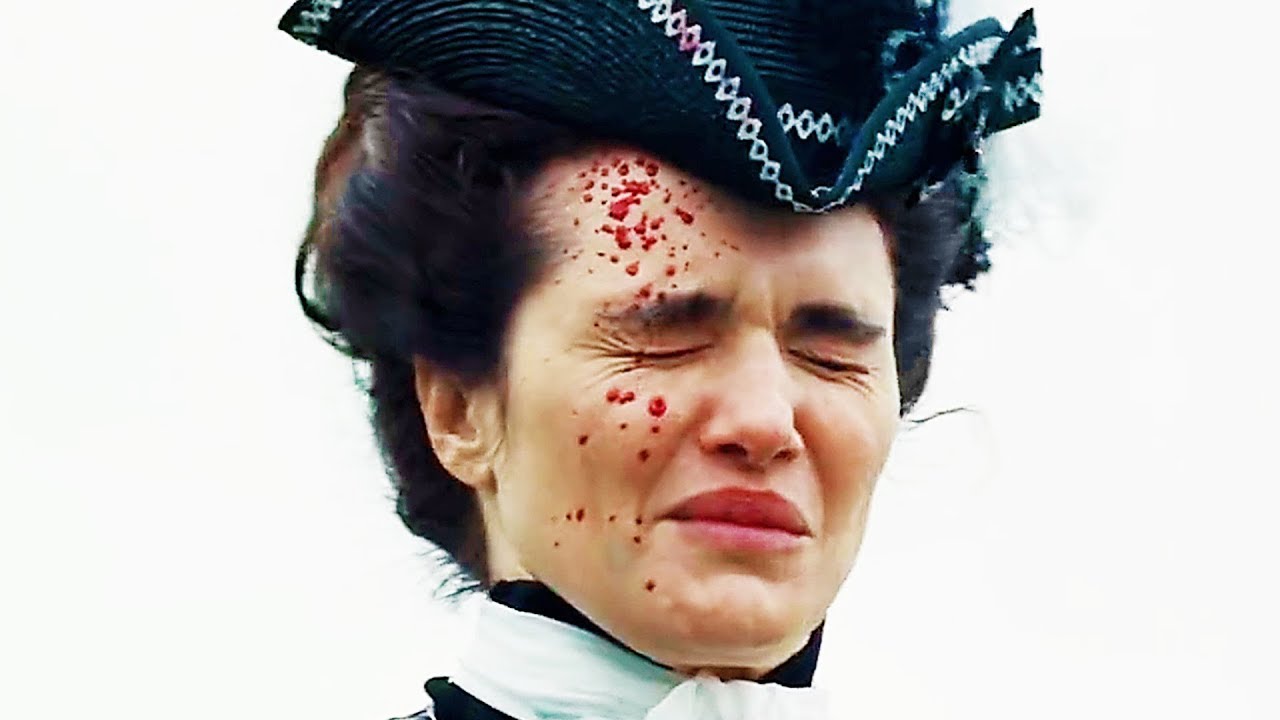
Screenwriter Bryce Kass has some interesting thoughts on the case of Lizzie Borden, the American woman suspected in the 1892 ax murders of her father and stepmother. In director Craig William Macneill’s hands, those intriguing ideas receive a proper, historical treatment.

Whether they have merit or not is mainly beside the point.

Lizzie (Chloe Sevigny) was a spinster of 32 when her parents died. She was home at the time, as was the family’s Irish immigrant servant, Bridget Sullivan (Kristen Stewart).

The film does not create a whodunit atmosphere, instead painting a historically realistic picture of some of the details that may have driven Borden to commit the crimes—likelihoods that wouldn’t have been considered in 1892 and have, therefore, rarely been taken into account over the years.

The struggle facing a single woman—economic and otherwise—is handled throughout this film with a desperate grace that elevates most scenes. Sevigny’s wily, lonesome outsider role plays to her strong suit. She shows here, as she did in 2016’s Love & Friendship, a capacity with the delicate language of the entitled.

Kristen Stewart continues to impress, even with a brogue. Yes, she is again morose, conflicted and put-upon, so maybe her range isn’t as strong as I’m suggesting, but she really knows her niche.

The way Macneill and Kass piece together the well-known pieces to this puzzle, this time considering how each may impact and be impacted by the fact that Lizzie was an unmarried woman, is consistently compelling.

Do the filmmakers take their somewhat subversive approach a step further than necessary, moving from honest if overlooked likelihood to vague possibility to “are they doing this just to be lurid”?

They do.

It doesn’t sink the film, though, mainly because Stewart and Sevigny commit to the direction and keep it from feeling exploitive. Plus, it is a fresh and believable take on a very old, oft-told story, so that counts for something.

https://www.youtube.com/watch?v=qwgtDHISXtQ

Managing Madness

Kusama: Infinity

by Hope Madden

There is a great deal to find frustrating in the life story of 96-year-old Japanese artist Yayoi Kusama, and even more to celebrate.

A maverick visual artist, Kusama is now the most financially successful female artist of all time. Given her years of struggle and the history of artists who languish during their lifetimes only to find success long after death, there is something supremely satisfying in seeing this uncommon talent live long enough to enjoy global success, both financial and critical.

The fact that she sees it from the voluntary confines of a mental institution is all the more curious and remarkable.

Co-writer/director/producer Heather Lenz’s biography follows Kusama’s story chronologically. Through interviews with the artist. and input from curators, gallery owners and friends, we’re privy to an unpleasant, and even scarring childhood. Naturally, it’s this very struggle that informed not only Kusama’s work but her work ethic, as well.

Driven and unimaginably brave, Kusama moved to the United States alone in the late 1950s seeking success. Unsurprisingly, her ambition was seen as brash and self-serving; meanwhile, her ideas were being lifted by better known (read: white, male) avant-garde artists of the era.

She created repetitive wallpaper before Warhol, who is just one of the icons of pop art to have robbed Kusama’s vision for their own inspiration.

Obviously, there is a light at the end of the tunnel and after many years of frustration followed by ostracism, Kusama has finally found global popularity.

Mirroring the tale she’s telling, co-writer/director/producer Heather Lenz’s film contains elements that frustrate, but what she celebrates more than makes up for it.

If you’re looking for clarity concerning Kusama’s biography, you’ll find little here. Whether vague stories of the artist’s childhood, brief but inarticulate tales of Kusama’s her early years in New York, or fascinating but disconnected images of relationships, Kusama: Infinity drops biographical ideas as soon as it picks them up.

What the film does convey well is the relationship between Kusama’s work and her mental state. Whether the OCD that refuses to let go of an image—hence the netting, polka dots and other repetitions in the work—to her depression and suicidal tendencies, Kusama’s mental health and art have always been tied.

The other great selling point is the sheer amount of Kusama’s artwork Lenz spills across the screen. Few artists render work so vivid, images benefitting from the very largest available canvas. Lenz piques your interest with the story of this unusual, fierce talent, but the payoff is in the color and spectacle of the art.

Bore More Years

American Chaos

by Matt Weiner

As a documentary, American Chaos is in want of a natural constituency.

It arrives far too late to offer anything more meaningful than the endless series of “Trump country” news features, all of which confirm the noncontroversial point that the Republican base still supports its Republican candidate.

And the brief talking head interstitials with subject matter academics are both too pat to be targeted at Trump voters and too superficial to provide anything new for liberals that doesn’t confirm things they’ve already argued about back and forth on family Facebook threads.

As for the film itself, it’s similarly competent but trivial. Filmmaker and card-carrying liberal James Stern sets out in the months before the 2016 election to meet with Donald Trump supporters, hoping to discover for himself why so many people supported his candidacy. A fair number of the interviews offer genuine insight into the lives of apolitical voters—that is, the vast majority of people (on both sides) who don’t really care about following politics or policy as much as they have vaguely formed ideas around personalities and parties, and that’s enough to get by.

But we’ve had months of media profiles and years of political science research to tell us all this before. And Stern can’t help but inject himself into the debate, which takes the form of Sorkinesque appeals to hypocrisy and reason. It’s not that Stern is technically wrong when he pushes back—it’s that if he hasn’t learned by this point from his own interviews that there’s something else driving these voters than pithy speeches and fact checking and who “won” a debate, it makes you question just how much he’s been listening to the very people he claimed to want to hear out.

Stern’s documentary is an illuminating anatomy of what went wrong from a liberal perspective, but it’s probably not the one he intended to make. As the chronology races toward Stern’s one-two gut punch of Trump’s election and inauguration, he attempts to contextualize what’s happening to his worldview in light of the people he spent months interviewing.

One of his subjects sums up her political platform by exclaiming, “If the left is unhappy, that means I’m happy.” This is a more honest and accurate breakdown of the election and beyond in 2018 than anything explored by Stern, who spends his months traveling the country in a state of perpetual naivete and hashtag resistance outrage, unmoored and bereft of meaningful solutions from his party’s own milquetoast elite who, it turns out, were just as slow to adapt to a world where cultural grievance has subsumed political interests.

Tugging on that string and filming the visceral id that spills out would have had more to say about who we are as a country than the extended personal therapy session we wound up with instead.


Monster Squad

The Predator

by Hope Madden

Shane Black loves him some Eighties, doesn’t he? The over-the-top machismo, the sentimentality, the tasteless and insensitive one-liners—the writer/director revels in every opportunity to splash those (and some blood and entrails) on the screen as he reboots The Predator.

This is the sixth installment, if you count the Alien vs. Predator films, so Black has his hands full finding a fresh perspective. First things first: a damaged, hyper-masculine male lead who uses humor to mask his pain. Enter Quinn McKenna (Boyd Holbrook, Logan).

A US Army sniper, McKenna and his men are in Mexico after some baddies and some hostages when a predator ship crashes. McKenna faces off with the nasty before making off with some of his gear. Then he’s in a bar/post office in Mexico. Then he’s in custody.

How did he go from A to B to C? Nevermind that! There are predator dogs this time!

There are a lot of those odd gaps in action logic, but since when is narrative clarity the point of a Predator movie (or a Shane Black movie, for that matter)? In many ways, Black is the ideal candidate to reawaken the sport-hunting franchise.

He clearly loves it, and he should, having played the small role of Hawkins in the 1987 original. Black takes pointed but affectionate shots at the source material and celebrates much of what made it (and most of Schwarzenegger’s 80s output) so fun.

Holbrook is a serviceable lead that Black quickly surrounds with a team of soldiers (Trevante Rhodes, Keegan-Michael Key, Thomas Jane). What kind of bunch are they? Rag and tag!

Olivia Munn jumps in as a scientist who drops f-bombs, Jacob Tremblay is inarguably cute, and Sterling K. Brown (characteristically mesmerizing) plays the villainous military dude.

The story touches on humanity’s path to extinction, as well as our own evolution. That last part leads to some questionably respectful commentary on folks on the Autism spectrum. (Folks with Tourette’s can expect the same level of respect you might find in an Eighties action film. Or a Norm MacDonald interview.)

The FX are good. Not War for the Planet of the Apes good, but way better than the Aquaman trailer that rolled pre-film. The action is fun and sometimes imaginative, but the rest of the film is largely lacking in imagination.

There’s a lot of coasting going on in The Predator. A lot of boxes being checked—sometimes checked with flair, but they’re still the same old boxes.


Gaslight Anthem

A Simple Favor

by George Wolf

Stephanie is a suburban single mom who keeps an “oopsie” jar for swearing and volunteers for everything at her son’s elementary school.

Emily is passionately married, drops frequent f-bombs and has a painting of her vajayjay hanging in the living room.

But a play date for their sons leads to an unlikely friendship in A Simple Favor, a crazy fun mystery with plenty of surprises up its sassy sleeveless number.

The first may be seeing the director is Paul Feig, who made his name with blockbuster comedies such as Bridesmaids and Spy.

So, he’s doing dark thrillers, now? Nope, he’s doing a satirical comedy with strong women, nice diversity and a pretty sharp bite.

Perky Stephanie (Anna Kendrick – perfect) and glamorous Emily (Blake Lively – ditto) share martinis and secrets until Emily turns up missing. Steph provides case updates on her Mommy vlog (“cookies and origami” help to ease the strain!) while spending more and more time watching Emily’s son and “comforting” her husband (Henry Golding from Crazy Rich Asians).

You’ll guess some of what comes next, but there’s plenty you won’t, unless you read Darcey Bell’s source novel. Screenwriter Jessica Sharzer (Nerve) shapes it for the big screen as a Gone Girl for the gaslight age, where ridiculousness is a default setting, all information is equally true/false and irony is a security blanket never far out of reach.

There are plenty of black comedic laughs to be found here, as well as clever plot twists and knowing nods to the expectations that come with roles of “wife,” “mother,” “career woman” and “friend.”

The running time starts to feel bloated by the third act, and the film flirts with joining the mundane fray it had been so giddily rising above. But it rallies for the win with a satisfying finale of comeuppance and LOL updates on how some characters have moved on.

A Simple Favor is not what the trailer makes you think it is – which turns out to be the perfect setup for a film with plenty of head fakes that lead to a mischievous good time.

In the Name of the Father

White Boy Rick

by Hope Madden

Detroit’s economic blight has offered a powerful backdrop to many a film—Only Lovers Left Alive and Don’t Breathe spring to mind. But for White Boy Rick, this decrepitude does not simply serve a fictional horror. It created a real one.

Rick Wersche Sr. peddled guns to Detroit lowlifes. Feds preyed upon his 14-year-old son with an offer: become an FBI informant or the old man goes to prison. Things escalated, Rick Jr. made some questionable decisions (as teens are wont to do), the Feds took advantage, and by the time he was 17, White Boy Rick was facing a lifetime prison sentence with no hope for parole. This for his first conviction, a nonviolent crime.

Making his acting debut, Richie Merritt cuts a believably affable street kid. He’s like a puppy, a mutt, with moppy hair and a bad teenage mustache. The characterization helps to clarify how he so easily ingratiates himself into dangerous gangs, or why he’s trusted by the same, but it’s a tougher sell when Rick turns kingpin.

Bel Powley nails the role of sister and more obvious victim of the family’s circumstances, while both Bruce Dern and Piper Laurie are a hoot in small roles. But it’s Matthew McConaughey who most impresses.

McConaughey hits not one false note as the self-deluded optimist, Rick Sr. All resilient façade and pathetic underpinnings, desperate to create a healthy future for his family even as his own illicit gun sales compound Detroit’s problems, Rick Sr. is a study in contradictions. McConaughey approaches the task with nuance and empathy, and the result amazes.

In its best moments, White Boy Rick laments the circuitous nature of poverty and urban decline. When it’s really on point, it even illuminates the infrastructure that perpetuates the tragedy.

In its off-moments, though, it tries too hard to present Rick Wersche Jr. as a good kid who didn’t deserve his fate. There is no doubt that Wershe did not deserve his fate, nor did countless other nonviolent felons convicted during the US’s dubious war on drugs. But there’s something about the way director Yann Demange (’71) differentiates the white boy from the rest of the criminals that is unsettling.

The racial dynamics of the film lack much of the nuance afforded the family drama. Demange invites us into the world that’s so appealing to Rick Jr.—a lure that’s far more compelling than just money—but he can’t follow through.

It’s too bad, because as a showcase for performances, White Boy Rick excels. It just can’t entirely decide what it wants to accomplish with its story.