Category Archives: New In Theaters

Reviews of what’s out now

House Divided

The Aftermath

by Hope Madden

While there are a number of fine points to James Kent’s The Aftermath, novelty is not among them.

You don’t need to know the plot, you just need to glimpse the movie poster: Jason Clarke is married to Keira Knightly; Alexander Skarsgård lives in their attic.

What happens, do you think? Any guesses?

It’s a love triangle you’d have to have your eyes closed to miss. No, the plot is not going to surprise or, to be honest, particularly entertain. Give Kent and Aftermath credit, then, for mining its backdrop for genuine tension, not to mention fascinating historical detail.

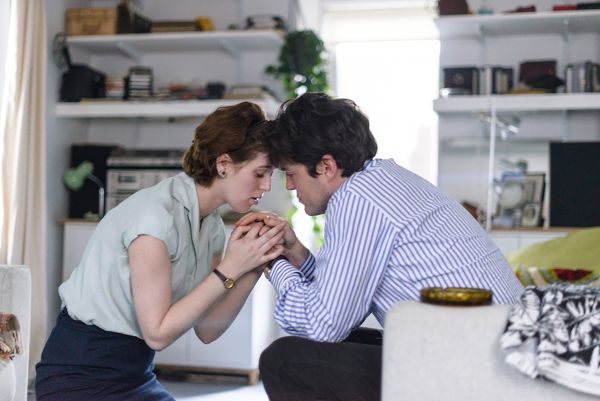
Knightly is Rachael Morgan, wife of a British colonel (Clarke, obv). She joins him in his post-victory assignment in what’s left of Hamburg, 1946. He’s been given the home of a German architect, Herr Lubert (Skarsgård), and in Morgan’s compassion (and naivete), he invites the former owner and his teenage daughter to stay on rather than face the harsh realities of the camps.

Clarke—who too often plays cuckolded husbands to waifish beauties and handsome houseguests—offers a sympathetic turn as a grieving man coming to grips with both a crisis of conscience as well as profound grief. Through him we glimpse the chaos of a divided city, conflict and hatred still echoing through rubble-strewn streets.

He’s intriguing, as are those minor characters who orbit his military life: the rogue Aryans still loyal to the cause, comrades taking pleasure in continuing to punish Germans, and the teenage girl lurking in the shadows of his own home.

Though the film continues to direct your attention to the beautiful people struggling against their desires, it’s angry adolescent Freda Lubert (Flora Thiemann) whose silent contempt compels attention. She’s wonderful, creating a spoiled, misguided character who’s hard to like and harder to predict.

It’s a nice distraction from a film that is otherwise as unsurprising as any you’re likely to see. Knightly and Skarsgård perform admirably in blandly familiar roles. And, of course, they look glorious. But pretty as they are, every moment they’re onscreen you’ll wish to be back out in the ruins of Hamburg with the actual characters.

Portrait of an Empty Cup

Diane

by Christie Robb

There’s a meme, “You can’t pour from an empty cup. Take care of yourself first.” Writer/director Kent Jones’s Diane is a character study of a woman in need of self-care. Her cup has gone bone dry.

The 70-ish widowed and retired Diane (played by the phenomenal Mary Kay Place) spends her days in service to others. She plays cards at the bedside of a cousin dying of cervical cancer. She brings casseroles to friends recovering from illnesses. She serves macaroni and cheese at a soup kitchen. And she returns again and again to the disheveled apartment of her drug addict son, incurring his abuse as she begs him to return to the clinic for treatment.

But when asked how she is doing, Diane responds with a pat response of, “I’m fine,” deflecting the conversation away from herself.

Over time the distractions disappear, giving Diane a lonely space to focus on herself. But that space exposes a shameful memory from her past that she’s kept busy trying to avoid by performing penance.

Place’s performance is raw and layered. The cracks she reveals in Diane’s polite self-sacrificing façade are natural, relatable and quietly devastating. And most of this is delivered by way of a slight change of facial expression or a shift in body language.

She anchors the film, and it emerges as an effective study of the everyday failures and secret shame that most of us carry with us as we drive about in our lives trying to do better this time.

Wastin’ Away Again

The Beach Bum

by George Wolf

Though it shares much more of the mind-altered DNA found in the works of Cheech, Chong  or S. Thompson, The Beach Bum left me quoting directly from John Hughes.

“You know when you’re telling these little stories? Have a point! It makes it so much more interesting for the listener!”

Writer/director Harmony Korine spent years as the cult auteur behind such WTF classics as Gummo and Trash Humpers, only to go semi-mainstream in 2012 with Spring Breakers, a surprisingly coherent pop culture rumination buoyed by a memorable turn from James Franco.

The Beach Bum‘s star power burns bright courtesy of Matthew McConaughey, which has to be the main reason the film got this size budget, promotion and release. But after watching him party with Snoop Dogg and Jimmy Buffett while wearing women’s clothing for 90 minutes, even the effortlessly likable McConaughey’s welcome wears thin.

He’s Moondog, a legendary gonzo poet who hangs in Key West while his uber-wealthy wife Minnie (Isla Fisher) tends their mansion in Miami. Reality comes calling when the Mrs. cuts off the gravy train, kicking him out and insisting that he dry out and finally write his novel if he wants to regain access to the family funds.

What to do?

Smoke some weed? Drink some beers? Bust out of rehab and wreak some havoc with Zac Efron? Sure, and maybe write a little bit on that old manual typewriter he drags around.

It’s all drenched in yacht rock (yes, that is “Key Largo” crooner Bertie Higgins), “Boats ‘N Hoes” bad boy style and improvisational freedom, and it makes for a shallow brew with a murky purpose.

Is Moondog’s crazy journey just an after-effect of Snoop Dogg’s special blend, Korine’s final ode to his wild past, or what?

What is clear is that after trying his hand at social commentary with Spring Breakers, Korine wants to have a good time. No doubt he and the cast (also including Johan Hill and Martin Lawrence) had a blast filming it, and good for them.

For the rest of us, though, The Beach Bum is a mildly funny one trick pony, a rambling barfly always cracking up at his own jokes.


Survival Instinct

Hotel Mumbai

by Brandon Thomas

On November 26, 2008, 10 Pakistani terrorists launched a coordinated attack in the Indian city of Mumbai. At least 174 people were killed, with thirty-one dying inside of the Taj Hotel where the initial attack turned into a four-day siege.

In the modern era, terrorism has become an ever-present part of our lives. Cinema’s response has been to turn these perpetrators into moustache-twirling villains with a penchant for money more than ideology. Only in the wake of 9/11 did filmmakers routinely start to tackle terrorism with gravitas. Paul Greengrass’s United 93 and Steven Spielberg’s Munich were two of the first films in this wave to treat terrorism in film as something more than an excuse to blow something up. Hotel Mumbai’s terrifying journey into the 2008 attacks places it firmly alongside these latter day efforts.

Hotel Mumbai follows a handful of guests (Armie Hammer, Jason Isaacs and Nazanin Boniadi) and hotel staff (Dev Patel and Anupam Kher) as they struggle to survive the armed assault by four gunmen. As the ordeal continues and family and friends are separated from one another, the surviving hotel employees band together to help keep the guests as safe as humanly possible.

The tension flowing through every second of Hotel Mumbai is palpable. When the violence begins, it’s shocking and matter-of-fact in its ferocity. Director Anthony Maras wisely keeps the action grounded, using a lot of hand-held camerawork to create a chaotic feel. There’s an eerie sense of normalcy to what’s happening that gets under your skin.

Speaking of normalcy, making the heroes of Hotel Mumbai the hotel guests, waiters and kitchen staff only adds to that sense of realism. We’ve already seen the version of this movie where the star is a cop or an elite team of commandos. Watching the hotel staff work together to usher the remaining guests to safety adds an emotional element that would be missing if this was simply an “action movie.”

Patel leads the pack with a riveting performance that isn’t showy or recycled. His character of Arjun is in complete contrast to the men terrorizing the hotel, his sense of honor and purpose driven by saving people.

Hotel Mumbai offers an unflinching look at the horror of terrorism. Thankfully, it also shows us that true heroism can exist even in the darkest of moments.


Elephant Ears

Dumbo

by Hope Madden and George Wolf

There was something so terrifyingly perfect in the idea of Tim Burton reimagining Disney’s 1941 circus tearjerker Dumbo. If anyone could rediscover, perhaps even amplify the grotesque tragedy lurking at the heart of this outsider sideshow, it should be Burton.

He seems at home with the material.

Burton’s Edward Scissorhands is basically Dumbo: an innocent misfit, safe only with the one who birthed him, tragically loses that protector and must face a cold, ugly and abusive world that accepts him only because of what it can gain from the very oddities it mocks.

Dumbo is maybe the most emotionally battering film Walt Disney ever unleashed on unsuspecting families. But Burton seems thrown off course by a hero seeking release over acceptance, and instead of that macabre sense of wonder that infuses Burton’s best efforts, he seems content to bite the white-gloved hand that is feeding him.

Dumbo, the wing-eared baby elephant himself, does come to impressive CGI life – all grey wrinkles, long lashes and big, beautifully expressive eyes.

The film’s other squatty little character – Danny DeVito – is also a joy to watch. As circus owner Max Medici, DeVito charms every moment onscreen, and seeing him face to face again with Michael Keaton (as the shady, badly-wigged amusement park magnate V.A. Vandevere) is a nostalgic hoot.

The balance of the cast—Colin Farrell, Nico Parker, Finley Hobbins, Eva Green—fluctuates from passable to painful while staying consistently detached, and any true emotional connection just cannot take root, despite the inherent head start.

Because let’s be honest, many parents will be carrying an emotional connection into the theater with them, perfectly ready to surrender to the ugly cry moment they know is coming.

And it does…but it doesn’t, the scene strangely cut off at the knees to serve a bloated narrative that adds nothing but running time. True movie magic, heartbreaking or otherwise, is nowhere to be found.

The only interesting thing Burton and screenwriter Ehren Kruger (The Ring, several Transformers installments) do, via the Vandevere character and his theme park, is deride the film’s parent company. It’s nearly impossible to view “Dreamland” as anything but a Disneyland stand-in, and equally difficult to decipher the purpose.

Are they calling out rampant consumerism, unsavory Disney memories such as Song of the South or none of the above? Whatever the answer, it only adds to the confusion found in the center ring of this misguided update.

https://www.youtube.com/watch?v=7NiYVoqBt-8


Orchestral Maneuvers

Woman at War

by Rachel Willis

One of the best things about Woman at War is the hero, Halla (a superb Halldóra Geirharðsdóttir). Not often do we see a heroic middle-aged woman, but that’s exactly what we get in director Benedikt Erlingsson’s odd, charming, thrilling comedic fairy tale about a female warrior fighting against the devastating environmental effects of a local aluminum plant.

Like any superhero, by day Halla is a model citizen protecting her secret identity as the “Mountain Woman.” A choir director who rides her bicycle to work, she lives a seemingly routine life. But her inner turmoil compels her to fight the environmental destruction she sees happening in the name of greed.

A wrench is thrown into Halla’s life when she learns that her dreams of adopting a child are finally coming to fruition. A little girl in Ukraine needs a home, and Halla wants a chance at motherhood as much as she wants to fulfill her mission.

Emphasizing the film’s heroic theme, musicians play the score onscreen. In terms of stage theater, it’s reminiscent of a choir that typically opens a play by setting the scene. Then by popping up throughout the acts, they keep the audience apprised of things happening “off stage.” Erlingsson uses these musicians to similar, if not exact, effect, and it’s a unique way to demonstrate Halla’s internal conflict.

To underscore the motif of the importance of environmental preservation, we’re treated to many scenes of Iceland’s vast natural beauty. Halla uses the environment to her advantage, finding out of the way locations to sabotage power lines (skillfully using a bow and arrow), effectively cutting power to the plant. She hides from authorities in natural fissures in the ground, and earns her media-branded nickname by being of the earth that she seeks to save.

Interesting questions are raised in connection with Halla’s mission. When does activism become extremism? What actions will we accept as the effects of climate change become more and more drastic? What will we do to protect our home?

Because Woman at War is interested in these questions, and it’s time we make a serious attempt to answer them.

Slow Down, You Move Too Fast

The Hummingbird Project

by Christie Robb

Director Kim Nguyen’s contributes a meditation into the nature of success in the modern world.

Wall Street traders and cousins Vincent and Anton Zaleski (Jesse Eisenberg and Alexander Skarsgard) resign from their jobs as high-frequency traders and embark on a quest to build a ramrod-straight fiber-optic cable joining the servers of the Kansas and New York stock exchanges. The objective: to make stock trades a millisecond faster than their competitors and make millions in the time it takes for a hummingbird to flap its wings.

Obstacles block their path—mountains, swamps, health issues, reluctant property owners, and a vengeful ex-boss played by Salma Hayek.

The technobabble in the film feels like it is based-on-a-true story. But, it isn’t. Eisenberg plays Vincent as a monomaniac. He’s almost as focused on his line as Ahab is consumed by destroying Moby-Dick. Skarsgard disappears into the role of Anton, contorting his height into an excruciating stoop and delivering a genius-on-the-spectrum performance that is nuanced, funny, sad, and kind of inspiring.

The Hummingbird Project is often beautifully shot, with frequent use of slow motion footage. However, it struggles in focus. It could easily have been tweaked into several different movies. One can imagine editing it into a comedy like Office Space. It could have been Hitchcockian corporate thriller by expanding Hayek’s role. Or it could have shone more of a spotlight on the relationship between characters to flesh out what seems to be the movie’s purpose: questioning whether racing for wealth is really a better use of time than downshifting to spend time with the people around you.

As it is, the movie tries to be too many things and ends up being an ok entry rather than a good one.


Dancing Queen

Gloria Bell

by Hope Madden

Six years ago, Chilean filmmaker Sebastian Lelio released a vibrant and unapologetic look at aging and living with his magnificent Gloria. He re-images that gem with Gloria Bell, his second English language film, placing the incomparable Julianne Moore at the center of a different kind of coming of age story.

Moore is Gloria, a single fiftysomething who’s starting to feel her mortality. The film itself is a character study of the type Lelio does best. His films nearly always focus unflinchingly on the struggles of a woman trying to live freely and authentically.

As with his Oscar-winning A Fantastic Woman, his underappreciated Disobedience, and the original Gloria, Lelio’s observational and unobtrusive direction trusts the lead to carry the weight of the film. Moore characteristically rises to the occasion.

In Moore’s hands Gloria is perhaps a tad more reserved, a little more tentative than the firebrand depicted by Paulina Garcia in the original, but she’s no less wonderful. As Gloria struggles between the freedom and the loneliness of independence, and as she comes to terms with her own mortality, Moore’s tenderness and vulnerability will melt you and her sudden bursts of ferocity will delight.

John Turturro offers impeccable support as Gloria’s love interest. The performance is slippery and unsettlingly believable. He’s joined by strong ensemble work from Michael Cera, Brad Garrett, Alanna Ubach and Holland Taylor, each of whom delivers the spark of authenticity despite limited screen time.

But make no mistake, Gloria Bell is Moore’s film.

Is this just another in a string of brilliant performances, one more piece of evidence to support Moore’s position among the strongest actors of her generation? No.

Gloria Bell is a beautiful film, one that fearlessly affirms the potency of an individual woman, one that recognizes the merit of her story.


And Them

Us

by Hope Madden and George Wolf

Jordan Peele loves horror movies. How cool is that?

It’s evident from the strangely terrifying opening moments of Us, when a little girl watches what is probably MTV from her suburban couch, the screen flanked by stacks of VHS tapes including C.H.U.D., and you’re pulled in to an eventful birthday celebration for this quiet, wide-eyed and watchful little girl (Madison Curry).

From a Santa Cruz carnival to a hall of mirrors to a wall of rabbits in cages—setting each to its own insidious sound, whether the whistle of Itsy Bitsy Spider or Gregorian chanting— Peele draws on moods and images from horror’s collective unconscious and blends them into something hypnotic and almost primal.

Then he drops you 30 years later into the Wilson family truckster as they head off for summer vacation. The little girl from the amusement park, Adelaide (Lupita Nyong’o – beyond spectacular) is now a protective mom.

And that protective nature will be put to a very bloody test.

A family that looks just like hers – doppelgängers for husband Gabe (Wnston Duke), daughter Zora (Shahadi Wright Joseph), son Jason (Evan Alex) and Adelaide herself – invade the Wilson’s vacation home, forcing them to fight for their lives while they wonder what the F is going on.

Even as Peele lulls us with familiar surroundings and visual quotes from The Lost Boys,  Jaws, then Funny Games, then The Strangers and Night of the Living Dead and beyond, Us is far more than a riff on some old favorites. A masterful storyteller, Peele weaves together these moments of inspiration not simply to homage greatness but to illustrate a larger, deeper nightmare. It’s as if Alice’s Adventures in Wonderland turned into a plague on humanity.

Loosely based on an old episode of Twilight Zone (which, not surprisingly, Peele is rebooting), Us is a tale full of tension and fright, told with precision and a moral center not as easily identifiable as Get Out‘s brilliant takedown of “post racial America.”

Do these evil twins represent the darkest parts of ourselves that we fight to keep hidden? The fragile nature of identity? “One nation” bitterly divided?

You could make a case for these and more, but when Peele unveils his coup de grace moment (which would make Rod Serling proud), it ultimately feels like an open-ended invitation to revisit and discuss, much like he undoubtedly did for so many genre classics.

While it’s fun to be scared stiff, scared smart is even better, a fact Jordan Peele has clearly known for years.

Guess who he’s reminding now?

Shotgun Safari

Dragged Across Concrete

by George Wolf

Songwriter Jim Steinman, best known for baroque and dramatically verbose musical epics often belted out by Meat Loaf, has said in interviews that he would love to write 3-minute pop toe tappers, he just doesn’t know how.

Filmmaker S. Craig Zahler can probably relate. Dragged Across Concrete is his third feature as writer/director, and he’s still clearly invested in the long game. Like Bone Tomahawk and Brawl in Cell Block 99, Zahler’s latest is full of strangely indelible characters and memorable dialogue, a film anchored in creeping dramatic dread that finally explodes with wonderfully staged brutality.

Brett (Mel Gibson) and Anthony (Vince Vaughn), street-smart cops in a fictional urban jungle called Bulwark, get popped when a bystander captures one overly zealous interrogation on video. A suspension without pay is something they’re forced to accept, but it isn’t long before Brett has a plan to make up for the lapse in funds with a little “proper compensation” on the side.

But of course, they’re not the only ones looking for a score.

Henry (a terrific Tory Kittles) is fresh out of the joint and needs money for his family. His old friend Biscuit (Michael Jai White) hooks them both up as drivers for a lethal bank robber (Thomas Kretschmann), and the long fuse to a standoff is lit.

This is Zahler’s slowest burn yet, but he keeps you invested with a firm commitment to character, no matter the screen time. From a new mother with near-crippling separation anxiety (Jennifer Carpenter) to a loquacious bank manager (Fred Melamed) and a shadowy favor-granter (Udo Kier), nothing in the film’s 159 minutes feels superfluous.

In fact, quite the opposite.

As Zahler contrasts the cops with the robbers, the sharply-defined supporters orbiting the core conflict only add to its gravity, despite a few moments than seem a bit too eager for Tarantino approval.

Gibson is fantastic, drawing Brett as the real bulwark here, defending what he feels is his with a savage, unapologetic tenacity. Vaughn, re-teaming with Zahler after a standout turn in Cell Block 99, again shows how good he can be when pushed beyond his default setting of “Vince Vaughn.”

Finally, the steady march of battered souls, desperate measures and eclectic soundtrack choices comes to a bloody, pulpy head, staged with precision and matter-of-fact collateral damage.

Zahler’s command of his playbook is hard to ignore. Though the glory of Concrete‘s payoff never quite rises to the breathtaking heights he’s hit before, his confident pace and detailed observations make for completely absorbing storytelling.

And two out of three ain’t bad.