All posts by maddwolf

Lady in Red

In Fabric

by Hope Madden

My last note after watching In Fabric: “Well, that was weird.”

Weird in a good way.

Nobody blends giallo’s surrealistic seduction with dry British wit (two elements that, to be honest, should not fit together at all) like Peter Strickland. Subversive and playful while boasting a meticulous obsession with the exploitation films of the Seventies, Strickland creates vintage-futuristic fantasies that live outside of time and evoke both nostalgia and wonder.

His latest follows a red Ambassadorial Function Dress and the havoc it wreaks on its wearers.

This sounds like Yong-gyun Kim’s 2005 Japanese horror The Red Shoes, but Strickland has something far less sensible, less predictable, and more memorable in store for you.  (Quick PSA: If you can be less sensible than a Japanese ghost story horror and still make a watchable, even fascinating, film, you are at the top of your game.)

We meet Sheila (Marianne Jean-Baptiste), lonely fiftysomething bank teller just finding her way back into the dating pool and in need of a new dress. She heads, during sales season, to Dentley & Soper, where a coven of sales women led by Strickland favorite Fatma Mohamed (she owns this movie) will do what they can to usher clients toward a “transaction of ecstasy.”

The dress, a “a double dream, diamond wrapped,” says the catalog, is “body sensual, captivating, candlelight glances, canape conversations.”

This heightened perfume-ad speak also spills from the department store sales women—each a cross between a Victorian witch and a mannequin—hinting at the fetishistic nature of the entire film.

Strickland, apparently, is about as fond of consumerism as Romero or Cronenberg. He’s also as fond of the color red as Argento. Unlike the giallo films that clearly inform Strickland’s aesthetic, here commerce, not violence itself, is the seductive, sexualized element.

Sheila is a good egg waiting to crack played with working class grace by Jean-Baptiste (Secrets and Lies). In the tradition of the genre, we root that good egg Sheila will somehow outwit the killer dress her saleswitch conned her into purchasing.

Sheila’s story represents the first half of In Fabric, a peculiar but somewhat straightforward horror film. At the film’s halfway mark, Strickland makes a quick left turn into full blown absurdity, which awaits you in the second half.

Not a frame, not a glance, not a bizarre line of dialog is wasted or misplaced in a bold vision that’s stylized nearly to death. In a good way. Strickland’s audacious anti-consumerism fantasy must be seen to be believed.

High Tension

The Aeronauts

by George Wolf

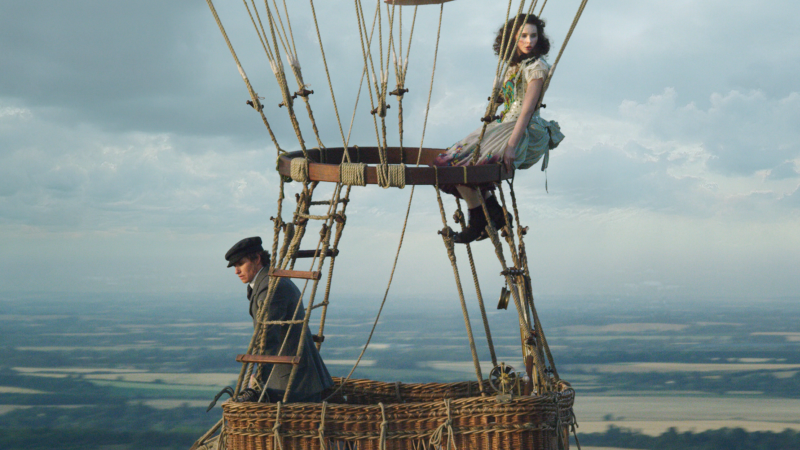
Director Tom Harper wastes little time in taking The Aeronauts into the wild blue, but I’m not complaining. Once we’re up there, I didn’t want to come down, no matter how many knots my stomach was twisting into.

Based on some of the true-life events outlined in Richard Holmes’ book Falling Upwards: How We Took to the Air, screenwriter Jack Thorne imagines how a spunky daredevil balloon pilot heroine might have helped pioneering London meteorologist James Glaisher break the world altitude record in 1862.

Oscar winner Eddie Redmayne crafts Glaisher as a politely determined man out to prove to his shirt-stuffed, muttoned-chopped colleagues that it just might be possible to predict the weather.

What Glaisher needed was to take temperature and humidity readings at the highest level of the atmosphere. If he failed, the ribbings from the boys at the Royal Society would be fierce. But if he prevailed, he would take the first step toward scaring the shit out of your mom on the 6 o’clock news.

And yeah, also make a huge scientific advancement.

While history remembers Glaisher’s partner was actually balloonist Henry Coxwell (hello, ladies), for these narrative purposes it is defiant aeronaut Amelia Wren (Felicity Jones). She’s haunted by a tragic memory from the past, but won’t let that – or the usual boys club baffoonery – deny her destiny as a “creature of the sky.”

I take no issue with the liberties taken. This isn’t a documentary, Jones is an Oscar nominee who shares a sweet brother/sisterly chemistry with Redmayne, and her character adds a welcome layer of mischief to a backstory that badly needs it.

Most importantly, as the focus quickly settles on two people in a balloon gondola, Amelia brings a sharp contrast to James that just makes the ride more fun and – thanks to the breathless visual gymnastics – sometimes downright terrifying.

Seriously, this film should come with a trigger warning for acrophobics, because Harper (Wild Rose, TV’s Peaky Blinders) and cinematographer George Steel unveil some truly awe-inspiring, anxiety-inducing set pieces begging for IMAX, or 70mm, whatever you can find.

The Aeronauts may give gentle reminders about the importance of science, but it pounds a visual fist in defense of the big screen. The film’s ultimate calling card is not the story but the ride (in real time, no less!), and a smaller canvas just will not do it justice.

Strap in tight, and enjoy the thrill.

Time and Tide

Waves

by Hope Madden

“Seize the day,” Tyler’s (Kelvin Harrison, Jr.) literature teacher reminds each student as they leave her classroom.

In a constant loop during weight training, Tyler’s wrestling coach barks,
“There are no second chances and there is no fucking second place!”

Even at home, Tyler’s relaxing moment alone with his loving stepmother Catharine (Renee Elise Golsberry) is interrupted by a very stern father (Sterling K. Brown, remarkable as always) reminding him that if he expects to achieve all that has been set out for him – wrestling at state championship level, securing a scholarship – he’d better get back to work.

Trey Edward Schults’s Waves is quick to show us that Tyler has it all: a loving and financially comfortable family, grades, talent, friends, and a gorgeous girlfriend (Alexa Demie). If there is time to enjoy it, there’s certainly no time to live it, to give into it, or to give anything without the clear expectation that it is forwarding something for himself. High expectations, high demands, high rewards, everything focused on Tyler, everyone focused on Tyler, Tyler focused on Tyler.

Waves sometimes feels like a less contrived, more Floridian view of Julius Onah’s Luce, the scab-picking indie in which Harrison proved himself a blistering and commanding lead. Are the demands put upon the brightest and most talented African American high school males too high? Are those supporting these young men deriving too much from their success to actually offer clear-eyed guidance?

Says Dad to an increasingly desperate Tyler, “We are not afforded the luxury of being average.”

While much of the drama leading to this moment could be generalized to most any adolescent male buckling under high expectations, this moment between father and son separates the narrative as one dealing specifically with the black American experience.

In 1968, George Romero famously cast Duane Jones as the lead in his groundbreaking zombie film Night of the Living Dead only, according to the filmmaker, because Jones was the best actor to audition for the part. The film’s enduring success has less to do with Jones’s talent (though that is evident in every frame) and more to do with the political power the film derives from seeing a black hero in this particular effort.

Schultz cast Harrison Jr. as the male lead in Waves because of his work with the remarkable talent in his previous effort, It Comes at Night. The white filmmaker’s script itself is semi-autobiographical, and there’s a superficial tidiness to Schultz’s cultural shift that Romero’s film didn’t suffer.

It’s not enough to topple the film by any means, but the shorthand and stylized moments that remark on the cultural shift from the story of a white adolescent male on a collision course with destiny and the story of a black young man on that same course feel specifically introduced and placed, while much of the rest of the film offers an uneasy authenticity that keeps your attention.

From Schults’s dizzying opening sequence, Tyler’s breathless youth in sunny south Florida is simultaneously exhilarating and reckless, a reality underscored throughout the film by Drew Daniels’s whirligig camera and Trent Reznor and Atticus Ross’s furious score.

What separates Waves from other chronicles of the frenzied fall of an idealized adolescent is his follow-up act, one in which the fallout of Tyler’s destruction implicates everyone who loves him, including his quiet sister Emily (Taylor Russell).

The point of her narrative is the redemptive nature of forgiveness. Here Schults uses the same camera movement and score to note again the hand-in-hand nature of freedom and danger in adolescence. But here, we sense things may not end up as dire.

Like Schults’s first film Krisha, Waves is embroiled in family issues as well as addiction, though this time the issues and the sociological context concern American blackness—questionable territory for a white filmmaker, even one as irrefutably talented as Schults. Perhaps thanks mainly to remarkable performances by Brown, Russell and especially Harrison, Waves rings mainly true.

Better Living through Chemistry

Dark Waters

by Hope Madden

Todd Haynes hasn’t written one of his own films since 2007’s I’m Not There, a biopic that refuses to fit neatly into that genre (making it a perfect fit for its subject).

The director’s collaboration with other writers has been both sublime (Carol) and spotty (Wonderstruck), the content sometimes feeling as if it simply is a mismatch for his own often gorgeously subversive vision.

So, yes, it’s a bit of a shock to witness the filmmaker who depicted Karen Carpenter’s battle with anorexia via Barbie dolls (Superstar: The Karen Carpenter Story) tackle the blue collar true story of a corporate defense attorney who grows a conscience and hits DuPont Chemical where it hurts the most.

Shooting again in southern and central Ohio, Haynes turns in the buttery glamour of Carol for a grimmer image of America.

Dark Waters sees Mark Ruffalo as Robert Bilott, a good guy who also happens to be a corporate lawyer. I guess he’s proof those two concepts need not be mutually exclusive.

A keep-your-head-down kind of colleague, Bilott is confronted at work by a friend of his grandmother back home, a curmudgeonly West Virgina farmer (Bill Camp) who is offering VHS proof that his cows are being poisoned.

The corporate lawyer in Bilott wants to ignore this problem. The salt-of-the-earth Midwesterner in him cannot.

Few actors play the scrupulous good guy as reliably or believably as Ruffalo, who leads the film with a quiet, fragile dignity.

Anne Hathaway co-stars as Bilott’s conflicted wife Sarah. It’s a small and somewhat thankless role for the Oscar winner, but she gives it some meat and, better still, a much needed edge that strengthens the film.

She’s not alone. William Jackson Harper (Midsommar) continues to prove that he’s really good at playing a dick. Meanwhile, veteran “that guy” Camp offers a perfectly off-putting, guttural performance. A number of other sharp turns in small roles, including those by Tim Robbins, Bill Pullman, Mare Winningham and Victor Garber, help Haynes shade and shadow what could easily have become a paint-by-numbers eco-terror biopic.

He can’t entirely break free, though, and Dark Waters in the end—however stirring, informative and timely the tale—feels far too safe to be a Todd Haynes film.

The One that Got Away

The Head Hunter

by Hope Madden

In a land of yore, the geography forbidding, a far off trumpet calls for the hardiest of warriors—those equipped to fight beasts.

Director Jordan Downey shows much and tells little in his nearly wordless medieval fantasy, The Head Hunter. The filmmaker parses out all the information you’ll need to follow this simple vengeance myth, but pay attention. Very little in this film is without meaning—no creepy image, no creak or slam.

In what is essentially a one man show, Christopher Rygh delivers a quiet, brooding performance for a quiet, brooding film. He cuts an impressive figure as the Vikingesque warrior at the center of this adventure and his work speaks of joyless endurance.

He answers the call of the trumpet. He fights monsters. He collects heads, which he spikes to the wall of his isolated cabin. The festering stench that must waft from this place!

The action takes place almost entirely off screen, which is clearly one way for Downey to keep costs down, but it does allow you to focus on a different part of the story. By denying viewers the release of battle victory, we get nothing but the anxiety of the preparations and the pain – physical and emotional – of the aftermath. A prime example of making your limitations work for you, Downey’s confident direction and strong storytelling instincts draw your attention not to the physical horror of battle but to the emotional horror of this existence.

Kevin Stewart’s cinematography gorgeously creates the mythical brutality of the land. Eric Wegener’s sound design is almost equally impressive, from the drip and splash of gore to the crackle of a flame to the clank of armor as well as the more ghastly, hypnotic sounds of the otherworld so savagely interrupting this one.

With so much to experience and so little to tell you what you’re seeing, the team effort is required and it pays off. It’s a far cry from the filmmaker’s most famous effort, 2009’s ThanksKilling (an annual seasonal indulgence for a small segment of us).

The only thing you’ll find in common between the two films is Downey’s inspired use of practical effects—another element that helps his bold and memorable effort stand out from the pack.

Go Beavers!

Knives and Skin

by Hope Madden

Falling somewhere between David Lynch and Anna Biller in the under-charted area where the boldly surreal meets the colorfully feminist, writer/director Jennifer Reeder’s Knives and Skin offers a hypnotic look at Midwestern high school life.

When Carolyn Harper (Raven Whitley) goes missing, carefully erected false fronts start crumbling all over town. Cheerleaders take a harder look at football players. Football players cry in their Mustangs. Goth girls fondle pink dresses. Pregnant waitresses bleed at the kitchen sink.

And everyone sings impossibly appropriate Eighties alt hits acapella. Even the dead.

Knives and Skin’s pulpy noir package lets Reeder explore what it means to navigate the world as a female. As tempting as it is to pigeonhole the film as Lynchian, Reeder’s metaphors, while fluid and eccentric, are far more pointed than anything you’ll find in Twin Peaks.

She looks at relationships between mothers and daughters, as daughters toe the line between acceptable and unacceptable levels of conformity and mothers bear the toll exacted by years of fitting in.

Reeder blurs that line between popularity and ostracism, characters finding common ground as they address the question: Are you a whore or a tease?

The ire is not one-dimensional. Though toxic masculinity requires a price, the males in Middle River, even the worst among them, are as sympathetic and as damaged by expectations as anybody.

Reeder’s peculiar dialogue finds its ideal voice with Grace Smith as Joanna Kitzmiller, a jaded feminist and budding entrepreneur. Likewise, Marika Englehardt and Tim Hopper bring extraordinary nuance and sympathy to what could have been campy characters.

This cockeyed lens for the middle American pressure cooker that is high school suggests exhilarating possibilities, but does so with a melancholy absurdity that recognizes the impossibility of it all.

And in the end, all the Middle River Beavers stare longingly at the highway that leads out of town.

Book Review: True Crime

by Hope Madden

“Every girl in the world was taught not to trust her gut. Every girl in the world knew she was the fool in the play.”

Samantha Kolesnik’s insightful first novel, True Crime, hypnotizes as it repels. Like a string of memories playing across the narrator’s mind during a long and loose car ride, the novella delivers a Southern gothic tale that calls to mind Flannery O’Connor or Shirley Jackson. The grim poetry of Kolesnik’s writing style, however, is uniquely hers.

As Suzy meanders through some of the more eventful times in her young life, you realize this is a narrator with the potential to  be unreliable if she valued anyone’s opinion enough to lie. But that doesn’t seem to be the case. Her story is mainly being articulated for her own benefit, a way to measure her culpability, evaluate her options, reflect on root causes and wrestle with the monster within.

True Crime is hardly an exercise in existential angst, though, and that’s mainly because Suzy is such an enigmatic and yet utterly straightforward character. Kolesnik’s prose is empathetic but not forgiving, which creates a fascinating atmosphere.

The approach of depicting events as memories allows Kolesnik the poetic license to focus just on the moments Suzy finds most compelling—the truth behind the details, the cause and effect, the timeline and technical details are rendered irrelevant. In their place Kolesnik offers a dead eyed but dreamlike depiction of the ugliest side of life.

What sets the piece apart from others of the same subgenre is the insight Kolesnik offers through the eyes of this young woman. She is both victim and beast in degrees that frustrate and inform, her narrative containing moments of genuine clarity concerning victimhood and the female form that rarely emerge in horror fiction.

Kolesnik’s style, her ability to create something that’s simultaneously aimless and meticulous, entrances as it delivers a quick, effective punch. In its own way an indictment of true crime culture that has overtaken the nation, the writing feels quietly but deeply fascinated by the compulsion to wade into a grisly reality.

Like the contents of the magazines Suzy so loves, Kolesnik’s tale contains a horrible beauty you can’t seem to look away from.

True Crime is available January 15, 2020 from Grindhouse Press.

You can also preorder on Amazon.

Pretty McFly (For a White Guy)

Fastest Delorean Part II

by George Wolf

When we last saw Adam Kontras and his record-setting Delorean, one of them was on the side of an L.A. freeway engulfed in flames.

Fastest DeLorean in the World ended with that fiery cliffhanger, and now Kontras is back to finish the story with his second documentary feature, Fastest Delorean Part II.

Kontras, a Columbus native who bought the Delorean and turned it into a stunning replica of Marty McFly’s Back to the Future time machine, has for years been making his living in L.A. by renting out the vehicle for a variety of gigs.

That led to a desire for setting the Delorean speed record, which Kontras chronicled to stirring effect in Part I. But aside from all the cool car stuff, what really drove the first film is the human drama that developed between Adam and his gearhead brother Kenny.

The status of their relationship was as much an unanswered question as the car fire, and Kontras readily admits his sequel won’t mean much to anyone who hasn’t seen the first film.

“It’s the rightful conclusion to everything,” Kontras said.

Plus, from the Universal Studios backlot to Paris and beyond, we get first person accounts of the often amazing places the car has taken Kontras and his good friend Don Fullilove, who played Mayor Goldie Wilson in the Back to the Future films.

“Just like the first one, I’m very happy as a storyteller to have somehow pieced it all together,” Kontras said. “The scope of everything is pretty intense…but holy fuck, I wish I wasn’t in it.”

“I am so done with the drama, I did everything humanly possible to make Fastest DeLorean a nice redemption story.”

“There will not be a part III.”

There will be more documentaries, though. Kontras is set to announce his next project in January, one he describes as “a love fest that has nothing to do with family.”

Okay, but what about time travel?

Fastest DeLorean Part II is streaming now on Amazon.