You know it’s been 34 years since we got a funny movie about arm wrestling?
True, it was Stallone’s Over the Top and it wasn’t meant to be a comedy, but the point is…the drought is over! Golden Arm is here with a new tournament, new stakes and plenty of laughs.
Danny – aka The Dominator! (Betsy Sodaro) – is a tough lady trucker who enjoys a good bar fight and the womano y womano competition of arm wrestling. Danny’s good, but not good enough to beat “Fuckin’ Brenda” The Bonecrusher (Olivia Stambouliah) in the upcoming championship tourney.
But you know who could be? Danny’s old friend Melanie (Mary Holland, who stole so many scenes in last year’s Happiest Season). Mel might be a soft spoken wimp who can’t even stand up to rude customers at her struggling bakery, but Danny also remembers Mel as having one impressive right arm.
So we’re gonna need a training montage!
First-time feature director Maureen Bharoocha serves it up, along with some nicely organic info on the rules of the game that serve to get us situated (don’t forget to “suck and tuck!”). And as Danny and Mel take to the road, the debut screenplay from Ann Marie Allison and Jenna Milly provides plenty of room for inspired antics (the bit about Twister had me howling) on the way to the arms race that ends with a 15k Grand Prize.
Holland and Sodaro make an endearing odd couple, and it’s the pure engagement of their characters that keeps the film afloat during a shaky first act. But hang in, because from picking out Mel’s wrestling persona (“I’m ‘The Ex-Wife!'”) to a gynecologist’s detailed condemnation of the phrase “balls out,” it just gets funnier as it rolls along.
Call it “stupid funny” if you want, but it’s still funny, with some underlying themes about gender stereotypes, personal growth and female friendships that are far from dumb.
It’s the bawdy excess that’s in your face, so close you may even miss the wink-wink nods to both the Stallone flick and TheKarate Kid. But those bits of subtlety are even more evidence that the rough edges in Golden Arm don’t come from sloppy construction.
Not that long ago, this film was called Percy and ran a full two hours. Since then, it’s gained a word and a half in the title while losing about twenty minutes of run time. What’s left is a rushed, but fairly standard telling of a real life everyman’s battle with a corporate behemoth.
In the late 1990’s, Saskatchewan farmer Percy Schmeiser (played with weary conviction by the iconic Christopher Walken) was sued by the Monsanto corporation for “patent infringement.” Their claim was that Percy was planting his fields with some of Monsanto’s patented GMO seeds without a license.
A multi-generational family farmer, Percy argued that he has never planted with anyone’s seeds but his own. His father taught him to be a “seed saver” and store the most robust seeds for use the following year. Any Monsanto seeds found in his fields, Percy argued, must have traveled by wind or passing trucks.
Monsanto’s lead counsel Rick Aarons (the always welcome Martin Donovan) ain’t buying it, and Percy’s folksy lawyer Jackson Weaver (Zach Braff) advises Percy and his wife Louise (Roberta Maxwell) to cut their losses and settle.
But Percy’s moral code – along with plenty of encouragement from environmental activist Rebecca Salcau (Christina Ricci) – lead him to the courtroom. Once there, the introverted Canadian farmer gets more attention than he bargained for, and pariah status in his own community.
The script from Garfield Lindsay Miller and Hillary Pryor hits all the required notes, but director Clark Johnson (2003’s S.W.A.T) never provides the breathing room to let events in or out of court truly connect. While many films are wise to trim the fat, the twenty minutes gone from PvG feel haphazardly culled, leaving behind whiplash edits and stalled resonance.
Led by the sympathetic Walken, the ensemble cast is uniformly effective, but caught in a scattershot narrative. With its mind on justice for the little guy, local and global farming conflicts, manipulation from all sides and above all, doing the right thing – Percy vs Goliath has many hearts.
And while all those hearts may be in the right places, what holds the film back is a tendency to take the early advice that Percy ignored. Make the cuts and settle.
If Best Summer Ever doesn’t turn your frown upside down, I’ll eat a bug.
Two high schoolers not named Danny and Sandy enjoy some sweetly romantic summer nights, then go their separate ways…until fate brings them back together for a musical teenage dream filled with a wonderfully diverse cast of actors.
Anthony (Rickey Wilson, Jr., showing easy charisma) and Sage, a charmer in a wheelchair (Shannon DeVido – who effortlessly steals this film), meet at a summer dance camp in Vermont. Anthony tells Sage he attends a dance academy in NYC – but’s he’s really a football star in Pennsylvania who relishes the chance to indulge his secret love of dance. Sage has a secret of her own – the illegal pot business her two moms (Eileen Grubba and Holly Palmer) operate that keeps the family constantly on the move.
But at summer’s end, an unexpected complication leads to Sage’s family landing in Pa. – and Sage enrolling at the very same high school Anthony attends! Oooh, this is delicious, especially for Queen Bee Beth (a terrific Madeline Rhodes, aka MuMu, also part of the songwriting team), the evil cheerleader who hatches a devious plan to become Homecoming Queen and take Anthony as her King!
Directors/co-writers Michael Parks Randa and Lauren Smitelli craft an irresistible take on the high school musical, populated by just as many physically and/or developmentally challenged actors as not. The joyful representation in this film will swell your heart, especially when you realize – early on – that none of the characters’ perceived disabilities are treated as anything less than ordinary.
And more than that, there isn’t an ounce of condescension to be found, as Randa and Smitelli find some big laughs skewering high school stereotypes. Beth casually drops surprise dick jokes, and two Statler and Waldorf-type booth announcers (Eric Folan and Phil Lussier) bring some hearty sarcasm to the big Homecoming game. See, Anthony is the team’s kicker – and he’s the star because the rest of the team sucks so badly (which causes the resentful quarterback [Jacob Waltuck] to hilariously cuss out the crowd).
Yes, the songs are often cheesy and sung over what sounds like weak karaoke backing tracks, but the title tune’s been stuck in my head for days now.
You’ll see some big names in the film’s list of producers, and some (Maggie Gyllenhaal, Peter Sarsgaard) even pop up in cameos. But the most important may be the members of Zeno Mountain Farm – a Vermont retreat committed to a world where “all can thrive, feel connected, and be empowered.”
For 72 minutes, Best Summer Ever gives us a glimpse of what that world might look like, and it’s inspiring, exhilarating and fun.
But watch out for that Beth – she’s so mean!
Best Summer Ever is available to stream starting Tuesday, April 27th
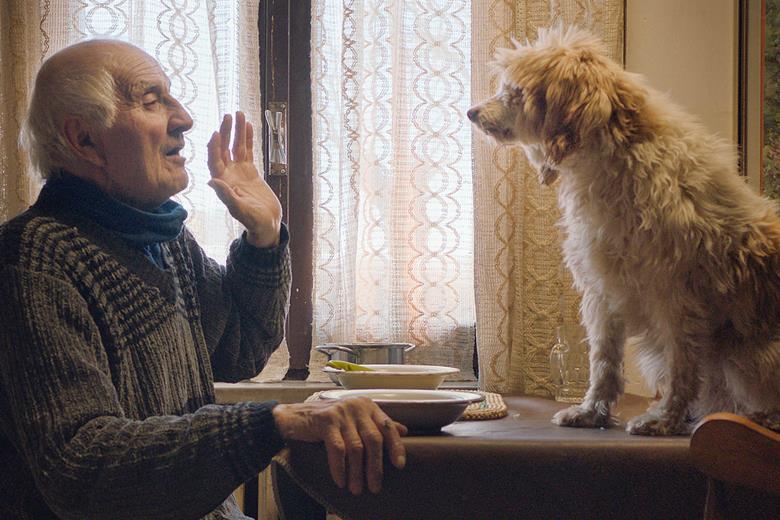
On the surface, a documentary about old men searching for subterranean fungi might not sound overly compelling. But as great docs often do, The Truffle Hunters introduces a world you may not be aware of, and the souls struggling to keep that world from slipping away.
To date, the highly-prized white Alba truffle has been resistant to cultivation. Documentarians Michael Dweck and Gregory Kershaw take us deep in the wilds of Piedmont, Italy, to meet a group of seventy to eighty-year-olds who rely on traditional methods and trusted dogs to find the elusive white Alba.
Dweck and Kershaw (The Last Race) employ a vérité style that’s instantly immersive and completely charming. These old time foragers cherish their proven methods and their canine partners in equal measure, taking care to protect both from the ravages of climate change and cutthroat profiteering as long as possible.
Often reminiscent of 2019’s Oscar-nominated Honeyland, the film transports you to a community that seems a nuisance to the modern world – even as gourmet palettes continue to cherish its fruits.
The 84 minutes in The Truffle Hunters is time well spent with old timers who are holding back the charge of progress in ways that are funny, defiant, sometimes curious but always joyful. Their days may be numbered, but their spirit endures, a spirit this film captures with beautifully subtle intimacy.
It takes a full two minutes to get a really good feeling about Together Together.
Writer/director Nikole Beckwith delivers witty, engaging dialogue from the jump, defining characters and setting the stakes in a beautifully organic manner. This is much more difficult than Beckwith and her two leads make it appear.
Matt (Ed Helms) is interviewing Anna (Patti Harrison) to be the surrogate mother who’ll deliver his child. Matt, a forty-something app developer, is single but wants to be a father. 26-year-old Anna needs the money and wouldn’t mind the healthy deposit in the bank of good karma.
So if you’re keeping score, the film boasts a fresh premise, crisp writing and likable personalities before you’ve sipped your beverage of choice. And as we follow Matt and Anna from first trimester to labor, Together Together is never less than warm, insightful and lovely.
With no romance and only a few laugh out loud moments (most of those delivered by Sufe Bradshaw’s sarcastic medical tech and Julio Torres as an over the top barista), you can’t really call this a rom-com. But even that seems to fit. Just like Matt and Anna, Beckwith (helming her second feature after 2015’s Stockholm, Pennsylvania) is proudly going her own way.
Helms adds important layers to his usual nerd persona, slowly revealing more detailed reasons why Matt is choosing to be a single father, and why Anna is challenging his perceptions on nearly everything.
Harrison, whose resume sports mainly TV and voice work, delivers a fantastically understated breakout performance. Anna is pleasantly frank and sarcastic, but guarded. She’s hiding some scars, and Harrison reveals them with ease and authenticity.
Beckwith fills nearly every frame with a tender empathy that has us pulling for this offbeat pair as a matter of course, making it that much easier for her to reach us. From surrogacy and masculinity to Woody Allen, Friends, and the proper use of tampons, the film drops its insight in ways that are consistently fresh.
There’s love and family and funny stuff here, and though none of it is quite the kind we’re used to seeing, all of it is wonderfully real. Together Together is a delivery that somehow feels comfortable and unique, both overdue and right on time.
With this episode we hit the big 200, so we wanted to celebrate in the most masochistic way possible. No! We wanted a really great topic (George’s choice) and a really great guest – filmmaker and co-founder/programmer of Nightmares Film Festival, Jason Tostevin.
Together we talk through the very best horror movies we could not watch a second time no matter what.
5. A Serbian Film (2010)
This is not a movie we would recommend to basically anyone. That’s not to say it’s a bad film – it’s pretty well directed, acted, and written. It’s just that the co-writer/director Srdjan Spasojevic is trying to articulate the soul-deadening effects of surviving the depravity of war. The film title is no coincidence – the film is meant to reflect the reality of a nation so recently involved in among the most depraved, horrific, unimaginable acts of war. It’s as if he’s saying, after all that, what could still shock us?
Like Pier Paolo Pasolini’s notorious 1975 effort Salo, or the 120 Days of Sodom – also a depiction of the depravity left behind after war – A Serbian Film overwhelms you with horrifying imagery.
https://www.youtube.com/watch?v=ddwrbcMmzlc
4. An American Crime (2007)
In 1966, Gertrude Baniszewski, along with three of her children and two neighbor boys, was convicted of what’s commonly considered to be the most heinous crime ever committed in the state of Indiana. The senior investigator described the prolonged abuse and murder of 16-year-old Sylvia Likens as the most sadistic case he’d investigated in his 35 years on the force.
In 2007, two films were released depicting the horror. The Jack Ketchum-penned The Girl Next Door found a larger audience, but co-writer/director Tommy O’Haver’s An American Crime is the far superior film.
Elliot Page offers a full, layered performance, making Sylvia a realistic character – someone you might have known in high school. Of course, that makes it even harder to stomach what becomes of her. The entire cast—an impressive ensemble—does stunning work, but the dark magic here is Catherine Keener. Giving one of the best performances of her already stellar career, Keener guarantees that it will be a long time before you recover from this movie.
3. The Painted Bird (2019)
If you paint the wings of a sparrow (or stitch a star to his jacket) the rest of the flock will no longer recognize him. The other birds will swarm and peck him until he plummets back to the earth. This is just one of the horrific lessons a young boy learns as he desperately searches for anywhere or anyone safe in war-torn Eastern Europe.
What follows is a brutal parade of the worst humanity has to offer. Domestic abuse, graphic violence, multiple instances of animal abuse and death, rape, child abuse and rape, and more. Then the war crimes start around hour three.
The Painted Bird is a test of endurance. It’s also a beautifully shot, well-performed, and incredibly moving piece of cinema. You simply have to be willing to go where it wants to take you. And all of those places are dark and darker.
2. Irreversible (2002)
French filmmaker/provocateur Gaspar Noe does not play well with his audience. Every film, no matter how brilliantly put together or gloriously filmed, is a feat in masochism to watch. Later efforts, like Enter the Void, spread the misery out for its full running time, but for Irreversible, he gave it to us in two horrifying scenes. While the head-bashing is tough viewing, the film centers on a rape scene that is all but impossible to watch.
Noe’s general MO is to punish you through sheer duration. The scenes last so long you feel like you cannot endure another minute, and this scene certainly does that. Not shot even momentarily for titillation, and boasting a devastatingly excellent performance from Monica Bellucci, it justifies its own horrific presence. There are other films with necessary and difficult rape scenes – Straw Dogs, I Spit on Your Grave, The Last House on the Left, Henry: Portrait of a Serial Killer – but none is harder to stomach than this.
1. Nothing Bad Can Happen (2013)
This film is tough to watch, and the fact that it is based on a true story only makes the feat of endurance that much harder. But writer-director Katrin Gebbe mines this horrific tale for a peculiar point of view that suits it brilliantly and ensures that it is never simply a gratuitous wallowing in someone else’s suffering.
Tore (Julius Feldmeier) is an awkward teen in Germany. His best friend is Jesus. He means it. In fact, he’s so genuine and pure that when he lays his hands on stranded motorist Benno’s (Sascha Alexander Gersak) car, the engine starts.
Thus begins a relationship that devolves into a sociological exploration of button-pushing evil and submission to your own beliefs. Feldmeier is wondrous—so tender and vulnerable you will ache for him. Gersak is his equal in a role of burgeoning cruelty. The whole film has a, “you’re making me do this,” mentality that is hard to shake. It examines one particular nature of evil and does it so authentically as to leave you truly shaken.
Her name is Anne Fedder. But Jakob’s Wife pretty much sums up the nearly invisible routine Anne (Barbara Crampton) is living.
Jakob Fedder (Larry Fessenden) is the well-known pastor of a small town church, and Anne is well known as his wife. Anne’s life seems to have only gotten smaller during her thirty-year marriage, and if pressed, she’d probably admit she wouldn’t mind a little shakeup.
A late-night meeting with old boyfriend Tom (Robert Rusler)? Intriguing, but his seduction skills got nuthin’ on The Master (Bonnie Aarrons, aka The Nun), who’s waiting on them both.
The next morning, Jakob gets the first clue that things will be changing.
“Did you make breakfast?” he asks.
Anne answers, “I’m not hungry.”
At least not for pancakes. After The Master’s touch, Anne is a brand new woman, sporting fresh hair and makeup, tight, low-cut dresses and provocative new appetites.
It’s no wonder this has been a passion project for Crampton (who’s also a producer), and she makes the extended feminist metaphor ring gloriously true.
Director/co-writer Travis Stevens (Girl on the Third Floor) wraps the bloodlusty tale in a fun retro vibe of ’80s low-budget practical, blood spurting gore, but it’s Crampton (and the chemistry with her fellow horror vet Fessenden) who truly elevates this beyond the standard vampire playbook.
To see a female character of this age experiencing a spiritual, philosophical and sexual awakening is alone refreshing, and Crampton (looking fantastic, by the way) makes Anne’s cautious embrace of her new ageless wonder an empowering – and even touching – journey.
Stevens revels in the B-movie underpinnings, stopping short of tackling any systemic issues inherent in a woman’s longtime restlessness. The focus stays intimate, and only on how Anne’s new freedom affects Jakob and their local community (which remains nameless, though filming was entirely in Mississippi).
But with Crampton and Fessenden so completely in their element, Jakob’s Wife is an irresistibly fun take on the bite of eternity. Here, it’s not about taking souls, it’s about empowering them. And once this lady is a vamp, we’re the lucky ones.
If all politics is local, then Our Towns is the most political film you’ll see this year.
Because authors James and Deborah Fallows had one rule as they traveled the country looking for towns with interesting stories. Never, ever talk about the national political climate.
The Fallowses, both longtime writers, reporters and academics, have lived and traveled all over the world. Their 2018 bestseller Our Towns: A 100,000 Mile Journey Into the Heart of America was based on their extensive reporting for The Atlantic on the civic and economic renewal of America’s towns.
Oscar-nominated directors Steven Ascher and Jeanne Jordan (Troublesome Creek: A Midwestern) put the gentle, reassuring authors front and center for an easygoing documentary from HBO that touts possibilities over partisanship.
From the influx of refugees in Sioux Falls, South Dakota to the twenty percent unemployment of Columbus, Mississippi; from the end of logging in Bend, Oregon to the climate change fears in Eastport, Maine, we see how these towns have adapted and thrived.
And, by the way, what we see is gorgeous, thanks to the drone footage from Bryan Harvey and the cinematography from him and Ascher.
The solutions – diversity, investment, innovation, local engagement – may not be revelations, but the surprise comes in seeing how some communities have actually been able to move these ideas from buzzwords to policy.
The film skirts specifics, as well as the deep ideological divisions that stand in the way of such progress, but even that seems true to the stated goal of locality. It never wavers, even in the face of celebrity. Because even though you clearly see actor Jeff Daniels playing guitar and singing with a band in Charleston, West Virginia, his national fame is completely ignored, as it should be.
It is not lost on The Fallowses that their book research coincided with a national recession and their film project debuts during a global pandemic. But even with such large-scale challenges, they say the building blocks for recovery are the same, and they start in our own neighborhoods.
For 97 minutes, Our Towns shows you that underneath all of our ugliness, there are success stories we can look to for examples of hope and possibility.
And now feels like a pretty good time to see them.