Join us for a great panel discussion, recorded live at this year’s Nightmares Film Festival!
Join us for a great panel discussion, recorded live at this year’s Nightmares Film Festival!
by Hope Madden and George Wolf
During production of writer/director Todd Field’s terrific 2001 feature debut In the Bedroom, Harvey Weinstein reportedly made life so miserable, Field considered leaving the movie business altogether. He did return in 2006 with the equally impressive Little Children, but Field has been quiet since then.
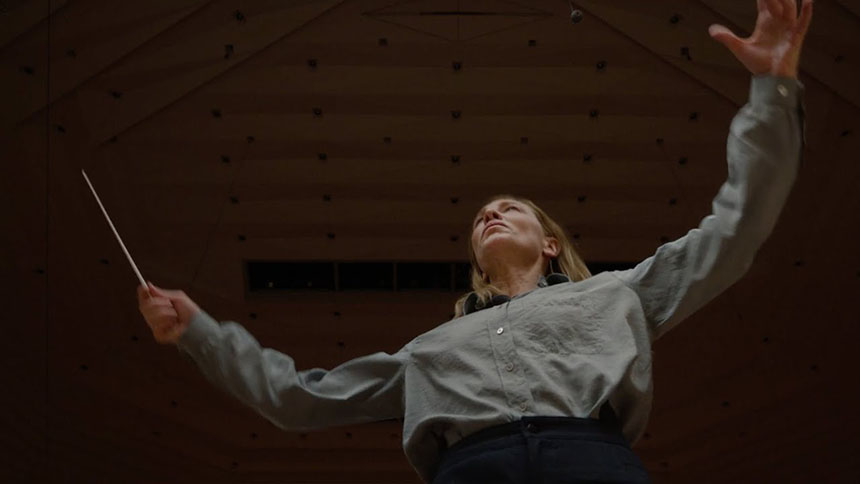
All these years later, it’s not hard to imagine the Weinstein experience as an inspiration for Tár, a searing character study of art, arrogance, obsession and power that’s propelled by the towering presence of (surprised face) Cate Blanchett.
She is Lydia Tár, the first female music director of the Berlin orchestra. A nicely organic interview introduction runs down Lydia’s impressive resume, immediately cementing the character as one of the greatest living composer-conductors in the world.
And, as is her way, Blanchett (who prepped by learning several instruments and studying conducting) needs mere moments to define Lydia with sharp, unforgettable edges.
Tár is a control master who will converse and condescend with excess pleasantries, all the while keeping antenna up for anyone in her orbit who might contradict her careful plotting. And Field’s use of precise sound design and only diagetic music is a brilliant way to reinforce the maestro’s level of influence on everything around her.
Lydia is in rehearsals for a triumphant performance of Mahler’s 5th symphony, and also has a new book prepping for release. So while there’s much going on professionally, it’s the detailed, yet unassuming way Field narrows his focus to Lydia’s personal cruelty that brings the film to such a resonant point.
She humiliates a young student for daring to question a status quo power structure, takes advantage of her dutiful assistant’s (Noémie Merlant from the exquisite Portrait of a Lady on Fire) ambitions, works to remove an Assistant Conductor (Julian Glover) who dares to criticize, and is routinely dismissive of her wife (Nina Hoss).
The way Lydia handles a child bullying her young daughter is our first glimpse at true sociopathic tendencies, but Field – with moments of both sly humor and biting sarcasm – gradually unveils a familiar culture of predatory behavior.
To say the portrayal is perfection feels almost dismissive or perfunctory considering Blanchett’s mastery of her own art, but maybe that’s why this role stands apart. Maybe it’s her own experience, so unlike nearly anyone else’s, that shapes the organic and human performance. You want to feel for Lydia, or at least recognize how a genius with power begins to believe they are entitled to something. Or someone.
It’s in moments when Lydia dismisses ideas of gender inequality or coyly celebrates the history of patriarchy in her own profession that Field and Blanchett best expose the insidious nature of power. The storytelling is striking in its intimacy, gripping in its universal scope.
Tár is a showcase for two maestros working at the top of their game.
Bravo.

by Hope Madden and George Wolf
In 2018, director David Gordon Green and writer Danny McBride did the almost unthinkable, something often tried but rarely accomplished. They made a good Halloween movie. Three years later they did what a lot of people have done. They made a bad sequel.
But the second film in a trilogy is tricky business. The origin story is out of the way and you can’t kill the villain – everyone already knows a third installment is coming. Some filmmakers thrive in that middle space, but most tread water until the big climax.
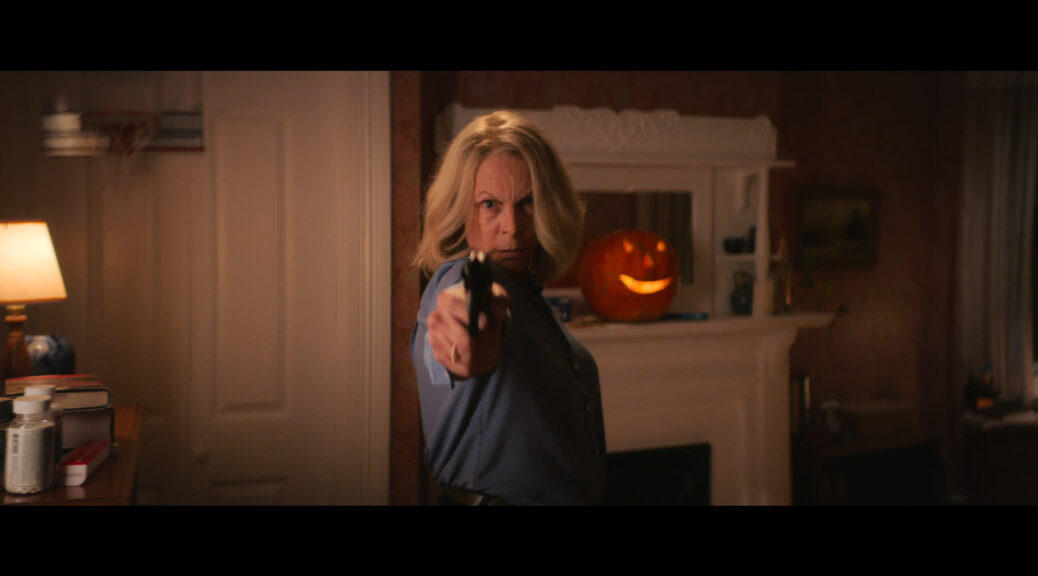
Well, that big climax is here. Laurie Strode (Jamie Lee Curtis) and Michael Myers (James Jude Courtney) face off in the final piece of Greene’s trilogy, Halloween Ends.
The bad second installment was better.
Rohan Campbell is Corey, a misunderstood outcast with tousled hair, bee stung lips and a motorcycle. The Strode women take a shine to him, Laure introducing him to granddaughter Allyson (Andi Matichak). But Haddonfield is pretty tough on Autumn romance, and this story is too rushed to resonate, too dull to be truly angsty.
Green has made some really good movies: George Washington, All the Real Girls, Undertow, Snow Angels, Pineapple Express, Joe, Halloween. One of the most impressive things about that list is the way it crosses genres like there is no border from one to the next. His first episode in the series was a mash note to the original. He wisely ignored all the other sequels and reboots and just brought us a clear vision for an Act 2.
Then, in lieu of a cohesive story, Green caves to some desire to pepper a sequel with odes and easter eggs in honor of all the franchise installments. He and co-writers McBride, Chris Bernier and Paul Brad Logan pick up an idea hinted at in two earlier episodes across the full constellation of films. An honest to god original thought would have been better.
It’s a sidetrack that some longtime fans might embrace, but the execution is littered with missteps. The new relationships do not feel authentic, much of the internal logic is questionable, and forget about scary, the film is too tired to even develop effective tension. There aren’t even any good kills.
We do get the final Laurie v Michael showdown that the title promises, which is a welcome return to giving the legendary Curtis some opportunity for badassery. But while Green & company manage a couple late-stage surprises, this is ultimately a disappointing end, with the highest of hopes limping to the finish for only lukewarm satisfaction.

by George Wolf
Just this past summer, Claire Denis explored psychosexual politics with the moving Both Sides of the Blade. Now, she has sex, lies and global politics on her mind, as Stars at Noon examines sweaty intimacies and slippery alliances.
Adapting Denis Johnson’s novel with co-writers Andrew Litvack and Léa Mysius, Denis keeps the Central American setting but shifts the timeline from 1984 to nearly present day. The threat of COVID-19 adds a relatable layer of suspicion to every interaction, in a part of the world where suspicious minds are easy to find.
Margaret Qualley is sensational as Trish, a young woman staying in a low-rent Nicaraguan hotel while working plenty of angles. There isn’t much to back up her claim to be a journalist (despite a late night call to magazine editor John C. Reilly in a wild cameo), and other details about her life are kept brief and ambiguous.
Trish seems to benefit from at least a couple friends in high places, while new friend Daniel (Joe Alwyn delivering some perfectly smoldering mysteriousness) could benefit from at least one person he can trust.
Daniel says he’s in town from London as an oil company consultant, but Trish is quick to let him know he’s become “a person of interest” with some powerful locals.
But how can this silly American girl know what’s what?
Qualley crafts Trish’s disarming persona beautifully, with a performance that shows a new depth to her talent. While the film’s dialog is often precise and enticing, Qualley makes sure Trish’s non-verbal ques do plenty of talking as well. That gives authenticity to Daniel’s seduction, and the dangerous complications that arise when another mysterious stranger (Benny Safdie) makes Trish a tempting offer.
The humidity of the region feels palpable, laying down a subtle air of oppression that pairs nicely with the more surface level dirty dealings while another wonderful score from Denis favorite Tindersticks works its magic.
Denis is in no rush here, and the narrative can meander through some awkward juggling of tones. But the journey of these characters and their moral posturing is always engaging, and Stars at Noon serves a hypnotic cocktail of intrigue mixed with lust, feminine power and cutthroat colonialism.

Horror is about power versus vulnerability. That’s why bullies and mean girls fit so well into the genre. You always hope the vulnerable will overcome. In this genre, there’s always the real worry that evil will overcome. But somehow, bullies and mean girls never stand a chance.
There are so many great ways to spend time with these high school baddies, but here are our five favorites:
Meg (Katherine Kamhi) was no picnic, but side-ponytail Judy (Karen Fields) is an all-timer when it comes to onscreen bullies. She hates everyone, is mean to everyone, but she really detests poor Angela (Felissa Rose).
“She’s a carpenter’s dream! She’s flat as a board and needs a screw!”
Like all mean girls in horror, Judy gets what’s coming to her. Still, you have to respect that ponytail.
Man, the kids of Derry have it rough long before the circus comes to Derry. Between Henry Bowers (Nicholas Hamilton) and his powerful mullet and the girls dumping wet garbage on Beverly, nobody’s safe. The Losers Club really brings them out of the woodwork.
In fact, they save Mike Hanlon’s life, which bonds the group through the real clown show. Maybe this is what made each of these kids tough enough to withstand he real clown show.
Sure, we know Conny learned to be a bully from his older brother, Martin. Maybe Martin learned it from his dad or something. But Oskar’s had just about enough of it.
Unfortunately, Oskar’s not as good at defending himself as he’d like to think he is once big brother shows up. Not that he really needs to defend himself anymore. In one of the greatest bully comeuppance sequences in all horror, Eli shows Oskar what friends are for.
Carlota Pereda complicates the mean girl trope in this brutal, moving, amazing Spanish horror film. Sarah is targeted by town mean girl Maca (Clauda Salas). Roci (Camille Aguilar) is almost as bad, but it’s Claudia (Irene Ferreiro) who really breaks Sarah’s heart. It wasn’t long ago, they were friends. Now Claudia is willing to taunt, humiliate, and in one instance, nearly drown “Piggy”.
Maybe that’s why Sarah does what she does when the three girls are taken. That is to say, maybe that’s why Sarah doesn’t do what she doesn’t do.
What else? Is there a more tragic scene? Is there a scene that better establishes a character, a context, or horror?
De Palma films the scene in question, appropriately enough, like a tampon commercial, all cheesecloth and beautific music. And then Carrie White (Oscar-nominated Sissy Spacek) desperately claws at her classmates, believing she is dying. It’s the most authentic image of vulnerability and terror you can imagine, matched in its horror by the reaction she receives from those she seeks: laughter, mockery and contempt.
The result is the ultimate in mean girl cinema and an introduction to a nearly perfect horror film.
by Hope Madden and George Wolf
Did you know that this is the 11th film in the Hellraiser franchise? There are 10 others, most of them terrible, a couple unwatchable. Why? How could it be so hard to create fresh horror from Clive Barker’s kinky treasure trove?
It appears David Bruckner (The Ritual, The Night House) wonders the same thing. He and screenwriters Ben Collins, Luke Piotrowski and David S. Goyer had no trouble peeling the flesh from this franchise and exposing something raw and pulsing.
Oh yes, and gay, but if you didn’t pick up on any of the gay themes in out-and-proud Barker’s series before they cast a trans woman to play The Priest aka “Pinhead,” you missed a lot.
Jamie Clayton, with a massive thanks to makeup and costume, offers a glorious new image of pain. In fact, the creature design in this film surpasses anything we’ve seen in the previous ten installments, including Barker’s original. Each is a malevolent vision of elegance, gore and suffering, their attire seemingly made of their own flayed flesh.
There’s also a story, and a decent one at that. Bruckner’s core themes replace the S&M leanings with trauma and addiction, following a young addict named Riley (Odessa A’zion) as she ruins everyone and everything she touches.
Riley’s boyfriend Trevor (Drew Starkey) has some inside info on where rich people stash their valuables, but when the two break open a safe… there’s only that strange puzzle box inside.
And what a magnificent puzzler it is.
Like everything about the film’s visual design, there’s new richness and lethal detail to the box. It hides complicated new configurations, and Bruckner – whose horror cred is now firmly established – reveals them in intriguing tandem with the slippery rewards offered by the Cenobites.
Fans of the original classic may have been understandably wary of a rebranding, but this new vision overcomes a slightly bloated buildup for a more than satisfying crescendo. The kinks may be gone, but the chains are still chilling, in a darkly beautiful world full of sensual, bloody delights to show you.
by George Wolf
Holy Schnikes, look at this cast. From the leads to small supporting roles, Amsterdam is loaded with Oscar winners, Oscar nominees, living legends, critical darlings and even one of biggest pop stars in the world.
And while Taylor Swift equates herself just fine, it’s the endless stream of veteran screen talent that keeps David O. Russell’s historical dramedy from collapsing much earlier than it actually does.
In the 1930s, Doctor Burt Berendsen (Christian Bale) and attorney Harold Woodman (John David Washington) are sad to hear of the passing of their former Army CO, General Bill Meekins (Ed Begley, Jr.). But Liz Meekins (Swift) is suspicious of her father’s death, and she pleads with Burt for the quick, secretive autopsy that ends up suggesting murder.
And that leads to an actual murder, with Burt and Harold on the run as the prime suspects, until Burt’s voiceover narration takes us back to 1918, when the two friends first met in the war that was supposed to end all wars. Both men suffered disfiguring injuries, and treatment from feisty nurse Valerie (Margot Robbie) spawns a deep friendship that fate rekindles in the 30s.
While Burt and Harold try to stay one step ahead of two detectives on their case (Matthias Schoenaerts and Alessandro Nivola), Valerie helps them try to connect the many dots that point to a shocking and dangerous conspiracy,
This is writer/director Russel’s first feature since 2015’s Joy, and it’s pretty clear the in last 7 years he’s developed a healthy respect for both Wes Anderson and Rian Johnson. Russell builds the whodunnit with criss-crossing layers of intrigue that recall Knives Out, and populates it with a sea of characters sporting detailed, Anderson-esque eccentricities.
And from Bale, Robbie and Washington, to Michael Shannon, Anya Taylor-Joy, Rami Malek, Andrea Riseborough, Timothy Olyphant, Zoe Saldana and more, the sheer fun of watching these marvelous actors dig in keeps you invested until you realize this should all be headed somewhere, shouldn’t it?
It should, and it eventually does, as Robert DeNiro’s General Gil Dillenbeck pulls the film into a retelling of the “Business Plot” conspiracy of 1933. And that’s when the levee of heavy-handedness breaks.
Russell impressed with a series of tonally assured films (Three Kings, I Heart Huckabees, Silver Linings Playbook, American Hustle) before the gimmickry of Joy. While the narration here is less distracting, once Russell pairs it with DeNiro’s speechifying, the lack of restraint is disappointing. There are valid points to be made about history repeating itself, but Russell doesn’t trust us to figure them out for ourselves.
Regardless of how much you already know about the Business Plot conspiracy, Amsterdam will give you an interesting history lesson. And if you laugh at the way your drunk uncle fills a straightforward story with rambling anecdotes after Thanksgiving dinner, then it will be an entertaining one, too.
by George Wolf
If you’re old enough to remember Al Franken’s “one man news gathering unit” bits on SNL, you’ll get an extra few kicks out of Deadstream, a Shudder original that packs smart, sarcastic, silly and scary into a fun 87 minutes.
Joseph and Vanessa Winter share writing and directing duties, with Joseph also starring as Shawn Ruddy, a disgraced internet personality. After seven years hosting his “Wrath of Shawn” livestream stunt show, Shawn’s trying to win back the followers lost through a series of ill-fated hijinks (such as paying a homeless guy to fight him).
So Shawn figures there’s only way to pull off “the biggest comeback event since the first Easter.” He will confront his greatest fear live on camera.
Ghosts.
Strapping on a Franken-worthy solo streaming outfit, Ruddy begins a live broadcast from inside Death Manor, “the most haunted house in the United States.” Of course, the one man nature of Ruddy’s show means Joseph is the only actor in the early going, and he proves to be a naturally engaging and amusing guide through the possibly supernatural.
Even as the film’s pace moves from calm to chaotic, Joseph gives Ruddy some sharp comic timing, reacting to viewer comments with deadpan asides and his own accidental expletives with pleas of “don’t demonetize me!” Joseph is able to find that middle ground between clueless douchebag and lovable goofball, enough to make gags like Shawn’s cringe-worthy apology for a racist stunt land with a satirical LOL.
And just when you think this premise might be treading water, a Ruddy superfan (Melanie Stone) crashes the live stream to take the fear factor up more than a few notches.
The Winters also handled the film editing, which may be the real MVP. The multiple cuts between Ruddy’s camera, his computer screen, and security cameras in the house often come in a fast, furious nature, but the technical craftsmanship and narrative integrity never waver.
Deadstream is a slick piece of work. It lands solid wink-wink zingers at the expense of both horror tropes and internet culture, while earning the “horror” in horror comedy with some serious haunts in the house.
Log in, and smash that “like” button.