Hamlet
by Hope Madden
Filmmaker Aneil Karia concerns himself with the curious, sometimes questionable responses of individual men to escalating tensions. After 2020’s Surge followed a remarkable Ben Whishaw through a harrowing, disorienting descent, Karia won an Oscar for the short film The Long Goodbye. The live action short kept its eyes on Riz (RIz Ahmed) as the dystopian present came for him and his family.
If one man’s reaction to an overwhelming situation is Karia’s passion, Hamlet seems like a proper inspirational match.
Paired again with his Long Goodbye collaborator, Karia sets Shakespeare’s great tragedy in modern London. Hamlet returns from abroad for his father’s (Avidjit Dutt) funeral. The family’s ruthless development company, Elsinore, must now change hands to the patriarch’s brother, Claudius (Art Malik), who intends to marry his widowed sister-in-law, Gertrude (Sheeba Chaddha).
Though much streamlined, the Bard’s drama is not rewritten for the times. Karia’s instincts for visual storytelling provide enough imagery to understand the modernized context, and Shakespeare’s dialog proves timeless as ever.
Karia’s dizzying visual style gives Hamlet’s psychological descent an urban flavor, while graffiti and billboards provide cheeky reference points. The entire ensemble, especially Chaddha, excel. But you will not be able to look away from Riz Ahmed.
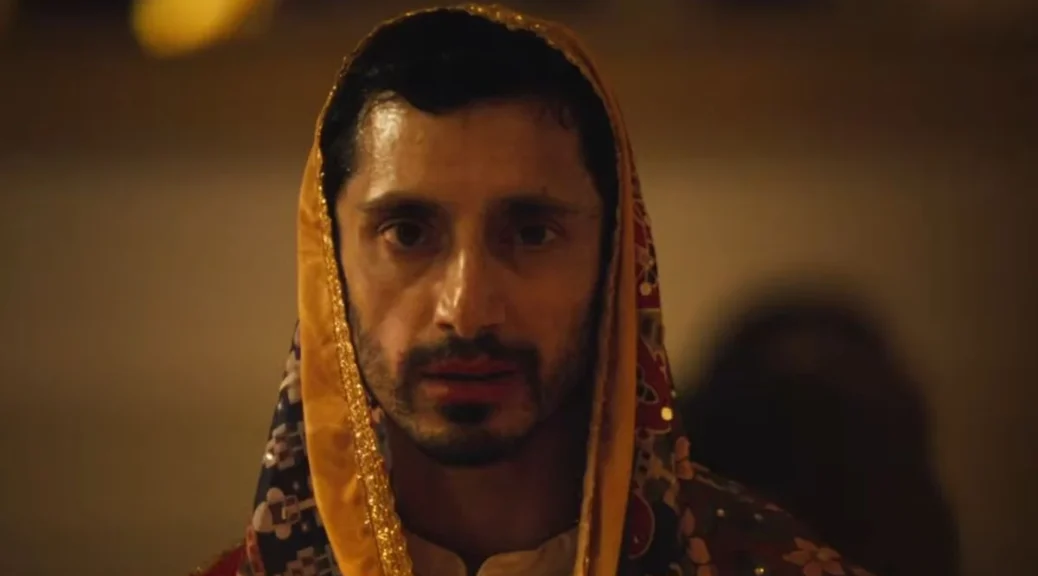
The role of Hamlet has been a make-or-break role for actors for four centuries. Ahmed makes it look effortless, so convincing is he in the grief of losing a father, the horror of a mother’s betrayal, and the pressure of tradition.
Joe Alwyn (Hamnet – guy likes this story, I guess!) as Laertes and Morfydd Clark (Saint Maud) as Ophelia bring depth and pathos to minimized characters.
Michael Lesslie adapts the tragedy. Though the writer’s gone on to blockbusters and superheroes, his first feature length script was Justin Kurzel’s impressive 2015 take on Macbeth. Once again, Lesslie proves adept at pruning what’s necessary only for the stage, giving his director room to tell the tale cinematically.
Reconsidering the cultural background within a South Asian culture doesn’t just freshen up the familiar. It impresses the universality and timelessness of the original work upon the viewer. The play within a play—Hamlet’s gift at the wedding—is the film’s showstopper. But Karia imaginatively stages some of the play’s most remembered scenes, adding vitality and action that takes advantage of the freedom from the stage while still amplifying the hero’s anxiety.



