Tag Archives: movies

Best Movies of 2018 So Far

You asked for it. Wait, did you? Well, you’ve got it: the best films of the first half of 2018. A great mix of blockbuster and indie, foreign and domestic, action, drama, comedy, SciFi and horror. The second half of the year has a lot to live up to!

10. Annihilation

Alex Garland’s work as both a writer (28 Days Later…, Sunshine, Never Let Me Go) and a writer/director (Ex Machina) has shown a visionary talent for molding the other-worldly and the familiar. Annihilation unveils Garland at his most existential, becoming an utterly absorbing sci-fi thriller where each answer begs more questions.

A strange force of nature dubbed “The Shimmer” has enveloped the land near a remote lighthouse, and is spreading. Years of expeditions inside it have yielded only missing persons – including Kane (Oscar Issac). When Kane suddenly returns home and almost immediately falls prey to a life-threatening illness, his wife Lena (Natalie Portman, perfectly nailing a desperate curiosity) is detained for questioning by the military.

Garland builds the film in wonderful symmetry with the hybrid life forms influenced by The Shimmer. Taking root as a strange mystery, it offers satisfying surprises amid an ambitious narrative flow full of intermittent tension, scares, and blood—and a constant sense of wonder.

Just his second feature as a director, Annihilation proves Ex Machina was no fluke. Garland is pondering similar themes—creation, self-destruction, extinction—on an even deeper level, streamlining the source material into an Earthbound cousin to 2001.

9. The Rider

The classic western sings a song of bruised manliness. Chasing destiny, sacrificing family and love for a solitary life, building a relationship with land and beast—there may be no cinematic genre more full of romance.

This is the hardscrabble poetry that fills writer/director Chloe Zhao’s latest, The Rider.

But what Zhao’s film avoids is sentimentality and sheen. With a hyper-realistic style showcasing performances by non-actors, she simultaneously celebrates and inverts the romance that traditionally fuels this kind of film.

Elegant and cinematic, but at the same time a spontaneous work of verite, The Rider breaks its own cinematic ground.

Zhao’s work is unmistakably indie, not a born crowd-pleaser, but beautifully lifelike. She has given new life to a genre, creating a film about the loss of purpose and, in that manly world of the cowboy, masculinity.

8. Disobedience

Gracefully adapting Naomi Alderman’s novel, Sebastian Lelio (A Fantastic Woman, Gloria) continues his interest in stories of women struggling to be free and live as their true selves, exerting their power to disobey.

Rachel Weisz, Rachel McAdams and Alessandro Nivola are all wonderful, crafting resonant characters as Lelio slowly builds the drama of a conflicting, scandalous triangle. Little backstory is provided early on, giving more weight to pieces that are picked up from characters carefully dancing around old wounds.

The message is love and mercy, and how these basic tenets of religion are often forgotten in the name of enforcing a preferred social order. Lelio and his committed actors make it intensely intimate but never salacious, a parable with a powerful grip.

7. The Death of Stalin

Opening with a madcap “musical emergency” and closing with a blood-stained political coup, The Death of Stalin infuses its factual base with coal-back humor of the most delicious and absurd variety.

The film cements director/co-writer Armando Iannucci (Veep, In the Loop) as a premier satirist, as it plays so giddily with history while constantly poking you with a timeliness that should be shocking but sadly is not.

So many feels are here, none better than the sheer joy of watching this film unfold.

It is Moscow in the 1950s and we meet Josef Stalin and his ruling committee, with nary an actor even attempting a Russian accent. Those British and American dialects set a wonderfully off-kilter vibe.

It all flows so fast and furiously funny, it’s easy to forget how hard it is to pull off such effective satire. We end up laughing through a dark and brutal time in history, while Iannuci speaks truth to those currently in power with a sharp and savage brand of mockery.

6. Foxtrot

From its opening shot – a slow, dizzying swirl above a patterned kitchen floor – Foxtrot commits to a cornerstone of disorientation. Through both narrative and camerawork, writer/director Samuel Maoz keeps you off balance as he constructs a deep, moving dive into one family’s struggle with loss and regret.

Maoz’s visuals, sometimes anachronistic, bold and darkly funny, are never less than fascinating. His writing is incisive and brilliantly layered, confidently moving toward a shattering finale without stopping to worry about whether you’re connecting every loose end.

Just when you may think you know where Maoz is going, you don’t. But the rug isn’t pulled by cheap gimmickry or emotional manipulation, but rather perfectly arranged pieces assembled by deeply affecting performances.

Like its namesake, a dance that will always lead you to “end up in the same place,” Foxtrot can be viewed from different angles with equal impact. You might see a sociopolitical statement on the filmmaker’s home country, a universal parable on the costs of war, or a starkly intimate take on family bonds.

5. Thoroughbreds

Directing his first feature, Cory Finley adapts his play about teenage girls planning a murder. It’s a buddy picture, a coming-of-age tale, Superbad, if you will. No, not really.

Wicked, surprising, unapologetic, cynical and buoyed by flawless performances, Thoroughbreds is a mean little treat.

Olivia Cooke mystifies, her observant but emotionally disinterested performance a magical thing to witness. Her Amanda has nearly perfected the art of pretending to be normal, pretending to care.

The fact that Anya Taylor-Joy’s Lily can see the advantage of this is what sets this coming-of-age tale apart from others.

If Cooke is great, Taylor-Joy is better. An actor who wears her vulnerability in her every expression, she gives great depth to this character on the precipice of adulthood, learning, as she must, that to prosper in her world you need to rid yourself of human emotions and replace them with acceptably false facsimiles.

It’s a fascinating look at how the other class comes of age, blackly comedic and biting.

4. A Quiet Place

Damn. John Krasinski. That big, tall guy, kind of doughy-faced? Married to Emily Blunt? Dude can direct the shit out of a horror movie.

Krasinski plays the patriarch of a close-knit family trying to survive the post-alien-invasion apocalypse by staying really, really quiet. The beasts use sound to hunt, but the family is prepared. The cast, anchored by Krasinski’s on-and-off-screen wife Emily Blunt is amazing. That you may expect.

What you may not expect is Krasinski’s masterful direction: where and when the camera lingers or cuts away, how often and how much he shows the monsters, when he decides the silence will generate the most dread and when he chooses to let Marco Beltrami’s ominous score do that work for him.

It’s smart in the way it’s written, sly in its direction and spot-on in its ability to pile on the mayhem in the final reel without feeling gimmicky or silly.

3. You Were Never Really Here

Two killers lie on a kitchen floor, gently singing along as the radio plays “I’ve Never Been to Me,” surely one of the cheesiest songs of all time. Only one of the men will get up.

It’s a fascinating sequence, one of many in Lynne Ramsay’s bloody and beautiful You Were Never Really Here. She adapts Jonathan Ames’s brisk novella into a dreamy, hypnotic fable, an in-the-moment pileup of Taxi Driver, Taken and Drive.

Joaquin Phoenix delivers an intensely powerful performance as Joe, a combat veteran whose been wounded in various ways. Joe lives with his mother in suburban New York, whetting his appetite for violence as a vigilante for hire who specializes in rescuing kidnapped girls and exacting brutal justice.

Together, Ramsay and Phoenix ensure nearly each of the film’s 89 minutes burns with a spellbinding magnetism. While Phoenix lets you inside Joe’s battered psyche just enough to want more, Ramsay’s visual storytelling is dazzling. Buoyed by purposeful editing and stylish soundtrack choices, Ramsay’s wonderfully artful camerawork (kudos to cinematographer Thomas Townend) presents a stream of contrasts: power and weakness, brutality and compassion, celebration and degradation.

2. Hereditary

Grief and guilt color every somber, shadowy frame of writer/director Ari Aster’s unbelievably assured feature film debut, Hereditary.

With just a handful of mannerisms, one melodic clucking noise, and a few seemingly throwaway lines, Aster and his magnificent cast quickly establish what will become nuanced, layered human characters, all of them scarred and battered by family.

Art and life imitate each other to macabre degrees while family members strain to behave in the manner that feels human, seems connected, or might be normal. What is said and what stays hidden, what’s festering in the attic and in the unspoken tensions within the family, it’s all part of a horrific atmosphere meticulously crafted to unnerve you.

Aster takes advantage of a remarkably committed cast to explore family dysfunction of the most insidious type. Whether his supernatural twisting and turning amount to metaphor or fact hardly matters with performances this unnerving and visual storytelling this hypnotic.

1. Black Panther

Just when you’ve gotten comfortable with the satisfying superhero origin story at work, director/co-writer Ryan Coogler and a stellar ensemble start thinking much bigger. And now, we need to re-think what these films are capable of.

Not a minute of the film is wasted. Coogler manages to pack each with enough backstory, breathless action, emotional heft and political weight to fill three films.

The cast shines from the top down.Chadwick Boseman, all gravitas and elegance, offers the picture perfect king. And is there anyone more effortlessly badass than Danai Gurira? No. Her General Okoye is here for the beat down.

Lupita Nyong’o is also characteristically excellent in the role of the conscience-driven liberal. In a scene where she expects Gurira’s general to commit what amounts to treason, Coogler expertly reinforces an amazingly well-crafted theme mirrored in other pairings: the friction between surviving by force or by conscience.

This theme is most clearly outlined by the conflict between Boseman’s King T’Challa and his new nemesis, Jordan’s Killmonger.

Michael B. Jordan, people.

Coogler hands this actor all of the most difficult lines. Why? Because it is material a lesser actor would choke on, and Jordan delivers like a perfectly placed gut punch. He sets the screen on fire, and though every single performance in this film is excellent, Jordan exposes the artifice. His castmates are in a Marvel superhero movie. Jordan is not. Instead, he is this rage-filled, broken, vengeful man and he is here to burn this world to the ground.

Coogler works with many of these basic themes found in nearly any comic book film—daddy issues, becoming who you are, serving others—but he weaves them into an astonishing look at identity, radicalization, systemic oppression, uprising and countless other urgent yet tragically timeless topics. The writing is layered and meaningful, the execution visionary.

Screening Room: Naughty and Nice

Welcome back! This week on the podcast we disagree on Sicario: Day of the Soldado, but our thinking is more aligned on Uncle Drew, Won’t You Be My Neighbor?, Hearts Beat Loud and Mountain. Plus, we’ll let you know what’s worth your time in new home entertainment releases.

Listen to the full podcast HERE.

WWFRD?

Won’t You Be My Neighbor?

by Hope Madden

The world did not deserve Fred Rogers.

A loving and tender soul if ever there was one, Fred Rogers saw children not as future consumers, but as vulnerable human beings who needed to know they had value.

Directed by documentarian Morgan Neville (Oscar winner for his 2013 doc 20 Feet from Stardom), Won’t You Be My Neighbor? trollies into the life of the children’s TV host. What you’ll learn is that, yes, Mr. Rogers was really like that.

What might surprise you, though, is how brave he was in representing the themes and conflicts of current events in the neighborhood. It seems everybody missed that—perhaps because of his gentle delivery, or maybe adults just couldn’t see past the puppets to notice. Rogers wasn’t out to be controversial. But when horrifying images from the Vietnam War, assassinations or terrorism splashed across TV screens, Rogers understood that this would frighten children, and they would need ways to cope that would not likely be there. So he did it himself.

The parallels to today are hard to miss, as is the current need for Rogers’s sincerity and idealism.

Neville mines ample archival reels from programs, interviews and home movies and offsets them nicely with talking head footage. The family exposes a man who struggled at times with exactly the kinds of insecurities and fears he addressed head-on for children on his show: fear of being a fraud, the need to be loved.

Neville’s film does not canonize the man. We see how uncomfortable he was with his SNL-style imitators and how infuriating he found trashy children’s programming.

Meanwhile, experts position him among the great child educators and colleagues see him as a fearless and savvy manipulator of the medium. An ordained pastor, Rogers also utilized his time with children to preach by example.

In one episode, Rogers is cooling himself on a hot day by bathing his feet. A visit from Officer Clemons, an African American character played by Francois Clemmons, prompts Fred to ask him to join. The two men sit blandly enough, side by side, their bare feet chilling in a plastic pool.

At that same time – as Neville points out with news footage – children may also have witnessed a different image on their TV screens: one of a public pool manager tossing bleach into the water to bully a black family into leaving the grounds.

Fred Rogers looked out for children, understanding what frightened us and making every attempt to help us through those “difficult modulations.” It’s tough to make it through the film’s 94 minutes without tearing up, and that’s not entirely from sentimentality. It’s from wondering whether today’s world is simply too cruel and cynical for Mr. Rogers.

Dia de los Muertos

Sicario: Day of the Soldado

by Hope Madden

How’s your summer going?

It may be good, but I bet it’s not Josh Brolin good.

He’s having a one-of-a-kind summer. The kind that follows blockbuster Avengers: Infinity War and Deadpool 2 with the sequel to the film that should have earned him his second Oscar nomination. (It also should have won Benicio Del Toro his second Oscar.)

But can Sicario: Day of the Soldado accomplish as much insightful commentary, intimate drama and visceral action as Denis Villeneuve’s riveting 2015 peek behind the curtains of the drug war?

The first piece of great news: writer Taylor Sheridan returns, scripting another border war with the cartels, this time focused less on drugs, more on smuggling terrorists across to the US.

Now for the bad news. Visionary director Villeneuve does not return, nor does legendary cinematographer Roger Deakins. Or Emily Blunt.

Dude, that hurts.

But del Toro and Brolin are back, and they were so fun last time. Brolin’s brash, deceptively easygoing Matt Graver has another mission requiring that he get dirty, which means more work for his favorite operative, played with shadowy precision by del Toro.

Cleveland’s own Isabela Moner joins the cast as a kingpin’s daughter, and for a moment you might think that the hole Blunt left has been filled. Defiant and solitary, Moner’s Isabella Reyes quickly becomes an enigmatic character you long to get to know better.

Unfortunately, we don’t. Equally underused is the great Catherine Keener, playing the administrator who holds Graver’s leash.

Dariusz Wolski is a gifted cinematographer, but he’s no Roger Deakins, whose brutal cinematic lyricism gave Sicario its arresting beauty. That fluidity is missing from the sequel, along with the fierce idealism that so perfectly balanced the cynical nature of the story.

Gone, too, are Graver’s eccentricities. Though Brolin’s performance is strong, the character himself has become little more than the traditional conflicted mercenary.

Likewise, del Toro is given a more ordinary man’s role. Not entirely ordinary, but that enigma that haunted Sicario serves more to keep the story moving forward, his time on screen rarely allowing a glimpse at who he is or, more frustratingly, how he and Moner’s Isabella respond to each other.

It sounds like it’s all bad news, and it’s not. Director Stefano Sollima serves up a fine, edgy piece of action for the summer. It’s just that I’d hoped for more.

The Grommets of Oz

Breath

by Hope Madden

Quiet poetry is hardly what we’ve come to expect from a surf movie. But actor-turned-director Simon Baker offers exactly that in his elegantly familiar coming-of-age story, Breath.

Based on Tim Winton’s novel, the film follows two mates in coastal Australia as their childhood friendship faces the snarls of the onset of adulthood.

Pikelet (Samson Coulter) —a beautiful gangle of limbs and promise—is the only child of a humble but loving family. He and Loonie (Ben Spence) are inseparable, though their futures are destined to veer in wildly different directions. Before that happens, they will tumble toward adulthood on some dangerous waves.

The lads find an unlikely mentor in the form of a bohemian surfer. Bodhi…no, I’m lying. His name is Sando (Baker), and for every one of Point Break’s Hollywood-slick moments of waves, wisdom and gleaming tan, Sando offers authentic surf-tossed ruggedness and reflection.

This film is less about that one big one, the one that’ll make you famous. It’s entirely about the journey, the solitude and the fear—what an individual can make of those elements, what those elements make of an individual. It’s about life.

The young actors’ performances are wonderfully true and fresh, each easily articulating those days immediately before adulthood claims a child, determining his inevitable direction. Breath is most at home as these two boys bristle and bond, but slightly less honest as they separate and explore the world’s dangerous secrets on their own.

The lads are full of promise, though you can already see a darker path for one. The adults onscreen, including Sando and his wife Eva (played with appropriate chill by Elizabeth Debicki), represent the many possible ways that journey could go wrong.

Though Baker directed a number of episodes of his TV show The Mentalist, Breath represents his first venture into feature filmmaking. He shows a knack for authenticity and understatement—two elements sorely lacking in coming-of-age dramas, not to mention surf films.

Even the way he captures the water evokes the idea of imperfection and wonder, unlike those crystal blue, foaming tubes we’ve become used to.

It works well with Winton’s words, adapted for the screen by Gerard Lee. Both he and Baker seem to have crafted the entire, lovely effort around one nearly perfect line: Never had I seen men do something so beautiful, so pointless and elegant, as if dancing on water was the best and brightest thing a man could do.

https://www.youtube.com/watch?v=chI8HpQt96Y

I Don’t Want to Go Out—Week of June 25

Well, not a lot to boast about in home entertainment this week. What we recommend is binging all the films of Justin Benson and Aaron Moorehead: Resolution, Spring and—available to stream or bring home this week—The Endless. The other options this week suck pretty hard.

The Endless


Tyler Perry’s Acrimony

Terminal

The Long F*cking Goodbye

Izzy Gets the F*ck Across Town

by Matt Weiner

For a character who’s supposed to have trouble holding down a steady job, Izzy is putting in some serious work: Izzy Gets the F*ck Across Town is a road trip movie that never leaves its first city, a shaggy dog celebration of Los Angeles with characters who could rival those in any LA noir. But more than anything it’s a sharp inversion of the manic pixie dream girl and the role she inhabits.

Written and directed by Christian Papierniak, Izzy GTFAT is disjointed by design. Mackenzie Davis (Tully) holds everything together as Izzy, a once-promising musician who is now too strung out to keep a catering job, let alone the man of her dreams. When she finds out that her ex-boyfriend Roger (Alex Russell) is getting engaged, she sets off across Los Angeles to make it to the big party and win him back.

At each stop in her journey, Izzy gets help from a standout supporting cast. Lakeith Stanfield, Haley Joel Osment, Alia Shawkat and Annie Potts run the gamut from wistful and strange to funny and strange to… well, strange and strange. These vignettes have the feel of early Richard Linklater, so while the structure of Izzy’s Odyssean journey gets repetitive midway through, the actors keep it interesting.

Papierniak gets the film back on track with Izzy’s major confrontations: first a bittersweet reunion with her sister (Carrie Coon), which hints at a lifetime of backstory in just a few tender minutes. And then finally with what has been teased all along: Roger’s engagement party.

Without giving too much away, the confrontation and aftermath go in a remarkable direction, serving up an altar of clichés only to mercilessly destroy them—a sacrifice to Izzy’s rebirth. She has spent the entire film careening from one manic pixie trope to the next in her desperate attempt to be the catalyst in somebody else’s story. So it’s pure delight to watch the way in which Izzy takes control after spending her adult life in thrall to her own fantasies, failures and dreams deferred.

There could easily be a version of this movie from Roger’s perspective. And ten years ago, we would all be expected to care about what happens to that bearded thumb and be happy for him. It’s probably the reality Izzy would have been happy with at that point in her life, too.

But times change. People change. Slowly, unevenly. And maybe not in ways we always hoped, but hopefully still, in some small way, for the better.


Dinosaur Poetry

Jurassic World: Fallen Kingdom

by Hope Madden

If you don’t know director J.A. Bayona, that’s unfortunate. His first three feature films—The Orphanage, The Impossible and A Monster Calls—emphasized storytelling skills that were equal parts visceral and poetic.

He picks up the Jurassic mantle with the latest in the franchise, Jurassic World: Fallen Kingdom. The visceral part seems likely, but dinosaur poetry? Sadly, no.

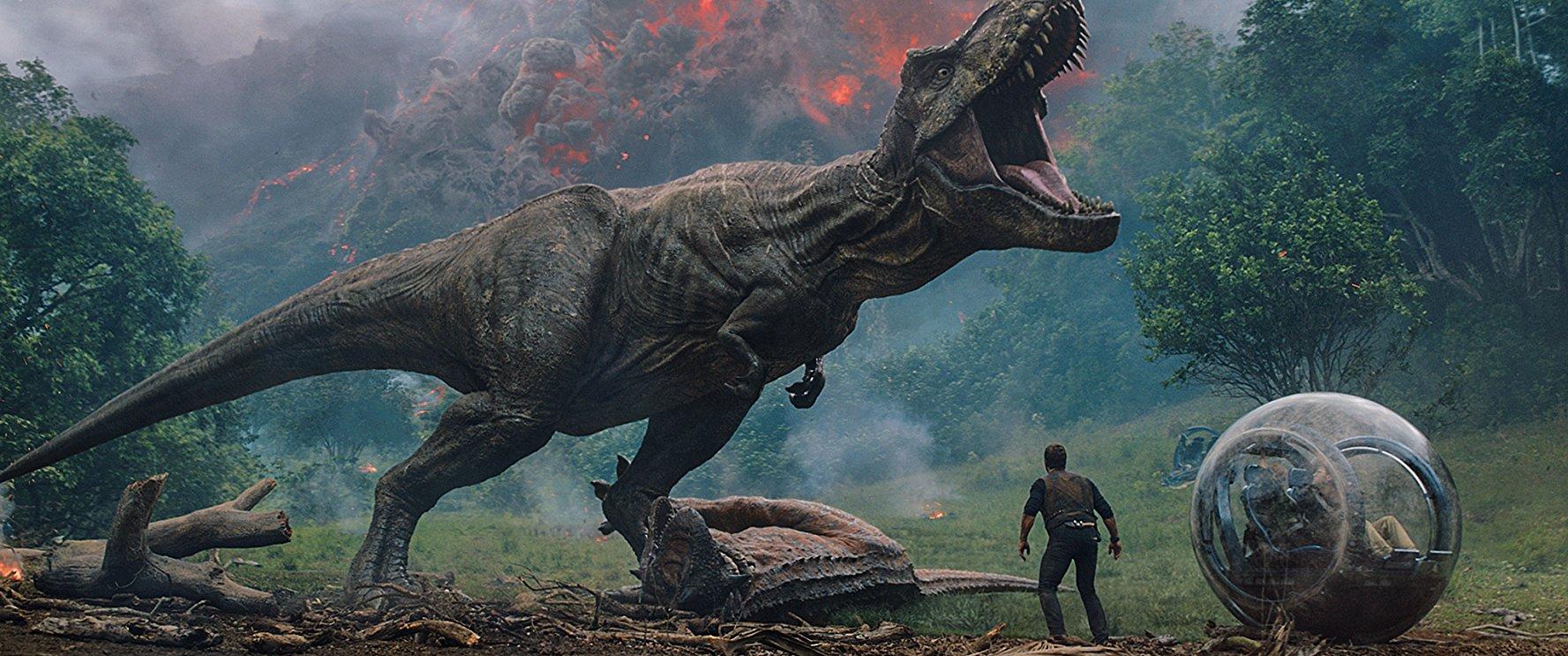
It’s been a few years since toothy, carnivorous hell broke loose on the island theme park Jurassic World. Though the un-Jurassic world has left those dinosaurs alone on their island—mostly—the island itself seems to be self-selecting extinction for the beasts, its now-active volcano an immediate threat to their very survival.

Claire Dearing (Bryce Dallas Howard) wants to save them. But how? I mean, dinosaurs are really big. Many of them bite. Interacting with them has proven dangerous and silly four different times. What’s a girl to do?

Well, put on some sensible shoes, for once, and take a deal from a dying old billionaire with a Hogwarts-style estate and a guilt complex. Benjamin Lockwood (James Cromwell), one-time partner of John Hammond (Richard Attenborough from the original film), wants to bring as many beasties as possible to a secluded island he owns where they’ll be safe.

Or is this just another example of idealistic lefties falling prey to greedy capitalists and scientists with their cadre of guns-for-hire?

It’s basically The Lost World with more volcano and less Vince Vaughn.

Howard’s Dearing—point of such contention in the previous installment with her severe hair, white pumps and icy demeanor just waiting to be melted by a real man—is simultaneously softer and stronger this time around. Howard, though, is mainly just dewy-skinned and earnest.

Chris Pratt returns as the real man in question, and he is as charmingly Chris Pratt as ever.

The real problem, besides the hackneyed and derivative story penned by Derek Connolly and Colin Trevorrow (who both penned Jurassic World, which Trevorrow directed), is Bayona’s tired direction.

Though he does not shy away from showing human carnage, there is not a fresh or compelling set piece in the film. What doesn’t feel directly lifted from earlier works plods along blandly, the only tension coming from the real curiosity about why the character hasn’t yet a) closed the door, b) climbed the ladder, c) run.

Yes, the sight of a volcano exploding on Hawaii (location for the filming) does generate some anxiety, and the sound of a child crying out near images of anything being caged against its will is even more horrific. It’s hard to credit Bayona for having his finger on the pulse of current events, though, given that he’d have completed shooting at least a year before our latest American shame.

Hell, dinosaurs would be a welcome change of pace at this point.

The Audacity and the Idiocy

American Animals

by Hope Madden

In 2012, director Bart Layton laid down one of the most compelling and nutty documentaries in recent history. His true crime doc The Imposter was one of those rare films that you could not predict nor could you turn away from. It was fascinating, and not just because the story was so wild, but because of Layton’s spry skills as a storyteller.

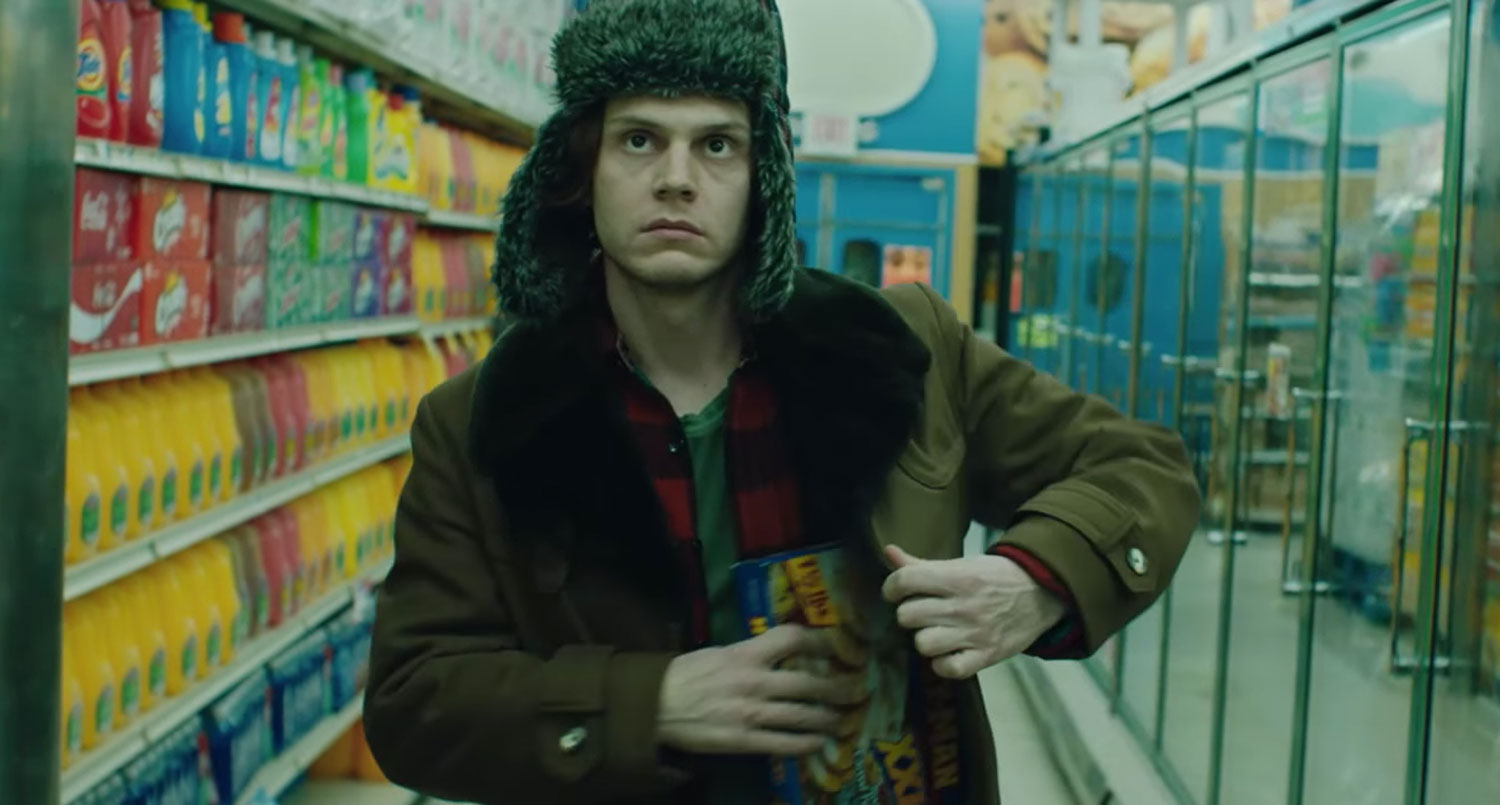
He’s again pulling from the world of true crime to tell a potent story with his latest, the narrative feature American Animals. The yarn he spins here: four perfectly reasonable, likable, comfortable college kids steal a set of pricey books from Transylvania University’s rare books collection, including Darwin’s original Origins of the Species and Audubon’s Birds of America.

The audacity of the plan itself is reason enough to pay attention. Buddies get the itch to do something big. Something life-changing. Consequences be damned. Or, more rightly, ignored.

Build from there with a truly talented group of young actors: Evan Peters (X-Men’s Quicksilver), Barry Keoghan (Killing of a Sacred Deer, Dunkirk – the kid can do no wrong), Jared Abrahamson (Sweet Virginia, Detour) and Blake Jenner (Everybody Wants Some).

Layton opens with text on screen: This is not based on a true story. The words “not based on” disappear, leaving: This is a true story.

A bold statement to make, and American Animals is as interested in the effect individual perspective plays on true stories as Craig Gillespie’s I, Tonya or Sarah Polley’s near-perfect 2012 documentary, Stories We Tell.

Once again, Layton blends fiction and nonfiction devices to question the possibility of honesty in storytelling. As he weaves from actors recreating the heist to the actual participants telling their versions of events, Layton poses intriguing questions about perspective and truth.

They aren’t questions he answers, though, or even truly explores.

The film works best when it digs into the American preoccupation with unlimited potential, the individual’s specialness. The four young men who risk their futures unnecessarily suffer from that curse of the restlessly entitled.

As you watch the inevitable collapse of a reckless gang of kids’ movie-inspired heist, American Animals suggests depth and introspection but feels more like it’s grasping for a suitable ending, an appropriate way to cap all this madness with a bit of insight.

The problem with the film is the problem with the heist itself: it was fun while it lasted, but was there really a purpose?

I Don’t Want to Go Out—Week of June 18

Dude, it’s the heat of the summer. No better way to escape all that hair-frizzing humidity than by lounging about in your own home watching movies. We understand. This week, you can choose from new indie comedies, horror, dramedies and straight up trash. Let us help.

Click the movie title for the full review.

The Death of Stalin

Unsane

Flower

Pacific Rim Uprising