Tag Archives: movies

Identity Theft

Luce

by Hope Madden

It’s appropriate that so much of the film Luce follows the titular character’s preparation for a debate. The film itself seems to beg for audience argument.

Luce is a bit of an American miracle. A boy soldier rescued from Eritrea at 7 by a wealthy white couple, he’s reinvented himself by the beginning of his senior year in high school, becoming the golden child: debate team captain, cross country captain, speech team captain and eventual valedictorian.

A sternly supportive history teacher (Octavia Spencer) raises questions, her goal to help ensure Luce understands that he “cannot fuck up.” It becomes the catalyst for a tense, borderline terrifying exploration of identity, preconceptions, race, refined society and who gets to take credit for what.

Kelvin Harrison Jr., so wounded and wonderful in It Comes at Night, holds all these puzzle pieces together as the enigma at the center of a mystery. His turn as the charismatic central figure in this highly polite and scholarly debate is fascinating, haunting and, in rare flashes, painfully vulnerable.

His manufactured persona, his carefully studied sincerity, emphasize an image that’s too good to be true. But Harrison Jr. brings so many additional layers—manifestations of survival techniques, an ability to read his environment and predict everyone’s behavior—that give his character needed complexity. Luce is not just a black student everyone can be proud of, or some wonderful example of how our system can work.

And that’s what makes him scary. So when he executes a history assignment too well—writing from the perspective of a historical figure who suggested violence as a moral response to colonialism—he freaks out a teacher (Spencer, wonderfully righteousness) who’d rather he embrace his favored status so she can bask in the glow.

Naomi Watts and Tim Roth play Luce’s socially conscious parents, and the pairing makes it tough to keep your mind from recalling Funny Games, Michael Haneke’s grim picture of affluent familial catastrophe. Whether intentional or not, the casting adds an underlying sense of urgent dread—as does Geoff Barrow and Ben Salisbury’s discordant score.

Watts is particularly strong, and the who-knows-what dance she does with Roth as their son plays one off the other adds a queasying rhythm to the mystery.

Julius Onah’s direction sometimes betrays the stagebound nature of the source material. (J.C. Lee adapts his own much lauded play.) Too much is revealed through lengthy monologues and there’s little smooth flow from scene to scene.

But his film teems with provocation and his cast more than meets that challenge. Harrison Jr. in particular is a revelation, an image of a thing that doesn’t exist but is so true you’ll never know if anything else is really there.

I Don’t Want to Go Out—Week of August 26

What do you want to watch this week? A musical biopic that finally manages to get past the standard “behind the music” approach is our pick because it’s a charming bit of fun. And because everything else that comes out this week kind of reeks.

Rocketman

Godzilla: King of the Monsters (DVD)

The Secret Life of Pets 2 (DVD)

I Do or Die

Ready or Not

by Hope Madden

Fucking rich people.

I don’t know about you, but this is a sentiment I can get behind.

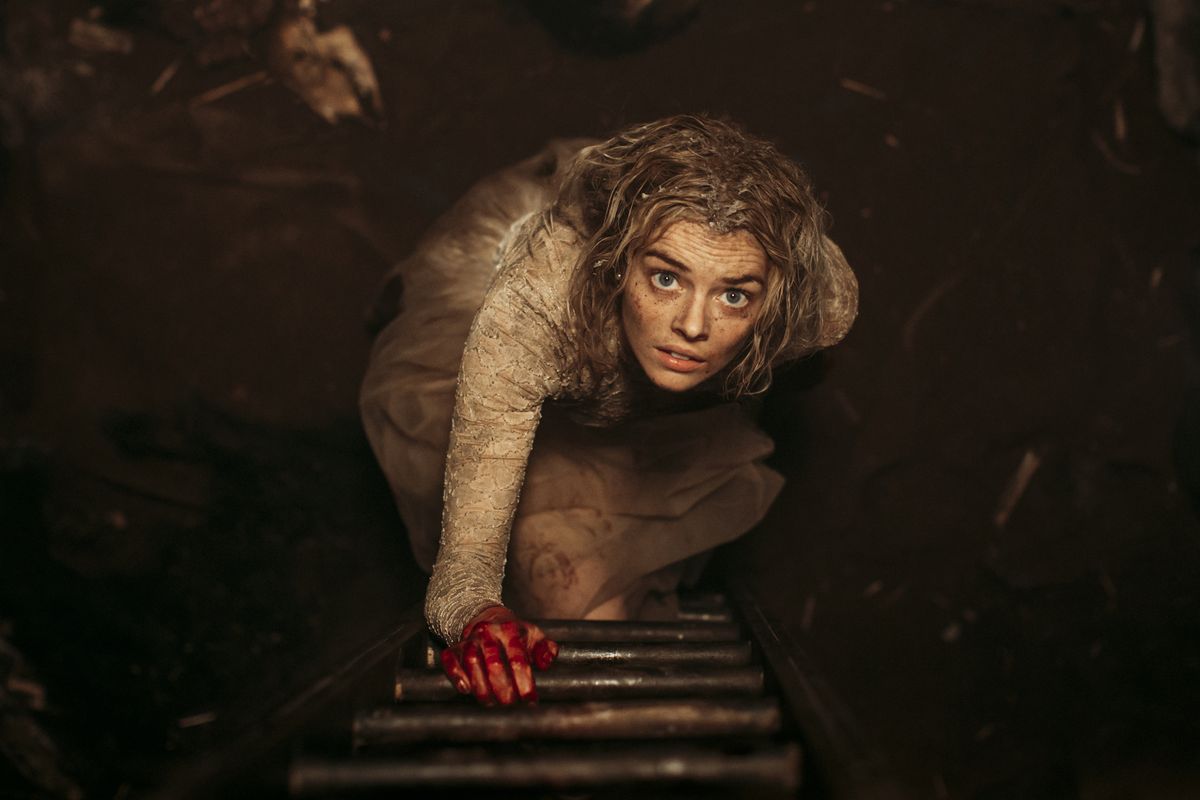
Grace (Samara Weaving, Mayhem) doesn’t know whether her soon-to-be in-laws are eccentric or they just plain hate her. Or maybe they are as evil as her groom Alex (Mark O’Brien) and his drunk-but-amiable brother Daniel (Adam Brody) say they are.

The brothers are just kidding, right?

Directors Matt Bettinelli-Olpin and Tyler Gillett (Devil’s Due—meh) invite you to join the happy couple as they plunge into a world where the wealthiest among us would rather commit murder than do without what none of them worked very hard to earn.

At midnight on Grace and Alex’s wedding night, everyone assembles in the Le Domas family game room: Mom and Dad (Andie MacDowell and Henry Czerny), Aunt Helene (Nicky Guardagni), other siblings and in-laws. It’s a ritual. Just one quick game of hide and seek. What could go wrong?

The inky black comedy plays like a game of Clue gone mad with arterial spray, the film’s comic moments coinciding most often with the accidental slaughter of servants.

The filmmakers take advantage of Weaving’s grit and comic timing, skipping from one bloody comic set up to the next. The plot and the chase move quickly enough to keep you from dwelling on the shorthand character development, the errant plot hole and the occasional convenience. It’s fun, it’s funny, and it’s a bloody mess.

And yet, the film feels safe, as if it is loath to truly represent the wealthy as people who’d leech the life from those beneath them (a la Get Out). Although, like Jordan Peele’s horror classic, Ready or Not introduces a deeply disturbing song almost as chilling as Get Out’s “Run Rabbit, Run.”

Weaving is proving herself to be reliably badass in the genre, her central performance elevated by the sometimes inspired work of the ensemble. MacDowell, in particular, seems to be enjoying herself immensely.

Even with the clever turns and cheeky performances, the film lacks substance. I mean, yes, I can indulge my secret belief that the rich are evil all day long. So, thank you Ready or Not for playing that card. In the end, though, the film’s just a slight and entertaining (and gory) way to waste your time.

Thump, Thump, Draaaag

Scary Stories to Tell in the Dark

by Hope Madden

Was there a story you heard as a kid that scared you sleepless? Mine was Bloody Fingers, the tale of a mangled man who dragged his carcass toward you. You could hear him coming: thump, thump, draaaaag. My neighbor used to sneak up behind me muttering those terrifying words.

Writer Alvin Schwartz knew how to work a kid’s nerves even better than my neighbor. Inspired by campfire tales and urban legends, he spun yarns for maximum kid fright, then paired them—and this is the important part—with the inspired line drawings by Stephen Gammell. The result, Scary Stories to Tell in the Dark, became the go-to for kids who like to be scared and schools who like to ban books.

Director André Øvredal (TrollHunter, The Autopsy of Jane Doe) and co-writer Guillermo del Toro both know something about tingling the spine. Together with a team of writers—some veterans of horror, some of family films—they’ve created an affectionate and scary ode to the old series of books.

Set in Mill Town, Pennsylvania around Halloween, 1968—trees are turning, Nixon is about to be elected, Night of the Living Dead is showing at the drive in—Scary Stories to Tell in the Dark follows three wholesome high school outcasts and a handsome out-of-towner. On the run from the Vietnam-bound, letter-jacket wearing bully, they hide in the old, abandoned Bellows place. The town says the house is haunted.

Sounds a little cliched, right? The kind of story you’ve heard over and over, but that’s exactly the point. To begin to tell Schwartz’s tales—all of them pulled from the collective unconscious, all of them drawing on those same old stories that were new to us as kids—Øvredal sets a familiar and appropriate stage.

His framing device works well enough for a while. Stella (Zoe Margaret Colletti), who hopes to be a writer herself, swipes creepy old child killer Sarah Bellows’s book of stories, but when she gets them home, new stories write themselves in the blank pages and, one by one, the kids in Mill Town go missing.

This is what PG-13 horror should look like. Yes, like most of the genre films engineered for youngsters, Scary Stories rehashes tropes familiar to adult viewers, but Øvredal’s clear fondness for the terrifying source material, especially the illustrations, gives the film the primal, almost grotesque innocence of a childhood nightmare.

The film’s tone is spot-on, performances solid and the set design and practical effects glorious. This is more than an anthology of shorts. It’s a cohesive whole that contains a handful of Schwartz’s nightmares, but the whole is not as great as the sum of its parts. Too heavy with clichés in the framing device, the film loses steam as it rolls into its third act.

An analogy of lost innocence, nostalgic without becoming too sentimental, this is old school scary, as unapologetically unoriginal as its source material and almost as effective.

https://www.youtube.com/watch?v=yf0JwXkXs0c


Truth and Injustice

Brian Banks

by Brandon Thomas

Anyone with two working eyes knows that the criminal justice system in the United States is far from perfect and rarely yields actual justice. The situation is even bleaker for young men of color. Even after their time is served, people convicted of a crime have a hard time finding work and maintaining new relationships.

As unfair as this is for everyone that goes through it, it can be especially grueling for people convicted of crimes they did not commit.

Brian Banks (Aldis Hodge) was once a star high school football player. He and his mother (Sherri Shepherd) had planned for Brian to attend college and hopefully make it to the NFL. All of that changed with a chance encounter that led to an accusation of kidnapping and rape. The barriers Brian faces after his release from prison lead him to a lawyer (Greg Kinnear) who might be able to clear his name and give him back his future.

Brian Banks is an interesting look at incarceration in that the film never once questions Brian’s innocence. In fact, the audience is clued in early on that Brian is a character we can trust. This film isn’t one that dwells on twists and turns. It’s more interested in Banks himself and what his plight says about our justice system. Unfortunately, that look tends to be one dimensional, and pushed through the lens of a mediocre TV movie-of-the-week.

Hodge (Hidden Figures, Straight Outta Compton) brings a humanity to this role that makes it easy to cheer for Banks despite the over-abundance of cliche. He does a wonderful job showing Brian’s frustration, hurt and disappointment all at once. It’s a tightrope performance, and Hodge pulls it off beautifully.

But there’s a cheapness to Brian Banks that makes it look like it would be right at home on the Lifetime cable channel. This is especially surprising since director Tom Shadyac spent the majority of his career making huge studio movies like Liar Liar, Bruce Almighty and The Nutty Professor. None of these films is exactly Lawrence of Arabia, but they still had a distinct visual flair. 

Despite a strong lead performance, Brian Banks can’t overcome its reliance on age-old courtroom cliche and melodrama that ends up bringing the movie down. It’s a film that had something to say, but the message became muddled and/or lost along the way.


Sail On Sailor

Maiden

by Hope Madden

“The ocean’s always trying to kill you. It doesn’t take a break.”

So says Tracy Edwards, and she should know. At 24 years of age in 1989, fresh off a stint as cook on a charter boat, Edwards skippered the Maiden with the first all-female crew to enter England’s Whitbread Round the World Race.

Thirty years later, documentarian Alex Holmes revisits this historic event with clarity and candor.

It’s certainly no surprise that the odds were stacked against Edwards, although it is fascinating to look back at just how these sailors were treated by other yachtsmen as well as the media.

According to Jen Mundy, Edwards’s girlhood friend and member of her crew, those set to sail Maiden were told: “You’re not strong enough. You’re not skilled enough. Girls don’t get on. You’ll die.”

Girls don’t get on?

Yes, even as the Eighties came to a close there were enough commonly believed stereotypes about women’s inabilities and bitchy tendencies to sink a yacht. And Holmes is not ready to let those spouting such idiocy off the hook. He interviews a number of journalists, each of whom admit to being convinced the Maiden has no shot at completing the race. The Guardian’s Bob Fisher went so far as to refer to the crew as “a tinful of tarts.”

He actually defends that headline in the documentary.

It’s impossible not to notice that the word “woman” is used maybe twice in the entire film, every participant, even Edwards herself, preferring the term “girls.”

Vocabulary aside, Holmes finds an interesting arc for a sports doc. As the race begins, simply finishing the first leg was cause for patronizing celebration: a bunch of girls didn’t die. Hooray!

But Edwards and crew were, like everyone else in the race in 1989, competitors invested in the competition, focused on winning and only on winning. Unlike their competition, the crew of the Maiden seemed genuinely, even wildly unaware of the profundity of simply participating.

The spirit of female defiance, that’s the flag the Maiden flew at journey’s end. After proving their ability – after besting their competition repeatedly —that celebration lost its patronizing taint.

Scene after windy, wet, terrifying scene—the nautical thrills crisply underscored by Rob Manning and Samuel Sim’s score—skipper and crew of the Maiden strategize, tough it out, and risk a watery grave. And why?

Mainly because one malcontent—Edwards, who’d been suspended 26 times before she was finally expelled from school at 15—wanted to do it and was told she couldn’t.

“What do you mean I can’t? That’s just idiotic.”

Indeed.

Bald & Bickering

Fast & Furious Presents: Hobbs & Shaw

by Hope Madden

Somewhere around its 6th installment, the Fast & Furious franchise tweaked its direction, abandoning logic and embracing ludicrous action as it jumped cars from skyscraper to skyscraper and waterskied off the back of launched torpedoes.

But things took off for real around Episode 7 when some mad genius decided to pit mountainous government operative Hobbs (Dwayne Johnson) against Limey nogoodnik Deckard Shaw (Jason Statham), each of them playing a self-lampooning version of themselves. Fun!

Where to go from there? How about we drop that whole car heist and espionage thing, expel Vincent Toretto and gang, bring in Idris Elba and see what happens?

And for the very first time, I was kind of looking forward to a F&F film.

Fast & Furious Presents: Hobbs & Shaw boasts more than ampersands. Internal logic? Cohesive plot? Thoughtful insights on man’s inhumanity to man?

Why, no.

Cheeky fun? Indeed!

The film indulges in the best elements of F&F (action lunacy, self-aware comedy) and dispenses with its weaknesses (schmaltz, Diesel). F&F: H&S consists primarily of fistfights, gun fights and vehicular chicanery stitched together with comic lines. Unfortunately, there is a plot, but it doesn’t get in the way too much.

A virus meant to thin the herd falls (or is injected!) into the hands of a rogue
(or is she?!!) MI6 agent. The CIA (or is it?!!!) pulls together the two old enemies for no particular reason, but Ryan Reynolds shows up in a decidedly peculiar cameo (one of several to look out for) that draws your attention away from the first of many gaping plot holes.

By this point (about 7 minutes into the film) we’ve been through three separate fight sequences, each meant to articulate the character of one of our leads: down-and-dirty badass (Hobbs), smoothly lethal sophisticate (Shaw), smart and efficient and highly contagious (Vanessa Kirby as MI6 virus thief Hattie), and Black Superman (Idris Elba, who gives himself the name, but if it fits…).

Right. Enough with plot, on to stupifyingly illogical and imaginative action. Hobbs & Shaw offers quite a spectacle.

It bogs down when it gets away from the explosions, wheelies and punches. Whether devoting excessive time to pissing contests or to dysfunctional family backstories, director David Leitch—who proved his action mettle with Atomic Blonde—too often forgets that words are not this franchise’s strongest suit.

Still, there is something compelling about watching Black Superman V Samoan Thor. I don’t know that there’s enough here for a franchise springboard, but there’s plenty for a wasted afternoon.

A Masterpiece It Is Not

Leo Da Vinci: Mission Mona Lisa

by Christie Robb and Emmy Clifton

During the recent heatwave as a bid to keep everyone entertained and out of the sun, I asked my upcoming Kindergartner, Emmy, to help me with my latest movie review.

Mom says…

Even a cup of ill-timed afternoon coffee was barely enough to keep me from nodding off during director Sergio Manifo’s animated adventure. The premise was interesting, centered around a teenage Leonardo Da Vinci who brings mechanical contraptions into being in  15th century Italy. But as we passed the 10 minute mark with no inciting incident, I realized we were in trouble.

Eventually we get it. Leo’s friend Lisa’s farm has been vandalized. The crops are destroyed. And without them, Lisa’s dad can’t pay the mortgage and she’ll have to be married off to the anemic son of their nobleman landlord.

The film has a little bit of everything: jokes that don’t land, phoned-in voice acting, questionable gender stereotypes (girls are described as “moody” and cry to get their way), characters who lack development, painful musical numbers that appear out of nowhere, exposition dumps delivered through dialogue, and a romance that makes Anakin and Padme’s in Attack of the Clones look nuanced.

But my favorite thing by far is the closing song. I’ll leave you with some of the lyrics:

When I am here with you

I’m a fish inside a creek

And I don’t know how to speak

Maybe a mobile phone would help

Kid says…

I enjoyed it more than the Little Mermaid, but less than Frozen. Leo was my favorite character. He did the fun stuff. Lisa, the girl, was ok. I’d watch it again. It was kind of scary in parts. Why does everything end up a skeleton in this movie?

Mom’s Verdict:

Emmy’s Verdict: