Tag Archives: movie reviews

Sleeps with the Fishes

Luca

by Hope Madden

It’s summertime. Who doesn’t want to look out on the bluest water as little boats rock in the breeze and kids cavort in a tiny seaside villa on the Italian Riviera? Awash in the wonder of childhood, the latest adventure from Pixar follows someone from under the sea who’s lured to dry land—against their parents’ wishes—and finds a whole new world.

Wait, that last phrase evokes a different movie, but Luca – a Disney + release that doesn’t require the Premier Access fee – does share a winking resemblance to Disney’s most famous fish out of water story. Young sea monster Luca (Jacob Tremblay) finds the idea of the world above sea level equally forbidding and fascinating. He discovers, with the assistance of another young sea monster named Alberto (It’s Jack Dylan Grazier), that as long as he stays dry, he can pass for human.

Good thing, since the whole villa where they hide from Luca’s parents (Maya Rudolph and Jim Gaffigan) is obsessed with finding and killing the elusive sea monsters of lore.

Writers Jesse Andrews (Me and Earl and the Dying Girl) and Mike Jones (who co-wrote last year’s Oscar winner for Pixar, Soul) essentially turned The Little Mermaid into a buddy comedy. Rather than digging into a lot of angst, self-sacrifice or villainy, director Enrico Casarosa— longtime animator and writer/director of Pixar’s lovely 2011 short La Luna—keeps things light and harmless.

The water here is shallow but bubbling with activity. Luca and Alberto make a friend in the feisty Giulia (Emma Berman), make an enemy of the conniving Ercole (Saverio Visconti), learn a trade, discover a love of pasta, develop a longing to learn, and take part in an Italian triathlon (the middle leg is pasta eating) so they can win enough money to buy a Vespa and see the world.

It’s busy. It looks pretty. The message – embrace who you are – is worthy, but there’s just not much in the delivery for the film to call its own. From any other animation studio, Luca would be a solid summer release, but for Pixar, it’s a middling effort on par with Onward or Finding Dory. It’s a forgettable if lovely time waster.


To All Who Enter

Woe

by Hope Madden

What is it that haunts us, really?

Horror has a blossoming subgenre that’s particularly spooked by that inescapable curse of heredity. The metaphorical horror of facing what your family has to hand down to you whether you want it or not fueled Relic, Hereditary, The Dark and the Wicked, and now, Matthew Goodhue’s family horror, Woe.

It’s been a year since his father died, but Charlie (Adam Halferty) still hasn’t seemed to put it behind him. He toils on his dad’s old house but doesn’t ever make any real progress. Same with the backyard. Same with everything. He barely evens speaks to his family anymore, even though his sister Betty (Jessie Rabideau) is about to get married.

Charlie’s not just grieving. There’s something really weird happening to him in that house, and it colors his perceptions of everyone and everything else. Mysterious phone calls and a sketchy meeting out in the woods might set things straight.

Wait a minute, when has that ever helped anything?

Goodhue’s script avoids easy answers or simple metaphors. He evokes an eerie atmosphere, one that seems to envelop Charlie and threatens to take in Betty, but something that everyone else appears to be immune to. That’s especially true of Betty’s well-meaning doofus of a fiancé, Benjamin (Ryan Kattner, as an endearing as any could possibly be).

The three performances sell the story, the Twilight Zone weirdness, and the human pathos that underly everything. Woe is a slow burn, rushing nothing but punctuating its fog of depression and sorrow with bursts of action and brief, welcome splashes of humor.

Video Nasty

Censor

by Hope Madden

Catch catch a horror taxi

I fell in love with my video nasty

            –The Damned

Damned, indeed.

Stern, driven Enid (Niamh Algar) takes her responsibilities seriously. Unfortunately for her, they come at a high price. Enid is a film censor in the most punishing time and place for such an endeavor: Thatcher’s England. It’s 1985, an era when controversial films hoping to make their way to screens big and small found themselves more butchered than their characters.

Co-writer/director Prano Bailey-Bond takes inspiration from this notion in her feature debut, Censor—an immersive era-specific horror. It is especially immersive for Enid.

She spends long hours deliberating on exactly where the line is between danger and acceptability: rewinding, examining frame by frame, if necessary, regardless of the nonchalance and casual derision of her co-workers. Enid is convinced it is her duty to protect people from these images.

As she herself drowns in repeated viewings of the most violent and depraved material, you have to wonder whether she might be better off protecting herself.

Bailey-Bond has other questions in mind, like why is it that Enid is so preoccupied with this job, how might it feed her own darkness, and what happens when her worlds blend together?

Censor is a descent into madness film—nothing new in the genre. And moments of Censor can’t help but call to mind fellow Brit Peter Stickland’s 2012 treasure Berberian Sound Studio. But Bailey-Bond and co-writer Anthony Fletcher evoke such a timestamp with this film, not just in the look and style, but with the social preoccupation.

As coincidences pile up – a definitive family decision, a horror movie-style murder spree, a film that hits too close to home — Enid seems to suspect that her real motive has been to censor her own thinking.

When she stops doing that, look out.

Algar’s prim and sympathetic, deliberate and brittle. It’s clear from the opening frame that Enid will break. But between Algar’s skill and Bailey-Bond’s cinematic vision, the journey toward that break is a wild ride.

Enter Sandman

Awake

by Hope Madden

There are so few things I enjoy more in this life than sleeping. Sleeping is the best. I love sleeping. This is one of the reasons director Mark Raso’s apocalyptic Awake got under my skin.

But it’s supposed to, after all. It’s not a comedy. It’s a spare, clever idea about some kind of celestial happening that throws off our hard wiring enough that we lose the ability to fall asleep. This power surge affects more than just our own circadian rhythms, though. It also shuts down all electric power, including car engines.

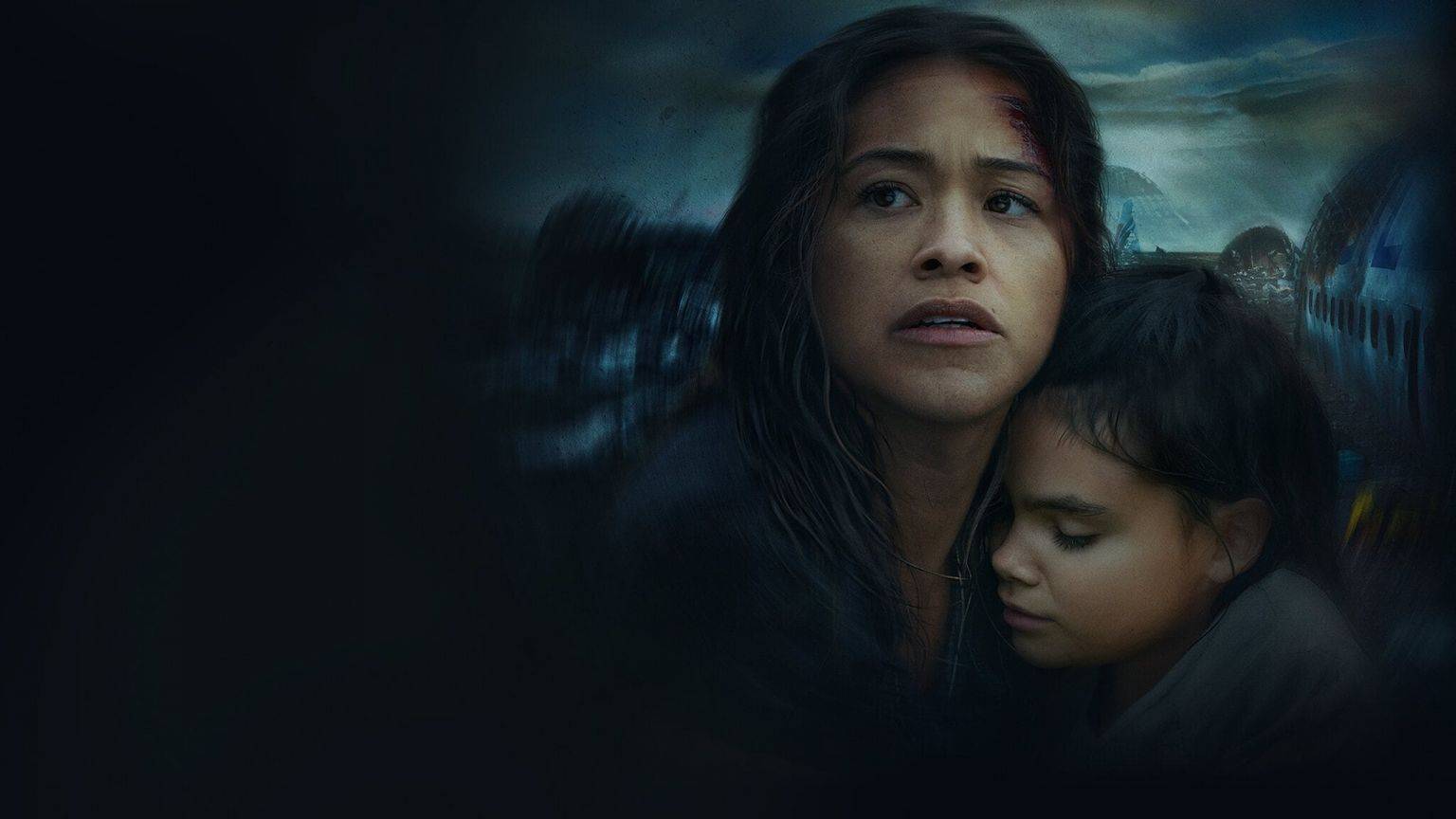
Jill (Gina Rodriguez) was tired already. She just finished the late shift as security at a local hospital when she picked her kids up for their day together—her son Noah (Lucius Hoyos) goes more reluctantly than her young daughter Mathilda (Ariana Greenblatt). By the time Jill understands what’s happening, she realizes the kind of danger her daughter is in—from religious zealots as well as government officials—because Mathilda can sleep.

So, there you have it. There’s a fight against the clock (the film outlines in great detail exactly how this will disorient and then eventually kill you) for this mother to figure out how her daughter will 1) survive the apocalypse and 2) continue to survive once everyone else is dead.

Rodriguez drives the film with a believable mix of savvy, grit and growing brain dysfunction. Several of the population-gone-mad set pieces are eerie and smart, although others are underdeveloped and unsatisfying.

Raso, working from a script he co-wrote with brother Joseph as well as Gregory Poirier, picks at one or two modern-day concerns but truly breaks new ground only rarely. Moments from The Mist, War of the Worlds, and just about every outbreak movie make their way into Jill’s family adventure. Borrowed as much of this is, it still comes together in a way that feels fairly fresh.

Support work from Barry Pepper, Jennifer Jason Leigh, Frances Fisher and Shamier Anderson offers the adventure shape and character while Rodriguez gives it a pulse. And some really heavy eyelids.

Random Acts of Comedy

Monuments

by Hope Madden

Random is good. Random is fun. It can be frustrating after a while, but it certainly isn’t boring.

Writer/director Jack C. Newell takes us on a not-boring road trip alongside Ted (David Sullivan) and his wife Laura’s (Marguerite Moreau) ashes. He stole the ashes from Laura’s weird family who never did like him, but they’d stolen the ashes from him in the first place so it probably wouldn’t have become a police matter if Ted hadn’t stolen that car while he was at it.

The thing is, Ted keeps seeing—even talking with—Laura, and he thinks she’s here to help him figure out what to do with her ashes.

So, that’s the gist: Ted does not know how to move on without Laura and this road trip will move him toward some kind of closure. It will also involve near-Lynchian dance numbers, shadow puppet displays, and no real sense of direction.

The aimlessness suits the character—Ted is lost, metaphorically and often literally. It works less well for the film. The final moments of Monuments leave you with the sense that something has been accomplished. Its meandering nature and basic structurelessness leave you wondering what.

Sullivan gives off a charming, goofy Nathan Fillion vibe—rarely a bad thing, and certainly the style of performance best suited to this laid-back, screw ball, existential comedy. Still, those are a lot of adjectives for one film, and they don’t necessarily fit together that well. Here’s where Newell gets himself in trouble.

There should be sadness here. Underneath all the zany moments and haphazard adventures, a rumble of grief should constantly threaten to break the surface. Without that genuine human soul, the humor doesn’t ring true and the random setups feel forced.

As solid as Sullivan is, when it does finally come time for Ted to mourn, to face his own desperate lonesome loss, the actor fails. Worse still, his insincerity feels like a joke itself, mocking what is ostensibly the entire core of Ted’s breakdown and the catalyst for his behavior.

If this irony led to some kind of absurdist “What’s really the point of it all?” theme, maybe it would have been worth it. Instead, it just feels random.

Sex and the Sitter

Deadly Illusions

by Rachel Willis

Something I’ve learned from movies is that if you’re going to hire a nanny, expect some professional lines to be crossed.

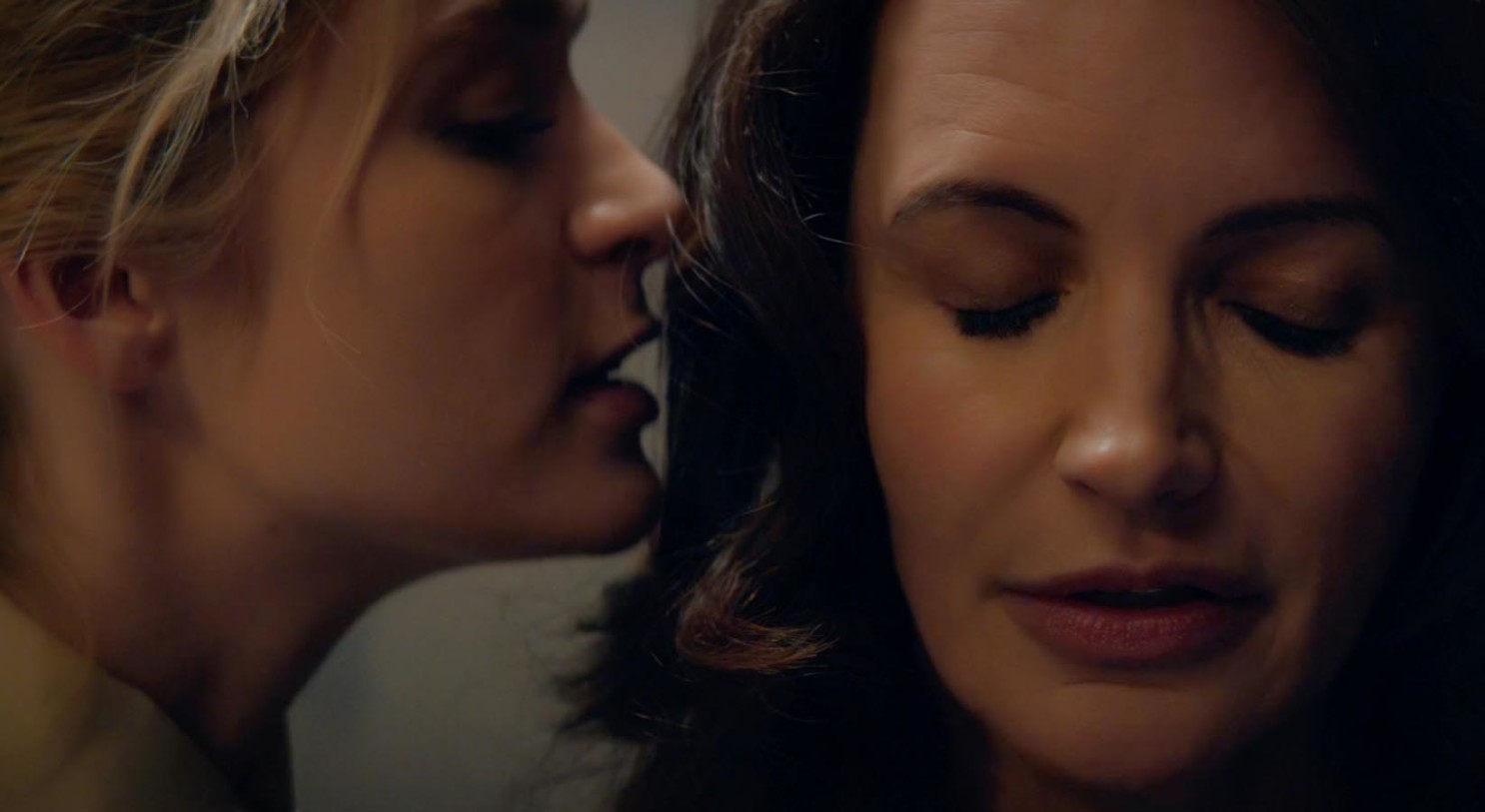
Such is the dynamic between Mary (Kristin Davis) and Grace (Greer Grammer) in writer/director Anna Elizabeth James’s erotic thriller, Deadly Illusions.

Mary is a novelist with a series of successful murder mysteries under her belt, but she hasn’t written a new one in a while. Her publisher is desperate to bring her back to pen a new addition. Mary’s reluctant, until her husband’s serious financial blunder makes the decision for her.

But who will take care of her kids while she writes? Enter sweet, innocent nanny, Grace.

The film’s set-up is slow to get going. It’s light on the eroticism and doesn’t feel like much of a thriller. The first act plods along, dropping the pieces into place as if aware we already know where this is going to go. It’s not a very compelling watch.

Things heat up in the second act, though not by much. We’re still waiting for the water to boil. The initial relationship between Mary and Grace quickly crosses into inappropriate territory. Mary takes Grace bra shopping and enters the dressing room with her. It’s predatory, though it seems the movie wants us to feel Grace is the aggressor in the scene.

As we simmer through, Mary’s creativity begins to interfere with her reality. As she loses herself in her new novel, she fantasizes about inappropriate activities with Grace. Or do those things really happen?

Things get weirder, and several clunky red herrings are dropped into the mix. This movie wants to keep us guessing, but it’s never enticing enough to make much of an impact.

Along for the ride is Dermot Mulroney as Mary’s husband, Tom. Mulroney is a capable actor, but doesn’t have much to do here – though his contribution to the film is more than that of the children whom Grace is hired to care for. You might forget Grace is a nanny and not Mary’s personal assistant.

Davis and Grammer have some fun with their roles, and their dynamic is curious if not entirely convincing. Grammer doesn’t have the chemistry with Davis that we need to be caught up in their relationship.

There are moments of enjoyment as the situations get stranger and the mystery more absurd, but overall, Deadly Illusions inspires more tedium than thrills.

Unchained Melody

Caveat

by Hope Madden

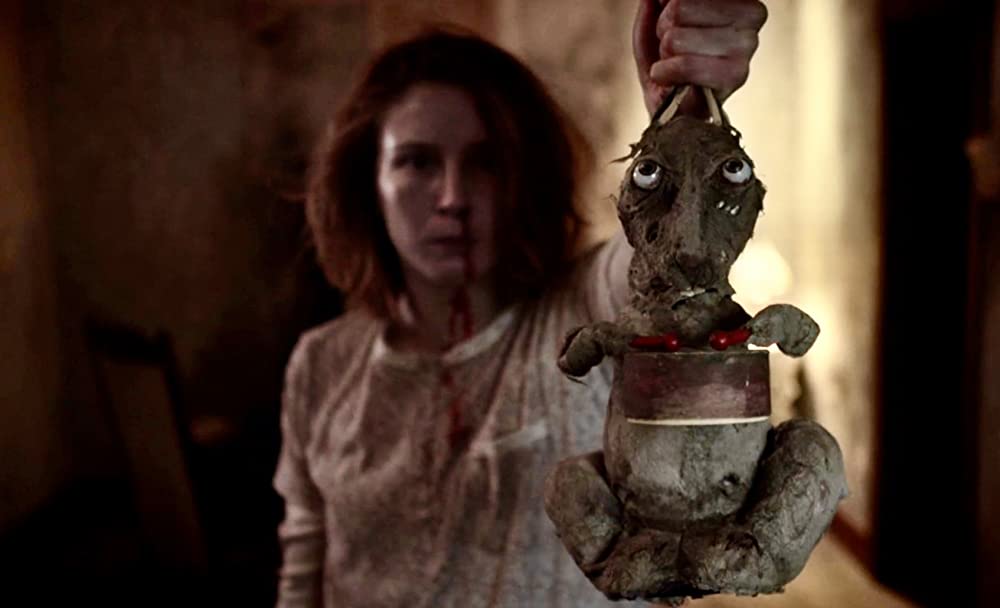
The room is dark, decrepit. A wild-eyed woman with a bloody nose holds a toy out in front of her like a demon slayer holds a crucifix. The toy – what is it, a rabbit? A jackalope? – beats a creepy little drum. Faster. Slower. Hotter. Colder.

This is how writer/director Damian Mc Carthy opens Caveat and I am in.

The woman is Olga (Leila Sykes), and we’ll get back to her in a bit, but first, we’re part of a conversation between the hush-voiced Barrett (Ben Caplan) and the foggy Isaac (Jonathan French). What can we tell from the conversation? They seem to know each other, Isaac’s had some kind of an accident, Barrett needs a favor.

The favor involves Olga, that house, and a long stretch of tightly fastened, heavyweight chain.

Dude, how good is Mc Carthy at this?

An expertly woven tapestry of ambiguity, lies and misunderstanding sink the story into a fog of mystery that never lets up. Isaac’s memory can’t be trusted, but he seems like a good guy. He looks like a good guy. Surely, he is a good guy! He’s just not making good decisions right now.

French shoulders the tale, and you hate to compare anything to Guy Pearce in Memento because who can stand up to that? No one, but still, Mc Carthy and French draw on that same type of damaged innocence and unreliable narration to stretch out the mystery.

Meanwhile, the filmmaker unveils a real knack for nightmarish visuals, images that effortlessly conjure primal fears and subconscious revulsion.

Caveat is not without flaws. Once or twice (when possibly channeling Mario Bava) Mc Carthy dips into camp unintentionally. OK, twice. These moments feel out of place in the unnerving atmosphere he’s created, which makes them stand out all the more. But it’s hardly enough to sink the film.

Mc Carthy does a lot with very little, as there are very few locations and a total of three cast members—all stellar. You won’t miss the budget. Mc Carthy casts a spook house spell, rattling chains and all, and tells a pithy little survival story while he’s at it.  

Painful History

American Traitor: The Trial of Axis Sally

by Hope Madden

A film about Mildred Gillars—better known as Axis Sally, American broadcaster based in Berlin during WWII—could be interesting. Gillars was an Ohioan and thwarted entertainer who found herself in Berlin just before the war. She threw her talents to Goebbels’s propaganda efforts and became one of the most popular radio announcers in the world, even in the U.S.

She was eventually tried for treason. But was it treason if she was no longer an American citizen? Was it treason if she was simply a voice talent, not the writer of the content? And even if she stood behind what she had to say, wasn’t that just free speech?

So much to dig into! And the director is Michael Polish, whose career is littered with underseen treasures like Twin Falls, Idaho, Northfork, and For Lovers Only.

Those gems were penned by Polish’s brother Mark. American Traitor: The Trial of Axis Sally was not. Michael co-wrote this script with first-time screenwriter Darryl Hicks, as well as Vance Owen, co-author of the book on which the film is based.

They do not possess Mark Polish’s poetic gifts.

They do have Al Pacino, though. As defense attorney James Laughlin, Pacino is Pacino—disheveled, fun, scrappy. He gets to deliver one of those passionate closing arguments you find only in movies. And he mines this dog meat of a script for a character.

Every moment he is off-screen is unendurable.

Meadow Williams takes the approach opposite Pacino’s, delivering an entirely superficial turn as Gillars. Part of this performance could pass for stoicism, but in flashback sequences of levity, she is painful. During her emotional breakthroughs, you may need to look away.

So, she fits right in. Aside from Pacino, the cast is uniformly awful. Some are worse than others. Thomas Kretschmann and Carsten Norgaard do not embarrass themselves as Goebbels and Gillars’s beau Max, respectively. As Laughlin’s in-court right-hand man Billy Owen, Swen Temmel does.

Pacino’s in his eighties and still makes about three films a year. Before this, it was The Irishman and Once Upon a Time…in Hollywood. Two out of three ain’t bad.

City of Secrets

Port Authority

by Brandon Thomas

Something about the magnetic attraction between opposites has captivated audiences for centuries. Whether it’s warring families, societal taboos, or just plain differing personalities, these stories stir up emotions as few others do. Port Authority might not end up being talked about in the same breath as Romeo & Juliet, Brokeback Mountain or The Notebook, but it’s a noble effort to tell a fresh and inclusive story.

An emotionally and physically battered Paul (Fionn Whitehead, Dunkirk) arrives in New York City fresh off the bus. One of the first people he sees outside of the Port Authority is Wye, pronounced like the letter Y (and played by trans actor Leyna Bloom), voguing with her friends. Alone in an unfamiliar city, Paul falls in with a rough crowd that performs questionable evictions and not-so-questionable shakedowns. After running into Wye again, Paul is unable to contain his attraction for her and they fall into a whirlwind romance. After finding out that Wye is trans, Paul must contend with his own feelings of inadequacy in regards to his family and his own identity.  

Thematically, Port Authority is simultaneously commenting on the idea of family and identity. Paul’s bruised appearance when we first meet him perfectly mirrors his equally battered psyche. The film gives us brief nuggets about Paul’s past with his mother, and his upbringing in various foster homes. Through Whitehead’s performance, it’s more than enough to know how damaged and untrusting this young man is. 

On the opposite end, Wye shows incredible comfort in her own skin – at least on the surface. Scorned by her biological family, Wye has surrounded herself with the family she’s created. It’s a wholesome glimpse at what Paul could have if he allowed himself to look inward. Her character comes dangerously close at times to only serving Paul’s growth, but Bloom’s captivating performance brings much passion and power to a slightly underwritten role. 

The success of Port Authority hinges primarily on the chemistry between Whitehead and Bloom, and they more than rise to the challenge. The two young actors bring a passion that any good romance needs to jump off the screen. The trauma both characters have experienced through their short lives is brought to life with a simmering intensity that both actors tackle so differently. They are subtle performances in a film that’s not always so.

Writer/director Danielle Lessovitz knows the story she wants to tell even if it’s a little bumpy getting there. The predictability in its structure (we all know Paul is going to get caught in his web of lies) doesn’t sink the film, but it does strike a certain, “Oh, we’re doing THAT?” chord. Her taut understanding of character arcs and casting help overshadow some of the more clunky story beats. 

The wonderful lived-in New York aesthetic (it’s executive produced by Marty Scorcese for Pete’s sake) helps the movie achieve a level of visual authenticity. The best NYC movies make the city itself a character – this one is no exception. The subways, the street corners, and the fire escapes all feel like extensions of Paul and Wye. 

Port Authority is a film that means well and mostly does well with its characters and cast. The story gets a little clumsy at times, but the genuine care shown for the characters more than makes up for any script blunders.