Tag Archives: movie reviews

Fun Bus

Drunk Bus

by Brandon Thomas

When you’re sober, drunk people are annoying. Drunk college students are infinitely worse. But drunk college students on public transportation? The absolute worst. Entertaining, but still the worst. 

Thankfully Drunk Bus leans harder into the entertaining part of the drunkenness, and leaves the annoying portions on the cutting room floor.  

Michael (Charlie Tahan, Ozark) isn’t a college student anymore, but he’s still intimately involved in campus life. See, Michael drives a bus on campus during the late shift. Affectionately known as the “Drunk Bus,” the route typically consists of inebriated students and the more colorful townies. After Michael is assaulted during one of his shifts, his boss hires a tatted-up, punk rock Samoan security guard named Pineapple (Pineapple Tangaroa) to keep the peace. The two men couldn’t be any more different, but they quickly strike up a friendship that leads Michael on a path of rediscovering who he is.

I’m of the mind that a good comedy is typically light on plot. Sure, there should be an overall story being told, but no one is asking for anything as comically complex as Tenet. That being said, Drunk Bus hits the sweet spot for me by being more of a character study that also borders on being a hangout film. There’s situational and physical comedy to be sure, but the majority of the laughs come through the interactions of these characters.

Speaking of characters, there are more than a few memorable ones. Directors John Carlucci and Brandon LaGanke pepper interesting personalities with equally interesting faces throughout the film. The standout being the imposing Samoan, Pineapple. Tangaroa is relatively new to acting, yet he brings a naturalistic charm to the role. He and Tahan find fast chemistry that has to work with as much screen time they share. 

Characters with names like “Fuck You Bob” and “Devo Ted” also charmed me to my core. An elderly character that says nothing but, “Fuck you!” and a middle-aged drug dealer who’s really into Devo might sound one-note – and they are to a point – but they also help define this ridiculously eclectic world the filmmakers have conjured. 

Drunk Bus dips its toe into cliche now and again, but, really, what comedy doesn’t? The strength of the film is its dedication to character and letting those relationships feel real and lived in.

Jens Wick

Riders of Justice

by Matt Weiner

Men will single-handedly gun down an entire biker gang rather than go to therapy.

That’s the premise from prolific writer-director Anders Thomas Jensen, where he reunites with Mads Mikkelsen in the dark comic revenge fantasy Riders of Justice.

At least I think this was dark comedy. Mikkelsen stars as Markus, an accomplished soldier who has to return from active duty to take care of his daughter Mathilde (Andrea Heick Gadeberg) after his wife dies in a freak train accident.

Or was it an accident? Fellow survivor Otto (Nikolaj Lie Kaas), an out-of-work programmer, is convinced that he can prove the accident was the work of notorious Danish biker gang the Riders of Justice. He brings in friends and fellow IT outcasts, the extroverted Lennart (Lars Brygmann) and the perpetually bullied Emmenthaler (Nicolas Bro).

Together, the trio enlists the help of Markus as their agent of justice, using a mix of tactics both morally dubious (computer hacking) and sociopathic (Markus quickly amasses a body count that John Wick would envy).

What starts as a straightforward revenge story quickly goes off the rails, but always in truly weird, delightful ways. The violence, once it starts, is swift and brutal. Mikkelsen removes all traces of warmth as the short-fused Markus, with Otto and his friends instead shouldering most of the comedy.

But Jensen isn’t nearly as interested in the physical mayhem as the emotional wreckage his oddball characters are all coping with. Whether it’s Markus and Mathilde working out what it means to be a family with just each other, or Otto and friends learning that not every search for meaning can be solved mathematically, Riders of Justice treats its characters with such forgiving empathy that it’s easy to forget that the group is also almost certainly responsible for the most murders in Denmark since the Vikings.

There’s a moment in the film, while everyone is trying to make sense of their own losses, when someone points out that “Unless you die at a young age, you will end up burying most of the people you love.” It’s hard to imagine a line like that coming up at any point in the Taken franchise. And yet for Riders of Justice, it’s just another observation—punctuated with a bullet, sure, but also a strong commitment to its own madcap existential vision.

New World Disorder

This World Alone

by Rachel Willis

Some of the best post-apocalyptic films don’t worry about the event or events that created a dystopian world. The audience is dropped into this landscape along with the characters and expected to adapt to the new rules and challenges.

With director Jordan Noel’s film, This World Alone, there’s an attempt to balance a Before and After centered around an event only known as The Fall. From the bits and pieces we get by way of opening narration, some cataclysmic incident occurred to render certain electronics (or maybe all of them) useless. The narrator, our main character Sam (Belle Adams), lets us know that cell phones, microwaves, and the internet are now obsolete.

It’s assumed that losing cell phones drove everyone crazy (or is that just my assumption?), mankind was nearly wiped out, and the survivors live in a world where it’s everyone for themselves, food is scarce, and you don’t even want to think about having a pet pig.

The problem with trying to construct a new world in reference to the old one is that it’s easy to trap yourself in numerous logical holes. If you have a good story, it’s easy to ignore those holes. If your story isn’t so good, the holes become chasms.

Sam was born in the Before, but only remembers the After. She spends a lot of time telling us about the Before, which is unnecessary since that’s where we live. Time would have been better spent showing us how this new world operates.

The film’s dialogue is often embarrassing, and it never lets us experience things naturally. Like the narration, it tells us a lot. Sam’s mom, Connie (Carrie Walrond Hood), constantly tells her she’s not ready for the world outside their secluded home. However, if the outside world is as dangerous as Connie always implies, wouldn’t she have better prepared her daughter to fight? Rather than waiting until she’s in her 20’s to suddenly goad her about her weaknesses?

There is some beautiful cinematography, courtesy of Trisha Solyn, that helps enhance the characters’ feelings of isolation. Pointed shots help us see how nature has begun to reclaim the earth. Watching these women alone surviving in a dangerous world is interesting, but a short amount of time is given to this setup.

The cinematography and the score are the movie’s highlights, but unless the film is Koyaanisqatsi, you need more than that to carry your film off successfully.

Wishful Thinking

The Djinn

by Hope Madden

There is something to be said for films that do a lot with very little. The ability to awaken the imagination without the help of a big budget, multiple locations, a giant cast or too much in the way of FX is a credit to filmmakers.

And hell, David Charbonier and Justin Powell’s The Djinn does most of it without dialog.

Dylan Jacobs (Ezra Dewey) and his dad (Rob Brownstein) have just moved into a new apartment. There’s a recent tragedy in their past, but that’s not the only reason Dad’s a little hesitant to go to his shift at the radio station. Dylan is mute and maybe he needs another day or two in the apartment to be truly safe on his own.

Ignoring his instincts, Dad leaves for work. For the balance of the film, we’re alone in the apartment with Dylan and the demon he innocently summons trying to regain his voice.

The Djinn succeeds on the strength of its young lead, who carries every scene without benefit of dialog. Star of the filmmakers’ 2020 horror tale The Boy Behind the Door, Dewey’s emotional performance is enough to keep you compelled for the film’s brisk run time.

Charbonier and Powell have other tricks up their sleeve to elevate their story. Cinematographer Julian Estrada, for one, who gives the impression that the apartment itself is watching the boy. Setting the film in 1988 frees the filmmakers up from recent tech that simplifies communication, which feels a tad like a cheat but does amplify a creepy sense of helplessness.

Not everything works, though. The filmmakers rely too heavily on music stabs and jumps, the soft rock soundtrack is curious, and a handful of tropes—the asthma inhaler, in particular—give the film a less-than-inspired feel.

But plenty of tense moments and creepy images punctuate the heartbreaking, age-old cautionary tale about getting what you wish for.

Roadside Assistance

Goodbye Honey

by Hope Madden

Another new horror flick that does a lot with a little, Goodbye Honey is off the festival circuit and available in your home.

Director Max Strand’s isolated roadside buddy picture hitches a ride in the big rig with weary traveler Dawn (Pamela Jayne Morgan). She will deliver this cargo on time—she will!—but first she needs to pull into this isolated, wooded spot for a rest.

Morgan’s performance snagged her a number of fest awards, including Best Actress from Nightmares Film Festival. With so very few other faces on screen, it’s lucky she can carry so much scenery. She gives the character layers with a turn sometimes conjuring Melissa Leo or Ann Dowd—a no-nonsense everygal who is sometimes slow to pick up on things, has a bigger heart than you may think, and will surprise you with violence as needed.

Her nap is complicated by a plea for help: a young woman (Juliette Alice Gobin) wearing nothing but a tee-shirt, asking for water and a phone to call the police. But Dawn’s defenses are up—a woman alone out here can’t trust just anyone. Still, she wants to do the right thing.

Quickly Strand tweaks tensions as the isolated location brings out others, violent looneys mostly. Dawn will take care of this, all of it. All that matters is that her client is none the wiser and that she makes this delivery on time.

Gobin delivers a strong, wild-eyed but smart performance. Paul C. Kelly’s small but pivotal role could not be more deftly handled. Among the three primary performers, there is barely a wasted word or glance.

Strand’s nimble screenplay, co-written with Todd Rawiszer, twists and turns in ways that are both unexpected and fully reasonable.

Though one or two of the predicaments that befall the pair feel contrived simply to lengthen the film to feature-length, on the whole, Goodbye Honey delivers a tight set of smart thrills.

Benny and the Deaths

Benny Loves You

by Hope Madden

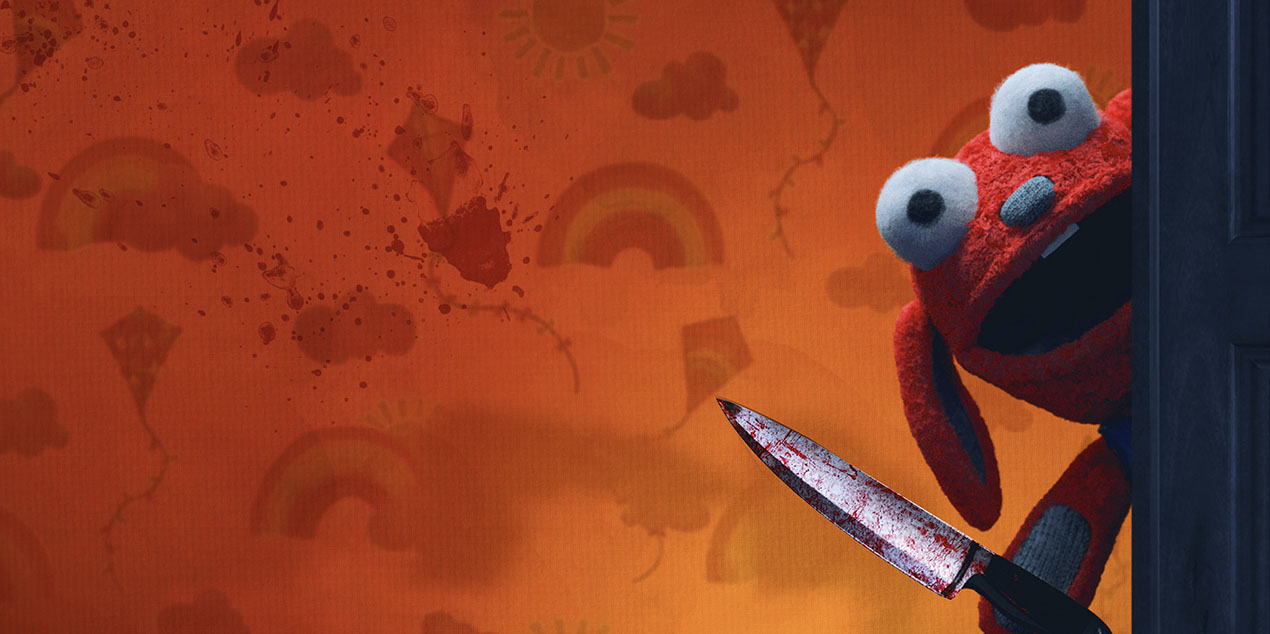
There is something inescapably silly about toy horror. Whether it’s a marionette or a ventriloquist doll, a china doll (with those creepy eyelashes) or a friend til the end, the toy itself can only generate so much authentic terror. After that, it’s just goofiness.

Karl Holt embraces that combination for his vengeful toy story, Benny Loves You.

We open on a spoiled child, her new Barbie, and the now-discarded stuffed dog, Todd. But soon we’re entrenched in the subpar life of Jack (Holt, who also writes and directs). It’s his 35th birthday. He still lives with his parents, still sleeps in his childhood bedroom that is still decorated as it was when he was seven.

Jack is a toy designer, but co-worker Richard (a colossal tit) makes him look like a peon. They’re both up for the same promotion. Things go from bad to worse, then worse, then worse still. Finally, Jack decides to grow up and put away all his childish things, including his beloved stuffed bear (Bear? With those ears?), Benny.

It goes less than well, the unruly toy responding like a bloodthirsty if very cheery jilted lover.

Holt turns in a solid performance as the stunted man-child living a nightmare of adulthood, and there are times when his writing suggests something deeper. He almost develops themes about arrested development, the entertainment/gaming/toy industry, maybe even masculine entitlement. Almost.

Instead of digging in, he settles for a superficial but generally charming and very violent comedy. (Dog lovers may want to skip this one.)

Low-rent FX heighten the film’s silliness and general wrong-headed glee. All the support work is on target, from George Collie as the noxious Richard to the love interest (Claire Cartwright), dog-loving boss (James Parsons), and incompetent cops (Anthony Styles and Darren Benedict). Each understands the tone here and nails it.

It’s just that it doesn’t amount to much. A mean spirit punctuates the romplike atmosphere a couple of times and feels wildly out of step with the balance of the film, but other than that, Benny Loves You offers forgettable, bloody fun.

Yippie Ki Yay, Micro Budget

In Action

by Christie Robb

In a world where two middle-aged men have access to a room, a series of Apple products, $22,730 from Kickstarter, and five years, expect a variety of action movie tropes to be stitched together with a thread of f-bombs and self-referential humor to create this strange quilt of a feature-length buddy-action-comedy/YouTube video.

In Action follows two former writing partners, Eric and Sean, who reunite at a frenemy’s wedding. Bored with their day-to-day lives, they decide to team up again to bang out an action movie screenplay asynchronously over email. But, unbeknownst to them, their script is intercepted by hackers and the writers get more action than they expected.

Directors/writers/stars Sean Kenealy and Eric Silvera manage to get a fair amount of bang for the low-budget buck. Not strong actors, the rapid banter between the two is engaging. And it has to be, because essentially the entire movie is just those two.

An assortment of minimal props, occasional animation, and (briefly) the use of action figures do serve to interject some variety. With the exception of some camera work and quick cuts that seem inspired by Shaun of the Dead, the camera is static. Other characters are mostly filmed over the shoulder, giving the impression that the only two involved in the film are Sean and Eric (sometimes in wigs or silly hats) until more than two bodies are shown on screen at the same time. Then, it becomes honestly a little confusing as to why these characters aren’t shot more conventionally. But, whatever.

The overall product, though, is fun with sound design and editing that are way more professional than you would expect. For an action movie with essentially no budget, it gets the job done pretty darn well.

Screening Room: Wrath of Man, Here Today, Fried Barry, Above Suspicion, The Oak Room & More

Tall Tales

The Oak Room

by Hope Madden

There’s nothing as immediately cool and comforting as a boozy hillbilly noir. The haunting soundtrack choices, shadowy basement barrooms, isolating cushion of all those trees—it’s a tall tale of blood, beer and backstabbing just waiting to happen.

That’s just what director Cody Calahan serves up from the opening strains of The Oak Room, a stylish little thriller. It may be a bit too wordy, but it repays you for your patience.

There’s a story within a story within a story on this blustery night in smalltown Canada as ne’er do well Steve (RJ Mitte, Breaking Bad) dares to show his face at closing time. He’s been gone a long time and bartender Paul (Peter Outerbridge) is none too happy to see him. There’s a score to settle here, a debt owed, and Steve has until midnight to take care of it.

First, though, Steve wants to tell Paul a story.

Over the next 90 minutes, Calahan weaves from near-midnight at Paul’s bar to Steve’s story and back, giving a lovely cinematic quality to the power of storytelling inherent in Peter Genoway’s script. There is something hypnotic in the way the night progresses, and in the way phrases and ideas repeat across different decades and different tales.

Outerbridge is particularly effective, but every actor remains true to the style the filmmaker develops. Genoway’s script gets away from him at times, especially in the first half of the film, giving certain scenes the feel of filler. A leaner script would have benefitted the overall project. As it is, there are conversations in the first half of the film that come close to breaking the spell Calahan casts.

The filmmaker deploys other tactics to keep you engaged, though. The Oak Room glories in its sound design, whether the creak of mop bucket wheels across a wooden bar floor, the swing of a metal trashcan lid, or the hush of the wind outside the window where snow deepens. Steph Copeland’s score—a mixture of Kabuki-style drums and Appalachian strings—foretells of violence and misery.

Calahan also develops a fun dose of dread as midnight nears and tales—both present and past—take sinister turns. It’s all good fun, though, right? Just a couple of guys passing the time until debts are to be paid.

Hillbilly Eulogy

Above Suspicion

by Hope Madden

There are films that open with voiceover. Sometimes the voiceover is a character who is already dead. These films are rarely very good.

It’s no spoiler. As Susan Smith (Emilia Clarke) waxes melancholic over the opening images of Phillip Noyce’s true crime thriller Above Suspicion, she’s straightforward with us. She’s dead, we’re watching her body being found, there sure are a lot of trees, and now she has a lot of time to think.

Chris Gerolmo (Mississippi Burning) adapts Joe Sharkey’s book about the case, which was also the subject of Aphrodite Jones’s book The FBI Killer as well as at least one true crime TV series episode. Why all the fuss?

Susan Smith’s case represented the first in history to see an FBI agent convicted of murder.

Smith, a smalltown Kentucky addict with two kids, a live-in ex-husband for a dealer, took a shine to Mark Putnam (Jack Huston) the moment she saw him. The shiny new FBI agent, just two weeks on the force, had taken the gig to begin to build a career. He and his wife Kathy (Sophie Lowe) had a 5-year plan.

Smith would alter that plan.

Noyce’s movie looks good. It looks the part, plenty of dusty small towns, low rent lots, dive bars and trees. And he’s assembled a game cast. Clarke surprises as a hard and hard-headed woman looking for a way out.

A cascade of odd ducks and smalltown curiosities give plenty of supporting actors the chance to add some layers to the Appalachian backdrop. Johnny Knoxville especially impresses as Smith’s low key but dangerous ex.

Huston’s take on Putnam is pretty forgiving. The performance feels indecisive. In his hands, Putnam is certainly too smart to fall into this situation, but is he naïve enough to do it? This is partly where the entire film falters.

The voiceover lets us know whose story we’re hearing, and yet somehow we’re mainly on Mark’s side through most of this. Kudos to Noyce and Clarke for sidestepping noble victim cliches and giving Smith a backbone as strong as her head is wrong, but the film’s overall tone lacks conviction.

It doesn’t help that we know where everything is going from the opening scene, since Smith tells us. There’s no real tension to build, and Noyce never takes advantage of his opportunity to give us an unreliable narrator. At least that would have given us something to think about. Lacking that, or any real insight and certainly no deep empathy for anyone involved, Above Suspicion can’t help but feel like a couple hours of wallowing in someone else’s pain.