Tag Archives: movie reviews

Next-Level Flower Arrangements

Queen Marie

by Christie Robb

Alexis Cahill’s biopic is a sumptuous surface-level look at Queen Marie of Romania’s impact on the negotiations leading up to the Treaty of Versailles—which wrapped up the first World War in 1919.

Promised by its allies to have all its disparate historical territories united at the conclusion of the war, Romania has been devastated by German occupation. Despite passionate pleas by the prime minister at the peace talks, none of the major players (Clemenceau of France, Lloyd George of the United Kingdom, and Wilson of the United States) can be bothered to lend an ear, much less lend some aid.

So, Queen Marie (Roxana Lupu, a veteran of royal portrayal), granddaughter of Queen Victoria, hops the royal train to Paris to lobby on her country’s behalf.

The attention to detail in the costumes, interiors, and settings is divine. It’s a joy to sit back and luxuriate in the opulence while historical personages debate national boundaries wearing haute couture in a variety of fancy reception rooms decorated by an almost ridiculous amount of freshly-cut flowers.

But once the delight of the visual treat starts to get old, there’s not much here to hold the attention.

We are frequently told of the sacrifices the Romanians made during the war and of the hardships they are currently suffering. But without grounding in the experience of a specific character, it’s a lot of tell with no show. (In fact, the film’s intro is several minutes of black and white footage with a voiceover summarizing Romania’s involvement in the war that’s more reminiscent of an early 2000s Biography Channel program than a feature film.)

We don’t get why a united Romania has any meaning for the people. We just have to take the well-dressed lady at her sometimes wooden word.

There’s also the issue that the story is overloaded with potential conflicts and character arcs that don’t seem to go anywhere.  There’s some sort of marital difficulties between the king and queen and a hint that Marie is having an affair. The heir seems to hate his mom and is conducting an affair with a woman who is unsuitable for reasons that are unclear. And more or less everyone tells Marie that she should probably just stay in her lane and focus on her clothes, children, and social engagements and stop with the politicking already.

I imagine all of this plays better for a Romanian audience for whom the history, characters, and subject matter are familiar. As an American with a very tenuous grasp on WWI and Eastern Europe generally, I found the film to be a pleasant enough introduction to an interesting person, but one that would have benefitted by sacrificing breadth of coverage for depth of character development.

Memories of Murder

Cerebrum

by Brandon Thomas

Every filmmaker dipping a toe into the science fiction genre is looking for that singular hook that will drive audiences wild. Think The Matrix with its kung-fu fighting in a simulated reality. Or Christopher Nolan’s Inception with its grounded look at dream invasion. Co-writer/director Arvi’s Cerebrum may not reach the heights of either of those movies, but it certainly seeks to have a hook of its own.

Tom (Christian James) has returned home at the behest of his father, Kirk (James Russo,  Django Unchained and My Own Private Idaho). The two men are barely on speaking terms, but Kirk has asked his son to help him on a project that could have a significant impact on retaining the memories in dementia patients. The project becomes much more complicated when corporate espionage, murder, and body-swapping come into the picture. 

Cerebrum doesn’t have the desire, or the budget, to go big like The Matrix or the movies of Chris Nolan. It’s not a film built around pushing technological limits or grand action sequences. This is a film that wisely knows its limits. Instead of a watered-down wannabe action-palooza, Cerebrum has more in common with a classic murder mystery. There’s even a pinch of neo-noir thrown in for taste.

Still, there’s an inherent cheapness to the film that’s hard to shake. The memory loading tech never goes beyond looking like anything more than a dollar store brand smartwatch. The movie would’ve benefited greatly from a better visualization of the technology and how the implementation of memories works.

Dual roles come into play in a big way during the latter half of the film, and James as Tom/Kirk does a commendable job swapping between the two. Sure, sometimes it’s as easy as throwing in a southern accent for Kirk, but James manages to get the interesting tics and mannerisms that Russo has as an actor. And speaking of Russo, the veteran character actor makes an impression with the limited screen time he has. I’ll admit, it’s a bit of a stretch to see Russo as a renowned scientist, but it’s not Denise Richards as a nuclear physicist Bond girl kind of a stretch.

Cerebrum lacks the “oohs” and “aahs” of a lot of modern sci-fi, but it still manages to tell an intriguing and economical story that’s worth a look.

South African Mayhem

Fried Barry

by Hope Madden

So, Fried Barry then.

Four years ago, South African writer/director Ryan Kruger made the 28th short film of his young career, a quick and experimental one-man meth attack starring Gary Green called Fried Barry. On the merits of Kruger’s vision for harrowing realism underlying a scifi vibe, as well as the startling central figure (Green is quite something to gaze upon), the short film made a big impact.

It’s also a single scene of a profound reaction to a drug. Not a lot to build on, and yet that’s just what Kruger does in his feature of the same name, streaming this week on Shudder.

Green returns as a Cape Town low life whose latest high is complicated due to an alien abduction.

Or is he just really, really, really high?

Kruger maintains an experimental feel, although his feature takes on more of a traditional cinematic structure. This primarily consists of Green—looking as disheveled, lean and imposing as ever—wandering wide-eyed and silent through Cape Town. Oh, the adventures he finds!

Most of them involve different women who are curiously interested in having sex with this obvious junkie. He must just smell so rank! Suspend disbelief. The movie is nuts.

It’s not entirely unique, though, as it continuously calls to mind Rolf de Heer’s notorious 1993 film Bad Boy Bubby—another Huck Finn style adventure about a man-child and the curiosities he stumbles into.

And to be honest, de Veer’s film is far more of a mind f*ck.

Fried Barry also conjures Terry Gilliam and Panos Cosmatos (top-notch purveyors of drug-fueled mayhem), and maybe even an especially high-octane Lynch. Which is to say, the film offers insanity to spare. Kruger’s episodic fever dream blends frenetic editing and a charged soundtrack into something harsher and harder than a psychedelic trip, but the film lives and dies with Green.

It isn’t as if the actor performs alone. He stumbles into and upon a slew of wild, weird and sometimes insane (literally) characters. But it’s Green you cannot take your eyes off of.

Dude is fried.

Aging Disgracefully

The Paper Tigers

by Hope Madden

“You look like a fat, Asian Mr. Rogers.”

That’s not how any middle-aged man wants to be described, least of all a man who was once one of The Paper Tigers.

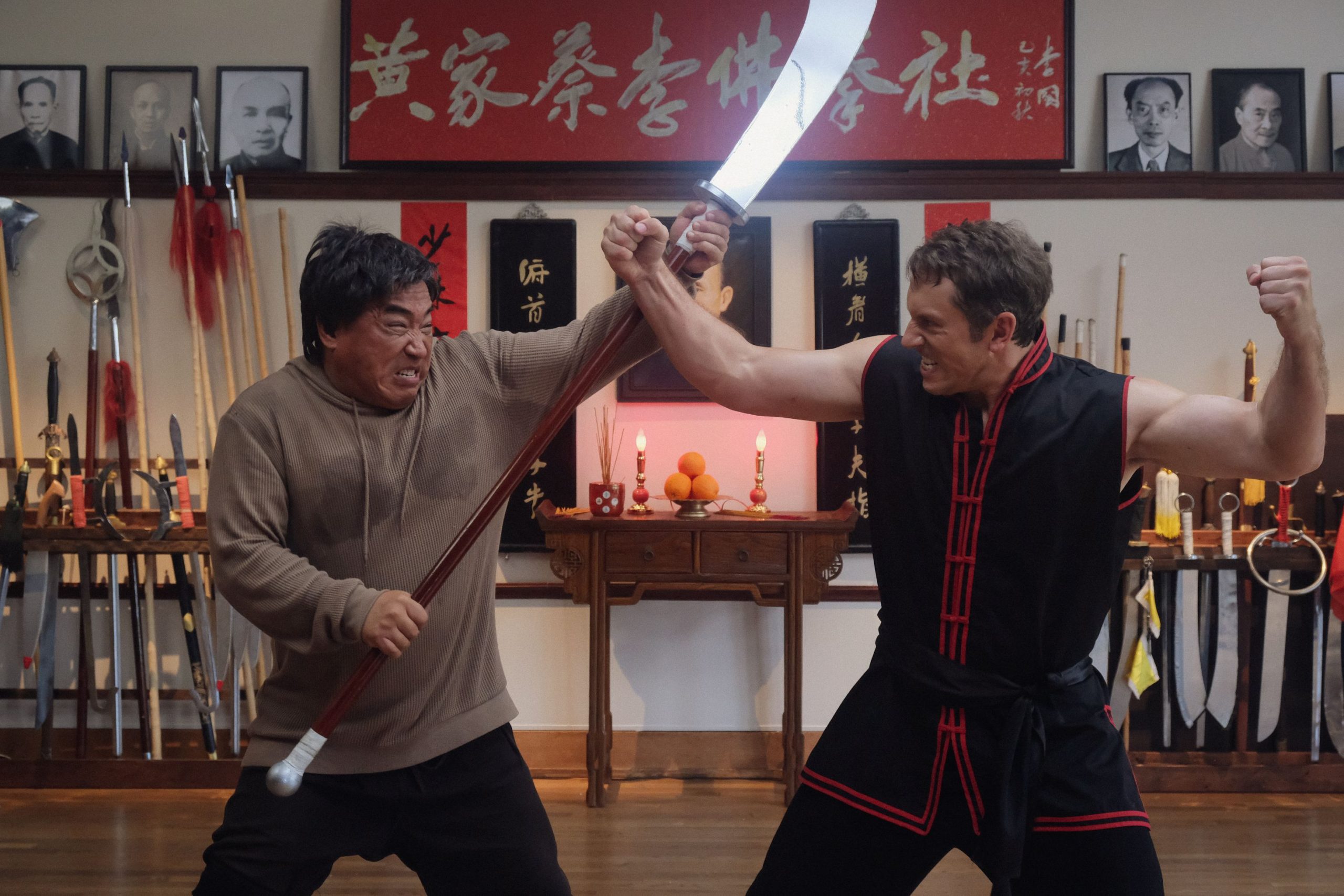
When Danny (Alain Uy), Jim (Mykel Shannon Jenkins) and Hing (Ron Yuan, Mulan) were in their prime, they were disciples of Chinatown’s great kung fu master Sifu Cheung (Roger Yuan, veteran of martial arts films). They couldn’t be stopped—certainly not by that poseur Carter (played with relish as an adult by Matthew Page).

But that was then.

It takes a murder mystery to convince the trio to a) talk to each other again, and b) fight. But first, they will really need to embarrass themselves.

Writer/director Quoc Bao Tran makes his feature debut with this family-friendly coming-of-middle-age comedy. Though the story itself is stridently formulaic, solid instincts for lensing physical comedy, as well as charming performances, elevate the film.

Uy offers a reliable center for the story. A relatable everyman, Danny’s lost focus on what matters, and Uy’s understated performance creates a nice counterbalance for some of the zanier moments in the film.

Page and Ron Yuan—whether together or separately—shoulder responsibility for most of those moments of lunacy. Yuan delivers an underdog you’re happy to cheer on, while Page’s comic foil is an embarrassing, irritating joy  to behold.

The writing is sometimes suspect. Formula makes up for a tight structure—you know where things are headed, even if not every step in the journey makes a lot of sense. But The Paper Tigers makes up for those missteps, mainly with affability and good nature. This is a hard film to root against.  

Screening Room: Without Remorse, Best Summer Ever, Four Good Days, Cliff Walkers & More

More Like Amateur

The Virtuoso

by Hope Madden

Hey, Anthony Hopkins just won his second Oscar! The octogenarian was not the favorite, but there’s no denying that, after dozens of phoned-in near-cameos, he landed the role of a lifetime and gave a performance to match.

So, back to phoned-in near-cameos, I guess.

In director Nick Stagliano’s The Virtuoso, Hopkins plays The Mentor, an enigmatic man in a shadowy office. Mentor to whom, you ask? To The Virtuoso (Anson Mount), of course. He’s one of those “put my black ops training to good use responding only to this one guy by phone who sends me on my missions and otherwise I am utterly, stoically alone” kind of guys.

The Virtuoso is a man of few words—except in voiceover. In voiceover you cannot get him to shut up, his monotone musings on scheduling, technique, blah blah blah so wearying you can’t help but suddenly, brightly realize all over again what an absolute masterpiece American Psycho was.

One hit goes well. One hit goes south. Then we dig in for the next hit, where all the voiceover details about planning, timing, persistence and detail go straight out the window.

From here, we’re with The Virtuoso step by step as he bungles this and misunderstands that and misfires his weapon over here and makes poor decisions over there. It might make a half-decent comedy if it weren’t played so, so, so seriously.

Stagliano and writer James C. Wolf aim for neo-noir hipness but miss the mark by a wide distance.

Mount does what he can and almost generates interest as his character practices making normal people faces in the mirror before going out in public. Hopkins is saddled with nonsensical speeches meant to suggest his deadened soul. He doesn’t try too hard to make anything of it.

Abbie Cornish does try, bringing a flash of human interest as The Waitress. But no amount of homespun charm can save a movie this dumb.

Do Not Pass Go

Murder Bury Win

by Cat McAlpine

Friends Chris, Adam and Barrett are trying and failing to launch their indie board game Murder Bury Win. When a mysterious benefactor expresses interest in developing the game, the friends have to ask themselves how far they’re willing to go to make their dreams come true.

Those unfamiliar with modern board games and the cutthroat, rarely lucrative industry that’s behind them may be left out on a handful of jokes. Especially the constant references to “Flaming Puppies,” a stand-in for the real game Exploding Kittens. But the film eventually descends into stakes we can all understand – life or death.

Writer/Director Michael Lovan spends a little too much time setting up the story and the other shoe could drop 10 minutes earlier. Murder Bury Win shines best when it’s being silly, and the more fun it has, the better it gets.

When Chris (Mikelen Walker) discovers he’s in the presence of his hero, he’s bathed in a holy glow from the window behind him. Fantasy scenes of the board game world make for fun vignettes. The horrifying use of a cheese grater pushes the comedic thriller into horror. These little moments stand out despite a sometimes stilted script.

The performances from the small ensemble cast shine across the board. Walker is a dreamer, and a stoic straight man who has finally had enough. Henry Alexander Kelly is able to summon grit for the soft and caring Barrett. And Erich Lane’s Adam becomes unhinged so easily, so seamlessly as the film progresses that he matches increasingly insane circumstances perfectly. Brian Slaten as Officer Dan and Craig Cackowski as V. V. Stubs both create fun, sometimes outlandish characters that counterbalance the main trio. And Lovan’s cameo brings such a weird energy that I wish he’d been in more of the film.

Lovan has an eye for color, effectively using red to bathe the remote cabin where most of the film takes place. The custom game mat, the too-long curtains, and even the backing of The Murder Wall (yes, you read that correctly) are all the color of blood. It trains you to recognize blood later as it appears in an otherwise white bathroom, in a fine mist across faces, and seeping through the bottom of a brown paper bag.

Each of the best friends is dressed in a bold signature color, yellow, blue, and green, like tokens on a gameboard.

Overall, Murder Bury Win is a zany look at our murder fantasies and what it takes for an ordinary person to suddenly become capable of such bloody acts. Whether you’re a board game fan or not, this film makes for a fun playtest.

Survive and Advance

Four Good Days

by Hope Madden

In many ways, Four Good Days feels like a Rodrigo Garcia film. The co-writer/director frequently spins tales of women, often mothers and daughters whose own pain keeps them from clearly seeing and addressing the pain they inflict.

His films (Nine Lives, Mother and Child, Albert Knobbs) routinely examine relationships built as much on survival as on love, and the strain that puts on people.

Glenn Close, a frequent Garcia collaborator, stars as Deb, put-upon mother of a drug addict. That addict, Molly, is played by Mila Kunis as you’ve never seen her. Kunis’s trademark big eyes swim in a gaunt face marked by the scars of the life of an addict, the actress’s million-dollar smile replaced with rotten nubs.

Kunis clearly lost a substantial amount of weight to complete the transformation from Hollywood sweetheart to hopeless addict. Her performance is not simply skin deep, either.

Characteristic of Garcia’s strongest films, the friction and flaws in these women leave the biggest impression. Kunis lands on the button-pushing most effective in manipulating her mother: chaos and accusation. In her hands, Molly is profoundly unlikable because why would she need anybody to like her? What does that get her? She shoots rapid-fire guilt and shame bullets at her mother and sees what hits.

Molly’s defenses and manipulations blend together so believably that when she does hit a note of emotional depth and sincerity, it’s heartbreaking.

Close’s performance is no less commendable, though her character is frustrating. The writing here has some trouble creating the natural if infuriating behaviors of a woman torn between protecting herself and believing in her daughter. Too often, the situations and behaviors feel like what they are: plot points meant to increase tension as we rush toward the inevitable climax.

Here is where Four Good Days (co-written with Eli Saslow) does not feel like a Rodrigo Garcia film.

The movie mainly makes up for these missteps. It’s a difficult film to watch in that it doesn’t tread on your sympathies, doesn’t create tragic and noble characters, doesn’t even ask you to like either lead. Instead, it insinuates itself in the battle between the shrill, ugly survival tactics a mother and daughter wield like daggers as they claw their way toward sobriety.

Fatality

Mortal Kombat

by Hope Madden

Dude, how dumb is Mortal Kombat?

So dumb! But—and this is the important thing—it’s R-rated. And not just regular old R-rated. This third attempt to bring the notorious Midway video game to the big screen is Aussie Rules R-rated.

As it should be. The video game inspired by Jean-Claude Van Damme and boasting fights-to-the-death can hardly be done justice with PG-13 movies and animated TV shows. I mean, sure, they did that and made an insane amount of money, but none of it was any good.

So, is this any good?

No! It’s idiotic. Insufferable, really, until Josh Lawson enters the scene, chained up and cursing a blue streak as Kano. The writing is awful and the acting is worse – except for Lawson, who’s a stitch.

But damn is this movie violent!

Again, as it should be.

Australian director Simon McQuoid has made commercials up to this point. He’s very good at stylized, 90 second, conspicuous drama. He’s also very good with a fight sequence and he’s not shy when it comes to glorying in fatalities. He includes plenty of nods to the most notorious moves from the video game franchise, fresh kill ideas, and even a well-placed Story of Ricky homage.

Nice.

McQuoid delivers less inspiration when dealing with actors, not that his screenplay (co-written with Dave Callaham and Oren Uziel, based on Ed Boon and John Tobias’s original characters) gave them anything to work with.

Lewis Tan (Netflix’s Wu Assassins) is our bland-as-cottage-cheese hero Cole, unmemorable in every way. The film outright wastes Tadanobu Asano. (He’s done a lot of amazing work over his 30+ years in film, but he’ll always be Ichi the Killer’s Kakihara to me.)

No one—not Jessica McNamee, Joe Taslim, Mehcad Brooks, Hiroyuki Sanada or anyone else—has much opportunity to create a real character. The arcs are telegraphed, the fight pairings obvious, and a lot of the villainous roles are tossed in and disposed of without fanfare toward the end of Act 2.

Why? Because Mortal Kombat is a big, dumb movie. So big and so dumb.

And so much gory stupid fun, I just might watch it again.

Thirst Like a Gang of Devils

Boys from County Hell

by Hope Madden

Lend me ten pounds and I’ll buy you a drink.

That’s Eugene’s (Jack Rowan) line. He’s done working for his Dad (Nigel O ‘Neill), the meanest bastard ever to run a construction crew. Eugene’s happy to waste his youth drinking with his mates in The Stoker and ushering naive tourists to that pile of stones they come out to see – not that there’s really a vampire under there. Certainly not the one, true vampire that inspired Bram Stoker in the first place.

Right! So, many pints and backhoes and buddies later we find out whether ol’ Abhartach under those stones is a myth or not.

As writer/director Chris Baugh adapts his 2013 short into a fun, effective monster flick, he begins by tossing out vampire tradition. Ireland’s own Bram Stoker had written a piece of fiction, after all, and this is reality. The new mythology is a little muddier and more monstrous than Dracula, but never less than fun.

Baugh taps into the same kind of smalltown boredom that situates the nation’s most memorable monster movies, from Grabbers to Rawhead Rex. He does a lot with a small budget, suggesting the monster more than showing it until the final act, but there’s plenty of blood to make up for the subtlety.

A couple of veterans (O’Neill, as well as John Lynch, also on Shudder right now in Christopher Smith’s The Banishing) give the cast a strong backbone. A solid group of young ne’er do wells (Louise Harland, Michael Hough and Fra Fee joining Rowan) create a lived-in camaraderie. The charm and familiarity among the ensemble are undoubtedly the reasons the film works as well as it does.

Boys from County Hell is a horror/comedy, but it’s rarely laugh-out-loud funny. It’s actually a good deal more tender in its own endearingly bull-headed way, with a narrative more focused on the father/son dynamic than on coming of age or bloodshed. Baugh’s deep sense of these characters and this terrain benefit the relationship building and give the film a nice throughline.

This is a “what are you going to do with your life” film, and for some people, it takes a good, old-fashioned bloodletting to help them make up their minds.