The Eyes of My Mother will remind you of many other films, and yet there truly is no film quite like this one.
First time feature writer/director Nicolas Pesce, with a hell of an assist from cinematographer Zach Kuperstein, casts an eerie spell of lonesome bucolic horror.
Shot in ideal-for-the-project black and white, an Act 1 event could come from any number of horror films. A mother looks out her window to see her young daughter, playing alone in the front lawn, talking with a stranger. There is something clearly wrong with the stranger, and things take a bad turn. But for Pesce, this simple, well-worn set-up offers endless unexplored possibilities. Because this bad man doesn’t realize that the isolated farm family he’s come to harm is very comfortable with dissection.
His film is told in three parts. Part 1, with the stranger, sees the young Francisca (Olivia Bond) finding her role in her family. It changes after the stranger’s visit.
Parts 2 and 3 catch up with the family quite a few years later. The now-grown Francisca (Kika Magalhaes) takes some extreme measures to end her loneliness.
There is much power in dropping an audience into a lived-in world – the less we know, the better. Pesce understands this in the same way Tobe Hooper did with The Texas Chainsaw Massacre, and though The Eyes of My Mother lacks the cynicism, satire and power tools of Hooper’s farmhouse classic, it treads some similar ground.
Where Eyes differs most dramatically from other films is in its restraint. The action is mostly off-screen, leaving us with the sounds of horror and the quiet clean-up of its aftermath to tell us more than we really want to know.
As retrained as it is, The Eyes of My Mother hardly lacks in sensual experience. Stunning, gorgeously lit frames are matched with garish sound editing.
Kuperstein’s cinematography is sometimes almost Malick-like. Pesce focuses that camera on nearly silent moments full of traumatic images. He creates dissonance between the peaceful, idyllic scenes and the pinpoint imagery, the horrifying sounds.
The quiet amplifies Francisca’s isolation. The sounds amplify something else entirely.
Though Eyes of My Mother is reminiscent of several Seventies horrors, its muted telling exposes a patience rarely found in the genre. Pesce repays you for your patience.
I’m curious. Is every film going to take on sharper, darker political meaning post-election? Because Miss Sloane definitely does.
First time screenwriter Jonathan Perera’s much-lauded screenplay documents Elizabeth Sloane, DC super-lobbyist. Driven and single-minded to a nearly sociopathic degree, Sloane finally finds a line she’s unwilling to cross when the gun lobby wants to hire her to make guns more appealing to women.
She abandons the big time firm that demands she rethink her gun-control stance and goes to work instead for the liberal opposition.
Though far from flawless, Miss Sloane has a lot to offer. Mainly, Jessica Chastain.
Her fierce performance and comfort with ambiguity come together in a turn that mesmerizes. This is an anti-hero, and Chastain gives her enough savvy, contempt, drive, self-loathing and vulnerability to make her fascinating. Not knowable, but forever provocative.
Though no other character in the film is nearly so fleshed out, a game supporting cast – including the welcome Michael Stuhlbarg and a pitch-perfect Mark Strong – help balance Chastain’s blistering presence.
Director John Madden – whose work tends toward the safer and tamer (Shakespeare in Love, Best Exotic Marigold Hotel) – here amplifies Chastain’s fiery delivery with frenetic camera movement and sudden close ups. He creates a pace that keeps attention, even when the screenplay begins to slog.
What’s exceptional about the film, aside from Chastain, is the way its core plotline and its greater themes work together. The us-versus-them battle, with each lobbyist one-upping the other in the most unconscionable (yet clever) ways, commands attention. But beneath all that Miss Sloane clarifies the way in which the American public is never privy to true information.
What we get, in its stead, is the narrative being pushed in increasingly obfuscated ways by different stakeholders.
The film builds to speechifying and heavy moralizing, often feeling too clever for its own good. It settles, while its titular firebrand would not. But before all the self-righteous Aaron Sorkinisms, Madden, Perera and Chastain get an awful lot right.
They push envelopes when it comes to a female anti-hero, answering only as many questions as necessary and leaving room for Chastain’s performance to fill in some gaps.
Together they also unleash an appropriately cynical view of a political system that is rotten.
Finally! We’ve been kicking this one around for a long time, but this week – with the help of Vince and Grant of the podcast In the Record Store – we finally tackle the best black and white films in horror.
What a list! We had no choice but to employ fuzzy math for this one, and even so we had to leave off so many greats – including some that Grant and Vince would have included.
6. Night of the Living Dead (1968)
From the brightly lit opening cemetery sequence to the paranoid power struggle in the house to the devastating closing montage, Night of the Living Dead teems with the racial, sexual and political tensions of its time. An unsettlingly relevant George A. Romero knew how to push societal panic buttons.
As the first film of its kind, the lasting impact of this picture on horror cinema is hard to overstate. Romero’s inventive imagination created the genre and the monster from the ground up.
They’re dead.
They’re back.
They’re hungry for human flesh.
Their bite infects the bitten.
The bitten will eventually bite.
Aim for the head.
Romero served as cinematographer for this project, likely choosing black and white as a cost saver, but we’d later learn that this format is 1) highly forgiving of zombie makeup, and 2) spookier. The color palette turns the Waltons-esque setting of the farm house into something isolated and sinister.
The shrill sense of confinement, the danger of one survivor turning on another, and the unthinkable transformation going on in the cellar build to a startling climax – one that utterly upends expectations – followed by the kind of absolutely genius ending that guarantees the film’s eternal position in the annals of horror cinema.
5. Eraserhead (1977)
There truly is no film quite like David Lynch’s first feature, eh?
Eraserhead defies simple summarization. Easily the most surreal of all Lynch’s films – which is a huge statement – the film follows sad-sack Henry Spencer (Jack Nance) dealing poorly with fatherhood.
The film becomes a nightmare of paternal angst and existential crisis – indeed, it may be impossible to name a film or filmmaker more able to bring a nightmare to life.
It’s also among the finest examples of corporeal horror you will find. The shadowy, grimy b/w photography – partially handled by Lynch’s longtime cinematographer Frederick Elmes – amplifies the dismal stagnation facing Henry.
At the same time, it gives a weird, nostalgic camp factor to the Lady in the Radiator and adds a particularly lurid element to that whole bleeding “chicken” thing.
Plus, the baby. Yikes. Alive with the most disturbing imagery, Eraserhead is impossible to forget.
4. Psycho (1960)
Among the four Oscar nominations the film garnered was one for John L Russell and his gorgeous black and white cinematography.
By 1960, most folks had abandoned black and white – including Hitchcock. But with his truest foray into horror, the master returned to the high contrast imagery for a number of reasons.
Sure, one of those was that it freed him up with the blood. Had all that stuff in the shower been red, he’d never have gotten away with it. Mrs. Bates wouldn’t have looked quite right, either.
Russell’s visuals also gave the film its lonesome American Gothic quality. Norman seemed more innocent, Marion Crane seemed more mysterious, and the old Bates house seemed spookier.
Of course, was there ever a question Hitch knew what he was doing?
3. Frankenstein (1931)
James Whale’s genius was in finding the monster fascinating, rather than the doctor. Nearly every other Frankenstein made before or since has been preoccupied with the doctor, but Whale understood that it was this unique beast, baby and man, evil and innocent, that should compel our interest. Who cares about one more doctor with a god complex?
Luckily for Whale, he had Boris Karloff. Karloff’s gift was in seeing the monster as a neglected child. His monster is sweet and tragic, characterized by the terrible freedom of a loosed child full of fear, unbridled excitement and shame. Karloff nails this childlike energy and ignorance married to a grown man’s strength in a way that no other actor truly has.
Obviously, in 1931 Whale had no choice but to film in black and white, but how fascinating that a movie without color created a green monster. What a testament to the film’s vidid imagery – created with the help of make-up guru Jack Pierce. A nightmare of greying flesh, black stitches and mechanical pieces, this image of the monster speaks of death, mad science and bad intentions.
https://www.youtube.com/watch?v=McUce_xwxeA
2. Nosferatu (1922)
Not the seductive, European aristocrat, cloaked and mysterious, oh no. With Count Orlock, filmmaker F. W. Murnau explores something more repellant, casting an actor who resembles an albino naked mole rat.
Given that Murnau equates the film’s vampire-related deaths with the plague, this vermin-like image fits well. But more than that, thanks to a peculiarly perfect performance by Max Schreck, Murnau mines the carnality of the vampire myth for revulsion and fear rather than eroticism.
Murnau’s gift was not solely in casting. The shadows danced, the dead rose and Europe writhed with the dead and dying. His skill with the camera was unparalleled. Between his casting and his camera, he made the most authentic vampire movie – perhaps ever.
Sure, the silent film style of acting appears nothing short of quaint today, and the Dracula tale has been told too, too often at this point. But Max Schreck is a freak, and in his bony, clawlike hands, Count Orlock remains the greatest vampire ever undone by a sinless maiden.
https://www.youtube.com/watch?v=sk70lSUqaM8
1. The Bride of Frankenstein (1935)
James Whale and Boris Karloff – with tag along make-up man Jack Pierce – returned to Castle Frankenstein for an altogether superior tale of horror. What makes this one a stronger picture is the dark humor and subversive attitude, mostly animated by Frankenstein’s colleague Dr. Pretorius (Ernest Thesiger).
Thesiger’s mad doctor makes for a suitable counterpart to the earnest and contrite Henry Frankenstein (Colin Clive, again), and a sly vehicle for Whale. This fey and peculiar monster-maker handles the most brilliant dialogue the film has to offer, including the iconic toast, “To gods and monsters.”
The sequel casts off the earnestness of the original, presenting a darker film that’s far funnier, often outrageous for its time, with a fuller story. Karloff again combines tenderness and menace, and Elsa Lanchester becomes the greatest goth goddess of all film history as his Bride.
Aaron Eckhart is a conundrum, isn’t he? He’s talented enough to land any indie gem, granite-jawed and handsome enough to elevate it to mass market appeal. Think Thank You for Smoking.
And yet, for every Rabbit Hole there’s an I, Frankenstein; for every In the Company of Men, an Incarnate.
His latest – his fourth of this calendar year – sees Eckhart as the wheelchair-bound, unshaven, grimacing Dr. Seth Ember. He’s damaged, damn it!
Don’t call him an exorcist. He doesn’t exorcise demons; he evicts supernatural parasites. He has an ability. You see, when he was young, he realized, “When I was asleep I could go into the minds of the possessed.”
How did he figure this out? How often did he get drowsy in the proximity of a possessed person?
No matter – can’t you see he’s damaged?!
When a liaison to the Vatican (Catalina Sandino Moreno) – don’t even get Dr. Seth started on the church! – lures him to a case of a possessed 11-year-old, it isn’t to save the boy. Oh no.
No?
No. It must have something to do with his damage. I’ll bet director Brad Peyton (that genius behind San Andreas) will soap-opera direct some weirdly stilted, flat and extreme-close-up-laden bit of ponderousness explaining the whole thing, but you will have lost the will to live before it’s all clarified.
There is one moment – not a scene, but a single moment – in this film where I believed Peyton might, maybe, possibly do something interesting.
Nope.
Worst thing about Incarnate? It’s not the made-for-SyFy-CGI. Not the superficial storyline, not the flatly uninspired direction. (Honestly, if Peyton had directed from inside a coma the film couldn’t have looked or felt more lifeless.)
It’s not the tedious ensemble performances, not the wildly predictable series of twists. It’s Eckhart. It’s as if he’s angry at us that he took this dog.
We didn’t make you do it, Aaron. We only sat through this festering corpse of a movie because you were in it.
The documentary opens on a man standing on a snowy ridge. With him are three animals: a horse, a goat, and an eagle. The man sacrifices the goat, sets the eagle free, and then slowly trots into the distance on the back of his horse. Cut to a school classroom, where we find 13 year old Aisholpan in braids.
Director Otto Bell deftly handles his Mongolian setting with equal care to the rich history, steeped in tradition and the modern life that the people now lead. He never patronizes the culture – a nasty habit of film makers delving into a new setting. Nomads, how quaint! Traditional regalia, how mystic! Instead, Bell simply shows life as it is today, a culmination of everything that came before.
Aisholpan is a young girl who boards at school during the week, and goes home on the weekends. She likes giggling with her friends, helping her dad with the family livestock, and wants to be an eagle hunter. A woman has never been an eagle hunter before, let alone a girl, but this doesn’t seem to phase Aisholpan.
There are, however, many old men who have quite a few grievances with a woman becoming an eagle hunter. “Who would make the tea?” “Women are too weak,” and “She’ll have to get married eventually.”
It’s a great use of the “talking heads” trope of documentaries. A series of men sitting in a tent, talking about how women can’t and shouldn’t hunt. Meanwhile, Aisholpan is doing just that.
Bell produces a film with a clear narrative and story arc, but the tale never stops feeling organic. The style of the film seems to shift seemlessly with need. Distant contemplative shots are evenly mixed with tight close-ups. Sometimes an eagle’s eye view shows off the vast landscapes. Sometimes the camera is literally strapped to an eagle. This ever-changing style, fluid to capture each moment at its best, suits the world Aisholpan lives in.
One of the best shots of the film is not a beautiful snowy mountain or a dramatic slow motion shot of an eagle in flight. It’s Aisholpan herself, having just fed her eaglet bloody, raw meat, now painting her sister’s nails a shade of purple. The eaglet sits beside them, on a stump, while the two girls chatter away. Aisholpan’s world is not just about dualities, but multitudes. Her desire to become an eagle huntress is not just an affront to the men who uphold the noble sport today, but all the generations that came before them.
Aisholpan never seems too threatened by the grumblings of old men, though. In fact she hardly raises the matter. She simply wants to be an eagle hunter like her father, and her father’s father. Because her father and grandfather support her, she imagines few other obstacles. The most inspiring bit is, becoming an eagle hunter is not Aisholpan’s highest aspiration, it’s just what she wants to do right now. When she grows up, she wants to be a doctor.
In turns grand and intimate, Allied blends pulp and melodrama with old Hollywood glamour.
We open on a dashing Max Vatan (Brad Pitt), landing in a North African desert where he’ll be met by a mysterious driver delivering his new identity. Vatan will join French Resistance fighter Marianne Beausejour (Marion Cotillard) in Casablanca on a mission to assassinate a Nazi official.
Director Robert Zemeckis’s vintage spy thriller begins with a bang. Stylish and gorgeous, the first act embraces an old-fashioned dazzle that suits both Pitt and Cotillard.
Problems arise – for Vatan and Beausejour, as well as the film – once the couple relocates to London. Vatan takes a desk job with the Royal Air Force while his new wife and child wait lovingly at home. But when command turns up evidence that Marianne could be a German spy, this ideal life begins to crack.
Both Cotillard and Pitt perform respectably with a script involving tensions that reach toward the ludicrous. Pitt carries himself with a weird stiffness, but his face wears joy, weariness and emotional tumult in a way that the actor has rarely managed.
Cotillard is characteristically excellent, her own demeanor turning the edge of every expression with a hint of something sour. She is effortlessly mysterious, a characteristic required for the part.
Steven Knight’s screenplay loses momentum once the couple settles into their homey London life, and for all Zemeckis’s visual wizardry, the balance of the film never recaptures the thrill of their early adventures.
Instead, we settle for several gloriously shot sequences – a love scene inside a car beset by a sandstorm, a party interrupted by an air raid. But even the tensest late-film moments feel staged, even borrowed.
Knight’s writing tends to play better with grittier, more street-savvy direction (think Eastern Promises or Dirty Pretty Things), but Zemeckis likes a big stage. The result, though often entertaining because of solid performances, is too much of a mishmash to really work.
Disney’s no Pixar, but in 2016 that doesn’t seem to matter. In an ocean of excellent animation this year, Disney’s Zootopia stands out as quite possibly the best – certainly the most relevant. While their holiday release, Moana, returns to some tried-and-true-and-tired tropes, it frees itself often enough from Disneyisms to become yet another strong ‘toon from the studio.
The animation behemoth never strays for too long from its merch-encrusted path. Yes, Moana (Auli’i Cravahlo) is a Disney princess. She’s the daughter of a Polynesian chief, but as demigod Maui (Dwayne Johnson) points out, “You’re wearing a dress, you have an animal sidekick – you’re a princess.”
Yes, she’s a princess who yearns for more than the responsibilities life affords her. (Mercifully, that dream never does involve a beau.) There are songs of self-actualization and the thrill of adventure. There’s a lot that’s familiar.
Set generations ago in the Polynesian islands, the film tells of the ancient demigod Maui – a shapeshifter who used his magical fishhook to steal the heart of the earth goddess, dooming the islands to eventual peril. Moana is called by the sea to find Maui, retrieve his hook and return the heart to save her people.
Moana draws comparisons to The Little Mermaid, Aladdin, Pixar’s Brave – hell, there’s even a bit of Mad Max on the high seas (nice!). But the film ultimately carves out its own presence, partly due to a refreshing cultural change.
From music to art to tattooing, the film offers more than a patronizing nod to Polynesian historical context. Also refreshing: sturdier looking characters, a lack of (creepy, pre-adolescent) love story, quiet mockery of standard Disney motifs, one fantastically jewel-encrusted crab.
Jemaine! The always welcome Jemaine Clement voices one of the many dastardly creatures Moana and Maui encounter on their trek, and he’s almost Tim Curry glorious. (He also has the best song in the film.)
He’s just one baddie in a film littered with fascinating menaces – from the coconut pirates (no, they don’t steal coconuts – they are coconuts) to various undersea dangers to the lava demon the heroic duo must defeat to save the world.
Johnson steals most of the film. With broad humor to match Maui’s enormous, ornately tattooed body, his chemistry with the teen voyager is nearly as entertaining as his struggles to shape shift.
The film has its troubles, including a slog of a first act, but Moana contains more than enough freshness to offset its weaknesses and guarantee holiday family fun.
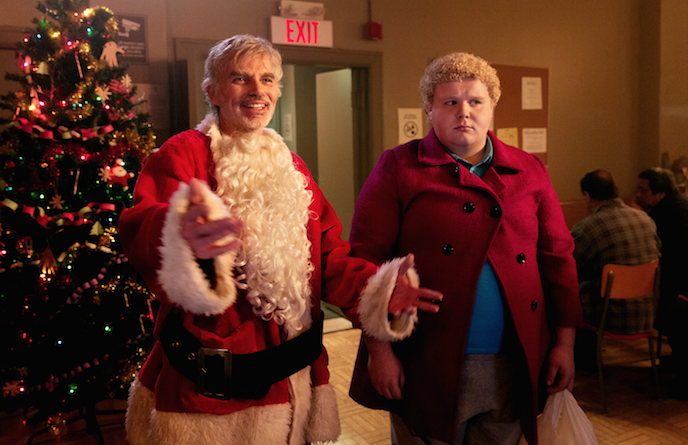
Thirteen years after showing us that it’s probably not a candy cane in his pocket, Bad Santa is back for more naughtiness.
Thirteen years, really?
Yep, which is just one of the reasons BS2 smells more like desperation than inspiration.
The always charming Willie Soke (Billy Bob Thornton) is trying to end his miserable life when Thurman Merman (Brett Kelly) walks in to offer him a sandwich and let Willie know that his old friend Marcus needs a meeting pronto.
Marcus (Tony Cox) says there’s an easy score of at least 2 million bucks waiting at a charity in Chicago. All they have to do is put the old suits back on, ring some bells for donation money and then rob the safe on Christmas Eve. Once in Chi-town, Willie learns the part Marcus left out. They’ll be working with Willie’s long-estranged and equally charming mother Sunny (Kathy Bates), who has organized the whole plan.
Then Thurman makes the trip from Arizona to be with Willie on Christmas, and the gang is back together!
Well, some of the gang, but not nearly enough.
Part one was more than just a hilariously shocking mix of the sacred and the profane. Director Terry Zwigoff and original writers Glenn Ficarra and John Requa put some subversive social commentary alongside distinct supporting characters that were perfectly fleshed out by the likes of John Ritter and Bernie Mac.
BS2 finds director Mark Waters (Mean Girls, Vampire Academy) and a new writing team not thinking any deeper than being crude and having Kathy Bates in the cast. The characters are thin, the plot is contrived and few of the jokes find a mark. Worse than that, the bad boy charm from BS1 is long gone, replaced with an unsavory streak of mean.
And then there’s Thurman Merman. He was the MVP of Bad Santa, so you can’t really have a sequel without him, yet there’s no way to recreate that magic. Thurman was 8 back then, and his unending belief in a “bad” Santa created a sweet conflict that felt impossibly real and drove the film. Sure, it’s a kick to see him at age 21 but beyond that, the writers can’t seem to decide how the character fits in anymore.
Much as I wanted to believe in Bad Santa 2, it’s just too much of an empty suit.
It’s been too long since we took a trip around the world to see how certain corners view horror. Today we head to the cluster of chilly Norse and Scandinavian countries to seek trolls, wolves, Nazi zombies – and to steer clear of household tools, if possible.
5. Trollhunter (2010) (Norway)
All ancient cultures generated fairy tales. They passed on stories that wrapped the virtues most respected at the time inside common dangers to tell tales of heroism and humor. Norway’s fairy tales all involve trolls. Indeed, their entire national culture seems weirdly identified with trolls. Why is that? Well, writer/director Andre Ovredal’s Trollhunter suggests that maybe it’s because trolls are a real problem up there.
Ovredal’s approach is wry and silly – adjectives that rarely hang out together, but maybe we haven’t seen enough of Norway’s cinematic output. The FX are sometimes wonderful, and especially effective given the otherwise verite, documentary style. Ovredal makes droll use of both approaches.
Trollhunter is definitely more comedy than horror, as at no time does the film actually seek to scare you. It’s a wild ride into a foreign culture, though, and it makes you think twice about the Norway section of Epcot, I’ll tell you what.
https://www.youtube.com/watch?v=vy2nAOdBUlw
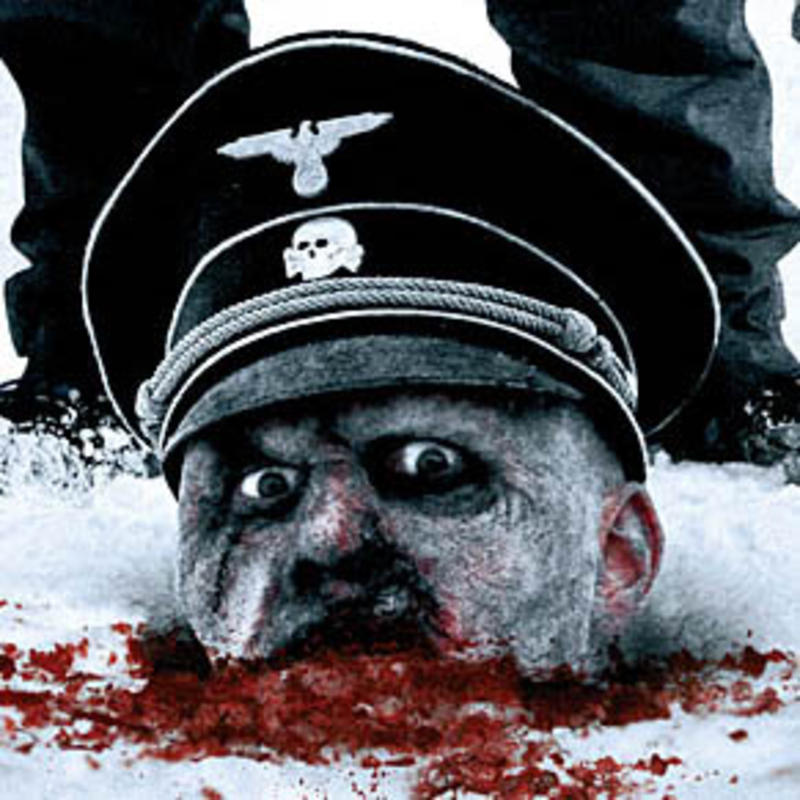
4. Dead Snow (2009) (Norway)
Nazi zombies, everybody! Hell yes!
Like its portly nerd character Erlend, Dead Snow loves horror movies. A self-referential “cabin in the woods” flick, Dead Snow follows a handsome, mixed-gender group of college students as they head to a remote cabin for Spring Break. A creepy old dude warns them off with a tale of local evil. They mock and ignore him at their peril.
But co-writer/director/Scandinavian Tommy Wirkola doesn’t just obey these time-honored horror film rules, he draws your attention to them. His film embraces our prior knowledge of the path we’re taking to mine for comedy, but doesn’t give up on the scares. Wirkola’s artful imagination generates plenty of startles, and gore by the gallon.
Spectacular location shooting, exquisite cinematography, effective sound editing and a killer soundtrack combine to elevate the film above its clever script and solid acting. Take, for example, the gorgeous image of Norwegian peace – a tent, lit from within, sits like a jewel nestled in the quiet of a snowy mountainside. The image glistens with pristine outdoorsy beauty – until it … doesn’t.
3. Antichrist (2009) (Denmark)
Saturated in the cinematic equivalent of melancholy poetry, punctuated with truly, deeply shocking moments of violence and brutality, Lars von Trier’s Antichrist takes the cabin-in-the-woods horror to brand new places, sharing his auteur cred with the horror genre.
A nameless couple (Willem Dafoe and Charlotte Gainsbourg) is wracked with grief after the death of their young son. They retreat to their remote cabin, hoping to speed the healing process. Things do not go well.
Dafoe and Gainsbourg give terrific, courageous performances. They are the only two actors onscreen for 99 percent of the film, and they do not shrink from the challenge. These are deeply flawed characters, and the performances are haunting.
Von Trier’s film is so gorgeous to see and so punishing to watch, the result is an amazing if bruising experience. His tone ranges from somber to insane, and one or two of the more vivid weirdisms feel terribly out of place. But there is no forgetting Antichrist, hard as you may try.
2. Hour of the Wolf (1968) (Sweden)
An atmospheric masterpiece, Ingmar Bergman’s meditation on artistic conflict and regret is a haunting experience.
Bergman favorites Max von Sydow and Liv Ullman are a married couple spending time on an isolated, windswept island. Ullman’s Alma is pregnant, and her relationship with her husband becomes strained as his time and attention become more and more consumed by visions, or demons – or maybe they’re just party people.
Von Sydow’s character is tempted with the decadence missing from the wholesome life that may be dissatisfying to him. But it’s Ullman, whose performance spills over with longing, that amplifies the heartbreak and mourning that color the entire film.
Shot in incandescent black and white, with Bergman’s characteristic eye for light and shadow, Hour of the Wolf is a glorious, hypnotic nightmare.
1. Let The Right One In (2008) (Sweden)
In 2008, Sweden’s Let the Right One In emerged as an original, stylish thriller – and the best vampire flick in years. A spooky coming of age tale populated by outcasts in the bleakest environment, the film breaks hearts and bleeds victims in equal measure. Kare Hedebrant‘s Oskar, with his blond Prince Valiant haircut, falls innocently for the odd new girl (an outstanding Lina Leandersson) in his shabby apartment complex. Reluctantly, she returns his admiration, and a sweet and bloody romance buds.
As sudden acts of violence mar the snowy landscape, Oskar and Ali grow closer, providing each other a comfort no one else can. The film offers an ominous sense of dread, bleak isolation and brazen androgyny – as well as the best swimming pool scene perhaps ever. Intriguingly, though both children tend toward violence – murder, even – you never feel anything but empathy for them. The film is moving, bloody, lovely and terrifying in equal measure.
Director (Ohio’s own) Lee Wilkof and screenwriter Ethan Sandler tap into years of collective wisdom from the inside to create a bittersweet, in-the-know glimpse at the near-thankless life of the workaday actor.
Gabriel Byrne, low key but excellent, is Lester Rosenthal – or Lawrence Rose, as the old playbill would have read. He’s having a hell of a time, as his longtime friend Hershel (Nathan Lane) explains to us via narration.
He’s a New York actor. An aging one whose dog just died, who hasn’t worked too steadily since that soap opera killed him off a few years back, who whiles away his days with similarly stagnant thesps in the Actors’ Equity Lounge, who may be willing to accept the role as King Lear’s Fool – in Dayton.
A mash note to the beleaguered actor in it for the long haul, No Pay, Nudity hits more often than it misses. The filmmakers possess a clear, lived-in knowledge of this world, this life. The yarn they spin is as empathetic as it is frustrated, and Byrne effortlessly embodies this embittered, wearied soul.
The premise is a bit slight and the resolution a tad rushed, but Wilkof and company make up for most of that with insight and affection to spare.