But let’s be honest, Helen Mirren in a bouncy house sounds fun, too, but we come to Winchester looking for some solid frights as well. Instead, we get a mostly nonsensical mishmash of jump scares and music stabs.
Directors/co-writers the Spierig Brothers (Daybreakers, Jigsaw) dive into the legend of the Winchester house, the mysterious mansion in California with endless oddities and rumors of spirits restless after meeting death at the barrel of a Winchester rifle.
Mirren is family matriarch Sarah Winchester, still grieving from the losses of her husband and child in 1906. She orders constant construction on the house, building room after room for the wandering spirits, and the Winchester company board sees an opening.
Dr. Eric Price (Jason Clarke), battling demons of his own, is hired to stay at the mansion and evaluate Sarah’s sanity, hopefully returning a verdict that would force her out.
Bumps in the night ensue.
Mirren and Clarke both rise above the material, which is pretty weak. The Spierigs can build no simmering tension or creepy atmospherics on the order of say, The Woman in Black (a very effective PG-13 haunter). Winchester is built only from standard “boo!s” and lazy red herrings.
As if the YA heroes in The Maze Runner films haven’t been through enough, here come the zombies!
OK, they’re really zombie-like, after catching the “Flare Virus” that is quickly sweeping the dystopian future world of the trilogy’s finale, The Death Cure. But some young adults seem immune, and when Minho (Ki Hong Lee) is among those rounded up for research purposes, Thomas (Dylan O’Brien) and the rest of his maze-running friends hatch a rescue plan.
Director Wes Ball is back to finish what he started with the first two MR films, and he flashes a well-developed eye for the composition of an effective action sequence. From the train-robbing prologue through the exploding finale in the “Last City,” the set pieces from Ball (a former visual effects supervisor) hold up. It’s what fills the time between the action, and how long it takes to reach that finale, that makes The Death Cure such a slog.
The themes are familiar and borrowed from any number of similar films, but it feels like there is a taut and tense action thriller buried somewhere beneath the two hour and twenty minute bloat.
While Will Pouter’s return gives the YA ensemble an impressive talent boost, Patricia Clarkson, playing little more than Standing Around Kate Winslet from the Insurgent series, is unnecessarily wasted. The connective drama here lacks the substance for all the mining it’s given, and the emotional depth the film is trying so hard to reach never materializes.
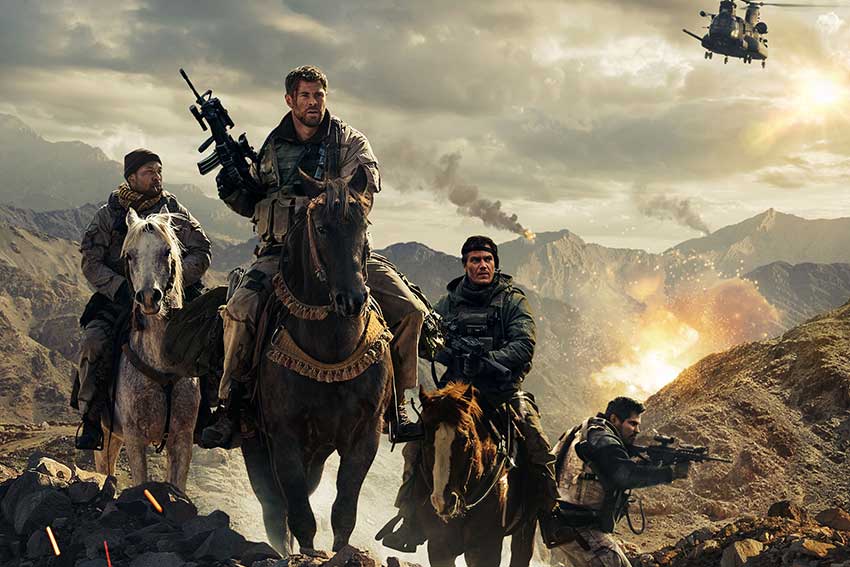
12 Strong tells a tale of extreme courage and heroism carried out by extremely courageous and heroic men. Like many films on a similar path, it sometimes struggles to navigate the overly familiar tropes that come with this territory.
In the weeks immediately after 9/11, the special forces team now known as the “Horse Soldiers” were the first deployed into Afghanistan. A dozen men, led by Captain Mitch Nelson (Chris Hemsworth, charismatic as usual), joined the soldiers under Afghan warlord General Dostum (Navid Negahban) in an attempt to take back a Taliban stronghold.
Director Nicolai Fuglsig, helming just his second feature, teams with experienced screenwriters Ted Tally (Silence of theLambs) and Peter Craig (The Town) to adapt Doug Stanton’s book with alternating layers of nuance and shallow cliche.
The men are tough, stoic, and bound by the brotherhood of battle. Their women and children back home must stiffen their lips and hold heads high while they long for their husbands and fathers to return. These traits are not weaknesses in the real world, far from it, but incorporating them into a big screen narrative without the essence of checking off obligatory character-building boxes has become a common obstacle that 12 Strong can’t overcome.
But almost every time you’re ready to give up on it, the film rebounds with a surprise. While there’s far too much exposition dialog, with the characters explaining things to the audience rather than talking realistically, there are also quiet moments that resonate. Dostum’s reminder to Nelson that he may already have a life “better than the afterlife” underscores the film’s success in showcasing the effective teamwork and diplomacy that emerged in the mission, despite the culture clash.
The ensemble supporting cast is loaded with strength (Michael Shannon, Michael Pena, William Fichtner, Moonlight‘s Trevante Rhodes), and Fuglsig finds his footing after a by-the-numbers start, rolling out some tense, gritty, and well-plotted battle scenes for a rousing finale.
The Horse Soldiers earned their statue at the 9/11 Memorial site, and 12 Strong is a well-deserved salute. It’s always watchable but also muddled, and too often chooses broad strokes over finer, more memorable points.
It may be an often misused phrase, but if you’d like an example of someone literally at a loss for words, you’ll find it in The Final Year.
Ben Rhodes, senior advisor to President Barack Obama, is trying to come to grips with the fact that Donald J. Trump had just become President-Elect of the United States. Rhodes tries several times to process a comment, and cannot.
It’s a striking sequence of an entire administration caught by horrific surprise, one of many indelible moments in director Greg Barker’s compelling look inside the final twelve months of the Obama presidency. Beyond the press conferences and photo ops, the film celebrates the daily grind of governing, and builds an ironic vibrancy from the slow and often frustrating march of persistence.
The goal is Obama’s vision of a “global common humanity,” and as the months wind down, we get close to the key players on his foreign policy team: Secretary of State John Kerry, UN Ambassador Samantha Power, National Security Advisor Susan Rice, and Rhodes.
It’s The West Wing with very real, incredibly high stakes, and from the Iranian nuclear treaty to the Syrian conflict, from the Paris climate accords to Boko Haram, we witness a commitment to progress that might be…steady…”harder to dismantle if we take a different turn.”
Which, of course, we did, a fact that lays bare the anchor in this film that’s as bittersweet as it is inescapable. Government needs people this committed, this intelligent, this qualified, this decent, and right now they seem in damn short supply.
Is Barker selective about what sides of his subjects we’re permitted to see? For sure, as that’s what a director does. But whether your political lean is left or right, the suspicion that Barker’s sitting on video of Obama bragging about sexual assault or calling some country a “shithole” would occur only to the most rabid of Hannitys.
It adds up to a fascinating, fly-on-the-wall account of 2016 that arrives already feeling like a freshly opened time capsule from some faraway yesteryear, a magical time when Presidents might have actually cared about other people.
“There’s no such thing as truth. Everyone has their own truth.”
That snappy piece of dialog is just one of the sharp edges I, Tonya uses to place a decades-old scandal right at the heart of an American cultural shift that feels mighty familiar.
Director Craig Gillespie, armed with a whip-smart script and a stellar ensemble, comes at the Tonya Harding 1994 Olympic soap opera from the perfect side: all of them.
The screenplay, a new career high for Steven Rogers (Hope Floats, Love the Coopers), breaks the fourth wall early and often, priming us for an array of “totally contradictory” testimony from these trailer-park super geniuses constantly pointing fingers at each other.
As Harding, Margot Robbie is electric, relishing the chance at a meaty lead role and proving worthy of every second she’s onscreen. We come to this film with any number of preconceived notions about Harding, so Robbie has to break through them and find the sympathetic layers.
She does, playing Harding as an unapologetic fighter, clinging to a sport that doesn’t want her while battling a cruel mother (certain Oscar nominee Allison Janney), an abusive husband in Jeff Gillooly (Sebastian Stan), an idiotic “bodyguard” with 007 delusions (Paul Walter Hauser) and eventually, a rabid public.
Or, maybe she was an ungrateful daughter and a scheming wife, in on the plan to hobble rival Nancy Kerrigan and eager to play the victim at her first opportunity.
Gillespie makes it a fascinating and darkly funny ride, with an undercurrent of bittersweet naivete. As the 1994 Winter Olympics get underway, we see Tonya’s drama play out alongside the birth of reality television, the rise of tabloid journalism and the start of the O.J.Simpson tragedy.
We would never be the same.
I, Tonya embraces the surreal nature of this tale but never mocks or condescends, even in its most comical moments. There’s poignancy here, too, plus tragedy nearly Greek in nature and a damn fine mix of real skating and visual trickery.
Never mind that East German judge. I, Tonya deserves the podium.
Word is, writer/director Alexander Payne has had the Downsizing idea for years, apparently waiting for when a satire of endless greed and unapologetic self-interest would feel the most relevant.
Good timing, then.
Payne, working with frequent co-writer Jim Taylor, returns to the political mindset he showcased so effectively in the classrooms of 1999’s Election. Here, their palette is a not-at-all distant future where science has come up with a solution for global sustainability: shrinkage!
By reducing people and communities to a ratio of 2.744 to 1, the potential for a guilt-free good life is off the charts! That sounds pretty great to Paul and Audrey Safranek (Matt Damon and Kristen Wiig), and a hilariously obnoxious info-mercial (Lauren Dern and Neal Patrick Harris, killing it) seals the deal.
Of course, it isn’t long before human potential meets human nature, familiar class systems develop and, as Paul’s smarmy neighbor (Jason Sudeikis) points out, getting small becomes more about saving yourself than saving the planet.
For three quarters of the film, the satirical slings and arrows find frequent marks, and layers deepen when Paul starts hanging with a crazy new neighbor (Christoph Waltz) and his cleaning lady (Hong Chau, in an award-worthy, film stealing performance).
Payne and Taylor aren’t as sure-footed when the satirical tone gives way to the absurd, or when a budding pretense makes the opening of a white man’s eyes feel a bit too heroic.
But while the scale of Downsizing is small, the film is thinking mighty big. The new world it envisions is engaging, with sharp comedy, unexpected turns and the keen observational structure to make it all impactful.
Did The Force Awakens simply recycle our Star Wars memories and sell them back to us? It did, but not simply, damn near brilliantly.
Then we got the sneak attack from the surprisingly deep Rogue One, a highly effective prequel that only strengthened our bond with the original Star Wars trilogy, and our confidence in the filmmakers now at the helm of this historic franchise.
The Last Jedi makes any letdowns seem light years away. With a deft mix of character-driven emotion, high stakes action and mischievous fun, it waves a proud flag for the legacy of this cinematic universe while confidently taking big strides toward crafting a new one.
Visionary talent Rian Johnson (Looper, Brick) now has the con as both director and sole screenwriter. His affection for the franchise, coupled with an innovative sense of character arc and storyline, combine for a freshness that respects nostalgia even while priming you to move beyond it.
Like J.J. Abrams, Johnson revisits iconic images and bits from the predecessors, but even with much more screen time for Mark Hamill’s Luke, Last Jedi feels less indebted to the original trilogy than did Force Awakens. You’ll find more humor (an opening “on hold” bit is a riot), more action and more Kylo Ren.
As Rey, Leia (Carrie Fisher in a bittersweet appearance), Poe (Oscar Isaac) and Finn (John Bodega) gather their scrappy troops to resist the First Order’s plan for pasty-faced, black-clad tyranny, the yin and yang of the film pits Adam Driver’s dark Ren against the spunky light of Daisy Ridley’s Rey.
Force Awakens gave Ridley plenty of opportunity to claim her spot at the center of the franchise, but Last Jedi allows Driver the chance to fully expand into the role of series villain. A true talent, Driver delivers a Ren who is emotionally manipulative and yet sincere (so emo!), needy and conflicted as he struggles to prove himself more than the “child in a mask” derided by Supreme Leader Snoke (Andy Serkis – aided by improved CGI).
Last Jedi also completes the transition of Poe into the courageous, never-tell-me-the-odds “flyboy” we knew was his destiny since the fist moments of Force Awakens. Isaac never disappoints, and it’s a joy to see him buckle this swash so Han-dily (sorry).
While we meet some great new characters, too, there is little exposition and a near constant barrage of action which renders the extended running time meaningless. It might get a little too cute once or twice, but there’s enough social commentary here to be relevant, enough visual glory to look wondrous, and more than enough spirit to be confident in its vision.
Things happen to characters we care about and to others we just met, and nearly all of those things carry the emotional heft of torches being passed.
And The Last Jedi makes it feel not only right but necessary, and all the more satisfying.
Last Flag Flying is a loving salute to the enduring nature of honor. Thoughtful and sometimes genuinely moving, it’s also not above getting laughs from three aging veterans trying to buy their very first mobile phones or arguing about the ethnicity of Eminem.
It is 2003, and Larry, aka “Doc,” (Steve Carell) is looking up two old Marine buddies for a very specific purpose. Doc, Sal (Bryan Cranston) and Richard (Laurence Fishburne) all served in Vietnam together, and now Doc needs his friends to help bury his son, who has just been killed in the Iraq War.
Once the men learn that the official story of the boy’s death isn’t exactly the real story, Doc declines a burial at Arlington, deciding to transport the body for a hometown funeral in New Hampshire.
Older gentlemen out for a wacky road trip? Is that what’s going on here?
Those fears are understandable but unwarranted, as director Richard Linklater confidently guides the film with gentle restraint and his usual solid instincts for organic storytelling. Some good-natured humor is framed from the three outstanding main performances, but it never derails the resonance of these characters grappling with the cyclical nature of sacrifice.
Linklater adapts the script with source novelist Darryl Ponicsan, who also wrote the 1970s servicemen-centered flicks Cinderella Liberty and The Last Detail. Last Flag Flying draws many parallels with the latter film, as it is not a stretch to see these characters as the Detail men taking stock of what the years have changed – and what they haven’t.
Though the perfectly-drawn contrasts of the three personalities seem manufactured at times, it matters less thanks to Carell, Cranston and Fishburne, who are never less than a joy to watch. You’ll need tissues handy for the touching final moments, but Last Flag Flying makes the tears, and the trip, worthwhile.
Transitioning slowly from a sweeping, outrage-fueled political drama to a hushed and intimate personal study, BPM becomes a deeply emotional portrait of hope and love.
It is France in the early 1990s, when Act Up/Paris is becoming increasingly confrontational in their protests, demanding an official AIDS prevention policy from the state, and an end to the indifference of the population.
Early on, director/co-writer Robin Campillo (Eastern Boys) skillfully uses Act Up’s regular meetings to bring us up to speed on procedures and strategies. Through the group’s infighting and organized protests, the film speaks to the often fragile power of activism, especially when some of the activists are dying.
The confusion caused by the AIDS epidemic is heavy in the air, and Campillo effectively pairs it with the desperation of those most personally effected, eventually settling on two in particular.
Sean (Nahuel Perez Biscayart) is HIV-positive and a veteran Act Up member, full of a passion that draws in the shy newcomer Nathan (Arnaud Valois). As the two draw closer, Campillo narrows his focus to the touching, slice-of-life glimpses that lie at the very heart of the cause.
BPM builds an earnest base through faithfully re-creating an era while reinforcing that era’s continued relevance to the present. But the film reveals its purpose through the smaller moments that inspire, reminding us of the courage needed to take a stand, and just what’s at stake if we don’t.
You won’t find many violins playing for the sad, lonely lives of good-looking people, but Bombshell makes a compelling case that a brilliant mind was long dismissed simply for belonging to a beautiful woman.
The woman was Hedwig Kiesler, an Austrian-born “enfant terrible” who found fame as Hedy Lamarr in the old Hollywood studio system while lamenting her label as nothing more than a glamour girl.
Over the last several years, Lamarr has finally gotten due credit for her ingenious idea of “frequency hopping,” the radio communication technology which laid the foundation for everything from remote controlled torpedoes in WWII to today’s wi-fi and GPS systems. That was far from all that was going on in Lamarr’s “pretty little head.”
The debut feature from writer/director Alexandra Dean, Bombshell lets Lamarr tell much of her story herself, thanks to a long-lost interview from 1990 that was discovered just last year. We hear of her talent for inventions, which began with re-assembling an old music box at the age of five, and plenty of highs and lows in a truly fascinating life.
A privileged childhood in Vienna is followed by family scandal over her landmark nudity in 1933’s Ecstasy, stardom, entertaining Mussolini, inventing a “Coca Cola cube” for soldiers, selling millions in war bonds, becoming one of Hollywood’s first female producers, building one of Aspen’s first ski resorts and finally, inspiring her plastic surgeons with ideas on better techniques.
Some classic archival footage and interviews with family and friends paint Lamarr as a woman with “so many sides and faces” who felt trapped by her beauty ’til the end, becoming a recluse when it left her.
Bombshell is an effortlessly compelling portrait, a bittersweet ode to a maverick who searched in vain for a way to unite her two worlds, and a time when she might get to be both “smart and Hedy Lamarr.”