This week in the Screening Room we hash out the good and the bac: Tomb Raider, Love, Simon, 7 Days in Entebbe plus everything out this week in home entertainment.
Listen to the full podcast HERE.
This week in the Screening Room we hash out the good and the bac: Tomb Raider, Love, Simon, 7 Days in Entebbe plus everything out this week in home entertainment.
Listen to the full podcast HERE.
by George Wolf
A film that sells the importance of negotiation while it details a harrowing plan of action, 7 Days in Entebbe gets caught in the awkward space between show and tell.
In July of 1976, Israeli Defense Forces invaded Uganda’s Entebbe airport for a daring rescue of hostages from a hijacked jetliner out of Tel Aviv. Bolstered by the support of Ugandan dictator Idi Amin, the terrorists were seeking the release of 40 Palestinian militants – as well as 13 other prisoners around the world.
As Israeli Prime Minister Yitzhak Rabin (Lior Ashkenazi) weighed his options, Defense Minister Shimon Peres (Eddie Marsan) led the chorus calling for military intervention.
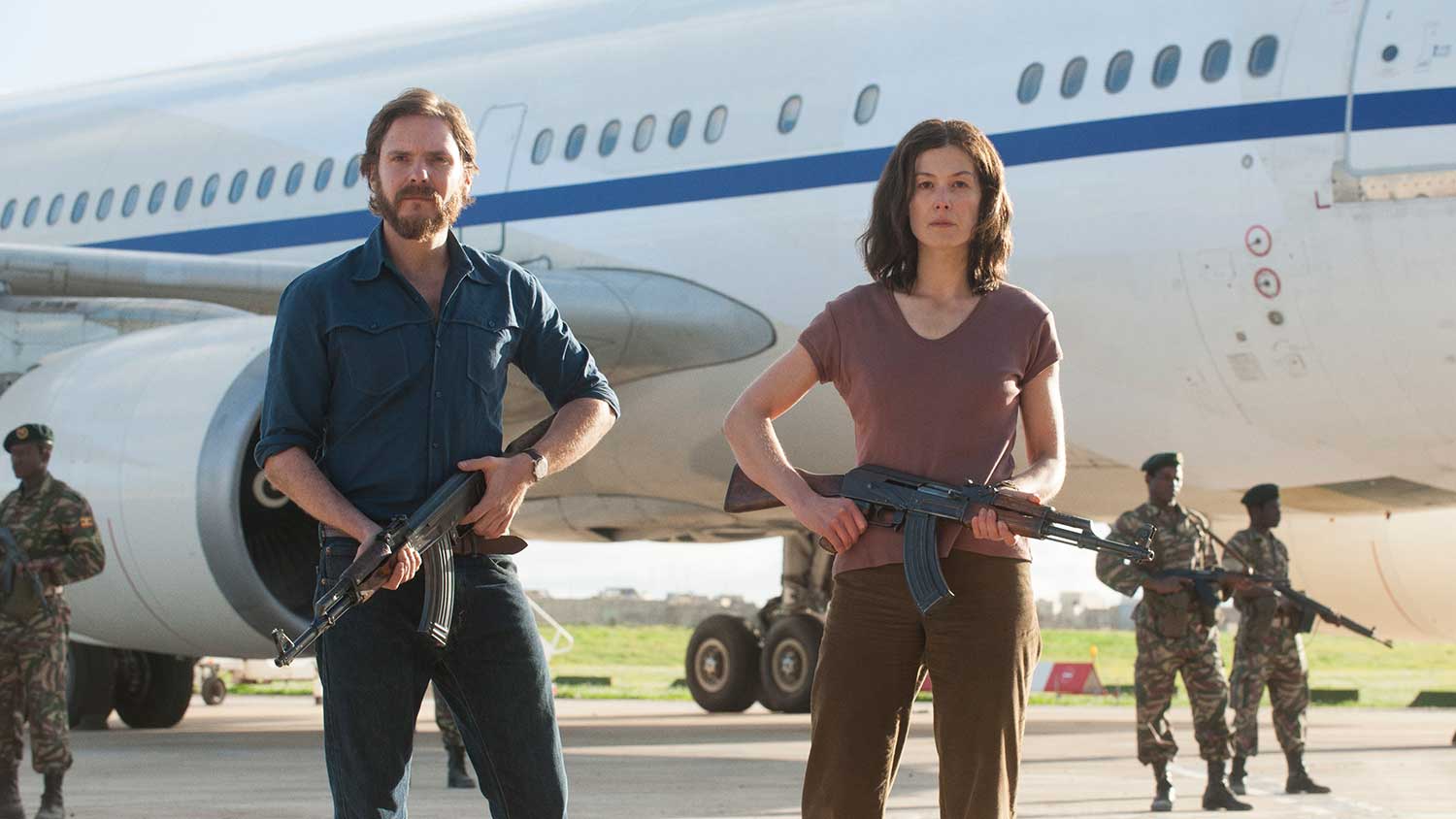
Director Jose Padilha (Elite Squad/the Robocop reboot) assembles the drama with precision, beginning with the motivations of German hijackers Wilfried Bose (Daniel Bruhl) and Brigitte Kuhlmann (Rosamund Pike). Padilha’s approach is detailed and informative, but often prone to favoring exposition over illustration.
Leading an outstanding ensemble cast, Bruhl and Pike both give terrific performances, letting us glimpse the early commitment of their characters and a growing disillusionment when the ordeal drags on. As the weight of the hijackers’ German heritage grows heavy amid their Jewish captives, the pair deal with their guilt in different ways, both finding an effective authenticity thanks to Pike and Bruhl.
Gregory Burke’s script has moments of bite (“You’re here because you hate your country. I’m here because I love mine.”) but retraces its steps too often, and the film feels like it’s running in place. Even more problematic is a curious approach to the actual rescue, when tension is undercut by the need to draw parallels with a well-rehearsed dance performance.
The payoff the film needs to resonate as more than a well-produced history lesson never materializes, and it leaves shrugging its shoulders at the elusive nature of peace.

by Cat McAlpine
Halfway through the new Tomb Raider, I thought to myself: “Well, you can’t have this kind of movie without those archetypes.” You know the ones: reluctant hero, loyal sidekick, irredeemable bad guy, henchmen with machine guns.
And then I second guessed myself, “Can you?”
That’s Tomb Raider’s most damning feature—it’s so familiar that it’s forgettable.
It’s not that Tomb Raider ISN’T fun (it is) or exciting (bike races, waterfalls, and bringing a bow to a gunfight, oh my!). It’s just that the relentless action is tired. The few connections between characters are forced or thrown away.
Alicia Vikander (Ex-Machina, The Danish Girl) gets few genuine moments to act, and she crushes it, but director Roar Uthaug seems afraid of the intimacy between Vikander and the camera. Every time she connects with a real emotion, the camera cuts away to a wide shot.
The exposition and key plot points are repeatedly spoon-fed to the audience. Lara Croft (Vikander) has to repeat each clue out loud as she discovers the answer to a riddle. Ugh.
And I’ve never seen a flashback that couldn’t be replaced with better writing. Tomb Raider has a lot of flashbacks.
“But Cat!” You say. “You’re a notorious hater. Didn’t you like anything?”
I’m so glad you asked.
When I sat down in the theatre, I wrote down a few primer questions, betraying my predictions for the film. They were these:
Is the male gaze present? Are the fight scenes realistic or stylized? Does it accurately echo the video game? How is the dialogue? Is there romance or just action? Are there other women in the film? People of color? Is there comedy? Is it predictable?
Good news: the male gaze is noticeably absent and Lara Croft is a genuine badass.
All the hand-to-hand combat feels realistic though many feats are delightfully improbable. Those improbable feats crisply reflect the basic mechanics of a video game: swinging from a hanging rope, traveling hand over hand along a railing, moving quietly through an encampment unnoticed.
There are other women and more diversity than expected, but not enough. A story that starts out vibrantly quickly narrows focus to a bunch of white people (plus sidekicks) fighting over a mystery of the Orient, while laborers (POC) who don’t speak English are gunned down for dramatic effect. #yikes
While I was glad that Lara got to kick ass without any romantic entanglements, I was genuinely disappointed that there wasn’t any real tension between her and Lu Ren (Daniel Wu, a great addition).
In summation, if someone wants to go to the movies this weekend, Tomb Raider is a fine pick. There’s a badass heroine, a handful of chuckles, and enough action to numb your brain for an hour and a half.
But it doesn’t redeem nearly as many sins of its genre as it repeats. It’s a predictable action adventure. No more, no less.
by Hope Madden
Whimsy, melancholy, existential dread—the absurdity of human existence. What can tackle it all?
Cartoons can.
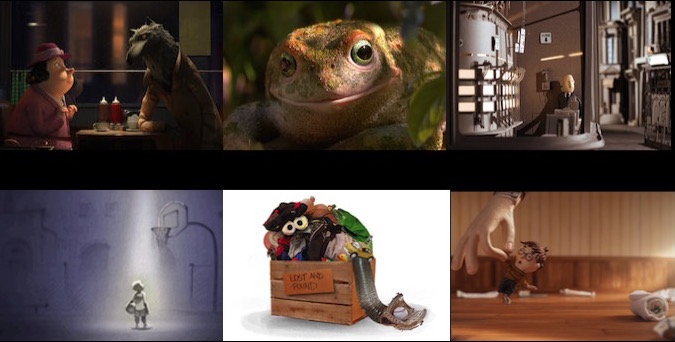
The 19th Annual Animation Show of Shows returns, jam-packed with tales both celebratory and cautionary. Human interconnectedness becomes a theme that runs throughout the program, one that feels simultaneously contemporary and retro.
From the brief, flippant Unsatisfying—a quick montage of irritating moments—to the lengthy morality tale Hangman, the film finds a wonderful balance in tone and mood, shifts mirrored in the ever-changing and always wonderful artistic styles of the shorts.
Traditional hand-animation, chalk and pencil, computer-generated art and even animation drawn directly on film stock, the choices made by the animators create unique atmospheres where each story can breathe and show off.
Kobe Bryant’s Oscar-winning Dear Basketball figures into the film, but its real highlights include Niki Lindroth von Bahr’s odd and amazing My Burden, Max Mortl and Robert Lobel’s bright Island, Tom Eshed’s charming Our Wonderful Nature: The Common Chameleon and David O’Reilly’s philosophical mind-bender, Everything.
There’s not a weak moment, truth be told, as headier fare is punctuated with musical flourishes or a quick laugh. The variety within the program and the sequencing of the shorts strengthens not only the overall experience but the human-ness that underlies the program’s unifying themes.
It’s lovely—sometimes funny, often sad, genuinely nutty and forever charming. If you’ve seen these celebrations of the art and glory of animation in previous years, you know the treat being offered. If you have not, this is your year.

by George Wolf
Some of the most tired young adult cliches – narration, idealized characters, the dreaded climactic essay reading – show up in Love, Simon.
So why is it such a winner?
Heart, smarts, and humor for starters. But it’s also the rare movie that earns points just for being here in the YA crowd, and for rightly assuming there’s no reason it shouldn’t be.
Simon (Nick Robinson) is an upper middle class high schooler in Georgia, with some awesome friends (Katherine Langford, Alexandra Shipp, Jorge Lendeborg, Jr.), awesome parents (Jennifer Garner, Josh Duhamel) and a big gay secret.
But then another kid at school comes out anonymously online, which leads Simon to adopt a fake name and reach out by email. So while much of the student body is guessing who the “secret gay kid” might be, two online pen pals bond over the uncertainties of being themselves.
Director Greg Berlanti (Life as We Know It) keeps the film moving, wrapping it with a clean, welcoming shine that would be just too peachy-keen if not for the smartly self-aware script from veteran TV writers Elizabeth Berger and Isaac Aptaker.
Adapting Becky Albertalli’s novel, the duo delivers some solid laughs (don’t mess with the drama teacher!), but more importantly, a knowing vibe that refuses to wallow in self-absorbed teen angst. Current events have reminded us that many teens are more than ready to meet harsh challenges with strength and wisdom, and Love, Simon gives them some refreshing credit.
It can’t go unnoticed that the film treats homophobic taunting as more mischievous than dangerous, but even that misstep feels ironically right. Everything about Love, Simon, from the casting to the set design, is effortlessly likable and comfortable, feeding the notion that this is nothing more or less than another teen romance.
It becomes a sweet, entertaining one, and it just might make some audience members feel a little less alone.
That makes Simon pretty easy to love.

by George Wolf and Hope Madden
Now that Adam Kontras’s first documentary feature is out, he has time to sit back and savor the accomplishment.
“I completely regret attempting it,” he says. “Had no clue it would turn out the way it did.”
How’s that?
“The movie turned out well,” Kontras says. “I just wish it wasn’t me.”
The film is Fastest DeLorean in the World, Kontras’s first-hand account of mixing business with record breaking. The owner of a Back to the Future-style time machine, Kontras documented his attempt at setting a new DeLorean speed record.
It is a fascinating story, filled with frustration, thrills, more than a little personal anguish and much more debt than expected.
Kontras, a Columbus native, left home for Los Angeles in late 1999 with a performance art piece entitled 4TVs, in which he played each member of a mock boy band that performed via separate TVs due to mutual hatred. Kontras decided to update his ambitions for fans from his on-air work in Columbus radio at WTVN and CD101 (now CD102.5) with a series of videos dubbed “The Journey,” unknowingly blazing the video blogging trail.
“I had a good email following through my time in radio,” Kontras says. “I decided to include a video with the first email announcing my move to LA and chronicling the whole journey. I just made a page with each email and video on the 4TVs site and figured I’d do it until I ‘made it.’ Eighteen years later, that video blog became a sort of therapy to handle all the bullshit out here. Once I was recognized in 2009 as the first and longest-running ‘vlogger,’ it won’t be stopping anytime soon.”
And then, like so many Midwesterners chasing Hollywood dreams, Kontras built a golf course and bought an iconic vehicle.
“I built a minigolf course in my backyard,” he says. “I was theme-ing each hole, and in 2014 an actual DeLorean Time Machine seemed like the caviar dream. Long story short, I took a loan and figured I could make the money back renting the car out. If that failed, I could sell the car at the height of Back to the Future madness in October 2015 (the “future day” Marty goes to in part 2).”
Kontras credits that “madness” with doubling his investment in 2015.
“To date, it’s still my only means of income, which is hard for me to even comprehend,” he says. “The car is simply that popular.”
Needless to say, owning that car has taken Kontras to some interesting places.
“The three times I’ve had it on the Universal lot at Hill Valley will always be surreal,” he says. “Driving Lea Thompson into Dodger Stadium, driving it on an aircraft carrier—2015 was incredible for big events like that. But my favorite events are usually the smaller ones where we get to surprise fans. You forget how much this car means to people sometimes.”
It has also led to a firm friendship with Don Fullilove, who played Mayor Goldie Wilson in the Back to the Future films and joins Kontras in his documentary.
“(Don is) as genuine as he seems on-screen and I honestly feel he saves the film,” Kontras says. “He keeps the pace light-hearted, although the content is anything but.”
As Kontras sets out to modify his car enough to reach world record DeLorean speed, costs and setbacks mount. Kontras leaned on his gearhead brother Kenny for both advice and actual work on the engine, and some of the most effective moments in the film come after their differing visions lead to a gasp-inducing bit of deception.
“I’m still struggling with the aftermath of everything and it doesn’t look like it will end anytime soon,” Kontras says.
Though The Fastest DeLorean in the World is Kontras’s first feature, the film has polish in both framing and editing, thanks to his experience assembling The Journey vlogs.
“(The film) was edited in Premiere Pro, and we used so many different cameras,” he remembers. “Mostly smartphones, to be honest. When you’re doing a lot of guerrilla shoots, being able to hand off an iPhone Plus with the steadicam feature is worth its weight in gold. So many of the shots were by friends that were just there to see what happened and I’d hand them a phone. It made editing a nightmare but I’m used to that.”
Did Kontras get his speed record? The film takes you on a captivating ride to find that answer.
“The movie ends with one helluva cliffhanger,” he says. “We’re presently shooting the sequel, the content of which seems to change daily. I’m still living every second and have no idea what or when that will be.”
Fastest DeLorean in the World is available now on Amazon.
by George Wolf
Alex Garland’s work as both a writer (28 Days Later…, Sunshine, Never Let Me Go) and a writer/director (Ex Machina) has shown a visionary talent for molding the other-worldly and the familiar. Annihilation unveils Garland at his most existential, becoming an utterly absorbing sci-fi thriller where each answer begs more questions.
A strange force of nature dubbed “The Shimmer” has enveloped the land near a remote lighthouse, and is spreading. Years of expeditions inside it have yielded only missing persons – including Kane (Oscar Issac). When Kane suddenly returns home and almost immediately falls prey to a life-threatening illness, his wife Lena (Natalie Portman, perfectly nailing a desperate curiosity) is detained for questioning by the military.
Lena, a biology professor with years of Army training, volunteers to join the new, all-female exhibition into “Area X,” hoping to find any shred of information that could save her husband’s life.
Adapting the first novel in Jeff VanderMeer’s “Southern Reach Trilogy,” Garland has found a perfect scratch for his psychological itch.
Garland builds the film in wonderful symmetry with the hybrid life forms influenced by The Shimmer. Taking root as a strange mystery, it offers satisfying surprises amid an ambitious narrative flow full of intermittent tension, scares, and blood – and a constant sense of wonder.
Just his second feature as a director, Annihilation proves Ex Machina was no fluke. Garland is pondering similar themes—creation, self-destruction, extinction—on an even deeper level, streamlining the source material into an Earthbound cousin to 2001.
Utilizing wonderfully strategic splashes of color, and a shifting timeline that drops purposeful breadcrumbs, Garland gives us a mystifying new world from the comforts of our own. Annihilation is the work of a top-tier genre filmmaker, and a challenging journey offering many rewards for those with no appetite for spoon feedings.
by George Wolf
Director Fatih Akin returns to an overtly political palette with In the Fade (Aus dem Nichts), and leans on a powerhouse lead performance from Diane Kruger to keep the film above standard thriller fare.
Kruger, starring in the first German language film of her career, is Katja, a German woman whose Turkish husband, Nuri, (Numan Acar) has rehabilitated himself after a stint in prison for dealing drugs.
On the way to meet a friend one morning, Katja visits Nuri’s office to drop off their young son, and never sees them alive again. They are the only casualties in what appears to be a targeted homemade bombing, and Katja’s recollections of a random woman she saw outside Nuri’s office become key in the trial of a neo-Nazi couple accused of the murders.
After his coming-of-age tale Goodbye Berlin two years ago, Akin is back on the socially conscious ground where he seems most comfortable. Most of In the Fade is anchored in a somber look at the toll of xenophobic hate, where human souls can come to be viewed as “no longer people.”
As a grieving mother looking for justice, Kruger delivers a masterful turn, making the weight of emotional turmoil feel achingly real. Katja struggles to exist in the haze of her heartbreak, juggling grief, bickering family members and a growing need for revenge. Kruger draws us in immediately, so much so that we feel the release when her quiet resolve finally erupts in emotional outburst.
The film’s third act, “The Sea,” has trouble delivering on the promise of all that Akin has cultivated in the first two (“The Family” and “Justice”). Events begin to follow a more conventional path, and though the outcome is striking, anyone familiar with Hollywood thrillers may find the narrative choices curious.
Worth seeing? Absolutely, and Kruger’s performance will likely linger even when the film’s voice does not.
by George Wolf
Pixar – the veritable Meryl Streep of this category – is here again, and deservedly the favorite to win more hardware. But some impressive frogs may spring an upset, while fractured fairy tales, a sports icon and emotional baggage round out a captivating program.
Dear Basketball – USA Dir: Glen Keane Wr: Kobe Bryant
From a distance, Bryant’s love letter to his sport may appear self-serving, but when brought to life through graceful, impressionistic chalk animation and a John Williams score, it becomes more. Vanity project? That’s fair, but it’s also a sincere farewell from a complicated legend.
https://www.youtube.com/watch?v=vA3Pqne28PE
Negative Space – France Dirs: Max Porter and Ru Kuwahata
With Sam’s dad often leaving on business trips, father and son form a bond forged in a perfectly packed suitcase. The stop motion animation is arresting and well-played, setting fertile ground for the bittersweet emotions the film explores.
Lou – USA Wr./Dir:Dave Mullins
Look at you Pixar, charming us again with your gentle humor and effective poignancy. A cousin to the Toy Story universe, Lou finds a playground bully meeting his match, in a good way. It’s surprisingly touching, and, no surprise, the frontrunner of the group.
https://www.youtube.com/watch?v=0iYsBnj2BUk
Revolting Rhymes – UK Wrs./Dirs: Jakob Schuh and Jan Lachauer
Based on the much-loved rhymes written by Roald Dahl and illustrated by Quentin Blake, Revolting Rhymes counters its somewhat bland animation with a talented voice cast (including Dominic West and Rob Brydon) to give famous fairy tales some new, sinister edges. Part one of a British TV double dip, it wanders off in spots but rallies at the finish.
Garden Party – France Dirs: Victor Caire, Florian Babikian, Vincent Bayoux, Theophile Dufresne, Lucas Navarro and Gabriel Grapperon
In a deserted, well-appointed mansion, some amphibians explore their surroundings and follow their primal instincts to unexpected results. Practically bursting with wondrous CGI photorealism, this ambitious film – a graduation project from a French animation school – offers delight in every frame.
Also included in the program are these additional animated shorts:
Lost Property Office – Australia Wr./Dir: Daniel Agdag
Coin Operated – USA Wr./Dir: Nicholas Arioli
Achoo – Japan
(rating for entire program)
by George Wolf
Remember when you asked your English teacher how long your term paper had to be and they answered “As long as it needs to be”?
This year’s group of live action short nominees does. The five stellar films will quicken your pulse, break your heart, educate and bring a welcome giggle, all offering satisfying cinematic visions in smaller packages.
DeKalb Elementary – USA Wr./Dir: Reed Van Dyk
A troubled young man (Bo Mitchell) enters an elementary school office, heavily armed and ready to kill, and a terrified administrator (Tarra Riggs) becomes mediator between the gunman and the police. Awash in breath-holding tension, the film boasts two terrific lead performances and a filmmaker with fine instincts for effective restraint.
The Silent Child – UK Dir: Chris Overton Wr: Rachel Shenton
Libby (Maisie Sly) is a four year-old deaf child who bonds with the social worker (Rachel Shenton) teaching her sign language. Shenton, who also wrote the film, is an advocate for deaf awareness and her passion shines through in this heart-touching and informative short.
My Nephew Emmett – USA Wr./Dir: Kevin Wilson, Jr.
In 1955, Mississippi preacher Mose Wright (L.B. Williams) tries to protect his 14-year-old nephew, Emmett Till (Joshua Wright) from two racist killers out for blood. Based on a true story, Kevin Wilson Jr.’s film is mournful and built from a simmering dread, but ultimately lifted by a spirit that that will not be broken.
The Eleven O’Clock – Australia Dir: Derin Seale Wr: Josh Lawson
While a temp secretary (Alyssa McClelland) minds the appointment book, a delusional patient (maybe Damon Herriman) of a psychiatrist (maybe writer Josh Lawson) believes he is actually the psychiatrist. As each attempts to treat the other, the session gets out of control. Seemingly inspired by Monty Python’s famous “Argument Room” sketch, it’s cleverly cheeky and sometimes hilarious.
Watu Wote/All of Us – Germany Dir: Katja Benrath Wr: Julia Drache
Based on the 2014 attack by Al-Shabaab militants on a Nairobi-bound bus near the Kenya-Somali border, Watu Wote is grounded in a familiar narrative theme, but buoyed by director Katja Benrath’s gracefully subtle hand. It’s a somber yet inspiring salute to courage, love and mercy.
Rating for full program: