Just One of Those Things has plenty of things going for it, but catch it right now, and you can add “timing” to the list.
Really, there’s never a bad time to be swept away by one of music’s all time great voices, but these 90 minutes seem even sweeter right about now.
Director Leslie Woodhead assembles a wealth of performance footage, archived interviews and even some home movies to trace Ella’s rise from reform school and homelessness to concert stages across the globe.
Buoyed by the tender narration from actress Sophie Okonedo, Ella’s story becomes one of happenstance, perseverance and one-of-a-kind talent.
Her original aspiration was to be a dancer, but when other dancers at the Apollo Theater’s amateur night in 1934 were too good, 16 year-old Ella decided to sing. From that night until her death in 1996, she mastered jazz, big band, the great American songbook, and of course, be-bop swing.
In fact, the film’s non-performance highlight is a truly fascinating, nearly clinical deconstruction of the otherworldly ability that made Ella perhaps the greatest “scat” vocalist the world has ever known. Watch and learn, hepcats, it’s amazing.
Though the bulk of the film is given a linear, by-the-numbers presentation, the musical history it recounts is essential. An important and timeless biography, Ella‘s got that swing.
Which, as you may have heard, means a thing or two.
Some of the best moments during Jon Stewart’s years on The Daily Show happened when his guest was some smug politician who had not done their homework.
Because Jon always did his, and the squirming politico would realize pretty quickly that Jon could throw some heaters. This funnyman was whip smart, too, and pretty handy with the b.s. detector.
It should come as little surprise, then, that Irresistible, Stewart’s second feature as writer/director, employs some purposeful, intelligent comedy as it sets about skewering today’s ridiculous political climate.
Daily Show vet Steve Carell is Democratic strategist Gary Zimmer. Stinging badly from the 2016 election, he’s inspired by a YouTube video of a former Marine hero dressing down the city council in tiny Deerlacken, WI.
Zimmer decides right then that Col. Jack Hastings (Chris Cooper) and his “redder kind of blue” appeal could be the centerpiece of a new nationwide project to expand the Democratic base. And it all begins with getting Hastings elected Mayor of Deerlacken.
This does not go unnoticed on the other side. Once GOP strategist Faith Brewster (Rose Byrne) and her crew come to town, the Mayor’s race in Deerlacken starts carrying some pretty high stakes – including one hilarious sexual side bet between the two opposing operatives.
After an impressively dramatic filmmaking debut with 2014’s Rosewater, Stewart returns to the satirical stomping grounds where he became a respected (and, to some, reviled ) voice that drove many worthwhile conversations.
Though the bite of this screenplay may be a bit softer, his narrative approach betrays a long game that trades the sharper knives for the chance at a wider reach. Because the cure for what’s infecting American politics is not going to spread through niche marketing.
Sure, you could call that a sellout, and for the first two acts of this movie you might be right. The “all politics is local” premise is certainly not new, nor are many of the talking points. But thanks to the two veteran leads, those points are just funnier.
Carell’s default manner is perfect for the quietly condescending Zimmer, an elitist who confuses nobility with blind ambition, and somehow thinks he has a shot with the Col’s much younger daughter (Mackenzie Davis).
The real treat, though, is seeing Byrne finally dig into another role worthy of her comedy pedigree. With the right material, Byrne is a comedic MVP, as she reminds anyone who’s forgotten that fact by making Brewster one hilarious, shameless, priceless piece of work.
Stewart may be known for his progressive leanings, but both the left and the right are in his sights here, along with unchecked political cash and obsessive pundits complicit in fostering the fear and shame game.
Easy targets? Sure. But if you don’t think Stewart’s smart enough to know that, than you never saw him blindside a back-slapping incumbent on late night TV.
Irresistible caters to your expectations just long enough to make you think you knew where it was going all along. The unassuming way the film upends those expectations might seem overly convenient, but it feels right, as if Stewart is practicing what he is taking care not to preach. And that’s just what might make it hard for mainstream America to resist.
It’s hard to do zombies well anymore. Mainly, you have to either
come up with an entirely novel concept or hope that the bloody mayhem works in
your favor.
In Yummy, the concept is only marginally original,
but the bloody mayhem is more than on target. Co-writer/director Lars Damoiseaux
assaults your gag reflex with a viscous mess of a horror flick. Blood and
entrails, of course, but expect a pretty inspired use of pus, liquid body fat,
tendons and other tissues and goos.
It makes for some slick surfaces, I tell you what! Plus some
unexpected little monsters keep things interesting and fun.
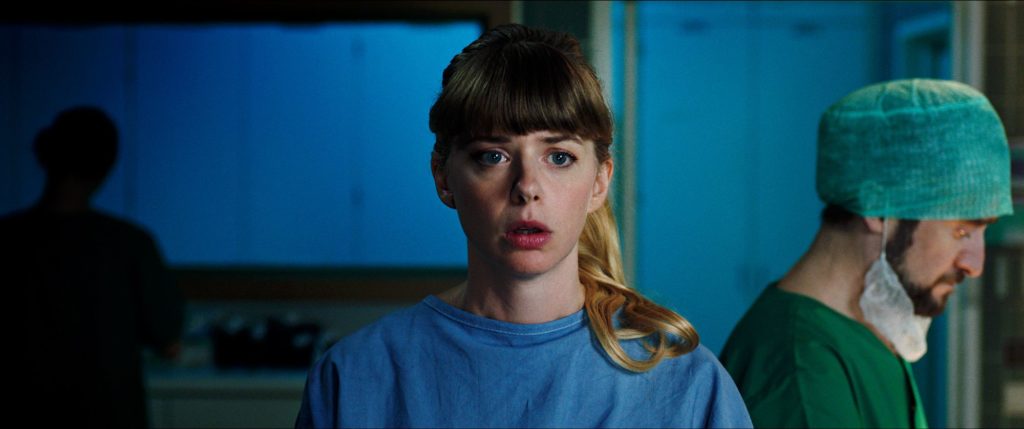
Set inside a cut-rate Eastern European cosmetic surgery
clinic, the film follows a mother, daughter and her boyfriend into a very bad
decision. Mom (Annick Christiaens) is after a series of nips and tucks; daughter
Alison (Maaike Neuville) wants breast reduction; boyfriend Michael (Bart
Hollanders) is just a good dude willing to drive everyone even though he’s
afraid of blood.
Here is a ripe premise for horror. Mom is a Cronenberg-esque vehicle for body horror as well as vanity shaming. Alison provides comedic possibilities (no one in the clinic can begin to understand her point of view). Hemophobic Michael offers the clear hero’s arc. (Or he’ll simply die of shock by the gooey second reel.)
And no, it’s not incredibly novel—zombie movies so rarely
are. But it’s smart, witty and fun. Damoiseaux accomplishes much with his
budget. Practical effects are great, performances are delightful, and nothing
beats a little well placed Stooges. (The band, not the knuckleheads.)
Yummy represents Damoiseaux’s feature debut as
director and writer, but he’s garnered attention and awards for years with his
work in shorts. Award winning co-writer Eveline Hagenbeek (Rokjesdag)
channels her affinity for conversational comedy into a script that may follow a
familiar structure but delivers a believable, funny edge that the game ensemble
takes advantage of.
Their collaboration is no masterpiece, but it is a lot of sloppy fun.
A poetry of dread – that’s what the best in this business can conjure with the right framing, movement, stillness. Whether it’s Dick Pope creating that just-off feel of bucolic 1950s Idaho for The Reflecting Skin or Owen Roizman forever narrowing the screen, our gaze and our options in The Exorcist, the cinematographer is horror’s true master. Mike Giolakis kept us looking around us and behind us to see where the monster might be in It Follows. John Alcott (The Shining), Chung-hoon Chung (The Handmaiden) and Mo-gae Lee (A Tale of Two Sisters) haunted and mesmerized us with color, movement and atmosphere. Has anybody done it better?
Here are our nominees for the best cinematography in horror.
Gorgeous. If you’re looking for something theatrical, a true marriage between cinematography and set design, Masaki Kobayashi’s Oscar nominee Kwaidan delivers the goods.
Yoshi Miyajima lenses four different ghost stories, each almost entirely shot on highly decorated sound stages, and what he captures is the feeling of make believe that gives each story the sense that it is being told, being embellished for your spooky enjoyment.
Each story is given its own look, its own personality. It’s bold and memorable filmmaking, and an absolute sight to behold.
4. Antichrist (2009) – Anthony Dod Mantle
Whether it’s the utter poetry of the opening tragedy, the claustrophobic dread of the middle section, or the lurking menace of the final reels, Antichrist is an absolute treasure trove of emotional manipulation.
At times, Anthony Dod Mantle’s cinematography feels at odds with the actual content on the screen—particularly in Act 1. But mining for beauty in pain is one of many ways director Lars von Trier succeeds in surprising and horrifying with this film.
Mantle finds a terrifying beauty in ugly thing von Trier throws at you, and the end result is a mesmerizing and brutal work.
https://www.youtube.com/watch?v=w4U5rdi9w-U&t=20s
3. Nosferatu (1922) – Fritz Arno Wagner
We needed to pay our respects to some of the earliest and most memorable work in cinema. Why F.W. Murnau’s Nosferatu? Because nearly 100 years later, there are still images that haunt your dreams.
Fritz Arno Wagner (who also lensed Fritz Lang’s glorious M) capitalizes on the unseemly, vermin-like look of Count Orlock (Max Schreck, genius) with creeping silhouettes, lurking shadows, and camera angles that emphasized his hideousness.
Whether it’s the shocking rise from the coffin, the shadow on the staircase, or the image of the sole survivor of the ship recently decimated by “the plague,” Murnau and Wagner’s images are as evocative today as they were in ’22.
2. The Lighthouse (2019) – Jarin Blaschke
The atmosphere is thick and brisk as sea fog, immersing you early with Oscar nominee Jarin Blasche’s chilly black and white cinematography and a Damian Volpe sound design echoing of loss and one persistent, ominous foghorn.
Director/co-writer Robert Eggers follows The Witch, his incandescent 2015 feature debut, with another painstakingly crafted, moody period piece. The Lighthouse strands you, along with two wickies, on the unforgiving island home of one lonely 1890s New England lighthouse.
Salty sea dog Thomas Wake (Willem Dafoe) keeps the light, mind ye. He also handles among the most impressive briny soliloquies delivered on screen in a lifetime. Joining him as second is one Ephraim Winslow (Robert Pattinson)—aimless, prone to self-abuse, disinclined to appreciate a man’s cooking.
1. Pan’s Labyrinth (2006) – Guillermo Navarro
In 2006, Guillermo Del Toro’s masterpiece may have somehow been overlooked as Oscar’s Best Foreign Language Film, but at least the Academy had the common sense to notice Guillermo Navarro’s cinematography.
He manages to create an atmosphere equally imaginative and bitterly realistic, something befitting a child’s logic. Like a fairy tale, the screen blends the magical beauty of good and evil. His vision is as hypnotic as it needs to be, as childlike as we need it to be. It’s beautiful, innocent and utterly heartbreaking.
7500, the emergency code for an airplane hijacking,
is the title of the feature debut for writer/director Patrick Vollrath. An
Oscar-nominated and much lauded filmmaker of shorts, Vollrath and his lead,
Joseph Gordon-Levitt, prove fine instincts for building tension while
maintaining understatement in a film that probably just shouldn’t have been
made.
Gordon-Levitt plays Tobias Ellis, co-pilot of a German
aircraft on its way to Paris. When Muslim terrorists attempt to overtake the
plane, Tobias finds himself in the unenviable position of refusing their
demands and witnessing the havoc they wreak.
We haven’t really seen JGL since Oliver Stone’s mediocre 2016 biopic Snowden. (He’s done a lot of voice work since, but we haven’t seen him.) But there was a time when the ageless actor (he’ll be 40 in February but he’s still playing baby faced 30-year-olds) appeared in almost every interesting film being released: Inception, The Dark Night Rises, Looper. And then came his own debut as writer/director: Don Jon—the best antidote for a romantic comedy perhaps ever.
Since then, even when his performance is solid (and it usually is), his film choice is not.
There are some exceptional reasons for the actor to show us
his face again in 7500. The role offers clear, no doubt fascinating
challenges. Much of the film is a one-man-show, and more intriguingly, the
actor and filmmaker work together to ensure that this hero is as dialed-down
and honest as he can be.
Vollrath’s film never revels in vengeance, never lusts after opportunities for comeuppance. And the downplayed emotion, the minutia of flying, the fear—all elements generally discarded in your Big Heroic Movie—give this film an unexpected air of humility.
Better still is the savvy use of limited vision, the claustrophobic
nature of air travel, the confinement of the hero to ratchet up tensions.
And yet.
For its subdued, humble approach, 7500 is a white
savior film about an American man protecting those in his care from scary brown
people. It picks a scab that’s been fingered to death, offers no real new take
and absolutely no excuse for its choice of antagonist.
This isn’t a true story. Vollrath could have imagined absolutely anyone to be hijacking this plane, and the subtlety of the filmmaking feels even more insidious because of his choice. No swelling strings, glib one-liners, flying flags or bombast mark this as pandering white supremacy.
Imagine if the world thought your father was one half of an all-time great love story, but the other half wasn’t your mother.
You’d probably want people to know her story, too.
Director Matt Riddlehoover lets the four daughters of Johnny Cash and Vivian Liberto remove the shadow that has long obscured their mother’s life. In the endlessly endearing My Darling Vivian, we’re introduced to a woman of great strength and grace, and an intimate story that reinforces both the power and pain of love.
Johnny and Vivian met as teenagers in Texas, writing passionate letters while he was away as an Air Force cadet, then marrying young and immediately starting a family before his legendary music career exploded.
Whether by necessity or choice, Riddlehoover interviews Rosanne, Tara, Kathy and Cindy Cash separately, and the result is a wonderful mix of memory and perspective. Rosanne’s remark that the sisters had “four different mothers” rings true as their recollections of youth often bounce off one another with a charming Roshoman-style variety.
The stream of still photos, home movies and excerpts from the nearly one thousand letters (!) Vivian saved presents incredible insight into the sweetness of young love and the increasing demands on the shy and anxiety-prone wife of a superstar.
While Johnny’s constant touring left Vivian alone to care for four children under six years old, the pressures of fame, Cash’s drug use and the shameful accusations about Vivian’s ethnicity all added to the toxic atmosphere. As rumors swirled about Johnny’s involvement with June Carter, news of their parents’ divorce actually came as a relief to the oldest of the Cash sisters.
The memories are often presented with aching detail – coming home from school and seeing fresh dry cleaning meant their mother had not committed suicide that day – and the openness of the family archives is breathtaking. And still, Vivian’s own voice remains absent, haunting much of the film until Riddlehoover plays that hand for maximum effect.
My Darling Vivian is essential to understanding the complete legacy of a cultural icon. But even beyond the celebrity trappings, it is a bittersweet testament to love, to family, and to scars that never quite fade.
And, most of all, it’s a record-straightening ode to a woman well worth knowing.
Why would a first-time feature director make sure her camera lingers a few extra beats on one of those old karaoke videos where the visuals bear no relation to the lyrics being sung?
Because it’s a sly reinforcement of the abrupt, defiant way that Shannon Murphy is telling the story of Babyteeth, and of the unconventional soul at the heart of the film.
That soul would be Milla (Eliza Scanlen), a seriously ill Australian teen who literally bumps into the 23 year-old Moses (Toby Wallace) while waiting for a tram.
She likes his hair, so he gives her a haircut. She brings him home, and suddenly Milla’s parents (Ben Mendelsohn and Essie Davis) have something new to worry about.
“That boy has problems!” Mom shouts.
Milla answers, “So do I!”
True enough, and Rita Kalnejais delivers a debut screenplay that embraces the tough and the tender while taking us inside a fraying family dynamic.
Mom Anna used to be a impressive pianist, but she struggles to stay off pills and keep her tears at bay. Dad Henry is a psychiatrist who handles Milla’s illness in a more pragmatic fashion while he develops a strange fixation on the pregnant neighbor (Emily Barclay).
Mendelsohn and Davis are customarily excellent, each reinforcing the different ways that grief can manifest itself, often pulling them closer and increasing their distance in equal measure. In lesser hands, the eccentricities of these characters could have dissolved into caricature or misguided comic relief, but Mendelsohn and Davis each bring a weary stoicism that keeps both parents grounded.
Scanlen, fresh off playing Beth in last year’s glorious revision of Little Women, is completely transfixing as a girl impatient to experience life. The more Milla is reminded of her sickness, the more she rebels, and Scanlen finds a mix of courage and fear that never feels false.
The whiff of death in coming-of-age dramas has often been reduced to manipulative claptrap, but Murphy takes a bulldozer to that notion with an ambitious narrative that does not allow you to get comfortable.
She introduces themes using chapter titles (some generic, some genuinely touching), transitions very abruptly and leaves some matters unexplained. Murphy’s approach is uniquely assured, requiring our attention but rewarding our emotional investment, as the few mawkish leanings are swept away by the film’s wickedly perverse sense of humor.
After years of directing shorts and TV episodes, Murphy lands on the big screen as a vibrant new voice. Like Milla, she is setting her own pace in the search for the beauty in life, and Babyteeth finds that beauty in unexpected places.
LGBTQ youth often find themselves at the receiving end of family and friend abandonment. The people who are supposed to support them through the coming out simply walk away. The story at the heart of Jack & Yaya is about what happens when two childhood friends go through the same life-changing events, and how those closest to them stick around to champion their lives.
Jack and Yaya grew up as next-door neighbors in south New Jersey. From early on, they both saw who the other truly was, a girl and a boy, even if the rest of their family and friends did not.
In her directorial debut, Jennifer Bagley wisely lets the film’s two subjects be front and center. Jack and Yaya share a genuine openness about their lives. Absent is any kind of hubris when the two of them talk about their struggles or their successes. This honest, matter-of-fact nature feels immediately welcoming.
The focus on day-to-day struggles for transgender people is real and evident even in this sunnier-than-normal documentary. Jack struggles with running into discrimination even in a city as large as Boston. Yaya worries about the constant financial stress around obtaining hormones. It’s a needed dash of reality.
As the colorful cast of characters who revolve around Jack and Yaya are introduced, it’s not hard to see how these two became the people they are. Bagley naturally captures the warmth and love that flows between all of them. Amidst the alcohol and ‘70s rock, Yaya’s uncle Eddie spills to the camera how much love he has for both Yaya and Jack. “All you need is frickin’ love!” bellows Eddie.
Jack & Yaya works exceptionally well at being a celebration of these two people as they figure out their ever-changing lives. This isn’t a film interested in making a grand social statement. Bagley lets these two tell their story, and show us who they really are through their own words and actions.
Jack & Yaya beautifully shows how good we all can be when we prop each other up. Jack and Yaya’s lives could’ve gone so much differently. But they had each other and a support system that evolved into a deep friendship of genuine acceptance and caring.
In Rio de Janeiro, Brazil, the neighborhood of Lapa is home to Luana Muniz, the focus of directors Theodore Collatos and Carolina Monnerat’s documentary, Queen of Lapa.
A photoshoot of Muniz opens the film. She is elegant in
black lingerie, holding a cigarette; the audience learns that she has been a
sex worker since the age of eleven and is now one of the most recognized
transgender (Luana prefers the term transvestite) activists in Brazil.
A hostel run by Muniz for over two decades provides a safe
haven for transgender sex workers. It is this world that Collatos and Monnerat
are privy to. They are given a level of access that allows the audience to
experience these women’s lives as they live them.
Muniz is a bit of a mother hen to the women, many of them
even call her Mother Luana. She scolds them for not cleaning up after
themselves, expresses concern over injuries, and fights to ensure the house
remains a place where transgender men and women can live and work safely.
It’s an important concern. Transgender men and women, and sex workers, experience violence at alarming rates. One of the women speaks of having gasoline poured on her before she escapes her attacker. The same woman is beaten and robbed one night, showing her injuries to her Facebook Live audience. Another woman is nearly raped but manages to flee.
However, the film focuses on more than one aspect of these women’s lives. It allows us a chance to spend time with the housemates and get to know them. There is a familial atmosphere as the roommates watch TV, do each other’s nails, eat meals together, and argue.
Some of the conversations are more interesting than others,
but the filmmakers play a critical role with their lack of presence.
They allow the group to share their own stories, to let their voices be heard
at a time when it is essential that those who have been silenced in the past
are allowed to speak.
Muniz says of herself, “the only star here is me,” and in
some ways, she is the sun to a community of people who need an advocate like
her. One of the women recalls seeing Muniz on TV as a child, never expecting to
know her as an adult, but it’s an example of the impact she has had on the
community. She teaches the women how to be safe, how to not be ashamed of who
they are, and that they are loved.