“If a lot of people have just a little bit of courage, then nobody has to be a hero.”
If we can’t see the truth in that statement right now, we
are truly lost. It’s a call to action, and an argument that For They Know
Not What They Do patiently articulates.
A sequel of sorts to director Daniel G. Karslake’s 2007 doc For
the Bible Tells Me So, For They Know Not What They Do revisits the Christian
church after more than a decade to gauge its movement on LGBTQ rights.
The film drops you into the lives of four families
navigating the complex world of faith and sexual identity.
Elliott is about to leave for his freshman year at Vassar,
and he and his parents walk us through what it’s like to trust your adolescent enough
to begin the irreversible. Ryan, with the help of his genuinely loving if
deeply misdirected parents, commits to praying the gay away. Sarah is as
committed to the political career she started as a middle school class president
as she is in fully transitioning. Victor survived a tragedy thanks in part to
the unflinching support of his Catholic parents.
In and around all of these stories, Karslake examines the
political backlash to marriage equality, particularly the way the religious
right has targeted the especially vulnerable transgender population and what
that has meant in terms of violence.
All of the parents involved display their courageous human frailty,
owning their immediate and long-term responses to knowledge of their children’s
sexuality or gender identification.
Their continued reliance on faith to help them see where
religious dogma had become poisonous is among the loveliest elements of the
film. These parents lean on their scripture’s concept of forgiveness (mainly to
forgive themselves for having harmed their children), love, and acceptance to
help them see beyond their own fear.
It’s a path Karslake takes as well. This is a forgiving
documentary. It never turns a blind eye toward the way the religious right uses
organized religion as a tool to oppress. But FTKNWTD is more interested
in how faith does not have to be tainted by this noxious hate. It’s a bold
vision for a documentary on Christianity and LGBTQ suffering.
It is also perhaps the film’s strongest selling point. Karslake doesn’t preach at, condescend to or even vilify the audience most in need of the film’s message.
Arielle (Bella Thorne) is bumming. She’s got a crap waitressing job in a boring Florida town, and she’s way over living with her mom and her mom’s creepy boyfriend. And too many people pronounce her name like the Disney princess! But that’s not the nearly the worst of it.
Her Instagram numbers are pathetic.
Enter a hunky new bad boy in town named Dean (Jake Manley), a gun, and a string of brazen robberies along the route to a new life in Hollywood, and those followers start piling up.
The news reports begin branding the couple as a modern day Bonnie and Clyde, but it’s clear early on that what writer/director Joshua Caldwell has in mind is a Natural Born Killers for the social media set.
While the film’s timing – dropping right when we are seeing social media push overdue social change – isn’t great, its goal is an ambitious one. The internet age still seems ripe for the type of darkly comic and satirical fish eye that Oliver Stone used to frame mass media in 1994. And no matter how well you think that film has aged, you can’t deny the boldness of the vision.
There’s nothing remotely fresh about Infamous, let alone bold. The last straw catalyst for leaving town, the sex while driving, the media obsession and the misplaced adulation of the masses all line up and fall as easily as the next robbery.
About an hour in, Arielle and Dean take a hostage (Glee’s Amber Riley with a nice, understated turn) and it seems Caldwell is finally trying to make his own statement. But it stalls from exposition and generality, leading nowhere close to the intersection where Stone planted his flag, one where the film’s true commentary transcends the style and narrative.
And there is style here. Caldwell gives much of the action an urgent pace and a livestream feel, with texts and comments often darting the frame to remind you where Arielle’s heart is.
But she, and Dean, are more cliche than character, and what they tell us about social media isn’t much deeper. The interchangeable, angst-heavy soundtrack choices only confirm that Infamous isn’t reaching beyond these two outlaw lovers, and the youngest of adult audiences may actually identify with them for all the wrong reasons.
Going into Darkness Falls, I felt upbeat and positive. Gary Cole is the heavy of the film? Sign me up! His track record as a villain (namely A Simple Plan and Pineapple Express) is pretty spotless in my book.
Then I watched Darkness Falls.
Cue sound of deflating balloon.
Detective Jeff Anderson (Shawn Ashmore) has become obsessed with his wife’s suicide, convinced that it was actually a murder. As Anderson delves deeper into other similar suicide cases, he finds that a father and son serial killer duo (Gary Cole and Richard Harmon) are stalking his city.
From the opening scene, Darkness Falls leans heavily into cliche, and, if I’m being painfully honest, laziness. The filmmaking lacks any real type of energy or urgency. Director Julien Seri’s artistic choices come across as inept and amateurish, never really settling on a specific style. Seri tends to stage many shots to look cool instead of helping to tell an engaging story.
Giles Daoist’s script isn’t up to the challenge either. Rather than try something new with the genre, Darkness Falls relies on the same tired detective movie tropes. Anderson is the loose canon detective that the brass just can’t handle. And I’d be ashamed to forget mentioning just how often he slams his palms on counters and/or tables and shouts things like, “Tell me where he is?!” Truly riveting screenwriting.
The “twists” in the film are ones we’ve seen countless times before in much better films. The climax itself was probably done at least three dozen times before 1990. A few genuine “oohs” and “aahs” could’ve helped Darkness Falls be something more than a feature-length Criminal Minds episode.
Performance wise, things don’t improve. Ashmore, who’s notable for playing more squeaky-clean roles, awkwardly tries to embody the tough-as- nails detective. When he’s not chewing up scenes with over-acting, Ashmore’s performance barely registers above bored. Cole, who I usually adore, doesn’t fare much better. His papa bear serial killer lacks any kind of menace. The character is more of a homicidal used car salesman than threatening maniac.
With its pedestrian writing, cruise control direction, and phoned-in performances, Darkness Falls spectacularly falls on its face.
Basing a horror film around the “scariest movie ever made” premise is ambitious. Is it smart?
Well, it’s ambitious. Because at some point, you’re going to have to show at least a snippet of this deadly frightening flick your film is referencing, and your audience is already poised to dismiss the impact.
Remember the “killer” tape in the The Ring? We had to see it, and if it didn’t totally creep us out when we did, the entire movie would have crumbled. But that video WAS creepy as Hell, giving The Ring the anchor it needed to stand as one of the best PG-13 horror flicks ever made.
Shudder’s Warning: Do Not Play remembers The Ring/Ringu quite well, building a familiar mystery around some urban legendary long lost film footage.
Mi-Jung (Ye-ji Seo) is a “film festival prodigy” on a two week deadline from a big South Korean studio to come up with a great horror script or she’s out.
She needs inspiration!
Film students at the local university hip Mi-Jung to the legend of a graduation film from years earlier. They can’t remember the title, but it supposedly screened once, with repercussions so dramatic the film was rumored to be directed….by a ghost.
Mi-Jung asks for help in an online forum and is instantly met with an ominous demand to cease the inquiries, which only draws her deeper into the mystery.
Writer/director Kim Jin-won provides some nifty atmospherics in the early going, but little else to demand your attention. While Kim doesn’t rely on cheap jump scares (thank you), he pushes the unreliable narrator trope via enough “waking from a dream” sequences to quickly become tiresome.
But the blood and the body count pick up in act two, as the film adopts some Blair Witch tactics – and openly cops to it, which is nice. Mi-Jung finds herself deep inside the cursed production, and we’re left to sort out the psychological strands of her experience.
The film-within-a-film may never grasp the elusive Ring ambitions, but hang in past the setup and Warning delivers a competent mystery and some fun terror in the aisles.
We didn’t want to let Black History Month slip by without recognizing the best Black characters in horror. Obviously, this is actually a countdown and podcast we could have done at any time, but any particular excuse to talk about William Marshall must be taken!
Regardless of the (far too often proven) cliche that the token Black character in any horror film is simply the first victim, there are many amazing characters and actors worth celebrating in this list. The all time kickass Pam Grier stars as a voodoo practitioner in Scream Blacula Scream (1973), Morgan Freeman brings his characteristic gravitas to the role of mentor cop and general smartypants in Seven (1995). Wesley Snipes combined vampire and badass in the Blade trilogy, as did Grace Jones in Vamp (1986) – and these are just a few of the candidates we will not be mentioning.
Nope, instead we present you with the five best Black characters in horror.
5. Selena (Naomi Harris), 28 Days Later (2002)
When it outbreak comes – and you know it will – what you want on your team is a pharmacist (someone with some medical training) who is not afraid to use a machete. Naomi Harris was the brains and the backbone of the ragtag group of survivors in 28 Days Later. Without her, Cillian Murphy wouldn’t have made it.
The great Danny Boyle, working from a script by Alex Garland (who wrote and directed the magnificent Ex Machina last year), upended a lot of expectations, giving us tenderness in the form of the great Brendan Gleeson, and a vulnerability in the newly-acquainted-with-the-apocalypse Murphy, but the brains and the bravery are Selena’s. That isn’t to say the realities of gender inequality disappear during the apocalypse – Nope! But this is a really uncommon character in a horror film: a strong, Black female survivor.
4. Peter (Ken Foree), Dawn of the Dead (1978)
When George Romero returned to his zombie apocalypse in 1978 – nearly a decade after he’d rewritten the zombie code with Night of the Living Dead – he upped the ante in terms of onscreen gore, but there were some pieces of the formula he wasn’t ready to let go of.
Two members of SWAT join their newsman buddy and his producer girlfriend, take off in a helicopter, land at a mall, and set up house while that whole zombie thing blows over. Ken Foree and Scott Reiniger as the buddies from SWAT create the most effective moments, whether character-driven tension or zombie-driven action. While the leads were flat and bland, Foree not only delivers the film’s strongest performance, but Peter is the most compelling character and the one you’re least willing to see go.
Oh my God, that voice! Yes, Candyman is a bad dude, but isn’t he kind of dreamy?
Like a vampire, the villain of Cabrini Green needed to be both repellant and seductive for this storyline to work, and Todd more than managed both. With those bees in his mouth and that hook for a hand, he is effortlessly terrifying. But it’s Todd’s presence, his somehow soothing promise of pain and eternity, that makes the seduction of grad school researcher Helen (Virginia Madsen) realistic.
Clive Barker wrote the original story, and the racial tensions that run through the film are both intentional and required. Madsen’s raspy-voiced heroine offers a perfect counterpoint to Todd, both of them a blend of intelligent and sultry that make them more parallel than opposite.
Todd would go on to love again in the Candyman sequel Farewell to the Flesh, as well as star or co-star in countless other horror films, but it was the first time you hear that voice in this film that sealed his fate as an iconic horror villain.
Did someone mention awesome voices and onscreen presence? The great William Marshall is the picture of grace and elegance as Mamuwalde, the prince turned vampire.
The film is a cheaply made Blaxploitation classic, with all that entails. For every grimace-inducing moment (bats on strings, homophobic humor) there’s a moment of true genius, almost exclusively because of Marshall’s command of the screen and the character.
Though he’s often hampered by FX as well as writing, the character remained true throughout the film, even to his death. It’s the kind of moment that could be brushed aside, in a low budget flick with a lot of plot holes and silly make up. But there’s more to Blacula than meets the eye.
Blacula is a tragic antihero and it’s all but impossible to root against him. Marshall brought more dignity to the role of vampire than any actor has, and the strength and respectability he imbues in the character were not just revolutionary at the time, but were so pivotal to that particular character that he has become a legendary character in the genre.
1. Ben (Duane Jones), Night of the Living Dead (1968)
Over the years, much has been made of director George Romero’s assertion that Duane Jones’s casting in Night of the Living Dead had nothing to do with his color; Romero simply gave the role to the best actor.
Maybe so – and certainly Jones’s performance alone has a great deal to do with the success of the film – but casting a Black male lead in this particular film at this particular juncture in American history is among the main reasons the film remains relevant and important today.
Jones plays Ben, the level-headed survivor holed up in a Pennsylvania farmhouse trying to wait out the zombipocalypse. Ben is the clear cut leader of this group of survivors, caring for the shell-shocked young white woman (Judith O’Dea), working in tandem with the young couple also hiding out, and engaging in a needless and ugly power struggle with that dick Mr. Cooper.
Jones’s performance is, as Romero points out, easily the strongest in the ensemble, and that work alone would have made the role and the film memorable. But it’s the kick to the gut documentary-style ending that not only marks the film’s sociological period, it is a horrifying reminder of all that has not changed in the world.
Though it carries the mantle of “inspired by true events,” Papicha works best on metaphorical levels. In her feature debut, director and co-writer Mounia Meddour profiles young women who lean on their friendships amid growing oppression in their homeland, skillfully revealing themes of identity and freedom in the process.
Lyna Khoudri is positively electric as Nedjma (aka “Papicha”), a university student in late 1990s Algeria. Her passion is fashion design, which is in sharp contrast to the extremists who demand that females cover up and submit to archaic methods of control.
As terrorists gain more leverage in the Algerian civil war and the dangers of resistance become more stark, Nedjma is determined to unite her fellow classmates in brave defiance. They will stage a forbidden fashion show, taking the fabric from their required haiks and reworking it for beautifully revealing new designs.
Meddour logically paces the growing passion for the show alongside the increasing threat from religious extremists. As the creeping march of oppression comes closer, Nedjma’s talent as a designer, and as an organizer, becomes an obvious (but effective) metaphor for the women struggling to retain any measure of control over their own bodies.
This layer of “defiant art” may bring to mind various other films – most recently And Then We Danced from last year – as will Meddour’s thoughtful treatment of female friendships under religious thumbs (The Magdalene Sisters). But even in the film’s most familiar moments, Khoudri’s wounded ferocity is always there to give Papicha it’s own sharply resonant edge.
The third act brings a sudden and unexpected tonal change, one that teeters on obscuring a loving and graceful narrative. But what you’ll ultimately take away from Papicha is how it finds intimacy in waves of social change, revealing moments of helpless joy in the fight against them.
Micro-budget horror movie The Deeper You Dig is co-written and co-directed by husband and wife John Adams and Toby Poser, who co-star alongside their daughter Zelda Adams. This is a story about an unusual family created by an unusual family.
The film centers on a close if unconventional mother/daughter duo (Poser and Adams the younger). The two make ends meet in a rugged mountain town by taking advantage of townies looking to hear their fortunes. But when her daughter goes missing, Ivy (Poser) reconnects with her long-forgotten abilities to determine what the police can’t.
Poser is particularly impressive, and what may be the most
intriguing thing about the way the film is written is how both Ivy and daughter
Echo are characterized. No cliché suits these two—each is carved out uniquely,
a blend of dissonant ideas that feel authentically human. Their undiscussed but
clearly present “outsider” nature only serves to underscore their emotional
need for each other, which gives the mystery resonance and adds a little
integrity to the supernatural elements as well.
Ivy’s relationship with new-in-town Kurt (John Adams) is
even more peculiar—rightly so. Adams the elder delivers a twisty, haunted
performance that’s the real heart of the film’s horror. His work is both
physical and emotional, with personality changes that never feel forced or
showy.
Not every performance is as strong as the central three, and
not every beat in the plot works. Certain moments feel pulled from TV
melodramas, and the film’s micro-budget is most felt whenever CGI is employed.
But The Deeper You Dig makes an excellent case for
seeking out low-budget indies. It’s creepy and satisfying. It explodes clichés,
keeps you guessing, and takes advantage of the clear trust among the actors to
create an unusual and compelling family dynamic.
Even with its handful of missteps, The Deeper You Dig clearly represents a group of filmmaking talent to keep an eye on.
I’m not sure which thrilled me more, that Elisabeth Moss was
set to portray the great Shirley Jackson, or that Josephine Decker was slated
to direct.
If you’re not familiar with Decker, give yourself the gift
of her 2014 minor miracle Thou Wast Mild and Lovely. Decker’s languid
style seduces you, keeps you from pulling away from her films’ underlying
tensions, darkness, sickness. She specializes in that headspace that mixes the
story as it is and the story as it’s told, which makes her a fitting guide for
Susan Scarf Merrell’s fictionalized account of this slice of Jackson’s life.
Which brings us to Moss, quickly ascending the ranks of “best actors of our generation” into the rarified air of “genius.” Moss has proven time and again that she can inhabit any character with a fearlessness that allows her to disappear and the character to emerge, fully human. Such is the case with the enigmatic, damaged and brilliant Jackson.
Shirley takes us into the period where the already
reclusive writer begins work on her novel Hangsaman.
This stretch of time coincides with the arrival of some help
for Jackson’s husband Stanley Hyman (Michael Stuhlbarg). The couple will be
opening their home to Stanley’s new teaching assistant (Logan Lerman), and his pregnant
wife, Rose (Odessa Young).
The film’s plot follows Jackson’s relationship with Rose,
which develops in tandem with her newest manuscript. The friendship unveils unkind
truths about power, sexual politics and other uglinesses that Jackson always
mined so formidably in her creepiest work.
Decker manipulates the pacing, melancholy and sensuality of
her tale beautifully, drawing a stirring performance from Young. But my god,
what she gets from Moss and Stuhlbarg.
To witness two such remarkable talents sparring like this,
aided by a biting script that offers them ample opportunity to wade into the
sickness and dysfunction of this marriage—it’s breathtaking.
The result is dark and unseemly, appropriately angry and gorgeously told—fitting tribute to the author.
Finally, someone truly understands what it’s like to be an
incredibly angry adolescent girl.
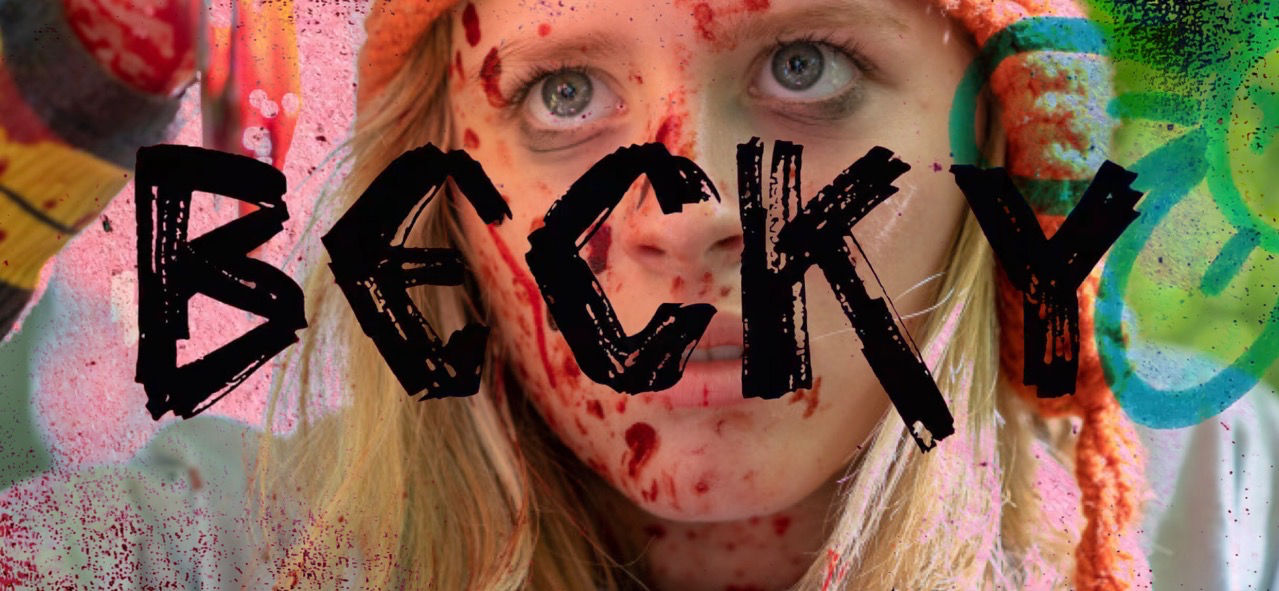
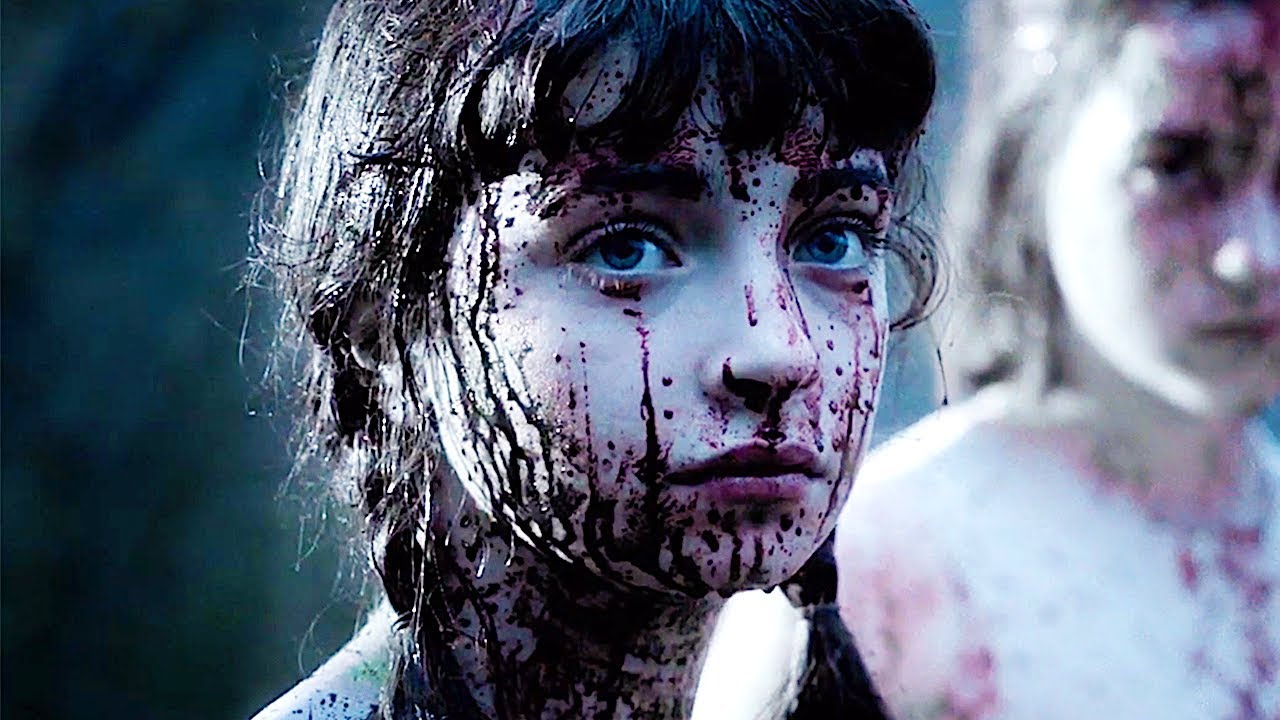
At the very least, Jonathan Milott and Cary Murnion’s film Becky
understands enough to be afraid of her.
The titular 13-year-old, played with convincing charisma by Lulu Wilson, is a handful for her widowed father (Joel McHale). Still, dad has decided this is the weekend to take Becky for a getaway with his girlfriend (Amanda Brugel), and her 5-year-old (Isaiah Rockcliffe). They head to the old vacation cabin for a big talk.
He soon finds that his 13-year-old may not be the scariest
thing on earth.
Or, you know what? Maybe she is.
Kevin James plays against type as a swastika-tatted up inmate, leader of a band of escapees. James may be hoping to catch the same mid-career fire Vince Vaughn has been fanning, mainly portraying the heavy in various indie thrillers. Early scenes play well, James cutting a solemnly menacing figure as he quietly organizes and orchestrates. But as the film wears on it becomes clear the actor can’t manage the sinister energy needed to really make an impression.
I’ll take this over Paul Blart, though.
Robert Maillet’s a lot of fun, though. At 6’10”, the one-time
wrestler dwarfs even the gangly McHale. He’s no master thespian, but his arc
creates a spectacular punctuation for Becky’s own transformation and his sheer
immensity brings a little needed anxiety to the film.
The writing team, which includes Lane and Ruckus Skye of the brilliant and as-of-yet undistributed Devil to Pay (originally titled Reckoning), cheats a little with this script. Backstories, motivations and mysteries—particularly as they articulate the villainous characters—feel less undefined than lazily obscured. Between that and James’s inability to truly sell the viciousness in his character, the family’s jeopardy lacks the intensity it needs for this film to truly impress.
Wilson does not. In her hands, Becky is a fascinating character, and it is with this character that the writing team and directors score the most points. The film is bloody, angry and, even for its fairly formulaic premise, unpredictable.
There are moments in Bruce McDonald’s head trip Dreamland
that are just bizarre fun, like that self-aware line delivered by Henry
Rollins. A lowlife gangster kingpin, his statement is as much a moment of
self-defense as it is a warning.
Rollins’s Hercules is one of many unseemly characters orbiting each other in this surreal, jazzy noir. Veteran character actor and welcome sight Stephen McHattie (Pontypool) plays dual roles: jazzman junkie and conflicted hitman.
One needs to exact retribution on the other, you see, but
maybe redemption of sorts could be arranged for both of them?
From one flesh-peddling nightclub to the highfalutin debauchery of a palace, McDonald’s fever dream offers consistently weird moments, each loosely connected to the next, all meandering toward a wild climax. Dreamland is a nutty drug trip of an underbelly film.
McHattie’s fun, especially as the anesthetized trumpet player. The other McHattie is having a tough time learning that you can’t rely on a junkie.
Both Rollins and Juliette Lewis are clearly enjoying themselves—Lewis, in particular, relishing every moment of over-the-top decadence and weirdness. Belgian character actress Stéphane Bissot impresses most as the sole voice of reason in the entire film. She’s deadpan hilarious.
Not that Dreamland is a comedy. Not that it isn’t,
either. It’s a tough film to characterize.
McDonald hit his artistic high water mark in 2008 with the inspired lunacy of Pontypool. For Dreamland he teams again with writer Tony Burgess, and together they dive back into themes of sanity, reality and jazz. But Dreamland lacks the fidelity of vision and the internal logic that made Pontypool simultaneously hilarious and terrifying.
Dreamland occasionally feels like a cheat. Worse still, it too often feels predictable when its every breath is meant to be just the opposite.
Still, there’s more than enough carnage and madness packed into this 90 minutes to keep you gawking.