Honk. It’s such an inelegant word. Not that beep or toot are much more graceful, but honk?
That’s what makes it such a perfect choice for writer/director Adamma Ebo’s look at commercial spirituality, Honk for Jesus. Save Your Soul.
First Lady Trinitie Childs (Regina Hall, amazing as always) is launching a comeback. Her husband, Pastor Lee-Curtis Childs (the incomparable Sterling K. Brown), had a little run in with morality and scandal five years ago. Since then, their mega church, Wander to Greater Paths—which once boasted more than 10,000 congregants—has been shuttered.
Well, no more! That scandal is almost behind them (there’s the issue of one hold out in the settlement…) and this dynamic duo is ready. And they want people to know, which is why Lee-Curtis agreed to let a documentary crew follow them as they prepare for their upcoming Easter Sunday resurrection.
What follows is a mockumentary of sorts, although Ebo’s point of view is not exclusively that of the documentarian (that elusive Anita). And while the world seems most interested in the pastor and his past transgressions, that sly Anita seems more drawn to the first lady.
To call this a satire, or really even a mockumentary, is to be a bit off the mark. Though it’s often funny, it’s not exactly a comedy, either. Brown’s damaged, shamed pastor is so pathologically single-minded as to be villainous outright. But Brown seems incapable of creating a character whose flaws don’t make him all the more human, and therefore tender, however irredeemable.
Likewise, Hall, whose performance is more decidedly comedic, mines Trinitie for deep conflict between submission to spirituality or to patriarchal bullshit. Her profound unhappiness partnered with her pride make the character a preaching contradiction in a church hat.
Solid support work bolsters the comedy (Nicole Beharie, in particular) and the tragedy (the late introduction of Austin Crute’s Khalil is powerful).
What starts off as a bit of fun at commodified religion’s expense turns into a surprisingly layered and cynical investigation into the damage organized religion of any kind can have, especially on those who believe.
For awhile, The Good Boss (El buen patrón) seems to reflect that elusive uncertainty principle the characters often discuss. The more we try to pin it down, the less we know of its nature.
And then writer/director Fernando León de Aranoa reveals his hand in a delightfully satirical manner, only to end up tipping the scale in the opposite, obvious direction.
And that would cause a furrowed brow from Julio Blanco (Javier Bardem), head of the Blanco Industrial Scales corporation. Blanco’s life – and work – is about perfectly equal measures.
“Hard work, balance, loyalty” is the company motto. Employees are family. Their problems are Blanco’s problems. And just when he’s a finalist for a prestigious business excellence award, Blanco’s got plenty of problems.
A longtime worker’s son is in trouble with the law. His production head’s wife might be banging another employee. And that new young intern (Almudena Amor) is returning Blanco’s frequent glances.
But worst of all, a guy he “had no choice” in firing (Óscar de la Fuente) is camped out across the street, protesting Blanco with signs and a bullhorn. And the guy will not leave.
As de Aranoa ticks off the days of the week, there are some glimpses of playful humor in the drama. But when Thursday rolls around, and Blanco’s security guard starts complementing the bullhorn guy’s rhyme schemes, The Good Boss starts having finger-wagging fun with the myth of benevolent “job creators.”
Bardem, no surprise, is a wonder. He slowly reveals cracks in Blanco’s facade of ethical bullshit, while never causing us one moment’s doubt about Blanco’s firm belief in this image he’s created. For Blanco, as long as the scales appear balanced, they are, regardless of the tricks it took to get there.
And anyway, he needs that award and the government subsidies that come with it. We don’t want “those artists” to hog the award money, do we?
Yes, the satirical fruit can hang pretty low, and de Aranoa’s subplot juggling skills start to waver as his narrative becomes more madcap. But right to the bitter end, Bardem can be trusted most when Blanco deserves it least, making sure The Good Boss is a satisfying day at the office.
Loosely based on a video game from 2016, writer David Ebeltoft’s Root Letter offers a unique take on the idea of a pen pal seeking out a friend in trouble. Though director Sonja O’Hara does her best to flesh out the surprisingly bare-bones story, there doesn’t seem to be much for her to work with.
Sarah (Keana Marie) is given a school assignment at school to write four letters to a pen pal. She goes above and beyond the requirements, exchanging dozens of letters with Carlos (Danny Ramirez), who was hospitalized after his girlfriend’s dad discovered Carlos in his daughter’s bed.
When Carlos receives a distressing letter one year after the end of his communication with Sarah, he sets out to discover what happened to her.
It takes surprisingly little for Carlos to find Sarah despite only knowing her first name and the name of her high school. Carlos is able to elicit help from an English teacher who offers him a not-so-subtle nudge in the right direction.
There isn’t a lot of meat to Carlos’s character. He doesn’t serve as a guide to the past, since Sarah’s story isn’t told through interviews with her friends, but rather through flashbacks from the previous year. The present story doesn’t raise new questions or offer surprising twists to the story. We’re mostly biding time waiting to get back to the heart of Sarah’s story.
And yet, Sarah’s tale isn’t very compelling either. It’s weightier than Carlos’s forays into Sarah’s past life, but not by much. For a mystery, there are zero surprises as you can predict each measure beat by beat.
There are also too many characters even though the number was greatly reduced compared to the video game. Aside from Sarah, few of the characters come to life in meaningful ways. Sarah’s best friend is the kind of woman who’ll do anything to keep hold of a tenuous relationship. Sarah’s mom is a stereotypical single mom drug addict with a bad back.
Sarah’s friend Caleb (Breon Pugh) is our most interesting character, but his brief moments on screen do little to make him stand out.
There is a certain quaintness to the story, particularly in the beginning – who knew letter writing could be so endearing? – but any originality is dropped in favor of a paint-by-numbers mystery. If only the actors had something more compelling to work with, perhaps their earnestness would have been rewarded with a more watchable story.
I’ve been a fan of the San Francisco 49ers for about fifty years, so I had a Colin Kaepernick jersey long before he started taking a knee during the national anthem.
And when I continued to proudly wear that jersey, I quickly learned how effectively Kaepernick’s peaceful protest had been twisted into hateful knots of white grievance.
In Kaepernick & America, directors Ross Hockrow and Tommy Walker revisit the protest’s timeline with insight and proficiency. But the subtle power of their documentary comes from its patience in deconstructing how Kaepernick’s true motives were distorted to fuel a racist narrative and a divisive election year.
And for those who don’t know Kaepernick’s personal history, Hockrow and Walker wisely begin with his upbringing as a trans-racial adoptee, and then follow his journey to NFL stardom, to falling one play short of winning Super Bowl forty-seven, to essentially being kicked out of the league.
It’s then that the film gives Kaepernick’s worldview a more distinct social and political context through archival footage and interview commentary (including CNN’s Don Lemon, an executive producer on the film).
With the birth of the Black Lives Matter movement after the 2014 death of Michael Brown, Kaepernick sought to speak out against police brutality in America. His silent act of social disobedience eventually made news, and activist DeRay McKesson becomes instrumental to the film’s success at revealing the historical nature of the resulting uproar.
Opposing views are supplied by anti-Kaepernick protesters and political candidates of the time, effectively rebutted by former U.S. Green Beret and NFL player Nate Boyer. Though Kaepernick’s protest began as a sit-down, he switched to kneeling after Boyer’s advice on a more respectful action. As we revisit the accusations and troop-shaming that were aimed at Kaepernick, Boyer’s recollections are a vivid reminder about just who was interested in thoughtful dialog amid conflict.
More concerned with correcting the record than breaking new ground, Kaepernick & America seems graceful and unassuming when placed against the vitriol spurred by the taking of a knee. But the film reminds us that protest is “the work of hope,” and ultimately looks toward a future of redemption for Kaepernick, and healing for a nation.
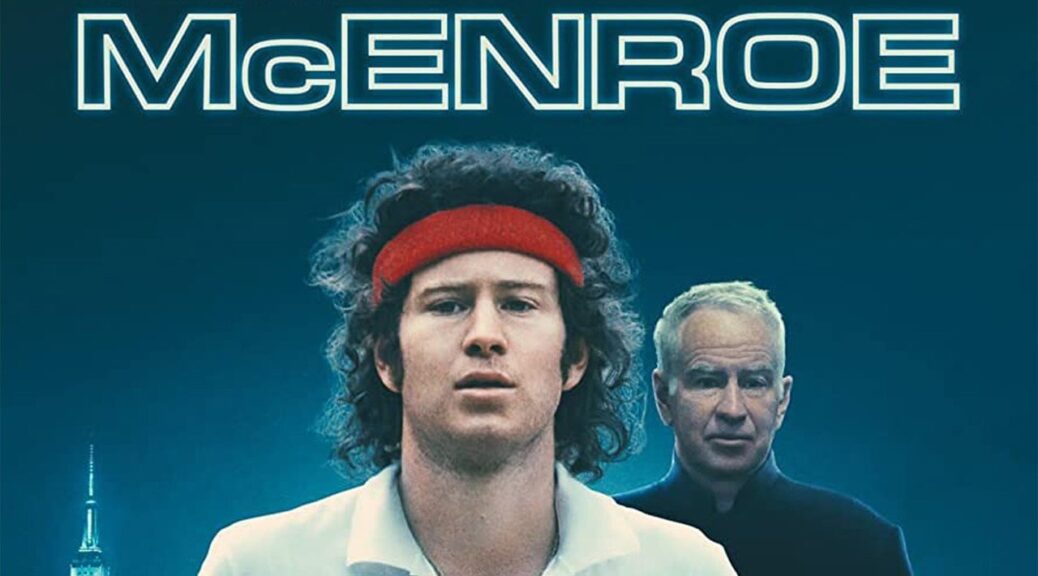
Start typing “John McEnroe” in the search bar, and “angry moments” still pops up as one of the top choices.
But why was he so angry? And why are we still drawn to his legendary outbursts?
Answer the questions, jerk!
Showtime’s McEnroe doesn’t shed much insight on either one, but it does serve as a fine celebration of a great champion and a fascinating personality.
Director Barney Douglas interviews McEnroe over the course of one long night in his native New York. John tells his tales in a sit down Q&A, then wanders the streets in the wee hours while the occasional passerby shouts his name.
And what do we learn? That John’s father was a perfectionist who withheld affection, and John is also a perfectionist who rarely let himself enjoy success. Not much is said about John’s relationship with his mother, which leaves a noticeable blank space in the film.
Douglas weaves in the archival footage to great effect, with thrilling tennis sequences and charming callbacks to pop culture of the late 70s and early 80s. There’s also a steady stream of commentators that ranges from Billie Jean King to Keith Richards. It’s all completely entertaining.
And ultimately, John is capable of some honest self-reflection, revealing late in the film how he recognizes his failures as a father and a husband (to Tatum O’Neal, who does not participate, and current wife Patty Smyth, who does), and is committed to being a better man.
But he’s not asking for us to feel sorry for him. And that’s good, because it’s hard to. John admits he had it pretty good growing up, he just wanted a better relationship with the old man. He excelled in a “sport for killers” by exploiting his opponents’ weaknesses and compartmentalizing his frequent anger. Fair enough.
So don’t come to McEnroe looking for a breakthrough psychoanalysis, you cannot be serious! Come to McEnroe to remember why we care about him in the first place.
Perhaps the most terrifying horror born of neighborly manners is Michael Haneke’s unnerving Funny Games (either his 1997 German-language original or his 2007 English-language remake). Writer/director Duncan Birmingham doesn’t go that far. What he does is walk a tightrope that’s a little goofier, a little less horrifying, but effective nonetheless.
Margo (Melissa Tang) and Adam (Ryan Hansen) throw a housewarming party. Well, Adam throws it. Margo endures it. She doesn’t honestly know what was wrong with their old neighborhood. It doesn’t help that their 5-year-old has had nightmares every night since they arrived.
Adam invites all his colleagues and bosses, hoping to impress without coming off as douchey. He’s upwardly mobile, although the house —which he got at a steal because of that nasty double homicide—might make them look a little higher up than they really are.
Not that Margo and Adam are the only partiers who aren’t what they seem. That really good-looking couple—the two who look like they just came from a really hip funeral—does anyone know who they are?
Maybe Sasha (Perry Mattfeld) and Tom (Timothy Granaderos) are the neighbors, as they say.
But probably not.
What we can say for sure is that they do not want to leave.
What transpires after all the other guests have gone would be a comedy of manners except that it feels pretty clear that something awful lurks underneath the handsome couple’s evasion and gaslighting.
Birmingham’s film is a mystery of sorts, although you’ll have most of that intrigue figured out pretty early. There is also a subplot about Margo’s friends who are babysitting. This goes essentially nowhere. Worse still, Birmingham rushes Act 3 and leaves you feeling short-changed.
However, that 30 minutes or so that Margo and Adam and Sasha and Tom have on their own gets pretty uncomfortable.
Hansen unveils surprising warmth within the needy, insecure Adam. He and Tang take the married couple in surprising and welcome directions. Mattfeld and Granaderos are drolly perfect as the home invaders masquerading as partygoers who just can’t tell it’s time to go.
A tight script wastes little time and manages to surprise even if you figure out the main mysteries early. Who Invited Them isn’t flawless, but it is an anxious bit of fun.
Exciting all MaddWolf Pack episode! Daniel Baldwin, aka The Schlocketeer, and Brandon Thomas join us to talk about a topic we stole from their Twitter conversation: which directors not known for horror made the best horror movies?
Be sure to listen because Daniel and Brandon both bring much knowledge (plus extra movie titles!) to the conversation. But here’s our Top 5:
5. Nosferatu, the Vampire (1979, Werner Herzog)
Sure, it’s another Dracula, but because it’s another Dracula by way of Murnau’s masterpiece Nosferatu, and it’s written and directed by the great Werner Herzog, it’s weird and wonderful.
Herzog uses the imagery Murnau created – in particular, the naked mole rat of a vampire – to turn vampirism into a pestilence to evoke the Black Plague of Europe. Klaus Kinski is that naked mole rat, and he is glorious.
Isabelle Adjani is the pure of heart maiden who is his undoing, but the way Herzog reimagines Jonathan Harker gives the film a cynical twist that feels like a surprise within this dreamlike adaptation. Gorgeous location shooting and an astonishing score help Herzog create a suffocating but captivating atmosphere.
4. The Haunting (1963, Robert Wise)
Coming off the big epics of The Sound of Music and West Side Story, no one would have expected the intimate psychological horror of Robert Wise’s The Haunting.
Shirley Jackson fans have to appreciate the way the film remains true to her vision of horror. Fans of horror have to appreciate Wise’s unbelievable knack for generating terror with sound design and imagination.
Yes, the performances are magnificent – especially Julie Harris, whose bitter Eleanor is picture perfect. But Wise’s mastery of form is what makes this G-rated film a lasting terror.
3. Hour of the Wolf (1968, Ingmar Bergman)
Like all Bergman films, this hypnotic, surreal effort straddles lines of reality and unreality and aches with existential dread. But Bergman and his star, Max von Sydow, cross over into territory of the hallucinatory and grotesque, calling to mind ideas of vampires, insanity and bloodlust as one man confronts repressed desires as he awaits the birth of his child.
As wonderful as von Sydow is as the central figure, a man spiraling toward insanity, it’s the heartbreaking Liv Ullman who owns this movie. Heartbreaking, solid, and the most unusual combination of strength and weakness, her Alma grounds the surreal elements of the movie.
The result is gorgeous, spooky, and so very sad. It’s one of the most underappreciated films of Bergman’s career.
2. The Shining (1980, Stanley Kubrick)
You know who you probably shouldn’t hire to look after your hotel? Jack Nicholson.
A study in atmospheric tension, Kubrick’s vision of the Torrance family collapse at the Overlook Hotel is both visually and aurally meticulous. It opens with that stunning helicopter shot, following Jack Torrance’s little yellow Beetle up the mountainside, the ominous score announcing a foreboding that the film never shakes.
The hypnotic, innocent sound of Danny Torrance’s Big Wheel against the weirdly phallic patterns of the hotel carpet tells so much – about the size of the place, about the monotony of the existence, about hidden perversity. The sound is so lulling that its abrupt ceasing becomes a signal of spookiness afoot.
Nicholson outdoes himself. His early, veiled contempt blossoms into pure homicidal mania, and there’s something so wonderful about watching Nicholson slowly lose his mind. Between writer’s block, isolation, ghosts, alcohol withdrawal, midlife crisis, and “a momentary loss of muscular coordination,” the playfully sadistic creature lurking inside this husband and father emerges.
He’s not the caretaker management expected, but really, was Grady? Like Grady and Lloyd the bartender, Jack Torrance is a fixture here at the Overlook.
1. Silence of the lambs (1991, Jonathan Demme)
It’s to director Jonathan Demme’s credit that Silence made that leap from lurid exploitation to art. His masterful composition of muted colors and tense but understated score, his visual focus on the characters rather than their actions, and his subtle but powerful use of camera elevate this story above its exploitative trappings. Of course, the performances didn’t hurt.
Hannibal Lecter ranks as one of cinema’s scariest villains, and that accomplishment owes everything to Anthony Hopkins’s performance. It’s his eerie calm, his measured speaking, his superior grin that give Lecter power. Everything about his performance reminds the viewer that this man is smarter than you and he’ll use that for dangerous ends.
Demme makes sure it’s Lecter that gets under our skin in the way he creates a parallel between Lecter and FBI investigator Clarice Starling (Jodie Foster). It’s Clarice we’re all meant to identify with, and yet Demme suggests that she and Lecter share some similarities, which means that maybe we share some, too.
If you thought Get Out was too nuanced, Ready or Not too wickedly funny, and what they both needed was some trusty Twilight obviousness, The Invitation is waiting for you.
Nathalie Emmanuel (Some Furious films, Game of Thrones) stars as Evie, a struggling art student in NYC who takes a DNA test and finds she has some new kin overseas.
Evie lost her dad when she was just a teen, and is still hurting from her mother’s recent passing only months ago, so this news lifts her spirits enough to accept a free trip to London for a lavish new-family wedding.
The country estate reeks of wealth, and Walter, the Lord of the Manor (Thomas Doherty) is handsome and charming. Flirtations help distract Evie from the ghostly apparitions, bumps in the night, and blood sucking.
Everyone’s very interested in Evie, giving little thought to the bride and groom who seem nowhere to be found.
Huh.
Director and co-writer Jessica M. Thompson borrows liberally from better films while leaning on tired devices such as red herring jump scares, waking from a nightmare, and handy clues that are nice enough to present themselves right when you need them.
But even those clues seem subtle next to the contrived exposition that takes liberties with vampire lore while it telegraphs the get out of jail free card that Thompson and co-writer Blair Butler (the dreadful Hell Fest) have for Evie. And by that time, all the character names taken from Stoker feel less like homages and more like desperation.
This invite promises only bargain-priced goth, watered-down frights and surface level commentary on classism and white privilege. The pivot from the Get Out setup to the Ready of Not revenge tour is much too long in coming, with a payoff that just isn’t worth the wait.
So wherever that bride and groom are, I bet they’re having more fun.
The logic seems inarguable. If Idris Elba wants to be in your movie, you say yes. If Tilda Swinton wants to be in your movie, you say yes. If both of them want in? You dance a jig.
To be sure, Swinton and Elba are excellent in George Miller’s new fantasy Three Thousand Years of Longing. Swinton is Alithea, a self-satisfied, hyper-intelligent, solitary creature who finds connection to her fellow humans through stories. She’s a narratologist. She studies stories, their structure and their meaning.
Elba is a djinn, a supernatural force Alithea has unintentionally let out of his bottle. He has some stories to tell. He is a maelstrom of weary tenderness and raw emotion, a wonderful balance of wisdom and naivete. Swinton’s chilly reason and childlike curiosity make a similar balance, and the two together are a delight.
Miller hasn’t made a film since his 2015 masterpiece Mad Max: Fury Road, and those are big boots to fill. His new effort looks gorgeous, as Elba spins yarns of his previous wish fulfillment mishaps across time.
Miller’s storytelling here is fanciful but meaningful. He is exploring storytelling, what it means to write your own story, and how authentic and original storytelling transports you. In this case, it transports Alithea from her modest hotel room to palace intrigue, battlefields and lustful chambers.
Both actors — two of the most talented and versatile working today — breathe life, love and dimension into their characters. It seems effortless, the way they make you believe them: two beings long resigned to being alone, slowly awakening to like-minded company.
They’re so good you can almost forget that they are playing the literally magical negro and the white heroine his magic helps on her journey. It’s a trope I think we all hoped was dead by now, but the truth is that the only way to avoid this trope with this particular film would be to deprive us of Elba, Swinton, or both.
It’s a conundrum and not the only flaw in the tale. The act three romantic plot feels a bit forced, though charming. Where Miller really succeeds is in delivering a layered consideration of the power and wonder of stories—even in the land of artless blockbusters, sequels and superheroes; even in an era of content creation.
It’s not a masterpiece and it falls into some old-school storytelling traps, but Three Thousand Years of Longing offers much originality and two undeniable performances.
It’s Christmas Day, and the one place Robert (Daniel Zolghadri) finds his comfort and joy is the comic book store.
And though the feature debut from writer/director Owen Kline may instantly earn a place alongside American Splendor, Ghost World and Crumb on the comic nerd movies Mt. Rushmore, a love for the funnies isn’t required for Funny Pages to cast its wild, weird spell.
Through massive bites of hamburger at a local New Jersey diner, Robert informs his parents (Maria Dizzia and Josh Pais, both perfectly exasperated) that he won’t be finishing his senior year of high school.
All Robert cares about is drawing comics, and he can work any boring job while he pursues his artistic dreams, so why not get right to it?
So he does, renting half a sweltering room in Trenton and working a few hours for Cheryl (Marcia DeBonis), a public defender with a list of several clients. And as luck would have it, one of those clients, Wallace (Matthew Maher), used to work for the famous Image Comics.
Sure, Wallace is angry, aggressive and openly hostile, but knowing him puts Robert one step closer to where he wants to be. And that means Robert wants to stay close to Wallace, whatever the consequences.
And there are plenty of awkward, often hilarious consequences.
Kline (son of Pheobe Cates and Kevin) develops memorably offbeat characters you don’t let go of easily. Zolghadri brings a wonderful zest to Robert’s coming-of-age, showcasing a sweetly resonant mix of resolve, confidence and vulnerability.
And from Wallace to roommates, from co-workers to best friends, there’s a universe of weirdos populating Robert’s journey up from square zero. Kline envelopes you in so many layers of nerdery that the film races past disbelief and circles back, crashing cars and dropping pants with a surprisingly lived-in abandon.
In the early moments of Funny Pages, Robert’s enthusiastic art teacher proclaims that his art should “always subvert!” That sounds like something Kline might have been told some time ago.