Tag Archives: MaddWolf

Fright Club: Satanists in Horror

It’s time to sift through that bountiful gift that is satanic horror. So many movies! So many black masses! So many purple robes, goat’s heads, high priests!! So many, indeed, that we had to leave off a ton of really great movies, so even though they didn’t make the final list, be sure to check out Ready or Not, Brotherhood of Satan, Race with the Devil, Blood on Satan’s Claw, Prince of Darkness, House of the Devil, The Sentinel, The Devil Rides Out, and the brilliant short film Born Again.

5. The Day of the Beast (1995)

Funny, startling and wildly irreverent, Alex de la Iglesia’s dip into Satanism is a giddy experience. It’s not just great Satanism horror, it’s an excellent Christmas movie!

A priest, a Satanist and a charlatan comb the city of Madrid on Christmas Eve in search of the birth ritual of the Antichrist. Their hijinx are feverish and frantic in a transgressively funny horror tale.

Gleefully gory mayhem suits the outlandish performances, together driving one of the gruesome auteur’s very best.

https://www.youtube.com/watch?v=C1K0CMF87ZY

4. Angel Heart (1987)

In Angel Heart, director Alan Parker develops a steamy atmosphere as we follow private dick Harold Angel (Mickey Rourke) through the bowels of New Orleans in search of information on missing crooner Johnny Favorite.

Rourke’s work is key to the film’s unseemly feel. Angel’s sympathetic and full of a disheveled charm. You’re sorry for him even as you know he’s outmatched and probably undeserving of your pity. He knows it, too, and that’s what makes the performance so strong.

Plus there’s the sheer diabolical presence of an understated Robert DeNiro. His well-manicured and articulate Louis Cyphre perfectly balances Rourke’s handsome slob, and both fit beautifully into this sultry version of 1955.

Deceptively bloody, unusually classy, effortlessly creepy, Angel Heart stays under your skin. Maybe it’s the casual evil, the lurid atmosphere. Maybe it’s De Niro’s understated menace, with those long nails and that hardboiled egg.

3. The Blackcoat’s Daughter (2015)

Winter break approaches at a Catholic New England boarding school. Snow piles up outside, the buildings empty, yet Kat (Kiernan Shipka) and Rose (Lucy Boynton) remain. One has tricked her parents for an extra day with her townie boyfriend. One remains under more mysterious circumstances.

Things in writer/director Oz Perkins’s The Blackcoat’s Daughter quietly unravel from there – although quiet is not precisely the word for it. There is a stillness to the chilly, empty halls. But thanks to the filmmaker’s brother Elvis, whose disquieting score fills these empty spaces with buzzing, whispering white noise, a sinister atmosphere is born.

Perkins repays your patience and attention. There are loads of sinister little clues to find.

2. Rosemary’s Baby (1968)

Rosemary’s Baby remains a disturbing, elegant, and fascinating tale, and Mia Farrow’s embodiment of defenselessness joins forces with William Fraker’s skillful camerawork to cast a spell. Along with Repulsion (1965) and The Tenant (1976), Rosemary’s Baby is part of Polanski’s “apartment trilogy” – disturbing films of tension and horror in which metropolitan life and nosey neighbors conspire to drive a person mad.

Working from Ira Levin’s novel, Polanski takes all the glamour out of Satanism – with a huge assist from Ruth Gordon, who won an Oscar for her turn as the highly rouged busybody Minnie Castevet. By now we all know what happens to poor Rosemary Woodhouse, but back in’69, thanks much to Mia Farrow’s vulnerable performance, the film boiled over with paranoid tension. Was poor, pregnant Rosemary losing it, or was she utterly helpless and in evil hands?

1. The Witch (2015)

The unerring authenticity of The Witch made it the most unnerving horror film in years.

Every opportunity writer/director Roger Eggers has to make an obvious choice he discards, though not a single move feels inauthentic. Rather, every detail – whether lurid or mundane – feels peculiarly at home here. Even the most supernatural elements in the film feel appallingly true because of the reality of this world, much of which is owed to journals and documents of the time, from which Eggers pulled complete sections of dialog.

As frenzy and paranoia feed on ignorance and helplessness, tensions balloon to bursting. You are trapped as this family is trapped in an inescapable mess, where man’s overanxious attempt to purge himself absolutely of his capacity for sin only opens him up to the true evil lurking, as it always is, in the woods.

Strings Attached

Pinocchio

by George Wolf

I saw a tweet not long ago that suggested Disney should stop with the live-action remakes and instead, re-do their classics with the Muppets.

That logic is sound. Disney now owns the necessary rights, of course, and Muppet treatments would at least ensure creative visions that run deeper than “because we can.”

Heck, Tom Hanks could still star in them, as he does in this new live-action version of Pinocchio. Really, it would be more of a surprise if Hanks didn’t play the kindly Geppetto, and he’s just as fitting as you would expect a GD National Treasure to be.

And since the film mixes Hanks and other live actors with impressive digital animation, seeing the name Robert Zemeckis (Who Framed Roger Rabbit?, The Polar Express, Welcome to Marwen) as director and co-writer gives you confidence the entire project will be well-crafted and satisfactory.

And it is. But if true magic is what your heart desires, keep wishing.

Young Benjamin Evan Ainsworth is in fine voice as the legendary puppet who longs to be a real boy, while Joseph Gordon-Levitt strains for that distinctive Jiminy Cricket phrasing and lands a little too close to South Park‘s Mr. Hankey.

But more importantly, Zemeckis and co-writer Chris Weitz seem too eager to justify their project via modern sensibilities. And in turn, they end up short-changing elements that made Disney’s original such an enduring favorite.

New songs add little beyond pop flavor, while one new character, Sofia the seagull (Lorraine Bracco) exists mainly to over-explain character motivations. Pinocchio’s friendship with Sabina (Jaquita Ta’le), a skilled puppeteer in Stromboli’s (Giuseppe Battiston) show, is well-intentioned but forced. Keegan-Michael Key’s foxy Honest John tempts Pinocchio with fame through references to “influencers” and Chris Pine.

Luke Evans does make a delightfully devilish Coachman, who leads Pinocchio to an effectively realized Pleasure Island that glimpses some darker themes. Exploring more of these layers would have strengthened the fairy tale roots, but it’s the tale of the Blue Fairy (Cynthia Erivo) that gets the shortest shrift.

“When You Wish Upon a Star” is not just a song for Disney. By now it’s the bedrock of their entire, world-conquering, fantasy-selling enterprise. And Erivo has a beautiful voice.

Let her let it gooooo! (pun intended). Yes, the song comes early in the film, but go ahead and hit us with an extended mix of full-blown goosebump orchestration while the fairy dust goes to work, then a reprise over the credits. Erivo deserves it.

It could have been a magical moment, and Pinocchio needs more of them. Much more than it needs Chris Pine.

Scare BnB

Barbarian

by Hope Madden and George Wolf

When you see as many movies as we do – especially horror flicks – taking us places we did not see coming is much appreciated.

Barbarian certainly does that, mashing horror, dark comedy and social commentary to wild and mostly satisfying ends.

Tess (TV vet Georgina Campbell) is in Detroit for a job interview. She books an Airbnb in an unsavory part of town, only to find out Kieth (Bill Skarsgård) booked the same place on HomeAway. What to do?

They talk, flirt a little, and Tess agrees to stay in the bedroom while Keith takes the couch. They’ll sort it out in the morning.

In his feature debut, writer/director Zach Cregger (The Whitest Kids You Know) lulls us with a competent but familiar hook. What’s really going on? Can Keith be trusted? Creeger throws in some creepy camera angles, terrific lighting maneuvers and jump scare fake-outs to build tension.

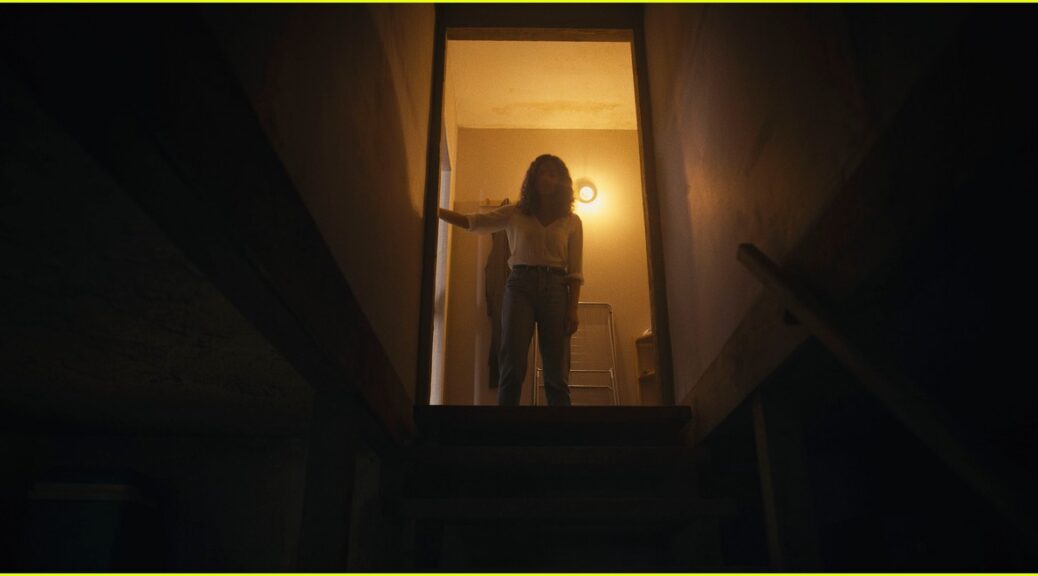
Then Tess makes her way down to the basement. Yikes.

But even after Tess’s startling discoveries, we’re still feeling like we have a grip on what’s ahead.

And then Cregger takes us to Hollywood, where producer AJ Gilbride (Justin Long) is sacked from his latest project due to allegations of sexual misconduct.

Um…what?

AJ’s story suddenly crosses paths with a tale set in the same house in 1982, this one starring Richard Brake. While that’s often great news for viewers, it is rarely good news for other characters.

What could start to feel disjointed and episodic instead congeals into a bizarre and brutal minefield of surprises. There are times when these surprises hang together with unrealistic decision-making, but Cregger’s sly script overcomes most of its conveniences and missteps.

Not every moment works. Certain choices feel ridiculous and breaks of levity keep the film from being as disturbing as maybe it should be, given the content. But most of that is forgivable, mainly because of the surprises Cregger has for us, and the nimble way he brings them out of hiding.

Hard to Portmanteau

Tiny Cinema

by Daniel Baldwin

Colloquialisms being taken to their absolute extremes. A woman struggling to find happiness in solitude. A pleasure-deprived man seeking help from his friends. Body horror ending not in goo and grue, but in dad jokes?!? Tiny Cinema is a comedic genre anthology film that wants to make you laugh and gasp in equal measure with the outrageous storytelling that it contains within. Does it succeed? Mostly.

Tiny Cinema is the latest cinematic endeavor of director/writer/actor extraordinaire Tyler Cornack and his motley crew of performers. If you’ve seen their previous effort, Butt Boy, you’re going to spot a lot of familiar faces across all six segments here. This film largely lacks that one’s Henenlotter-esque weirdness, however. It instead opts for a modern Twilight Zone vibe; offering up situations where ordinary people find their lives turned upside down by strange occurrences that are either tied to everyday problems (i.e. loneliness, sexual dysfunction, dating) or become twisted takes on everyday sayings (i.e. “That’s what she said!” and “Yo momma!”).

The results are mixed. On the positive side of things, there is a great host in the form of the quirky and deeply charismatic Paul Ford. The first three segments are also really entertaining (particularly “Bust!”). Furthermore, what really helps Tiny Cinema along is its cast. The troupe that Cornack has pooled together are all beyond game for whatever delirious nonsense he asks of them and that helps smooth over even the segments that don’t really work. They help to drive his best ideas home and make his films worth seeking out.

It’s in the back half where things begin to wobble, as the other three segments aren’t nearly as strong. Almost all anthology films have weak spots. Unevenness is par for the course with episodic storytelling. The weaker segments here are the slighter ones that just aim for shock value. Unfortunately, with them all filling out the second half of the feature, it means that it starts with a bang and ends with a bit of a whimper.

Tiny Cinema might be a step down from Butt Boy, but it’s a solid indie slice of portmanteau moviemaking. If you’re game for some weird fun, this might just be up your alley.

In the Company of Women

House of Darkness

by Hope Madden

Who hurt Neil LaBute?

Would it surprise you to find that the latest from the writer/director behind In the Company of Men and Your Friends and Neighbors (as well as the less impressive Wicker Man reboot and others) is a meditation on sexual dynamics, power and agency? That it’s brimming with psychosexual wordplay? That it’s bitter and a bit misguided?

How many times can we disassemble the mating ritual to judge and shame those involved?  

Sometimes LaBute does it well—so well that it’s tough not to look forward to whatever he releases. House of Darkness sees the filmmaker again exploring his favorite topic, this time within a horror context.

Justin Long riffs on his nice guy persona, his character Hap actually referring to himself at one point as “one of the good ones.” (Had Hap seen Promising Young Women, he might have had sense enough not to make such a claim.)

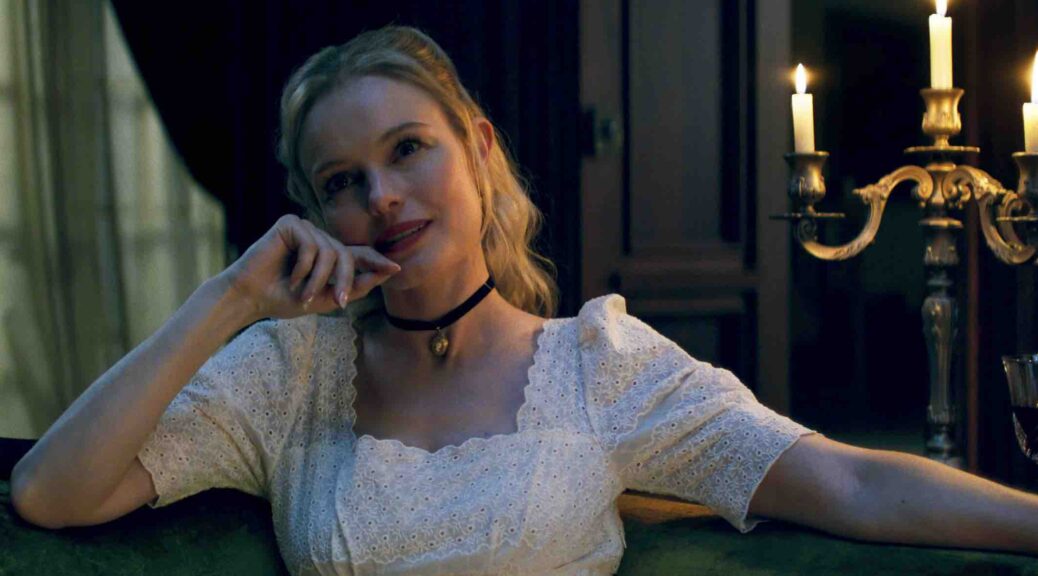
Hap’s been lured into the stately gothic manor of the lovely Mina, played with controlled ferocity by Kate Bosworth. Bosworth seems to relish the directness of her character. Mina’s disinterest in accommodating Hap’s insecurities is glorious—a reminder of how casually brutal LaBute’s work can be.

Perhaps because he started his career as a playwright, each of LaBute’s films rise or fall on dialog. House of Darkness is a chamber piece – it could easily be a stage play (though it’s likely a Covid production). Limited performers pepper scenes with double entendres in an awkward dance of “will we or won’t we” sexual politics.

The difference this time around is the genre trapping, a first for the filmmaker. The look is lush and effective, particularly the more fantastical sequences. Long — a genre veteran — delivers a bit of nuance, his Hap never entirely sympathetic but definitely hard to hate.

The story builds effectively enough. It’s just that nothing is ever in question. The genre tropes are more threadbare from use than LaBute’s banter-driven power game. Worse, the point rings hollow, like a disingenuous, cash-grab reversal of In the Company of Men.

Once Upon a Time in Africa

Saloum

by Hope Madden

There is no denying the stylistic mastery of Jean Luc Herbulot’s Senegalese horror Saloum. An opening voice-over describes revenge as a river that eventually drowns you, but a wise viewer will follow Herbulot’s current because this film knows where it’s going even when you don’t.

We open during the 2003 coups in Guinea-Bissau. In an incredible shot down an alley of endless bodies, we first meet three hooded men. These men are mercenaries, Bangui’s Hyenas, and they’ve come to extract a drug dealer from the dangerous city. But his escape goes south and soon Chaka (Yann Gael), Minuit (Mentor Ba) and Rafa (Roger Sallah) find themselves hiking across deserts, boating through winding waters, and laying low in an unusual little hideaway near the delta in Senegal.

Already we’ve gone from war movie to crime thriller to Western, and we’ve barely exited Act 1. Act 2 will float between mystery and revenge thriller before Herbulot finally embraces the supernatural horror we realize has been bubbling just beneath the surface all along.

A trio of fascinating performances keeps your eyes fixed on the Hyenas. Gael’s unreadable, unbreakable smile hides true intentions, charms and terrifies depending on the scene. Ba’s mystic/elder statesman helps the film transition from one subgenre to the next and gives the trio a center. Meanwhile, Sallah’s explosive Rafa is a constant surprise.

Gregory Corandi’s cinematography conjures each new genre beautifully without creating abrupt leaps from one to the next. Colors are amazing, vistas are both beautiful and dangerous, and there’s always movement just beyond where you look. Western slides into thriller, which bends toward horror, the popping action the one constant through the entire running time.

Herbulot splashes his cinematic influences across the screen: Leone, Woo, Peckinpah, Tarantino (whose own style amounts to a concoction of the previous three). It’s a heady mix. It’s not style over substance, although the style does draw attention away from the film’s weaker elements. Instead, it’s the calling card of a filmmaker leaving his mark on genre filmmaking.

Not Even Supposed to Be Here

Clerks III

by Hope Madden

In 2017, Danny Boyle returned to Scotland with T2 Trainspotting. You know, to see how Mark, Sick Boy, Spud and Begbie were dealing with middle age. The result was poignant, funny and self-aware.

Writer/director Kevin Smith likewise revisits Leonardo, New Jersey to see how Dante and Randall are faring with their own midlife crises. Again, the result is poignant, funny and self-aware.

I swear to God.

For Clerks IIII, Smith delivers a wild mix of amateurish moments, inspired soundtrack choices (that’s the first time I ever enjoyed My Chemical Romance’s Welcome to the Black Parade), sentiment, callbacks, social commentary, and genuine fondness. The end of the filmmaker’s slacker trilogy delivers an ode to independent filmmaking and his own journey as a filmmaker.

Dante (Brian O’Halloran) reenacts the worst days of his youth every day, wasting his life at the convenience store he now co-owns with bestie Randall (Jeff Anderson). The long-shuttered video store next door is now a cannabis shop run by Silent Bob (Smith) and Jay (Jason Mewes), naturally.

After Randall has a heart attack behind the counter, he decides the only way to give his life meaning is to film a movie of his antics at the convenience store.

Essentially, Clerks.

Smith’s style remains a weird mix of sincerity and irreverence. For that reason—and because his leads are the least talented actors onscreen—Clerks III sometimes lands as cloying. But both Anderson and O’Halloran also offer surprising emotional depth here, especially Anderson.

Smith brings back nearly every “actor” who populated his ’94 breakout, and a few of the main players from its 2006 sequel. There’s also a lengthy montage of auditions for Randall’s movie, which allows Smith to fill the screen with other recognizable faces.

The whole movie’s an inside joke, but if you’re on the inside, it’s bound to draw a smile. More than that, if you’re a Kevin Smith fan, Clerks III is a sincere mash note to you.

https://www.youtube.com/watch?v=XMspLXUjjBk

Less Fun than a Barrel of Monkeys

Gigi & Nate

by Tori Hanes

Gigi & Nate follows the story of an unlikely bond between recent quadriplegic Nate (Charlie Rowe) and his service monkey.

Director Nick Hamm’s film tracks the pair’s difficulties due to Nate’s disability and society’s stigmas around their pairing. Running at a generous 1 hour and 54 minutes, the bond between man and primate is thoroughly, though not particularly well, examined. 

Gigi and Nate seems to miss the backbone of what makes this unique story interesting. Threaded by a plot riddled with holes, a strong emotional ethos has no channel through which to flow. Instead, Hamm and writer David Hudgins string together uneven attempts to create a compelling narrative. These attempts hit the beats of any PG, feel-good, family-friendly story, while remaining seemingly uninterested in exploring any nuance.

The story initially paces along logically. It takes a devastating blow, however, when concentration on the human-animal connection is severed and focus turns to a bizarre examination of society’s skepticism toward the human/primate pairing. With this, whatever fuel burning the emotional fire behind the story runs dry. 

Performances, including Rowe’s, struggle to rise above surface level. Nate’s lack of metamorphosis is staggering. We see the glimmer of change directly following his accident, but are ultimately disappointed in Nate’s quick return to a sunny-despite-the-circumstances disposition. The filmmakers never allow the audience inside the full depths of Nate’s psyche, so no catharsis can be earned. 

This lack of depth creates real problems. Narrative solutions feel unearned. Outlandish antagonists are clumsily formed, their stories undeservingly resolved. A potentially intriguing tale from an underrepresented perspective is lost to a cop-out of a resolution.

Gigi & Nate is especially disappointing because the film —though it takes significant creative freedom— is inspired by the true story of quadriplegic Ned Sullivan. While the filmmakers’ hearts were undoubtedly in the right place, their sincerity doesn’t justify a film that does little work to amplify the voices of the people it’s portraying. 

If you’re just looking for your cuteness dosage, Gigi (played by Capuchin, Allie) certainly has her moments, but you’re better off skipping this film and picking up Marley and Me.