Tag Archives: Madd at the Movies

Sister Act

Benedetta

by Hope Madden

In 17th Century Italy, a nun challenged the church as well as social and sexual norms, rallying a town around her. Was she a charlatan? Was she a saint? Regardless, she seems to be a fascinating image of early feminism. You’ll have to imagine that yourself, though, because her story has been brought to the screen by Paul Verhoeven, which means her story is now soft-core porn.

Who would have thought that the director behind Showgirls would eventually make a hot lesbian nun movie? I mean, besides everyone.

Verhoeven challenged preconceptions about himself as a filmmaker (mine, anyway) in 2012 when he released the most discombobulating rape-revenge thriller, Elle. A masterstroke of a performance by Isabelle Huppert certainly helped.

With Benedetta, Verhoeven takes another shot at ogling the female form inside a context that suggests that ogling is really empowering.

Benedetta (Virginie Efira) was dedicated to the Virgin Mary as a young child by her wealthy father and has been at the convent since she was 10. She’s content, a devoted disciple. As an adult, though, the sexual awakening triggered by new novice Bartolomea (Daphne Patakia) coincides with ecstatic visions of both righteous and demonic leanings.

Is Benedetta crying out for attention and power, or is something supernatural truly afoot?

That right there — the question of the source of these visions, whether the result of a lust for power, true divine intervention, or undiagnosed schizophrenia — might have given Verhoeven’s film a cogent central conflict.

Naturally, his interest is in the sexual awakening.

Which is fine, if uninspired. You might be surprised by how many films you can find that depict shockingly attractive sisters engaging in nun-on-nun action. (I recommend Alucarda.)

At well over two hours, the film feels remarkably self-indulgent. There are the requisite nods toward the corruption of the church, but Verhoeven, who co-wrote an adaptation of Judith Brown’s book with David Birke, earns points for sidestepping the demonizing of the Mother Superior and the other nuns.

Instead, the always luminous Charlotte Rampling portrays Mother Superior as a wise, graceful and respectable businesswoman working within a profoundly misogynistic system. Scenes between Rampling and Lambert Wilson, as the ambitious and crooked head of the regional church, spark with wit and cynicism.

Still, the director cannot pass up the opportunity to fetishize an act of church-sanctioned torture. One step up, two steps back and all that.

If you’re longing for a film about women and the historical, hysterical afflictions they faced because they were women, but you really miss seeing these lessons from a leeringly male perspective, I have a hard time imagining a film that better suits your mood than Benedetta.

Hard Candy Christmas

The Advent Calendar

by Hope Madden

Who needs a new Christmas horror story?

I do. Y’all can have your Hallmark romances but give me a little yuletide carnage and I’m filled with holiday cheer.

This Christmas season, writer/director Patrick Ridremont comes through with the Belgian horror The Advent Calendar.

It’s been three years since the accident that put Eva (Eugénie Derouand) in a wheelchair, but it’s still sometimes tough for her to tolerate the ableism and ignorance of those around her. Luckily her bestie Sophie (Honorine Magnier) cheers her with a visit and a gift — an antique wooden advent calendar she picked up in Germany.

There are rules. There is candy. There will be blood. (But there is candy, so how bad can it be?)

The “be careful what you wish for” storyline is as vintage as the ornate and impressive prop, but cursed object horror can be powerful when done well. Ridremont does it well, allowing time for his ensemble to develop their characters. And though the film skirts cliché, Ridremont respects his audience’s ability to keep up. We’re not spoonfed.

Better still, Eva has depth enough as a character that when she finally moves willingly toward doing the wrong thing, you feel her resignation more than her selfishness.

Derouand portrays Eva’s bitterness and longing so clearly that the film never has to bow to montage or flashback. And when the time comes to get spooky, The Advent Calendar delivers.

There’s plenty of blood, but it’s the way it’s meted out that ramps up tensions. We start off with people we’re trained to want to see picked off, but viewer beware: there’s a beautiful mutt in danger here as the cursed object worms its way into Eva’s life.

The FX are not as impressive as the performances, unfortunately, but the creature itself is creepy as hell. Better still, his existence and the origin of the Advent Calendar are left a bit to the imagination. It’s a clever sleight of hand, Ridremont taking advantage of our familiarity with his subgenre when he needs to, while still leaving behind the tangy taste of mystery.

Fright Club: Best of Charles Band

Legendary indie horror filmmaker Charles Band joins Fright Club this week to talk about his new book Confessions of a Puppet Master, Marilyn Monroe, spotting talent, and VHS art. He even gives us some advice on our first feature film.

5. Trancers (1984)

Directed by Charles Band, the film follows a hard-boiled Blade Runner style mercenary into the past. Jack Death (Tim Thomerson) must stop a villain from killing off the ancestors of those who keep him from ruling the world. If they’re never born, he will be unstoppable, thanks to his army of zombielike Trancers.

The point is, Helen Hunt. To say that she makes the most of this material is an understatement. She’s adorable, charming, and she carves a memorable character out of less-than-stellar written material. The rest is fun, cheesy scifi.

4. Troll (1986)

The 1986 original Troll boasts a surprising hodgepodge of names in the ensemble: Julia Louis-Dreyfus, Michael Moriarty, June Lockhart (the mom from the Lost in Space TV show), Sonny Bono, as well as a who’s who of “Hey, I got to get out of here in time to be on that Love Boat episode” stardom. It’s a grab at the burgeoning genre Joe Dante created in 1984 with Gremlins, comic stuff about a troll king turning San Francisco apartment dwellers into plants.

The other thing that stands out in this 1986 flick is that the protagonist (and his father, come to think) is named Harry Potter. There’s a witch, too. Coincidence?

A good mash-up of humor and gore highlighted by the young Louis-Dreyfus in a small but funny role, it’s the kind of movie that epitomizes what producer Charles Band (who has a cameo) did best.

3. Rawhead Rex (1986)

Clive Barker penned this one. No, he did not like the film it turned out to be, but you might. Band produced this Irish horror that sees a wildly unhappy couple, their doomed children, and a small town on the Emerald Isle accosted by a reincarnated demon with a face that looks like raw meat.

Another memorable VHS cover made this one of those movies you immediately associate with video stores, and though the acting is hardly top quality, the creature design is hideous and fun.

2. Puppet Master (1989)

If any movie capitalized on the VHS box, it was Puppet Master. The tag Evil comes in all sizes looms large above a theatrical trunk, wedged open to show a group of hideous little puppets. And the film didn’t disappoint, because those little evildoers get themselves into all manner of bloody, slug-spewing trouble.

The point-of-view camerawork, fun cameos and inspired creature designs make up for a lot of script and acting weaknesses and the film easily carries that Charles Brand stamp: low budget, funny, campy, gory fun.

1. Re-Animator (1985)

Re-Animator boasts a good mix of comedy and horror, some highly subversive ideas, and one really outstanding villain. Band knew a movie worthy of distribution when he saw one, and this film became a surprising theatrical hit for him.

Jeffrey Combs, with his intense gaze and pout, his ability to mix comic timing with epic self-righteousness without turning to caricature, carries the film beginning to end. His Dr. Herbert West has developed a day-glo serum that reanimates dead tissue, but a minor foul-up with his experimentations – some might call it murder – sees him taking his studies to the New England medical school Miskatonic University. There he rents a room and basement laboratory from handsome med student Dan Caine (Bruce Abbott).

They’re not just evil scientists. They’re also really bad doctors.

Screening Room: House of Gucci, Encanto, Power of the Dog, Bruised & More

Ground and Pound

Bruised

by Hope Madden

It isn’t exactly Michelle Rosenfarb’s writing you’ll remember after viewing the MMA drama Bruised. The story itself offers a rehash of sports cliches that make the film anything but memorable. Still, there is something about it that sticks.

Part of that is the way director Halle Berry embraces the bleakness beneath the underdog sports story. Berry stars as Jackie Justice, one-time octagon phenom who lost it all and found herself drunk and cleaning toilets post-stardom.

Here’s where Berry — both behind the camera and in front — digs into something we did not get with Rocky Balboa or Maggie Fitzgerald or any of the other earnest, down-on-their-luck prizefighters in cinema. There is no scrappy optimism, no unquenchable ambition, no romantic dream.

And Justice only gets back in the game for the money.

It’s a risky move, giving us a less-than-likable protagonist and still asking for us to root for her, but Berry’s up to the task as a performer. She convinces. Justice is weary, angry, vacant and just one step ahead of all the trauma that made her fighting mad in the first place.

Here, again, is where the writing lets Berry down. Random scenes of exposition are wedged in periodically where none is needed, while other information remains weirdly—though sometimes intriguingly—vague. But certain scenes are brilliant, charged with emotion and brutality, and sometimes tenderness.

Bruised also contains a slew of really strong performances, the most interesting of which is delivered by Sheila Atim as the sage mentor/manager. Adriane Lenox, Adan Canto and Shamier Anderson also shine in supporting turns, as does Danny Boyd Jr., who has the unenviable task of creating a character out of a shameless trope. He manages.

There are workout montages. There are emotional subplots. There is backsliding and heartbreak. It wouldn’t be an underdog sports film without them. But every so often, Berry gives us something raw and surprising. The performance makes you realize her range is wider than we may have expected. The film points out that her talent is greater than expected, too.   

Every Little Thing She Does

Encanto

by Hope Madden

No one wants to believe themselves ordinary. Not even calm, supportive Mirabel Madrigal (Stephanie Beatriz). But ordinariness happens to be her defining quality because she is the first Madrigal in three generations who has no magical gifts.

Her mother can heal with food. Her sister has super strength. Her cousin can shape shift. But when the day came for Mirabel to receive her magical gift, nothing happened. When the magic of the Madrigal family — magic that has kept the entire town of Encanto in peaceful enchantment for decades — starts to crack, is it all because of Mirabel?

One of many reasons that Disney’s 60th feature Encanto charms is that this unsure adolescent does not find out she’s secretly a princess. She has no makeover. It isn’t romance that helps her see her own specialness. Thank God.

Lin-Manuel Miranda’s music is another reason. Infectious, upbeat and surprisingly insightful, the songs in Encanto speak to individual insecurities in a way that hardly suggests the magical nature of the film. Lyrics illustrate sincere worries about letting people down, living up to expectations and other universal and yet intimate worries.

If you worry the film sounds a bit drab and reasonable, fear not because the vibrant color, lush landscapes, intricate interiors and clever, high-energy animation keep the magic popping. Set in Colombia, Encanto reflects the magical realism favored in the literature of the land and that, too, makes for a unique cartoon experience.

John Leguizamo and Maria Cecilia Botero join Beatriz in a voice cast that brims with pathos, love and energy, just like the family they depict. Much about the complex interactions within the family feels like honest if uncharted territory for a Disney outing — flawed heroes, loving villains, and the notion that selfishness and selflessness as equally problematic.

The flip side of that coin is that the world of Encanto doesn’t feel very big and the stakes don’t feel very high. If that were the only drawback to co-directors Jared Bush, Byron Howard and Charise Castro Smith’s approach it would hardly be worth mentioning. Unfortunately, they undermine the complexity they find in familial love with a too-tidy ending that robs Encanto and its inhabitants of some hard-won lessons.

Screening Room: Ghostbusters Afterlife, King Richard, Tick Tick Boom, Zeroes and Ones and More

So it goes…

Kurt Vonnegut: Unstuck in Time

by Hope Madden

Closure is hard for a lot of us. Take Robert Weide. The Curb Your Enthusiasm producer and director has been working on a Kurt Vonnegut documentary since the Nineties.

A rabid fan since his first introduction to Vonnegut’s work by a high school teacher, Weide went on to teach a class on the author at the same high school. When Weide began producing documentaries for public broadcast some years later, he hand-wrote a letter to his hero, offering to make Vonnegut the subject of his next project.

Kurt Vonnegut wrote him back.

Very often, when a documentarian inserts themselves into the film, it’s hard not to wonder why. In this case, seeing Weide’s face as he recounts opening the handwritten note from his idol (which he still has) explains everything.

Kurt Vonnegut: Unstuck in Time is not a simple biographical doc on an icon of American literature. This is a real-life depiction of one of humanity’s most common fantasies: becoming close friends with your celebrity hero.

The illuminating doc is there, too, but even that is affected by the friendship. You can see it in the trusting relationship between Weide and Vonnegut’s children, who describe a distant man they got to know more through his writing than through time spent with him.

That very intimacy likely helps Weide and co-director Don Argott (Last Days Here, Believer) uncover a rarely captured side of the famously acerbic and funny author.

A chronologically unmoored approach (very Billy Pilgrim, sans the aliens) lets the doc ease you into the subject matter. We get to know Weide, we meet Vonnegut, we find what we might hope to find about Kurt. (It’s OK to call him Kurt, we’re friends now.) He’s funny, charming, goofy, brilliant, friendly. How awesome would it be to meet [insert your name of choice here] and have them respond to you like this?

It would be awesome.

From there, Weide is as likely to gush over some act of camaraderie, fawn over some new accomplishment, or dig into a Vonnegut misstatement in hopes of greater understanding — as you would with a loved one whose behavior concerns you.

Little by little, the film peels away what we may have assumed about Kurt Vonnegut to find what was underneath it all — most of which we should have guessed at given the words he committed to the page. And though the film is overlong and perhaps slightly too wrapped up in Weide himself, it warmly and bittersweetly answers one of life’s most relatable questions.

What if my hero wanted to be my friend?

Brothers in Harms

Zeros and Ones

by Hope Madden

Abel Ferrara, man. Dude refuses to follow a traditional film structure, and sometimes that works so well. Bad Lieutenant and The Addiction — two of my favorites — took on a dreamlike atmosphere thanks to the filmmaker’s loose structure and it suited both pictures.

Beginning with 2014’s Pasolini, Ferrara seems to have abandoned the standard framework entirely, his films becoming more dreamlike than lucid. His latest, Zeros and Ones, follows that path.

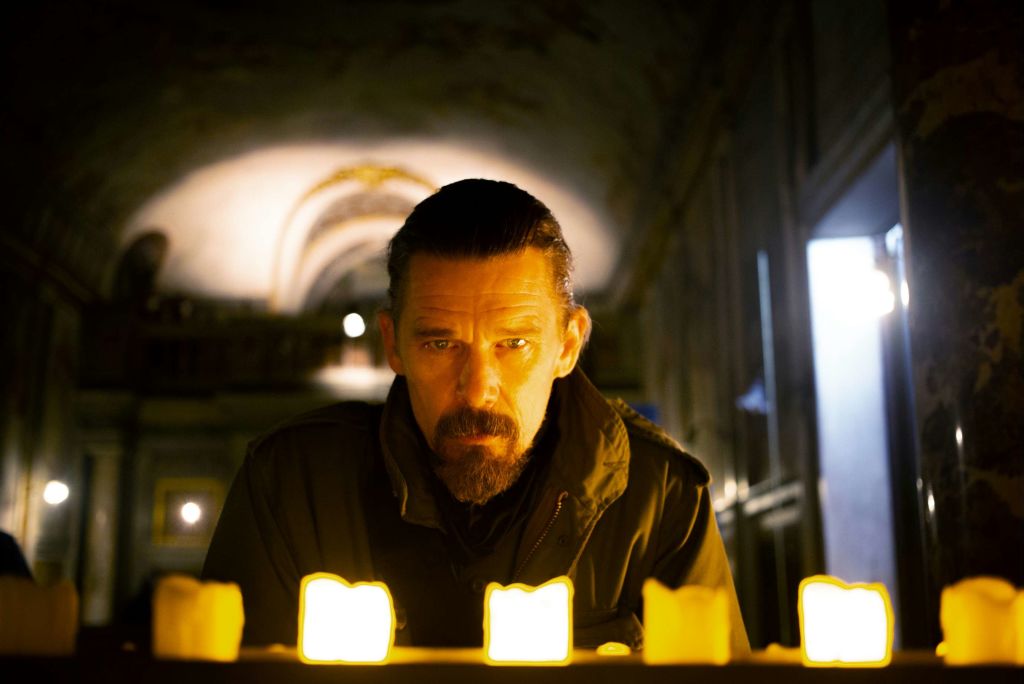
Ethan Hawke stars in this hazily connected sequence of scenes emphasizing one man’s journey toward a realization about himself, his brother and the world around him. Hawke plays both the journeyman, a military specialist of some kind, and his brother, a freedom fighter in Rome.

Hawke wanders empty post-pandemic Rome as bits of military and religious debauchery and double-crossing weave and bob across the screen. Meanwhile, Hawke’s voiceover oscillates between meta-Christian reflections and calls to action.

For his part, Hawke delivers two discernibly different characters, sure, but in keeping with Ferrara’s themes, two distinct types: apostle and wayward soldier. Nothing feels scripted, and with a veteran like Hawke, that works out fine. Like Willem Dafoe in so many of Ferrara’s recent films, Hawke inhabits the desolate dreamscape with a weary resignation, a ghost guiding us toward some dark inevitability.

Zeros and Ones is a pandemic film, but rather than feeling like a filmmaker doing whatever they can with the situation, this one seems like an opportunity Ferrara has been waiting for. He isn’t doing his best within unreasonable constrictions, he’s finally found that empty, nihilistic apocalypse he’s prepared for. The empty streets and lonesome, masked figures feel apiece of his greater goal.

What was that goal? What is it always? The world is filth, hope is futile, man is doomed. You’ve seen his films, right? If so, you probably already know where you’ll fall on Zeros and Ones. It is less poetic and self-indulgent than Tommaso or Siberia, less sensible than his earlier work, and less compelling than a lot of what he’s done. And the explosions look ridiculous.

And yet, there is nothing quite like an Abel Ferrara film.

Fright Club: Claustrophobic Horror

Claustrophobia is a common terror, which makes it a common theme in horror films. Whether the entire film generates a sense of entrapment (The Thing, Rec, Pontypool, Misery) or the filmmaker inserts moments of claustrophobic terror (Shadow in the Cloud, The Pit and the Pendulum), these movies hit a nerve. Today we spend some time in tight quarters counting down the most claustrophobic horror movies.


5. The Hole (2001)

Nick Hamm’s 2001 thriller finds a handful of spoiled boarding school teens sneaking away while the school’s on holiday. They want to see what kind of trouble they can get into with a couple of undetected days in the underground bomb shelter they discovered well behind the school.

It’s all fun and games until they can’t get out.

Thora Birch delivers a brilliant turn as the lead — vulnerable and yet entirely conniving and psychotic, her Liz is mesmerizing. Kiera Knightly shines as well, as does Embeth Davidtz as a detective who won’t be fooled by Liz’s psychosis.

Or will she?

https://www.youtube.com/watch?v=S79NgoLKvVs

4. Cube (1997)

Making his feature directing debut in 1997, Vincenzo Natali, working from a screenplay he co-wrote, shadows 7 involuntary inmates of a seemingly inescapable, booby-trapped mazelike structure. Those crazy Canucks!

Cube is the film Saw wanted to be. These people were chosen, and they must own up to their own weaknesses and work together as a team to survive and escape. It is a visually awe-inspiring, perversely fascinating tale of claustrophobic menace. It owes Kafka a nod, but honestly, stealing from the likes of Kafka is a crime we can get behind.

There is a level of nerdiness to the trap that makes it scary, in that you know you wouldn’t make it. You would die. We would certainly die. In fact, the minute they started talking about Prime Numbers, we knew we were screwed.

3. Buried (2010)

Almost did not make it past the trailer for this one. A tour de force meant to unveil Ryan Reynolds’s skill as an actor, Buried spends a breathless 95 minutes inside a coffin with the lanky Canadian, who’s left his quips on the surface.

A truck driver working in Iraq who wakes up after being hit on the head, Paul Conroy finds himself inside a coffin. He has a cell phone and a lighter, but not the skill of Uma Thurman, so he is pretty screwed.

The simple story and Reynolds’s raw delivery make this a gut-wrenching experience.

2. The Descent (2005)

A bunch of buddies get together for a spelunking adventure. One is still grieving a loss – actually, maybe more than one – but everybody’s ready for one of their outdoorsy group trip.
Writer/director Neil Marshall begins his film with an emotionally jolting shock, quickly followed by some awfully unsettling cave crawling and squeezing and generally hyperventilating, before turning dizzyingly panicky before snapping a bone right in two.

And then we find out there are monsters.

Long before the first drop of blood is drawn by the monsters – which are surprisingly well-conceived and tremendously creepy – the audience has already been wrung out emotionally.
The grislier the film gets, the more primal the tone becomes, eventually taking on a tenor as much like a war movie as a horror film. This is not surprising from the director that unleashed Dog Soldiers – a gory, fun werewolf adventure. But Marshall’s second attempt is far scarier.
For full-on horror, this is one hell of a monster movie.

1. The Vanishing (Spoorloos) (1988)

Back in ’88, filmmaker George Sluizer and novelist Tim Krabbe adapted his novel about curiosity killing a cat. The result is a spare, grim mystery that works the nerves.

An unnervingly convincing Bernard-Pierre Donnadieu takes us through the steps, the embarrassing trial and error, of executing his plan. His Raymond is a simple person, really, and one fully aware of who he is: a psychopath and a claustrophobe.

Three years ago, Raymond abducted Saskia (Johanna ter Steege) and her boyfriend Rex (Gene Bervoets) has gone a bit mad with the mystery of what happened to her. So mad, in fact, that when Raymond offers to clue him in as long as he’s willing to suffer the same fate, Rex bites. Do not make the mistake of watching Sluizer’s neutered 1993 American remake.