Screening Room: Spider-Man: No Way Home, Nightmare Alley, Swan Song and More
Spider-Man: No Way Home
by Hope Madden and George Wolf
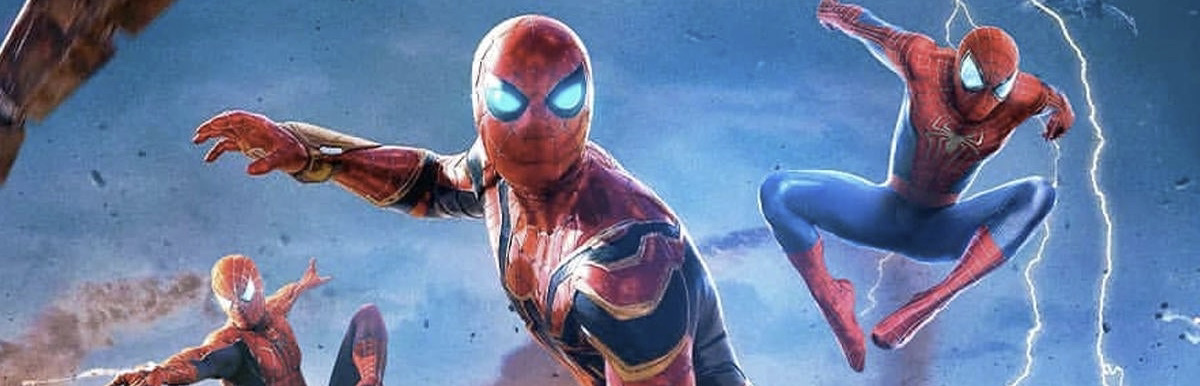
Holy cow, how fun was that?!
Director Jon Watts, working again with writers Chris McKenna and Erik Sommers, uses the third in their Spider-Man series to remind us why we all hope for the best whenever we watch a comic book movie.
Peter Parker (Tom Holland) was found out in the previous installment, Spider-Man: Homecoming. And what he’s learned is that life is more complicated for you and more dangerous for your loved ones when your true identity is known. It’s a lesson most all Spider-Men and most superheroes have to contend with at one time or another. (Except Iron Man. Narcissists, amirite?)
Things have gotten so bad for him, his girlfriend MJ (Zendaya) and his bestie Ned (Jacob Batalon) that he asks for help from a wizard with responsibility issues (Benedict Cumberbatch, having one hell of a year).
What happens next? We see lessons learned from the profound (and rightful) popularity of 2018’s animated treasure, Spider-Man: Into the Spider-Verse. Portals open and Spider-Man characters come pouring in from across the multiverse.
So do other people, inside jokes, and constant opportunities to strengthen themes Spider-Man has spun since Stan Lee and Steve Ditko.
Oh, sure, it’s nostalgic. It panders. It also spills over with joy. This third installment showcases the naïve optimism and youthful sweetness that has made Watt’s first two episodes such a great time, that are so perfectly embodied by Holland.
Rather than feeling like those Marvel overreaches in defining their own universe, Watts’s film uses the opportunity of pulling in other movies to celebrate the hero, his roots, and what he stands for as an icon of comics, heroes, and childhoods the ‘verse over.
It’s a blast spending time with memorable characters, and each of these actors bring something charming to the screen. Watts and his writers fondly recall what’s gone before, even when ribbing some minor shortcomings.
When a superhero franchise gets far enough in that it requires a multitude of villains to one-up its prequel, things usually go south. Watts, on the other hand, gets stronger with each episode. Between his savvy filmmaking and his lead’s endless charm, he’s easily crafted the best set of superhero films in the Marvel (or Sony) universe. Given the excitement around Spider-Man: No Way Home, Peter Parker may not just save the multiverse. He may save the multiplex.

This season has inspired so much horror. You have classics like Black Christmas, foreign masterpieces like Inside, Calvaire and Sheitan, and tons upon tons of guilty pleasures. Today we narrow the focus to the best of the Santas – those fur coated, black booted terrors that can really ruin a festive noel. Here are our favorites.
Lewis Jackson’s yarn about a damaged boy growing up to be a murderous Santa may sound like every third holiday horror to come out in the 80s, but because it was one of the first to do it, it doesn’t fit the predictable pattern. More importantly, Brandon Maggart’s sympathetic performance elevates this film above schlock horror like Silent Night, Deadly Night (and its sequels) to something considerably better.
Yes, childhood memories of Dad and Mom getting cozy under the mistletoe while Dad’s dressed as Father Christmas have had an ill effect on Harry. His zealotry concerning the season, the ribbing he takes from people he knows, and the naughtiness he sees all around him finally push him over the edge. Predictable enough, and with a low budget that allows for very few jingle bells and whistles. Still, Jackson’s script goes unexpected places and Maggart delivers more than standard fare as the marauding Claus.
A trio of Canadian directors – Steve Hoban, Brett Sullivan, and Grant Harvey – pull together a series of holiday shorts with this one. Held together by Dangerous Dan (William Shatner), the small-town radio announcer who’s pulling a double shift this Christmas Eve, the tales vary wickedly from three teens trapped in their own wrong-headed Nativity, to a family who accidentally brought home a violent changeling with their pilfered Christmas tree, to a dysfunctional family stalked by Krampus, to Santa himself, besieged by zombie elves.
Yes, there is a second film out this holiday season with Krampus in it. You know what? This one’s better – in fact, it’s almost patterned after Krampus director John Dougherty’s cult favorite Trick r’ Treat and it offers more laughs and more scares.
Plus Shatner! He’s adorably jolly in the broadcast booth, particularly as the evening progresses and his nog to liquor ratio slowly changes. This is a cleverly written film, well-acted and sometimes creepy as hell. Merry f’ing Christmas!
That mullet! That house! Rene Manzor’s 1989 holiday horror predates Home Alone by one year, but both films have the same idea in mind. What if an incredibly rich family leaves a kid to defend himself against home invaders on Christmas Eve?
Except in this case, rich doesn’t begin to cover it and the home invader isn’t a couple of suburban thugs, it’s a psychotic dressed as Santa. Patrick Floersheim brings layers of tragic man-chid mental instability to the role, and that gives the film a lot of depth. Alain Lalanne is adorable as the mulleted boy who believes in Santa, and Louis Decreux – as his go-along-with-anything grandpa – is equally precious.
The editing leaves a lot to be desired, so the action sequences and montages lack propulsion. But the set decoration is amazing. This is a fun one.
What is every child’s immediate reaction upon first meeting Santa? Terror. Now imagine a mash-up between Santa, a pirate, and an old-school Catholic bishop. How scary is that?
Well, that’s basically what the Dutch have to live with, as their Sinterklaas, along with his helper Black Peter, sails in yearly to deliver toys and bag naughty children to kidnap to Spain. I’m not making this up. This truly is their Christmas fairy tale. So, really, how hard was it for writer/director Dick Maas to mine his native holiday traditions for a horror flick?
Allegorical of the generations-old abuse against children quieted by the Catholic Church, Saint manages to hit a few nerves without losing its focus on simple, gory storytelling.
It’s not just the Dutch with a sketchy relationship with Santa. That same year Saint was released, the Fins put out an even better Christmas treat, one that sees Santa as a bloodthirsty giant imprisoned in Korvatunturi mountains centuries ago.
Some quick-thinking reindeer farmers living in the land of the original Santa Claus are able to separate naughty from nice and make good use of Santa’s helpers. There are outstanding shots of wonderment, brilliantly subverted by director Jalmari Helander, with much aid from his chubby-cheeked lead, a wonderful Onni Tommila.
Rare Exports is an incredibly well-put-together film. Yes, the story is original and the acting truly is wonderful, but the cinematography, sound design, art direction and editing are top-notch.
by Hope Madden
Children in peril, cool creature design and a monster that still feels new, even though it’s centuries old. Franco-Moroccan filmmaker Talal Selhami delivers all this and more in his latest effort, Achoura.
The tale bounces around three different time periods. Many years ago, a young girl and boy run away from her arranged marriage, taking shelter in an abandoned house. They are found, and not just by the husband.
Years later, four young friends playing in a cornfield wander into the same house and meet with tragedy. In modern-day Morocco, three of those four come to terms with just what it is they experienced.
Achoura is the third film I’ve seen in recent years focused on a djinn— a spirit of Middle Eastern folklore. Earlier this year, David Charbonnier and Justin Powell released their chamber piece, The Djinn, and back in 2016 came Babak Anvari’s terrifying sociopolitical treasure, Under the Shadow.
Selhami’s film lacks the power of the latter and the focus of the former, but it still brings the goods. The filmmaker is at his best working with children, establishing an unsettling vulnerability that gives his horror real punch.
The adult storyline works less well — certain head-scratching behavior begging too much suspension of disbelief — but Omar Lofti’s tender performance almost makes up for that. A bridge of sorts between the children and adults in the tale, he enlists your investment in solving the riddle and saving the day.
Romain Paillot’s score conjures Ghostbusters as well as E.T., disconcerting choices given what’s in store for youngsters in Selhami’s film. Things don’t go well for them, and their suffering gets a tad lost in the narrative. It’s as though the film began as a metaphor about molestation but changed course somewhere and never properly righted itself. It gives the film a sense of thematic meandering.
Selhami scores points with the creature, though. The image, echoed throughout the film in drawings and artwork, is eerie and the monster itself looks great when handled practically. The VFX leaves something to be desired, unfortunately, marring a few scenes that would otherwise have been seriously unnerving.
Achoura also marks the second film this year to take inspiration from Moroccan folklore, after Alexandre Bustillo and Julien Maury’s Kandisha. And though Selhami’s cinematic storytelling shows some weak spots, he and his creepy film are part of a movement expanding the look and language of horror, and that’s worthy of applause.

by Hope Madden and George Wolf
Step right up, folks, and witness a master of the macabre! See Guillermo Del Toro twist the familiar tale of ambition run amuck! Gasp at the lurid, gorgeous, vulgar world of Nightmare Alley!
Bradley Cooper stars as Stan, good lookin’ kid on the skids taken in by Clem (Willem Dafoe, creepy as ever) to carny for a traveling show. Stan picks up some tricks from mentalist Zeena (Toni Collette) and her partner Pete (David Strathairn), then lures pretty Molly (Rooney Mara) to the big city to set up their own mind-reading racket.
Things are going swell, too, until Stan gets mixed up with psychiatrist Lillith (Cate Blanchett) whose patient list includes some high rollers with large bank accounts ripe for the picking.
That’s already one hell of an ensemble, but wait there’s more! Richard Jenkins, Ron Perlman, Mary Steenburgen and Tim Blake Nelson all add immeasurably to the sketchy world Stan orbits.
What Del Toro brings to the tale, besides a breathtaking cast and an elegantly gruesome aesthetic, is his gift for humanizing the unseemly. Edmund Goulding’s 1947 adaptation of William Lindsay Gresham’s novel (a solid slice of noir with Tyrone Power in the lead) dulled the edges of any seediness. Even Tod Browning’s Freaks – maligned as it was – found the unsettling carny life mainly wholesome.
Cinematographer Dan Lausten and composer Nathan Johnson create a delicious playground for Del Toro’s carnival to call home, one where even the most likable members of the family turn a blind eye to something genuinely sickening and cruel happening in their midst. The filmmaker plumbs that underlying horror, complicating Stan’s arc and allowing the film’s climax to leave a more lasting mark.
As usual, Del Toro wears his feelings proudly on his sleeve, with unmistakable but organic foreshadowing that ups the ante on the stakes involved. Anchored by another sterling performance from Cooper, Stan’s journey rises to biblical proportions. An actor whose gifts are often deceptively subtle, Cooper makes sure Stan’s pride always arrives with a layer of charming sympathy, even as it blinds him to the pitfalls ahead.
And Blanchett – shocker – is gloriously vampy. She swims elegantly through the sea of noir-ish light and framing that Del Toro bathes her in, as Lillith casts a spell that renders Stan’s helplessness a fait accompli.
Nearly every aspect of the screenplay (co-written by Del Toro and Kim Morgan) creates a richer level of storytelling than the ’47 original. The dialog is more sharply insightful, the finale more dangerously tense and the characters – especially Mara’s stronger-willed Molly – more fully developed. All contribute greatly toward the film rebounding from a slightly sluggish first act to render the two and a half hour running time unconcerning.
For Del Toro fans, the most surprising aspect of Nightmare Alley might be the lack of hopeful wonder that has driven most of his films. As the title suggests, this is a trip to the dark corners of the soul, where hope is in damn short supply.
So as much as this looks like a Del Toro film, it feels like a flex just from taking his vision to the sordid part of town. But what a vision it turns out to be – one of the year’s best and one of his best.
Don’t believe me? See it with your own eyes, step right up!
by Hope Madden
Nicole Kidman does not look like Lucille Ball. Javier Bardem does not look like Desi Arnaz. You’ll forget that not long into Being the Ricardos, a change of pace for writer/director Aaron Sorkin.
Sorkin’s biopic shadows the couple through one particularly tumultuous week in their lives as a married couple as well as TV superstars.
Kidman has the voice, the attitude, and the wearied wit to bring Lucille Ball to life. Her brittle, believable turn grapples with the pressures of being Hollywood’s most bankable comic genius. Lucille Ball was the biggest TV star on earth, a massive moneymaking machine whose eye for physical comedy and ear for lazy comic riffs elevated content and deflated co-stars and co-workers. Kidman plays a boss pretending not to be the boss and bristling at the compromise.
Those populating the soundstage and writers room around her — Nina Arianda, Tony Hale, Alia Shawkat and a bland Jake Lacy — create a fractured work dynamic looking to collapse under this particular week’s unprecedented pressure due to a leaked news story about Lucy.
Besides Kidman, the two big standouts are not surprising. JK Simmons, who’s never turned in an unremarkable performance in his life, wrestles with a character who would be easy to dismiss or despise. In the veteran’s hands, though, William Frawley (I Love Lucy’s Fred Mertz) is the tender, well-meaning if wrong-headed voice of the times.
Bardem oozes charm, charisma and aptitude as Ball’s under-regarded husband. Vanity and vulnerability roil quietly, almost out of sight, and Bardem’s chemistry with Kidman sparkles.
Being the Ricardos is not funny, and it’s hard to fathom a film about Ball that isn’t at least incidentally funny. But let’s be honest, comedy is not really Sorkin’s bag. The way he looks at success, particularly for a woman at this time period, is as smart as anything he’s done.
Sorkin reins in his characteristic rat-a-tat-tat hyper-intellectual dialog just enough to let characters be human. Their on-screen personas meet their off-screen realities in a way that allows a firmly remarkable cast to deliver twice the goods.

by Hope Madden
In looking back over the notes I took as I screened Mike Mills’s latest feature, I find more single words than helpful phrases or insights. I wrote down these words: intimate, vulnerable, hopeful, sincere, earnest.
In other words, C’mon C’mon is a Mike Mills film.
The filmmaker’s most memorable movies dig deep into one connection within a family to see how that tumult ripples out to the rest of our hero’s relationships. Beginners pitted a man’s evolving bond with his aging father (Christopher Plummer, who took home an Oscar for the role). Six years later, Mills digs into mother/son issues with the incandescent 20th Century Women. (Mills nabbed his first Oscar nomination for the screenplay.)
In C’mon C’mon, a man’s changing relationship with his young nephew mirrors his deepening bond with his estranged sister. That man, Johnny, is played by Joaquin Phoenix, who presumably does not need to be described as one of the greatest actors working today because everyone knows that by now.
Phoenix is particularly endearing in this film, hitting those earlier adjectives with such authenticity it would be very easy to believe he simply loved the little boy he was spending all this time with, regardless of the amount of energy a 9-year-old sucks from you, not to mention the frustration that comes with that territory.
Jesse, the 9-year-old, is played by quite an amazing actor himself. Woody Norman (love that name!) shoulders the responsibility of being precocious, frustrating, brilliant, adorable, tender and human. He soars, and his chemistry with Phoenix couldn’t be more charming or genuine.
So many adjectives!
Gaby Hoffmann deserves one, too, because she’s wonderful as well as Norman’s mom, Johnny’s sister Viv. Viv needs to look in on Jesse’s father, a bipolar musician who’s bitten off more than he can chew with his new job, new apartment and new dog. Johnny agrees to look after Jesse, eventually bringing the boy along with him to New York and then New Orleans where Johnny interviews kids for a radio program.
Johnny is finding out how the world looks to a child and realizing that it is genuinely terrifying.
Both sound design and cinematography also need to be acclaimed as adjective worthy as well, because this film looks and sounds amazing.
Mills blends the interviews (of non-actors whose responses are not scripted) with the fictional relationships among Johnny, Jesse and Viv. The blending of reality with fiction is seamless enough to buoy the sense of authenticity and heighten a mood of empathy.
As is true with Beginners and 20th Century Women, C’mon C’mon wraps the messy, awkward, disappointing realities of being human in a blanket of hope. As cloying as that sounds, the film is so sincere it’s hard to deny its warmth.
by Hope Madden
Just two features in, filmmaker Michael Pearce is proving himself a master craftsman. His sly ability to shift tone is matched by storytelling instincts that leave you holding your breath against seemingly inevitable heartbreak.
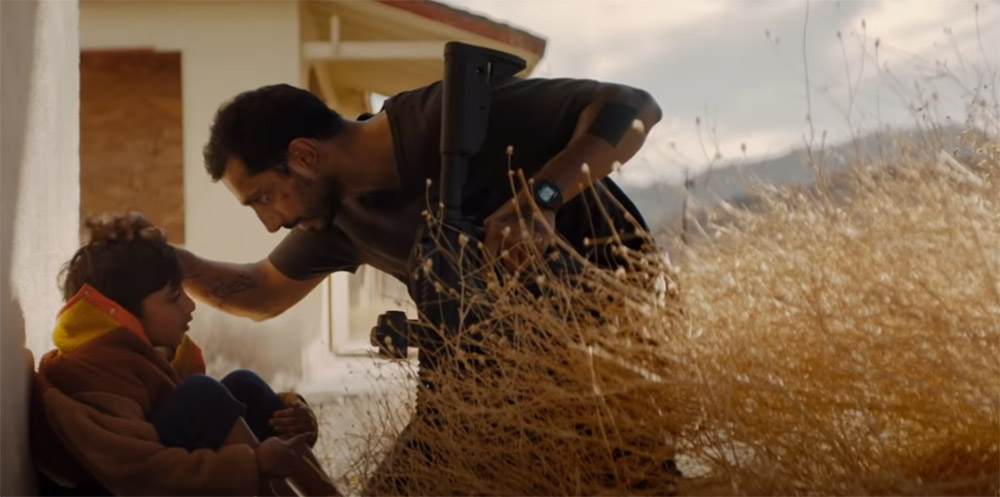
Pearce’s 2017 film Beast (see it if you haven’t!) benefitted from Jessie Buckley’s raw, morally complicated performance. For his latest, Encounter, he can thank Riz Ahmed.
Fresh off his Oscar-nominated turn in Sound of Metal (see it if you haven’t!), Ahmed delivers another searing, searching turn, this time as Malik. A marine with 10 tours under his belt, Malik returns to the home his wife makes with another man. He arrives not to cause familial conflict, but to save his sons (Lucian-River Chauhan and Aditya Geddada, both as cute as they are talented) from a problem much bigger than mere marital discord.
Ahmed’s chemistry with the young actors brings a touching vulnerability to every scene, and as the boys’ road trip turns ever darker and wearier, Chauhan proves a formidable acting partner.
Rare missteps stand out specifically because of their rarity. When a line delivery rings false, over-the-top or melodramatic it screams its presence because this cast and this script deftly convey so much so honestly.
Octavia Spencer offers support in a role that feels out of step with the jarring authenticity the main cast brings to an otherwise wild, almost sci-fi storyline. Likewise, the police force Spencer’s parole officer Hattie rides along with — soft-spoken Shep (Rory Cochrane) and self-satisfied Lance (Shane McRae) — toe the line between character and cliché.
Otherwise, though, Pearce, Ahmed and gang uncover tensions and complications, picking at your worries for these sweet boys and their beautifully damaged father. Tone shifts gradually but decidedly, every moment building a queasying energy until the inevitable finale (a beautifully choreographed sequence that calls to mind the insect infestation imagery of Act 1 while articulating the nerve-frazzling tension).
The filmmaker and his game lead challenge expectations both in theme and in genre, and while their gamble doesn’t entirely pay off, it’s often riveting stuff.