About a year ago, Universal Studios pulled the release of The
Hunt because of the amount of gun violence. Commendable.
Later that year, other studios released Ready
or Not—critical darling, but didn’t do great box office. Then Knives
Out, which was both a critical darling and box office giant. And, of
course, Parasite
would go on to win all the Oscars. Even documentary short.
While The Hunt does contain a goodly amount of
violence—guns, knives, hand grenades, pens, stilettos, kitchen appliances—it
also boasts the one thing that appears to be the universal key to
entertainment. It hates rich people.
Who doesn’t?!
Director Craig Zobel (Compliance), along with writers Nick Cuse and Damon Lindelof (both of TV’s Watchmen and The Leftovers), takes no prisoners as characters take a bunch of prisoners, drop them in a field somewhere and, you know, hunt them down for sport. The film gleefully skewers both the left and the right, often in ways you wouldn’t expect but should.
This is a meticulously structured horror film, the tidy
beats allowing the writers to insert surprises that play on your preconceived
notions in clever ways. Like Jordan Peele, Zobel proves a nimble manipulator of
both horror tropes and social commentary.
And casting.
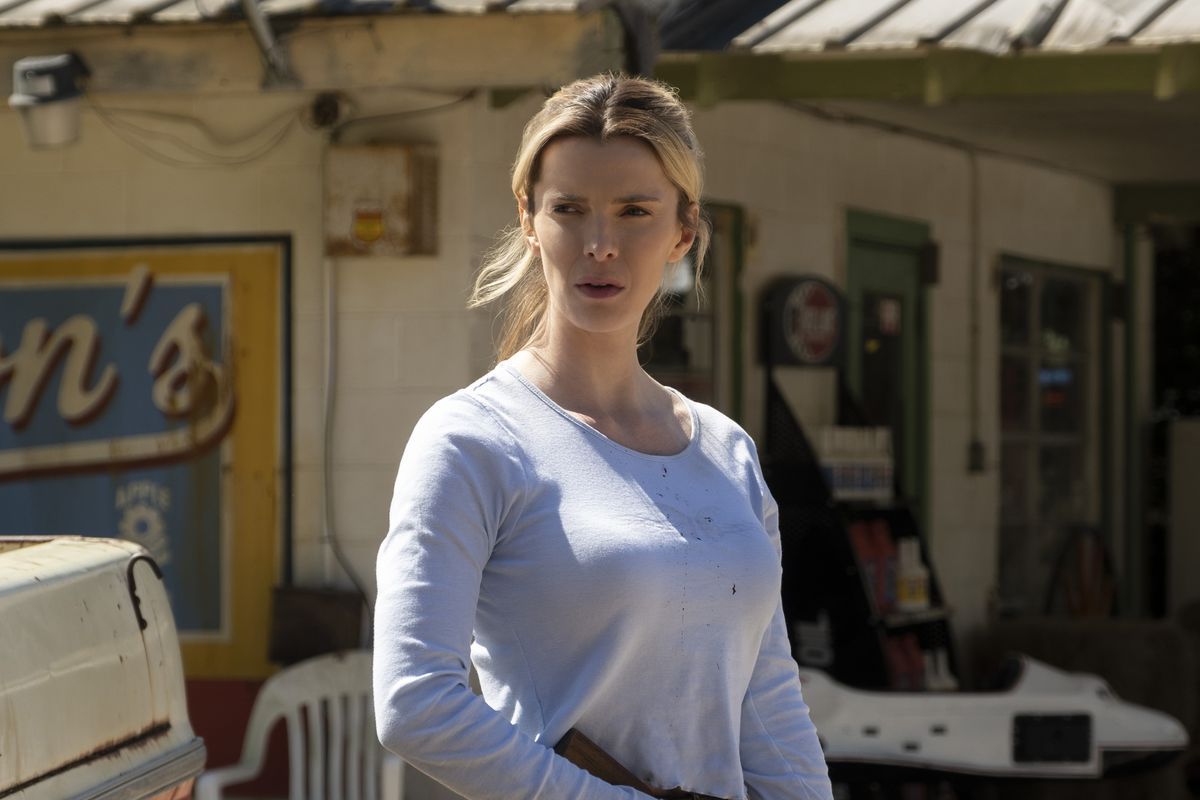
I have to think Betty Gilpin was the most disappointed when
this film was shelved last year because it is her break out. No more support
work as the hot mean chick, Gilpin’s Crystal is the wrong badass to
underestimate. The performance is never showy but quirky and genuine, which
goes a long way toward increasing believability.
Zobel populates the herd with familiar faces (Emma Roberts,
Ike Barinholtz, Hilary Swank, Amy Madigan), mainly for sleight of hand. Though
most get little screen time, and each is handed a fairly one-dimensional
character, both the writing and the performances mine that gimmick for a lot.
Positioned to infuriate everyone in one scene or another, the film is brash and bracingly level headed. It’s violent AF, no doubt, but what it reflects back at us is far smarter than what you might expect. The Hunt is a darkly comedic, socially savvy, equal opportunity skewering and it is a blast.
Like Todd Haynes’s 1995 film Safe, Swallow shadows
a lovely homemaker with little of merit to occupy her time who eventually falls
prey to an unusual malady.
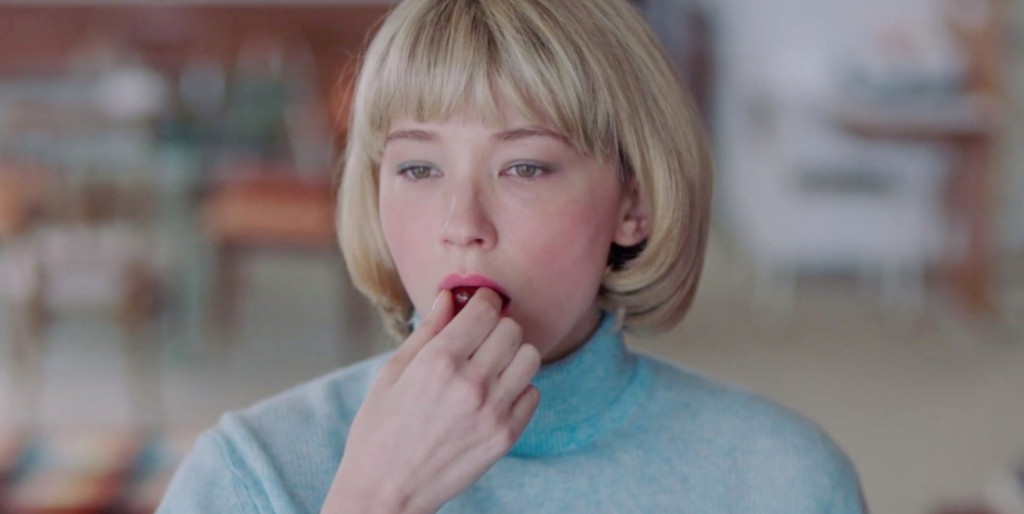
Dressed like something out of a 1950s pantyhose ad, Hunter (a transfixing Haley Bennett) fluffs pillows, prepares dinner, and waits for her husband Richie (Austin Stowell) to come home from work. She’s so grateful. Just really thankful, she nods in a hushed, respectful, humble tone.
You might think that pregnancy would give Hunter something meaningful to do with her time: prepare the nursery, read up on parenting, that sort of thing. But the only thing she really wants to do now is to swallow things she shouldn’t.
Putting a relevant twist on the classic “horrific mother” trope, writer/director Carlo Mirabella-Davis uses the rare eating disorder pica to anchor his exploration of gender dynamics and, in particular, control.
At times almost Hitchcockian in its suspense, anxiety and balance of gender hysterics, Swallow feels urgently present but simultaneously old-fashioned. The costume choices, the vacant expression Hunter wears like a mask, the way she smooths and tucks her hair—all of it rings with the tone of the dementedly June Cleaver-esque.
Where Mirabella-Davis’s talent for building tension and framing
scenes drive the narrative, it’s Bennett’s performance that elevates the film.
Serving as executive producer as well as star, Bennett transforms over the
course of the film.
The path Swallow takes is eerily, sometimes
frustratingly similar to Haynes’s Safe. Both films cover similar themes,
both take on a meticulously crafted visual aesthetic, and both boast
incandescent lead performances. Indeed, Bennett here is every ounce as
believable and touching and transfixing as the great Julianne Moore as Haynes’s
brittle heroine.
But where Haynes played things a little too ambiguously to
satisfy an audience, Mirabella-Davis embraces clarity—although first he flirts
and then dances with it before the full bear hug. The first half of this film
is almost sleight of hand, the filmmaker telegraphing imagery too meticulous
and obvious.
When things finally burst, though, director and star shake
off the traditional storytelling, the Yellow Wallpaper or Awakening
or even Safe. The filmmaker’s vision and imagery come full circle with a
bold conclusion worthy of Bennett’s performance.
Hot damn, look at these rocks! If you can’t find a movie to entertain you this week as you hide away from the germs outside your door, we can’t help you.
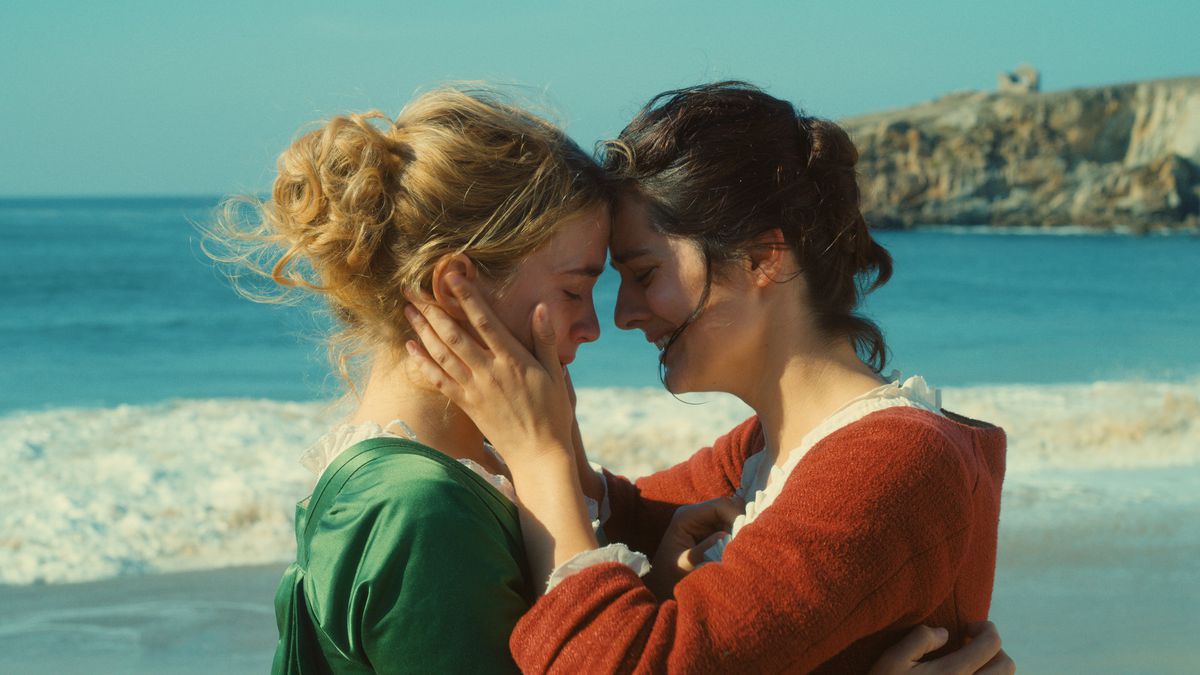
Celine Sciamma follows up the vitally of-the-moment indie Girlhood with this breathy, painterly period romance only to clarify that she is a filmmaker with no identifiable bounds. In the 1790s on a forbidding island in Brittany, Marianne (Noemie Merlant) arrives to paint the wedding portrait of Heloise (Adele Haenel), but since Heloise is not marrying voluntarily, she will not sit for a painter. So, a ruse is developed: Marianne pretends to be simply a companion as she steals glances then sketches from memory into the night.
What develops along with the startlingly beautiful
intimacy between the women is a thoughtful rumination on memory and on art, on
the melancholic but no less romantic notion that the memory, though lonesome,
is permanent and perfect.
Portrait of a Lady on Fire is a tenderly romantic
film of self-discovery that asks a lot of questions.
What would life be like with no men at all, the film seems to ask. Unseen, nameless men (because we see very few) may rule the world, and the existence of one casts a pall over the events of the film. But, at least until Mother (Valeria Golino) returns with news of the wedding, this is a community of women.
On the island, women gather at a bonfire, passing time,
singing and seeking each other’s guidance. In the austere mansion, Heloise,
Marianne and servant Sophie (Luana Bajrami) look after one another. In a more
intimate chamber, two women become friends and then lovers and then, likely,
the most important relationship the other will ever have.
Offering a master class in visual storytelling, Sciamma relies far less on words than images, ending conversations or omitting them entirely, able instead to deliver meaning with a glance, a gesture, a flame or an ocean wave.
And with art. What Sciamma is able to convey about love,
struggle, empowerment and art by virtue of the changing canvas on which
Marianna must commit Heloise’s portrait is truly extraordinary.
Sciamam’s film has a painterly quality, frame after frame worthy of museum wall space. And yet, Portrait lacks artifice. Thomas Grezaud’s set design, Dorothee Guiraud’s costumes and, in particular, Claire Mathon’s cinematography blend together to create a costume drama worthy of the historical and art period in question.
Portrait of a Lady on Fire is breathtakingly gorgeous. But, like Heloise’s portrait in the film, that’s not enough to make it a masterpiece. It’s the authenticity to the intimacy—perhaps partly born of the fact that Haenel and Sciamma are a real life couple—that’s inescapable, and it drives the piece.
Like Marianna’s final portrait, Sciamma’s film offers truth, and it’s astonishing.
Leave it to our Correspondent from the Future, Cory Metcalfe, to come up with this killer topic. We rank the best horror films in which not one single person dies—not during the running time, anyway. And yet, they’re scary. Well, they range from funny to spooky to unsettling to terrifying, but these films prove that a good filmmaker can terrify you without pushing the knife all the way in.
5. Compliance (2012)
Compliance is an unsettling, frustrating and upsetting film about misdirected and misused obedience. It’s also one of the most impeccably made and provocative films of 2012 – a cautionary tale that’s so unnerving it’s easier just to disbelieve. But don’t.
Writer/director Craig Zobel – who began his career as co-creator of the brilliant comic website Homestar Runner (so good!) – takes a decidedly dark turn with this “based-on-true-events” tale. It’s a busy Friday night at a fast food joint and they’re short staffed. Then the police call and say a cashier has stolen some money from a customer’s purse.
A Milgram’s experiment come to life, the film spirals into nightmare as the alleged thief’s colleagues agree to commit increasingly horrific deeds in the name of complying with authority.
4. They Look Like People (2015)
Christian (Evan Dumouchel) is killing it. He’s benching 250 now, looks mussed but handsome as he excels at work, and he’s even gotten up the nerve to ask out his smokin’ hot boss. On his way home from work to change for that date he runs into his best friend from childhood, Wyatt (MacLeod Andrews), who’s looking a little worse for wear. Christian doesn’t care. With just a second’s reluctance, Christian invites him in – to his apartment, his date, and his life.
But there is something seriously wrong with Wyatt.
Writer/director Perry Blackshear’s film nimbly treads the same ground as the wonderful Frailty and the damn near perfect Take Shelter in that he uses sympathetic characters and realistic situations to blur the line between mental illness and the supernatural.
3. The Conjuring (2014)
James Wan’s classic haunted house tale delivered real scares from start to finish. Yes, this is an old fashioned ghost story, built from the ground up to push buttons of childhood terror. But don’t expect a long, slow burn. Director James Wan expertly balances suspense with quick, satisfying bursts of visual terror.
Wan understands the power of a flesh and blood villain in a way that other directors don’t seem to, eschewing CGI for practical effects and understanding that our physical danger is not always as terrifying as what could happen to our souls.
2. Freaks (1932)
Short and sweet, like most of its performers, Tod Browning’s controversial film Freaks is one of those movies you will never forget. Populated almost entirely by unusual actors – midgets, amputees, the physically deformed, and an honest to god set of conjoined twins (Daisy and Violet Hilton) – Freaks makes you wonder whether you should be watching it at all. This, of course, is an underlying tension in most horror films, but with Freaks, it’s right up front. Is what Browning does with the film empathetic or exploitative, or both? And, of course, am I a bad person for watching this film?
Well, that’s not for us to say. We suspect you may be a bad person, perhaps even a serial killer. Or maybe that’s Hope. What we can tell you for sure is that this film is unsettling, and the final, rainy act of vengeance is truly creepy to watch.
1. The Babadook (2014)
You’re exhausted – just bone-deep tired – and for the umpteenth night in a row your son refuses to sleep. He’s terrified, inconsolable. You check under the bed, you check in the closet, you read a book together – no luck. You let him choose the next book to read, and he hands you a pop-up you don’t recognize: The Babadook. Pretty soon, your son isn’t the only one afraid of what’s in the shadows.
Writer/director Jennifer Kent’s film is expertly written and beautifully acted, boasting unnerving performances from not only a stellar lead in Essie Davis, but also the alarmingly spot-on young Noah Wiseman. Davis’s lovely, loving Amelia is so recognizably wearied by her only child’s erratic, sometimes violent behavior that you cannot help but pity her, and sometimes fear for her, and other times fear her.
Much of what catapults The Babadook beyond similar “presence in my house” flicks is the allegorical nature of the story. There’s an almost subversive relevance to the familial tensions because of their naked honesty, and the fight with the shadowy monster as well as the film’s unusual resolution heighten tensions.
Good intentions are very mortal and perishable things.
So are people.
Leigh Tiller lets good intentions muck up what should have
been an easy crime to get away with. No one would have known. No one would have
suspected. Not that there wouldn’t be complications, but she’d deal with those
later.
While co-writer/director Matthew Pope doesn’t reinvent the
wheel with his Rust Belt noir Blood on Her Name, it is actually the
refreshing simplicity of the storytelling that compels you to pay attention.
That and Bethany Anne Lind’s performance.
As Tiller, Lind weaves a dotted line between upstanding and
sketchy. Her compass doesn’t always point due North, or maybe it does, or at
least maybe it could. Right? It could. It’s this struggle, most of it internal,
that Lind characterizes with subtle anguish to give the film an aching,
remorseful tenderness, a longing for what should be but what is always just out
of reach.
Pope populates his low rent neighborhoods with an intriguing
mix of characters, none of whom are rendered with broad strokes. Dani Wilson is
especially strong as a fading white trash hottie, while Will Patton finds dimension
as an old man who believes he deserves a second chance but probably does not.
Blood on Her Name is a film that should feel bleak
but it rebels against its own grim fate. This is a film that knows Leigh Tiller
deserved better choices, stronger options. It’s a film that doesn’t want to
give up on small town, low rent, hard work. But it’s also a film that’s
bracingly clear-eyed about the reality that balances that optimism.
A seedy motel, a low-rent Sigfreid & Roy, the sketchy
side of a tourist town during low season—Albert Shin’s Disappearance at
Clifton Hill is a neo-noir told mainly in nostalgic colors, smoke and
mirrors.
The setting for the mystery is the Rainbow Inn Motel, a dump just off the Niagara River gorge that’s seen better days, though it’s tough to imagine when those days might have been.
Abby (Tuppence Middleton – British much?) is home to complicate the fulfillment of her mother’s will, because that will involves selling the old Rainbow Inn to the town mogul who looks to raze Abby’s memories in favor of day-glo paint ball.
What is it she remembers, exactly? A fishing trip down in
that gorge. A one-eyed boy. A kidnapping.
Shin mines all those wistful ideas about going home again as
Abby begins sifting through sordid secrets, wealthy families, and the decay of
the once wondrous world of her youth. Where will her sleuthing lead?
Aah, the untapped resources of your local public library. Is
that a microfiche machine?!
Shin excels at nailing atmospherics. Tourist trap towns do feel seedier off-season, their sparsely populated amusements somehow sad. In Shin’s hands, the town, its near vacant fun house and caged tigers all conjure the notion of childhood perverted.
Magician’s trickery. Sleight of hand.
The delightfully dodgy Abby is the epitome of an unreliable narrator, although to Shin’s endless credit, we’re not asked to believe something she’s telling us. We are with her, step by step, as she convinces herself of something, which allows us—like Abby herself—to really hope she might actually be on to something.
There’s a fluidity to the way Shin and co-writer James Schultz
unveil Abby’s own sketchiness, beginning with a barroom conversation/seduction.
This is also where he begins to introduce a delicious stew of supporting
characters, each one a little quirkier than the last.
Hannah Gross particularly impresses as Abby’s far more
grounded sister Laure, but I was probably most excited about Walter.
When you think of David Cronenberg—and I think of him
often—you don’t always consider his acting. But he does add a little something
something to films. Here he charms as Walter, area historian and podcaster: “Remember,
rate and review.”
Disappearance at Clifton Hill is not a flawless film, but it is deceptively competent. It’s fun and clever. Middleton’s clear eyed yet delusional Nancy Drew never ceases to be appealing.
And just when you think Shin and company have tidied up a little too quickly…smoke and mirrors, my friend.
Any film centering on a character on the Autism spectrum is
risking a lot. It’s far too easy to simplify this character to a handful of
tics that lend themselves to a narrative device: Mercury Rising, Extremely
Loud and Incredibly Close, Forest Gump. (That’s right. I said it.)
But if it’s done well, if the character is a character and
not a narrative device, the film can benefit immeasurably.
The Night Clerk falls somewhere in between these two
options.
Writer/director Michael Cristofer leans on a committed cast,
including the always wonderful Tye Sheridan in the lead, to pull you into a
mystery thriller that may be too simple for its own good.
Sheridan is Bart. He works nights at a hotel near his home and
in his off hours he practices. He rehearses human interaction, small talk. He
and his mother (Helen Hunt, a touching mixture of brittle and tender) live day
to day in what has clearly become well-worn patterns. Most nights at work are
probably uneventful, but on this particular night, Bart discovers a murder.
The detective on the case (John Leguizamo) suspects Bart, but
Bart is distracted by a kind hearted and lovely new guest (a convincing Ana de
Armas).
Without Sheridan’s committed performance, the film would
fall apart. At no point does Sheridan, Cristofer or this film condescend to
Bart. The audience isn’t one step ahead of the character; we are piecing
through the mystery along with him. We aren’t asked by the film to pity Bart
but to be frustrated along with him, and Sheridan is up to the task of keeping
this character from tipping into martyrdom.
The problem with this film is not the characterization of a
young man with Asperger syndrome. The issue is the writing.
Cristofer may nail the characters—and for the most part, with
the help of talented performers, he does. But the lapses in logic when it comes
to the policework, not to mention the basic simplicity of the plot itself,
keeps the film from really engaging or staying with you.
The plot feels almost too uncomplicated to be a TV drama let
alone a feature film. Tensions over the outcome never rise above a flutter, and
regardless of how strong the performances—de Armas, Hunt and Sheridan, in
particular—this is a thriller that rarely manages to generate any real tension.
As a character study it’s intriguing, sometimes comical and certainly respectful. It’s a showcase for solid acting, but not much else.