Anchored by the powerful bond between a K-9 Marine and his handler, Megan Leavey is a thoroughly respectful and frequently touching testament to heroes of differing species.
Kate Mara is fantastic as Corporal Leavey, who was twice deployed to Iraq with her bomb-sniffing dog Rex, saving multiple lives until they were both wounded by an improvised explosive. After her return to civilian life, Leavey mounted an impressive campaign to adopt Rex, and was ultimately successful with an assist from her Senator, New York’s Chuck Schumer.
Director Gabriela Cowperthwaite, who nearly brought Sea World to its knees with the documentary Blackfish, builds Megan Leavey with impressive restraint in each of its themes. Never a jingoistic war film, shameless recruiting tool or schmaltzy ode to a dog’s purpose (pun intended), the film, like its subjects, does a job and does it well.
At times tense, loving, and even goosebump-worthy, Megan Leavey is a fine reminder that family comes in all breeds.
Two years ago, Krisha served as a stunning feature debut for writer/director Trey Edward Shults. Gripping in the intimate nature of its truths, it heralded Shults as a new filmmaker with tremendous potential.
That potential is realized with It Comes at Night.
He may have bigger stars and a larger budget this time out, but Shults shows storytelling instincts that are already well-seasoned. Resisting any pressures to mainstream his scope and “go bigger,” Shults get even more intimate. While Krisha showed a very tangible threat infecting a family, It Comes at Night is more abstract, an intensely personal take on fear and paranoia.
Deep in the woods, Paul (Joel Edgerton, solid as always), Sarah (Carmen Ejogo) and their teenage son Travis (Kelvin Harrison, Jr.) have established a cautious existence in the face of a worldwide plague. They have boarded their windows, secured their doors, and enacted a very strict set of rules for survival.
At the top of that list: do not go out at night.
This rigid domestic order is tested when the desperate Will (Christopher Abbott) breaks in. He has a wife, Kim (Riley Keough) and toddler to protect, and is offering all they have in exchange for refuge.
It Comes at Night has been on horror fans’ radar for some time, but it will test the patience of those satisfied with cheap jump scares or spoon-fed explanations. As with Krisha, Shults builds the film around his own experiences, using Travis to often mirror how Shults himself dealt with a death in the family. Through Travis’s nightmares, we are kept off balance, questioning just what is real and who can be trusted.
Shults explores the confines of the house with a fluid camera and lush cinematography, slyly creating an effective sense of separation between the occupants and the dangers outside.
But what are those dangers, and how much of the soul might one offer up to placate fear itself?
In asking those unsettling questions, It Comes at Night becomes a truly chilling exploration of human frailty.
“Who hasn’t had the impulse to put their life on hold for a moment…just vanish completely?”
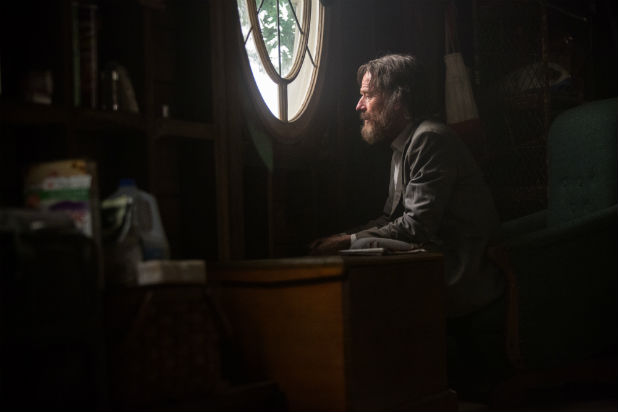
Howard Wakefield (Bryan Cranston) gives in to that impulse, and his moment of resignation becomes months in a self-imposed exile, wallowing in self-pity and watching his family from an attic window.
Sure, Howard has a nice job, beautiful family and sweet home in suburban New York, but he’s been lulled into a stupor by the whole domestic routine. After yet another trying day, Howard ventures up to the attic above his separate garage…and decides to stay there.
Writer/director Robin Swicord adapts E.L. Doctorow’s short story with a workmanlike precision, dutifully providing all the building blocks for this high-concept parable, but never finding the depth or profundity she seeks.
Cranston, here’s a shocker, is fantastic, digging commendably deep in a search for the humanity his character badly needs. Howard has some first-world problems, as he labels suburbia a place people can feel “protected from what’s wild,” but can’t challenge his privilege with anything more dire than dumpster diving or poor hygiene. Howard is far from likable, and though Cranston is all in, finding a reason to root for his quest is tough sledding indeed.
As he spies on his wife (Jennifer Garner) and two daughters, Howard fancies himself the veritable wise old hermit, observing the folly of modern life and dispatching simple truths. It’s well-meaning, but these truths are of the standard greeting card variety, rendered even less impactful from the film’s inherent need to tell (through voiceover narration or talking-to-himself musings) instead of show.
At times, Wakefield has the feel of a one-man show. With Cranston, the man makes it worth watching, even when the show can’t quite keep up.
What with rumors of recuts, controversies over costuming and the recent hubbub caused by all-female screenings, Wonder Woman has caused quite a stir.
Of course, she’s been causing a stir since 1941.
In the hotly anticipated film directed by Patty Jenkins (Monster), the Amazon princess is compelled to leave her peaceful paradise when WWI American spy Steve Trevor (Chris Pine) crash lands. Learning for the first time about the global destruction, she sees it as her duty to try to end the war.
Gal Gadot returns, after a brief turn as the highlight in Batman V Superman, this time shouldering lead duties in the role she seemed destined for. Her action sequences are convincing – two years in the Israeli military will do that. Playing a newcomer to “civilized” society, Gadot finds an appropriate balance of naiveté and self-sufficiency.
Jenkins and screenwriter Allan Heinberg (in his film debut after an arc of WW comics and years in TV) also strike an effective balancing act with the multiple elements at work in their film: period war drama, sweeping romance, action film and superhero origin story.
That origin story, with an inherent freshness unburdened by multiple reboots, is part coming of age, part fish out of water. As it introduces a new hero and questions if the world deserves her, Wonder Woman benefits from a bit of easy charm and the deft handling of some touchy items.
Chris Pine is the charm. As the dashing Capt. Trevor, he carries self-aware good humor and comfortable chemistry with the lead, and he delivers a few of the film’s best lines.
As for Jenkins’s handling, there’s much to be said for the minefield she inherited with this project: the costume, the lasso – hell, the cartoon Wonder Woman has an invisible jet. There’s plenty to ridicule here, or, for a fanboy, to revere.
Jenkins, finding middle ground between Marvel’s wisecracking and DC’s weighty seriousness, inserts light humor, occasionally reverses traditional comic book gender roles with success, and still manages to simply craft a solid superhero movie.
She can’t escape the genre penchant for excess, and by the third act, Wonder Woman starts feeling every bit of its two-hour and twenty-minute running time. But there is definite hope here, not only for humanity, but the future of the DC film universe.
You want to know the fears and anxieties at work in any modern population? Just look at their horror films.
There are certain anxieties that plague us no matter the era. It Follows, for instance, brilliantly brought horror’s long obsession with underage promiscuity into modern focus. Unfriended, #Horror, Rings, The Den and dozens of others touched on our loss of control in a digital age. You could even read The Witch as a comment on the power of radicalization.
What horror films had their fingers most firmly on the elevated pulse of their respective times?
6. Hostel (2005)
In April of 2004, photos and videos from Abu Ghraib detention center created a previously unimaginable public dialog about the appropriateness of torture. And we knew that what we were seeing on the news had to be far less graphic and horrific than what we didn’t see.
The sudden realization that there were so many more people on earth who believed there were appropriate uses for torture – and that there were others who could so easily be provoked to indulge their bloodlust – sparked a real, palpable discomfort in the US.
Writer/director Eli Roth created a new subgenre with this his meditation on that very bloodlust. As his tourists hit Slovakia in search of wild times, they become the fodder for someone else’s hedonistic indulgence. Graphic and provocative, Hostel is hardly a masterpiece or even a classic, but there is no question that it touched a nerve.
5. The Wolf Man (1941)
By 1939, the second great war had begun. The tale of shadowy European villainy turning a good hearted American man into a monster felt somehow compelling to an audience seeing yet another generation of soldiers facing and contributing to the real horror of war.
Like most of the films on this list, The Wolf Man created a mythology many would copy. But writer Curt Siodmak’s take on the monster that lurks inside a good man differs from many because he pulled on his own experience with Nazi Germany to create an atmosphere. He’d seen firsthand what it looks like when apparently good people turn suddenly savage.
Lon Chaney, Jr.’s sympathetic performance only drove home the point that it could be anybody. You want badly for this decent-hearted man to somehow be saved, but you know that he’s done too much. There is no redemption left for him now.
4. Rosemary’s Baby (1968)
The late Sixties saw cultural change like few eras before or since. Roman Polanski’s adaptation of Ira Levin’s tale mined more than a few, but it was the sexual revolution that most fed this picture’s dread.
The Pill was first approved for use in America in 1960. This led to some happy people, yes, but also a lot of worry. Whenever science steps into God’s territory, people get anxious. This tension fueled many horror films, but the way Polanski represents the female body as a reproductive tool entirely outside her own control is endlessly terrifying.
It helps that Mia Farrow is the picture of vulnerability, trying desperately and without success to regain power over her own body and future. Doctors are no help – they’re in on it. She can’t look to her husband because he benefits from this perversion of her biology as much as anybody. It’s a fascinating observation, filmed so that we can’t help but feel that we are voyeurs in her struggle.
3. Get Out (2017)
What took so long for a film to manifest the fears of racial inequality as smartly as does Jordan Peele’s Get Out.
Peele writes and directs a mash up of Guess Who’s Coming to Dinner, Rosemary’s Baby and a few other staples that should go unnamed to preserve the fun. Opening with a brilliant prologue that wraps a nice vibe of homage around the cold realities of “walking while black,” Peele uses tension, humor and a few solid frights to call out blatant prejudice, casual racism and cultural appropriation.
Peele is clearly a horror fan, and he gives knowing winks to many genre cliches (the jump scare, the dream) while anchoring his entire film in the upending of the “final girl.” This isn’t a young white coed trying to solve a mystery and save herself, it’s a young man of color, challenging the audience to enjoy the ride but understand why switching these roles in a horror film is a social critique in itself.
https://www.youtube.com/watch?v=A2JbO9lnVLE
2. Night of the Living Dead (1969)
Romero’s first zombie film – the first proper zombie film – hit upon cultural anxieties aplenty. The generation gap that accompanied the era of social change had people seeing those of the other generation as aliens – or maybe zombies?
The war in Vietnam – televised almost constantly, and for the first time – was reflected in Romero’s onscreen broadcasts of unimaginable horror. He depicts the changing paradigm of the generations in the power struggle going on inside the besieged house.
More than anything, though, Romero hit a nerve with his casting. The filmmaker has long said that African American actor Duane Jones got the part as the lead because he was simply the best actor in the cast. True enough. But his performance as the level headed, proactive, calm-under-pressure alpha male – followed by Romero’s gut-punch of a finale – spoke volumes and is one of the main reasons the film remains as relevant today as it was when it was released.
1. Godzilla (1954)
Is Godzilla the best film on this list? No. But, more than any other film in the genre, it spoke directly to global anxieties, became a phenomenal success, and changed the face of horror.
As Japan struggled to re-emerge from the 1945 bombings of Hiroshima and Nagasaki, director Ishiro Honda unleashed that dreaded kaiju—followed quickly by a tidal wave of creature features focused on scientists whose ungodly work creates global cataclysm.
Far more pointed and insightful than its American bastardization or any of the sequels or reboots to follow, the 1954 Japanese original mirrored the desperate, helpless impotence of a global population in the face of very real, apocalyptic danger. Sure, that danger breathed fire and came in a rubber suit, but history shows again and again how nature points out the folly of man.
From The Omen‘s Mrs. Baylock to Rocky Horror Picture Show‘s domestic and handyman, you’ll find questionable help aplenty in horror (and not quite horror). Chan Wook Park’s The Handmaiden explored the dual sized anxiety of having a stranger living in your house – or being the stranger living in someone else’s house.
Good horror directors know how to pick that scab, because having a stranger inside the household is unnerving, but being that stranger can be even worse.
6. Estranged (2015)
Going home again can be a drag, but it proves especially tough for January (Amy Manson) in director Adam Levins’s Estranged. Recovering from a near-fatal accident, she’s wheelchair-bound and stricken with amnesia. Even so, something feels completely wrong about the stately mansion and doting family she returns to for her recovery.
Estranged pulls you slowly through the twisty mystery of January’s recuperation and the unusual family she’s found herself a part of. So much of what Levins is working with could easily feel stale – amnesia? Wheelchair-bound invalid in a spooky, isolated manor? There’s even a butler in full gear. All you need are Scooby and the Mystery Machine and we’d have some real sleuthing on our hands.
The film offers an appealing blend of familiar and novel, repellent and elegant – forever playing with the idea that there is something foul and festering beneath the surface of this lovely home. His eye for detail and his cast’s natural ability help pull the whole ordeal together into a satisfying, if understandably unpleasant, product.
5. I Am the Pretty Thing that Lives in the House(2016)
Writer/director Osgood Perkins (Blackcoat’s Daughter) spins an effective ghost story with this one.
Lily (Ruth Wilson) has been hired to nurse famous New England author Iris Blum during her final months. Blum made her name writing spooky books Lily’s too afraid to open, and she regularly mistakes Lily for someone named Polly.
Polly is the main character in Blum’s most famous novel, about a beautiful bride who dies in an old New England home – not unlike the home Lily now finds herself rattling around with no company but the bedridden and mainly catatonic old woman.
A feat of atmosphere, very smartly written and quietly observed, the film generates tension early and builds on it masterfully for the full 87 minutes. Old fashioned but never dated, it’s a throw-back spook fest that can’t help but pull you in.
4. The Others (2001)
Co-writer/director Alejandro Amenabar casts a spell that recalls The Innocents in his 2001 ghost story The Others. It’s 1945 on a small isle off Britain, and the brittle mistress of the house (Nicole Kidman) wakes screaming.
She has reason to be weary. Her husband has still not returned from the war, her servants have up and vanished, and her two children, Anna and Nicholas, have a deathly photosensitivity: sunlight or bright light could kill them.
The new servants seem to understand their roles – maybe too well.
With the help of cinematographer Javier Aguirresarobe and supporting actress Fionnula Flanagan, Amenabar introduces seemingly sinister elements bit by bit. It all amounts to a satisfying twist on the old ghost story tale that leaves you feeling as much a cowdy custard as little Nicholas.
https://www.youtube.com/watch?v=0bMEGtUxajY
3. The Shining (1980)
You know who you probably shouldn’t hire to look after your hotel?
Jack Nicholson.
A study in atmospheric tension, Kubrick’s vision of the Torrance family collapse at the Overlook Hotel is both visually and aurally meticulous. It opens with that stunning helicopter shot, following Jack Torrance’s little yellow Beetle up the mountainside, the ominous score announcing a foreboding that the film never shakes.
The hypnotic, innocent sound of Danny Torrance’s Big Wheel against the weirdly phallic patterns of the hotel carpet tells so much – about the size of the place, about the monotony of the existence, about hidden perversity. The sound is so lulling that its abrupt ceasing becomes a signal of spookiness afoot.
Nicholson outdoes himself. His early, veiled contempt blossoms into pure homicidal mania, and there’s something so wonderful about watching Nicholson slowly lose his mind. Between writer’s block, isolation, ghosts, alcohol withdrawal, midlife crisis, and “a momentary loss of muscular coordination,” the playfully sadistic creature lurking inside this husband and father emerges.
He’s not the caretaker management expected, but really, was Grady? Like Grady and Lloyd the bartender, Jack Torrance is a fixture here at the Overlook.
2. The Innocents (1961)
Little Miles and Flora – orphaned nephew and niece of a selfish London bachelor – need a new governess. Uncle hires the clearly brittle Miss Giddens (Deborah Kerr) based on her letter confessing that more than anything, she loves children.
The ease with which he charms her into taking the position, and the first of the film’s regular mentions of imagination as a gateway to the truth, predict quite a lot.
Quietly desperate and delicately high strung, Kerr’s performance is the perfect central image in The Innocents, the best of many screen adaptations of Henry James’s The Turn of the Screw. Is Kerr’s hypersensitive governess turning delusional as she spirals toward spinsterhood, or are her angelic charges in danger of becoming possessed by the spectral lovers who seem to haunt the property?
Thanks to Kerr, the wickedly cherubic turn by Martin Stephens (the most popular child actor in England’s Fifties and Sixties) as young Miles, and Freddie Francis’s gorgeous black and white photography, this eerie ghost story is a glorious study in the shadowy line between reality and imagination.
1. Get Out (2017)
When white Rose (Alison Williams) takes her black boyfriend Chris (Daniel Kaluuya) home to meet the fam, she assures him race will not be a problem. How can she be sure? Because her Dad (Bradley Whitford) would have voted for Obama’s third term “if he could.” It’s the first of many B.S. alerts for writer/director Jordan Peele, and they only get more satisfying.
Rose’s family is overly polite at first, but then mom Missy (Catherine Keener) starts acting evasive and brother Jeremy (Caleb Landry Jones) gets a bit threatening, while the gardener and the maid (Marcus Henderson and Betty Gabriel, both black – whaaat?) appear straight outta Stepford.
Peele is clearly a horror fan, and he gives knowing winks to many genre cliches (the jump scare, the dream) while anchoring his entire film in the upending of the “final girl.” This isn’t a young white coed trying to solve a mystery and save herself, it’s a young man of color, challenging the audience to enjoy the ride but understand why switching these roles in a horror film is a social critique in itself.
Get Out is an audacious first feature for Jordan Peele, a film that never stops entertaining as it consistently pays off the bets it is unafraid to make.
Michael and his mistress Lucy? Mary and her boyfriend Robert? Or, could it be Michael and Mary, even after all those years of marriage?
Credit writer/director Azazel Jacobs for turning the romantic dramedy inside out, weaving sly writing and touching performances into a thoroughly charming take on the resilience of love and the frustrating struggle to pin it down.
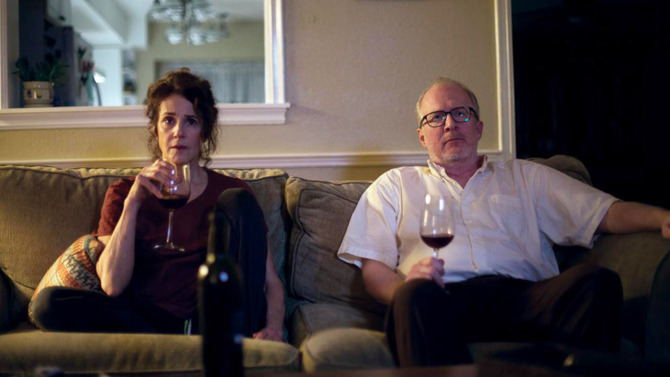
Tracy Letts and Debra Winger are both wonderful as Michael and Mary, a dispassionate husband and wife who have grown to give each other only slightly more regard than the pieces of furniture in their suburban home.
Lucy (Melora Walters) is impatiently waiting for Michael to ask for a divorce, while Robert (Aiden Gillen) is expecting the same from Mary. Both are assured the time will finally come after the upcoming visit from Michael and Mary’s son Joel (Tyler Ross).
But when an old spark is reignited, suddenly it’s the Mr. and Mrs. who are sneaking away from their side pieces for some passionate alone time.
Such a premise could easily crumble into sitcom-ready zaniness, but Jacobs isn’t mining for cheap laughs. His script does have moments of effectively dry humor, but The Lovers is just as likely to uncover truths through a heavy silence.
Both Letts and Winger effortlessly wear the weariness of their characters. We may not know exactly why they’ve drifted apart, but the actors convey such a reliable authenticity we are rooting for Michael and Mary almost immediately.
The Lovers is sneaky in its casual nature. Through subtle storytelling and stellar performances, it finds meaning in places rarely explored this effectively, and a gentle confidence that frayed emotions can still bond.
I remember the sweaty, battered face staring at me from the cover of Sports Illustrated in 1975, a face that had taken plenty of punches, and was lining up to take more at the hands of The Greatest.
It was face of Chuck “The Bayonne Bleeder” Wepner, who was about to fight Muhammed Ali in the old Richfield Coliseum near Cleveland – then a sparkling new jewel – for the heavyweight championship and inspire a young Sly Stallone to write a screenplay about “The Italian Stallion.”
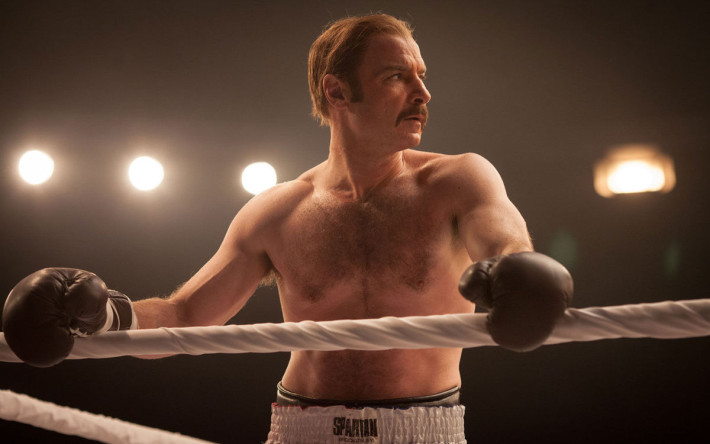
Chuck finally gets the story of the real-life Rocky on the screen, utilizing painful honesty, subtle humor and a compelling performance from Liev Schreiber to craft a touching look at hard lessons learned.
Director Philippe Falardeau (Monsieur Lazhar, The Good Lie) gets the 70s period details just right, and surrounds Wepner’s shot at the title with cinematic versions of the cliched boxer looking for his chance to be a contender, sharply illustrating how much Wepner defined all that is celebrated about life in the ring.
As Wepner claws his way to the New Jersey heavyweight championship, he watches 1962’s Requiem for a Heavyweight and longs for respect, even as he continually takes his wife (a terrific Elizabeth Moss) and daughter for granted while following his love for “wine, women and song.”
Besting all expectations, Wepner’s plan to “wear (Ali) down with my face” lasted into the 15h and final round, and he became one of the few opponents to actually knock Ali to the canvas. His increased celebrity status, and the news that the Oscar-winning Rocky was based on his life, only fueled Wepner’s primal urges and accelerated a downward spiral that included drugs, divorce, and fighting live bears.
Schreiber is transformational, adopting the voice, gait and body control of a lumbering man with a good heart and great survival instincts, but a child-like self control that often betrayed him. Schreiber commands the screen without ever being showy, blending easily with an outstanding supporting cast that includes Naomi Watts, Ron Perlman, Jim Gaffigan, Michael Rappaport and Morgan Spector (as Stallone).
Familiar in theme but illuminating with its intimacy, Chuck is a fascinating glimpse at life imitating art imitating life.
Did you hear about the lifeguards that fight crime?
“Wow, that sounds like a really entertaining but far-fetched TV show!”
So says Brody (Zac Efron), one of the new recruits on the super lifeguard team at Emerald Bay, and this very self-aware attitude is the main reason the big screen Baywatch works as well as it does.
Yes, the entire premise has always been a ridiculous excuse to ogle beautiful bodies, so director Seth Gordon (Horrible Bosses) wisely chooses to have some fun with that and not be stingy with the slo-mo!
Dwayne Johnson is Mitch, head of the Baywatch team and all-around King of the Beach. He’s got Stephanie (Ilfenesh Hadera) and C.J. (Kelly Rohrbach) as his veterans on the squad, while Summer (Alexandra Daddario) and Ronnie (Jon Bass) are rookies who just won their spots during open tryouts.
Then there’s Matt Brody (pinching his character name from two of the lead roles in Jaws is another clue this film’s tongue is in the right cheek), an Olympic swimmer nicknamed the “Vomit Comet” for the way his career flamed out thanks to gold medal partying.
Brody arrives thinking he’s God’s gift to Baywatch, quickly learns some humility, and joins the team just as they’ve stumbled onto another case. Could local business tycoon Victoria Leeds (Priyanka Chopra from TV’s Quantico) really be the biggest drug dealer on the beach?
And she might get away with it, too, if not for these lifeguards and their sexy meddling!
Writers Damian Shannon and Mark Swift come from the land of bad horror (Freddy vs. Jason, Friday the 13th reboot) but they’re able to tap into a witty and breezy R-rated vibe that tests some crude waters without ever diving in.
As often as the ladies flaunt buns and cleavage, Johnson and Efron’s suns out/guns out show gets even more attention, which seems only fair as their roles also have the most substance. It helps that the actors share an easy, likable chemistry and neither is above poking fun at their own image. Self-deprecation is usually endearing, and running gags involving Brody’s nicknames and a “mini-Mitch” aquarium decoration are consistent winners.
Hey, it’s summer, the perfect time for a trashy little novel to read by the pool. Baywatch fits that same bill, and ends up all the more fun for not trying to be anything else.