Click HERE and join us in The Screening Room this week to break down Baby Driver, The Beguiled, Despicable Me 3, The House, The Bad Batch and what’s new on home video!
Click HERE and join us in The Screening Room this week to break down Baby Driver, The Beguiled, Despicable Me 3, The House, The Bad Batch and what’s new on home video!
Land a’ goshen, the year’s half over already! How the F did that happen? Well, we’ve watched 161 films so far this year. Whew! Which have been the best? The new episodes of both Planet of the Apes and Spider-Man would’ve made the cut, but our judges said July releases didn’t count, so….let’s have a look at what did.
You want to know the fears and anxieties at work in any modern population? Just look at their horror films.
You probably knew that. The stumper then, is what took so long for a film to manifest the fears of racial inequality as smartly as does Jordan Peele’s Get Out – an audacious first feature that never stops entertaining as it consistently pays off the bets it is unafraid to make.
At the top of that list: do not go out at night.
But what are the dangers, and how much of the soul might one offer up to placate fear itself?
In asking those unsettling questions, It Comes at Night becomes a truly chilling exploration of human frailty.
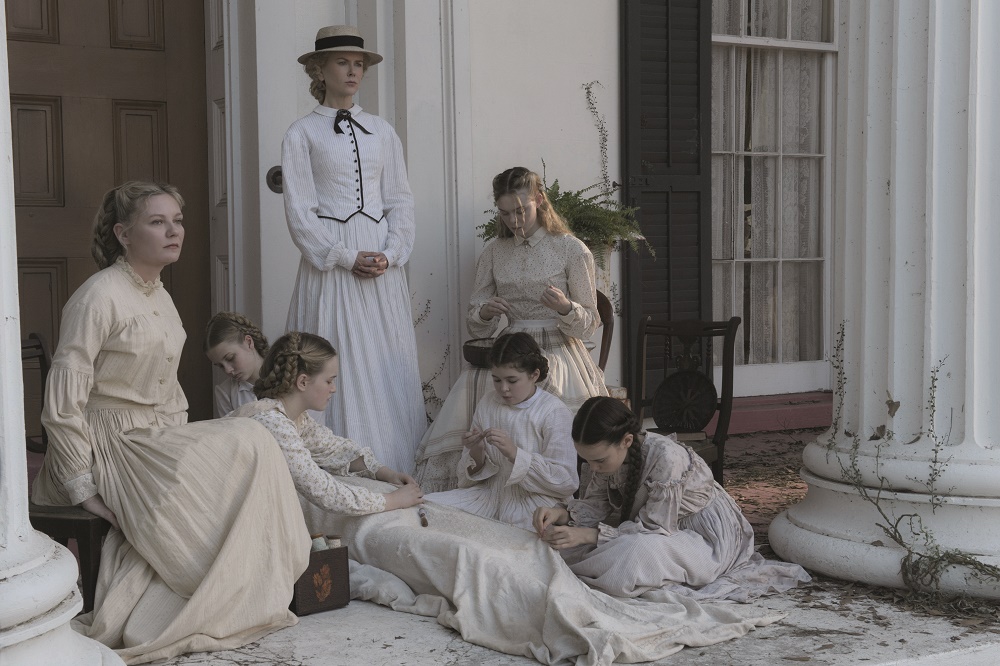
Snugly hidden near the fighting in Confederate territory, a girls’ school takes in a wounded Union soldier. Delicately shifting allegiances, power struggles, competition, longing, fear, and danger waft between the columns of Miss Farnsworth’s Seminary for Young Ladies.
Sofia Coppola develops a languid and ornate atmosphere, punctuated where necessary to create a sense of dread and urgency. Her cast is uniformly excellent, their commitment to character leading to a finale that’s as devastating as it is inevitable.
Bloody and bleak, tossing F-bombs and the franchise’s first flash of nudity, Logan is not like the other X-Men.
Logan relies on themes of redemption – a superhero’s favorite. Director James Mangold pulls ideas from Children of Men and Mad Max Beyond Thunderdome, but his film reminds me more of The Girl with All the Gifts. (If you haven’t seen it, you should.)
The point? The children are our future and Logan’s real battle has always been with himself. Almost literally, in this case.
Start to finish, the soundtrack-driven heist flick Baby Driver has a bright, infectious charm – and you can dance to it.
The beats offer more than a gimmick to ensure the flick dances along – the tunes getaway driver Baby (Ansel Elgort) has buzzing through his ear buds give rhythm to his impressive high speed antics.
The game cast never drops a beat, playing characters with the right mix of goofiness and malice to be as fun or as terrifying as they need to be. For all its danceability, Wright’s film offers plenty of tension, too.
No doubt, events get brutal, but never without reminders that Young is a craftsman. Subtle additions, such as airplanes flying freely overhead to contrast with the theme of captivity, give Hounds of Love a steady dose of smarts, even as it’s shaking your core.
https://www.youtube.com/watch?v=UNEurXzvHqE
Writer/director Julia Ducournau’s has her cagey way with the same themes that populate any coming-of-age story – pressure to conform, peer pressure generally, societal order and sexual hysteria. Here all take on a sly, macabre humor that’s both refreshing and unsettling.
It’s a performance that should not be forgotten come award season, and it anchors a smart, detailed film as compelling as any political thriller, yet as familiar as your last little white lie.
Blackcoat’s Daughter behaves almost the way a picture book does. In a good picture book, the words tell only half the story. The illustrations don’t simply mirror the text, they tell their own story as well. If there is one particular and specific talent this film exposes in its director, it is his ability with a visual storyline.
Pay attention when you watch this one. There are loads of sinister little clues to find.
The split personality trope has been used to eye-rolling effect in enough films to be the perfect device for writer/director M. Night Shyamalan’s clever rope-a-dope. By often splitting the frame with intentional set designs and camera angles, or by letting full face close-ups linger one extra beat, he reinforces the psychological creepiness without any excess bloodshed that would have soiled a PG-13 rating.
The noteworthy fact about Free Fire is not that it has a ballsy first act, but that the entire film is a third act. With scarcely a word of context, we’re rolled into an empty warehouse just in time for a shootout to begin, and there we will stay until the film concludes.
There is a barely controlled, very funny, incredibly bloody chaos afoot here, and it is a wild and entertaining sight to behold.
Perhaps best of all is how Colossal works out of the conceptual corner it backs into. Much like the Koreans who keep coming downtown no matter how often the monster appears, Vigalondo is committed to the end, delivering a strange but satisfying in-the-moment fable.
The Lovers is sneaky in its casual nature. Through subtle storytelling and stellar performances, it finds meaning in places rarely explored this effectively, and a gentle confidence that frayed emotions can still bond.
No, Volume 2 can’t match the ruffian charm of the first, and there are some stretches of not-much-happening-here. But James Gunn’s sequel shares a lot of heart, swashbuckling visuals and more than a few solid belly laughs.
by George Wolf
It’s a simple formula, really: D = sO2.
A comedy’s desperation is equal to the speed at which the outtakes start rolling, squared. Which means The House is mighty desperate to send you home laughing.
There’s plenty of talent involved, but it’s a film held together with barest of threads, as if the prompt for writers Andrew Jay Cohen and Brendan O’Brien (from the very funny Neighbors films – so what gives?) was merely to round up some funny people and hope they do funny things.
Will Ferrell and Amy Poehler are certainly funny, and they star as Scott and Kate Johansen, who start to panic when their daughter Alex (a curiously bland Ryan Simpkins) is accepted to Bucknell University.
They can’t afford Bucknell University.
Teaming up with their crazy, Vegas-loving friend Frank (Jason Mantzoukas) the Johansens open a secret neighborhood casino, kicking off a wave of uninspired riffs on stuffy suburbanites acting all Soprano and shit.
Cohen, making his feature directing debut, leaves plenty of contrived loose ends behind in search of the next forced gag. Fred and Barney may have pulled off a similar premise for 23-minutes in an old Flintstones episode, but The House is built on a less than sturdy foundation.

by George Wolf
I’ll be honest, it took a little research before I remembered anything at all about Despicable Me 2 that wasn’t a minion.
And even when those little yellow scene-stealers got their own movie, the result was surprisingly mediocre.
The entire franchise has been memorable only for being so easily forgettable. So how’s part 3?
It’s fine.
Steve Carell returns as the voice of Gru, the super villain-turned good guy who’s now teamed up with wife Lucy (Kristen Wiig) for double the secret agent heroics. And, their three adopted daughters are back to say “fluffyyyyyyyyy!’ and other adorable things.
The family ties get more tangled when Gru meets his long lost twin brother Dru (also Carell), who convinces him to return to the dark side and steal a massive diamond from an 80s-obsessed baddie named Balthazar Bratt (South Park‘s Trey Parker).
The writing and directing teams are full of animation vets who have been at least some part of every film in this franchise, so it’s little wonder DM3 can’t find ways to revitalize the brand. It doesn’t really want to.
While all the films have been pleasantly amusing, part 3 may actually land the greatest number of solidly funny gags. The “minions in prison” sequence is an inspired hoot, and an 80s dance-off between Gru and Bratt keeps silly going long enough for a decent payoff.
But again, while the latest Despicable Me will satisfy the kids with its frenetic zaniness and give the parents some escapist smiles, it might raise a question once part 4 comes calling.
“Which one had the twin brother again?”

Oh, the bounty that is home entertainment this week! Loads of stuff – most of it mediocre – but one brand spanking new option that kicks all manner of ass.
Here’s what you can find in new home entertainment. Click the title for a complete review. And as always, please use this information for good, not evil.


Want to watch something at home? Wow – there’s one thing this week. One. But rest easy – there are like a million things next week, so we’ll just fixate on this one today and then next Tuesday, we’ll have the energy.
Here’s what you can find in new home entertainment. Click the title for a complete review. And as always, please use this information for good, not evil.
This week in The Screening Room, we discuss Cars 3, 47 Meters Down, All Eyez on Me, Rough Night, and the new releases on home video. CLICK HERE to join us!
by George Wolf
After being woven through films such as Notorious and Straight Outta Compton, the life of Tupac Shakur finally gets its own treatment in All Eyez on Me, an earnest biopic ultimately too comprehensive for its own good.
Demetrius Shipp, Jr., boasting an uncanny resemblance in an electric screen debut, captures Tupac’s fire and swagger, while Danai Gurira (The Walking Dead, Mother of George) is ferociously compelling as Tupac’s mother (and former Black Panther) Afeni Shakur. Their scenes together consistently deliver the emotional heft lacking elsewhere.
Director Benny Boom, a veteran of music video and television projects, is committed but becomes waylaid with an unfocused meandering.
After a promising start fleshing out the drive and outrage that sprung from Shakur’s upbringing, Boom and his writing team get bogged down with a scope more dutiful than effective. In an effort to tell as much of Tupac’s story as possible, All Eyez on Me loses the chance to show us the depth that made him an icon.
https://www.youtube.com/watch?v=6VC0aSPfyQk
by George Wolf
As great as the Disney/Pixar lineup is -and it’s pretty great- the Cars franchise sits low in the batting order, especially after the debacle that was Cars 2 six years ago. Cars 3 rebounds nicely, but still can’t match the meaningful substance of Pixar’s best.
We catch up with legendary race car Lightning McQueen (voiced by Owen Wilson) in a changing sports world. Suddenly, a new generation of “NextGen” cars, led by rookie sensation Jackson Storm (Armie Hammer), is taking over. New team owner Mr. Sterling (Nathan Fillion) brings in a young trainer named Cruz (Cristela Alonzo) to get McQueen adapted to the new technology, but her “senior project” only fuels the feeling that the legend should stay in the garage for good.
Animation vet Brian Fee helms his first feature as director/co-writer with Cars 3, and while the visual style is characteristically luscious, the story that he’s telling never quite rises above the pleasantries of showing kids some talking cars and introducing a new line of tie-in merchandise.
The gags are amusing but seldom funny and the plot takes some turns that may confuse the young ones, but the bigger concern is what’s missing.
As Cruz reveals her true love is not training but racing, and McQueen reflects on his tutelage under Doc (Paul Newman), the movie has the chance to find the poignancy and resonance that has driven Pixar’s most touching classics.
You’ll find it in Lou, the Pixar short the runs before the feature.
Alas, Cars 3 drives on by, satisfied with “believe in yourself” mantras that are greeting card ready, and a first-place trophy for the cheerfully harmless.
A ripe topic for the genre, serial killers. There’s not much more terrifying than that. And while most films on that theme tend to be police procedurals, plenty of horror movies contend with that loner who thirsts for his (or her) next kill.
Some are done with humor – The Greasy Strangler and Sightseers among the best. Some (Peeping Tom, for instance) give us sympathetic villains. Some (Wolf Creek among them) do not. Others exploit the killers’ exploits for the sake of exploitation. We’re looking at you, Man Bites Dog and The Last Horror Movie.
All those mentioned above are required viewing, but what are the best of the best? Glad you asked!
In 2001, actor Bill “We’re toast! Game over!” Paxton took a stab at directing the quietly disturbing supernatural thriller Frailty.
Paxton stars as a widowed dad awakened one night by an angel – or a bright light shining off the angel on top of a trophy on his ramshackle bedroom bookcase. Whichever – he understands now that he and his sons have been called by God to kill demons.
Whatever its flaws – too languid a pace, too trite an image of idyllic country life, Powers Boothe – Frailty manages to subvert every horror film expectation by playing right into them. We’re led through the saga of the serial killer God’s Hand by a troubled young man (Matthew McConaughey), who, with eerie quiet and reflection, recounts his childhood with Paxton’s character as a father.
Dread mounts as Paxton drags out the ambiguity over whether this man is insane, and his therefore good-hearted but wrong-headed behavior profoundly damaging his boys. Or could he really be chosen, and his sons likewise marked by God?
Brent Hanley’s sly screenplay evokes nostalgic familiarity, and Paxton’s direction makes you feel entirely comfortable in these common surroundings. Then the two of them upend everything – repeatedly – until it’s as if they’ve challenged your expectations, biases, and your own childhood to boot.
Min-sik Choi (Oldboy) plays a predator who picks on the wrong guy’s fiancé.
That grieving fiancé is played by Byung-hun Lee (The Magnificent Seven), whose restrained emotion and elegant good looks perfectly offset Choi’s disheveled explosion of sadistic rage, and we spend 2+ hours witnessing their wildly gruesome game of cat and mouse.
Director Jee-woon Kim (A Tale of Two Sisters) breathes new life into the serial killer formula. With the help of two strong leads, he upends the old “if I want to catch evil, I must become evil” cliché. What they’ve created is a percussively violent horror show that transcends its gory content to tell a fascinating, if repellant, tale.
Beneath the grisly violence of this unwholesome bloodletting is an undercurrent of honest human pathos – not just sadism, but sadness, anger, and the most weirdly dark humor.
If you can see past the outrageously violent images onscreen, you might notice some really fine acting and nimble storytelling lurking inside this bloodbath.
A giddy hatchet to the head of the abiding culture of the Eighties, American Psycho represents the sleekest, most confident black comedy – perhaps ever. Director Mary Harron trimmed Bret Easton Ellis’s novel, giving it unerring focus. More importantly, the film soars due to Christian Bale’s utterly astonishing performance as narcissist, psychopath, and Huey Lewis fan Patrick Bateman.
There’s an elegant exaggeration to the satire afoot. Bateman is a slick, sleek Wall Street toady, pompous one minute because of his smart business cards and quick entrance into posh NYC eateries, cowed the next when a colleague whips out better cards and shorter wait times. For all his quest for status and perfection, he is a cog indistinguishable from everyone who surrounds him. The more glamour and flash on the outside, the more pronounced the abyss on the inside. What else can he do but turn to bloody, merciless slaughter? It’s a cry for help, really.
Harron’s send up of the soulless Reagan era is breathtakingly handled, from the set decoration to the soundtrack, but the film works as well as a horror picture as it does a comedy. Whether it’s Chloe Sevigny’s tenderness as Bateman’s smitten secretary or Cara Seymour’s world wearied vulnerability, the cast draws a real sense of empathy and dread that complicate the levity. We do not want to see these people harmed, and as hammy as it seems, you may almost call out to them: Look behind you!
As solid as this cast is, and top to bottom it is perfect, every performance is eclipsed by the lunatic genius of Bale’s work. Volatile, soulless, misogynistic and insane, yet somehow he also draws some empathy. It is wild, brilliant work that marked a talent preparing for big things.
Henry offers an unforgivingly realistic portrayal of evil. Michael Rooker is brilliant as serial killer Henry (based on real life murderer Henry Lee Lucas). We follow him through his humdrum days of stalking and then dispatching his prey, until he finds his own unwholesome kind of family in the form of buddy Otis and his sister Becky.
Director John McNaughton’s picture offers a uniquely unemotional telling – no swelling strings to warn us danger is afoot and no hero to speak of to balance the ugliness. He confuses viewers because the characters you identify with are evil, and even when you think you might be seeing this to understand the origins of the ugliness, he pulls the rug out from under you again by creating an untrustworthy narrative voice. His film is so nonjudgmental, so flatly unemotional, that it’s honestly hard to watch.
What’s diabolically fascinating, though, is the workaday, white trash camaraderie of the psychopath relationship in this film, and the grey areas where one crazy killer feels the other has crossed some line of decency.
Rooker’s performance unsettles to the bone, flashing glimpses of an almost sympathetic beast now and again, but there’s never a question that he will do the worst things every time, more out of boredom than anything.
It’s a uniquely awful, absolutely compelling piece of filmmaking.
https://www.youtube.com/watch?v=IU3P6WXzvXU
It’s to director Jonathan Demme’s credit that Silence made that leap from lurid exploitation to art. His masterful composition of muted colors and tense but understated score, his visual focus on the characters rather than their actions, and his subtle but powerful use of camera elevate this story above its exploitative trappings. Of course, the performances didn’t hurt.
Hannibal Lecter ranks as one of cinema’s scariest villains, and that accomplishment owes everything to Anthony Hopkins’s performance. It’s his eerie calm, his measured speaking, his superior grin that give Lecter power. Everything about his performance reminds the viewer that this man is smarter than you and he’ll use that for dangerous ends.
But it’s Ted Levine who goes underappreciated. Levine’s Buffalo Bill makes such a great counterpoint to Hopkins’s Lecter. He’s all animal – big, lumbering, capable of explosive violence – where Lecter’s all intellect. Buffalo Bill’s a curiously sexual being, where Lecter is all but asexual.
Demme makes sure it’s Lecter that gets under our skin, though, in the way he creates a parallel between Lecter and Clarice Starling (Jodie Foster). It’s Clarice we’re all meant to identify with, and yet Demme suggests that she and Lecter share some similarities, which means that maybe we share some, too.