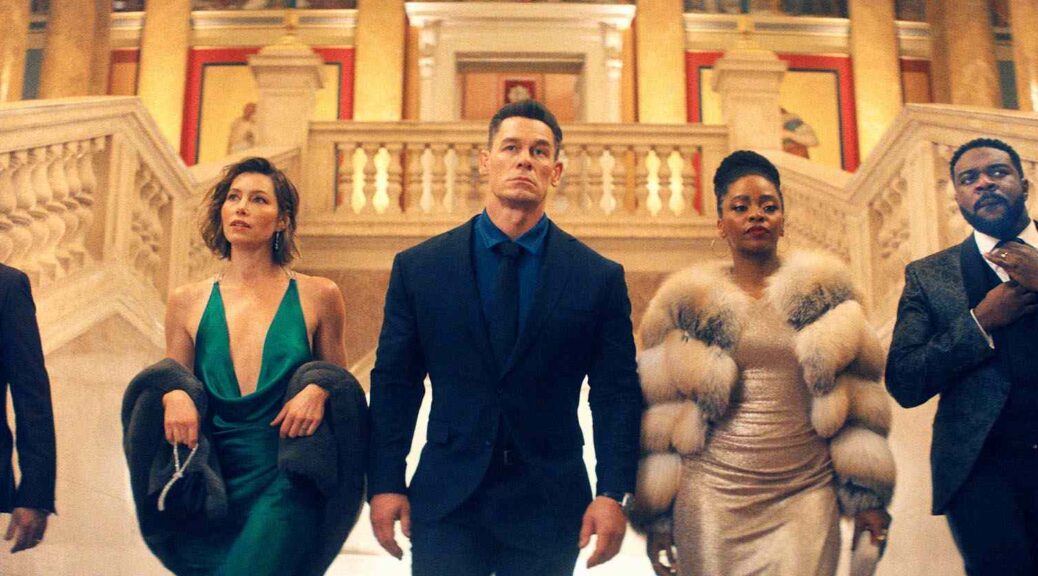
Well, that’s a stretch. And remember, Jaws is a shark movie, but so is Sharktopus.
Apple TV’s Matchbox isn’t sharkspoitation bad. In fact, if you just hang with its overlong runtime, the film finds an unabashed cornball groove that will bring both smiles and eye-rolls.
The title only refers to the fact that a group of middle school friends were Matchbox enthusiasts back in the day. Now, decades later, one of those friends is a secret agent while the rest stayed in small-town Ohio.
But after completing a dangerous spy mission for his boss (Danai Gurira), Sean (John Cena) goes back home to pay last respects to an old mentor. After sharing beers with the old Matchbox gang, they’re all drugged and pulled into a globe-trotting chase for a stolen bomb.
Good thing that Aimee (Jessica Biel), Ted (Arturo Castro), Crosby (Sam Richardson) and Charmaine (Teyonah Parris) all have skills that come in mighty handy in a save-the-world scenario. Director Sam Hargrave (the Extraction films) puts his action skills to work for a minor league True Lies that keeps a kid-friendly feel despite all the violence and explosions.
Why this is over two hours I don’t know, but everyone in this likable cast seems to be having a good bit of fun. Cue it up with a few cold ones after the kids go to bed, and Matchbox: The Movie should give you a bit of fun, too.
Expect some groans, as well, but that’s what the beer’s for.
Ryan Coogler’s stunning first feature, 2013’s Fruitvale Station, proved his instincts as a storyteller. It also made apparent the force of nature that is Michael B. Jordan. That the two could go on just two years later to craft the fresh and vibrant Creed from the tired Rocky franchise showed that the blockbuster was as much in their mastery as the indie drama.
But a Marvel superhero action flagship? That’s Big. Big budgets. Big canvas. And with Black Panther, big expectations. Are Coogler and Jordan up to the challenge?
Hell yes.
Just when you’ve gotten comfortable with the satisfying superhero origin story at work, director/co-writer Coogler, co-star Jordan and the stellar ensemble start thinking much bigger. And now, we need to re-think what these films are capable of.
The action—whether air battles, hand-to-hand or via car chase—is breathtaking.
Wielding a palette of colors and visuals unseen to this point inside the MCU—this set design is glorious, situating a SciFi tech metropolis easily within a world that still embraces ancient tradition, an isolated world that evolved in its own course rather than being led by the evolution of the world outside. Wakanda looks unlike anything we’ve seen in the Marvel Universe or any other.
Not a minute of the film is wasted. Coogler manages to pack each with enough backstory, breathless action, emotional heft and political weight to fill three films.
The cast shines from the top down, but there are some stand-outs.
Chadwick Boseman, all gravitas and elegance, offers the picture perfect king—one who’s respectful of tradition yet still ready to open his eyes to the plight of his brothers outside his hidden nation of Wakanda.
Side note: is there anyone more effortlessly badass than Danai Gurira? Trick question, there is no question—the answer is no. And though she has remarkable range (if you haven’t seen her 2013 indie Mother of George, give yourself that gift today), her General Okoye is here for the beat down.
Lupita Nyong’o is also characteristically excellent in the role of the conscience-driven liberal. In a scene where she expects Gurira’s general to commit what amounts to treason, Coogler expertly reinforces an amazingly well-crafted theme mirrored in other pairings: the friction between surviving by force or by conscience.
This theme is most clearly outlined by the conflict between Boseman’s King T’Challa and his new nemesis, Jordan’s Killmonger.
Michael B. Jordan, people.
Coogler hands this actor all of the most difficult lines. Why? Because it is material a lesser actor would choke on, and Jordan delivers like a perfectly placed gut punch. He sets the screen on fire, and though every single performance in this film is excellent, Jordan exposes the artifice. His castmates are in a Marvel superhero movie. Jordan is not. Instead, he is this rage-filled, broken, vengeful man and he is here to burn this world to the ground.
His scenes with Boseman provide a cunning twist on the battle between a struggling hero and his evil twin. Usually a tired staple of sequeldom, BP adds an undercurrent of Shakespearean drama to the inevitable showdown of two characters who could easily represent the dueling inner conflict of one.
Coogler works with many of these basic themes found in nearly any comic book film—daddy issues, becoming who you are, serving others—but he weaves them into an astonishing look at identity, radicalization, systemic oppression, uprising and countless other urgent yet tragically timeless topics. The writing is layered and meaningful, the execution visionary.
Blistering social commentary, brilliant escapist fantasy, eye-popping visual wonder—Black Panther has it all.
After being woven through films such as Notorious and Straight Outta Compton, the life of Tupac Shakur finally gets its own treatment in All Eyez on Me, an earnest biopic ultimately too comprehensive for its own good.
Demetrius Shipp, Jr., boasting an uncanny resemblance in an electric screen debut, captures Tupac’s fire and swagger, while Danai Gurira (The Walking Dead, Mother of George) is ferociously compelling as Tupac’s mother (and former Black Panther) Afeni Shakur. Their scenes together consistently deliver the emotional heft lacking elsewhere.
Director Benny Boom, a veteran of music video and television projects, is committed but becomes waylaid with an unfocused meandering.
After a promising start fleshing out the drive and outrage that sprung from Shakur’s upbringing, Boom and his writing team get bogged down with a scope more dutiful than effective. In an effort to tell as much of Tupac’s story as possible, All Eyez on Me loses the chance to show us the depth that made him an icon.
Mother of George is a stylish, visual feast, a film steeped in cultural traditions surviving in the modern world, and the universal anguish over complicated life choices.
Isaach De Bankole (The Limits of Control) and Danai Gurira (The Walking Dead) are both excellent as, respectively, Ayodele and Adenike, a Nigerian couple living in Brooklyn. At their wedding, Ayodele’s mother proclaims the couple’s first son will be named George, a responsibility that weighs heavily on Adenike as the months pass without a pregnancy to announce.
Family and friends present homemade solutions such as fertility blessings and traditional teas, but the situation grows dire. Finally, Adenike”s mother-in-law offers her a shocking solution.
Director Andrew Dosunmu, blessed with the sublime cinematography of Bradford Young, often keeps his camera still, letting the characters move in and out of frame, while embracing the vibrant colors ever present in the traditional garments and in other neighborhood surroundings. As Ayodele and Adenike continue their attempts at conceiving a child, Dosunmu bathes the lovers in a tender, sensual tableau.
The script, a first from playwright Darci Picoult, is often understated and poetic, but eventually turns to moments of melodrama and contrivance as Adenike becomes more desperate to please her husband and extended family.
Those moments aside, Mother of George is a lush, richly visual work from a director who shows much potential for originality.