Tag Archives: entertainment

Pika Pika

Pokémon Detective Pikachu

by Hope Madden

When my son was small and we played pretend, I made believe I was Snorlax so I could lay on the couch and do nothing. Does that make me a bad parent? Well, a lazy one, anyway, but the point is, I logged countless hours on that couch watching all manner of pocket monster.

I was dragged unwillingly into the world of Pokémon. No, I am not exactly the target audience for Pokémon Detective Pikachu (read: I am in no way the target audience for this movie). But, when Pikachu (voiced by Ryan Reynolds at his Ryan Reynoldsiest) says, “Mr. Mime is the worst,” I know enough to understand that shit’s the truth.

So, there is a plot. It involves loads upon loads of daddy issues, primarily (but not exclusively) those that hang over Tim Goodman (Justice Smith). In looking for his father he falls into a mystery involving a Pikachu who is not only adorable (he admits as much himself at least twice), but is also connected to Tim. Tim can understand him.

For the uninitiated, Pokémon just repeat their own names over and over and over again in a manner that makes you want to take your own life, and yet you tolerate it because you really do love your son.

But not this Pikachu! Sure, others can only hear his cute “pika pika,” but Tim can hear actual words, and those words are telling Tim, in a humorously snarky way, that he needs to unravel this mystery and work on his interpersonal skills.

Bill Nighy shows up as an entrepreneur/philanthropist/genius. Meanwhile, Ken Watanabe languishes with bafflingly limited screen time as a detective who is, let’s be honest, not very good at his job.

Kathryn Newton is a plucky would-be investigative journalist, her trusty Psyduck in tow. (Note: Psyduck is also the worst.)

Part of the entertainment value here is the genuine fondness for the content director Rob Letterman and his army of screenwriters bring to the table. Good looking CGI, committed performances and a solidly comedic but not too ironic tone also help.

The film doesn’t shoot over the heads of the youngest fans, does embed scads of references and homages for those there for nostalgia, and throws around enough kid-friendly Reynoldsisms to entertain parents who mercifully missed out on Pokémon Gen 1 and 2.

Is it a colossal waste of Ken Watanabe’s talent? Oh God, yes. Terrible.

But honestly, otherwise I don’t have a lot of complaints.

Gimme an A! A! R! P!

Poms

by Christie Robb

At a time when movies are pushing three hours, it feels weird to want one to run longer, but at just over an hour and a half, Poms feels way too short. It’s like a long SNL sketch.

A female-centric comedy about a retired teacher aching for one last shot at her childhood dream of becoming a cheerleader seems like a good option for Mother’s Day weekend—especially for the Boomers and their kids. The cast looks solid: Diane Keaton, Jacki Weaver, Pam Grier, and Rhea Perlman. Poms coming “from the studio that brought you Bad Moms” appears promising.

But it’s all just perfunctory.

Director Zara Hayes and writer Shane Atkinson, both TV veterans making feature debuts, introduce characters via montage and then give them little to do or say.

People become strange antagonists, set on denying the senior cheerleading squad practice/performance time for no discernible reason. Folks burst into tears or have 180 degree shifts in perspective simply because the plot demands it.

Still, Keaton’s performance of a woman striving to live in the moment while hiding terminal cancer is effective. The chemistry between Keaton’s snarky Martha and Jacki Weaver’s bubbly Sheryl is cute. And when they are performing, the women look like they are having a nice time.

You just wish that there was more of a story there, more character development, more cheerleading even. The cast is way too good for this.

Charlie’s Angels

Charlie Says

by Hope Madden

It’s been 50 years since Charles Manson and his family effectively terminated the 1960s. Filmmaker Mary Harron (American Psycho) joins Daniel Farrands and Quentin Tarantino in commemorating the anniversary.

Earlier this year, Farrands unleashed the grim and quickly forgotten The Haunting of Sharon Tate, while Tarantino’s next likely cultural phenomenon, Once Upon a Time in Hollywood,  promises to shine some of its spotlight on the Manson family crimes as well.

Harron’s film, Charlie Says, follows Leslie Van Houton (Hannah Murray), Susan Atkins (Marianne Rendon) and Patricia Krenwinkle (Sosie Bacon), three years after their incarceration, as they reflect on Manson’s promises and their own actions.

The aptly titled film is as concerned with the women’s brainwashing as it is the crimes themselves, although it unfortunately provides no real insight into either.

Harron spends about half the film in the California Women’s Correctional Facility, where the trio is taught by dedicated grad student Karlene Faith (Merritt Wever, portraying the author of the book that inspires the film).

The eerie chorus of “Charlie says…” greets nearly every question Wever lobs at her students, which generally spurs a flashback to time on the ranch with Charlie (Matt Smith).

Here we hit a snag, because Smith lacks the charisma, the hatred, the ugliness or the psychotic aura to pull of Manson. He is never terrifying, never seductive—never convincing.

In fact, most of the flock lacks the weather beaten conviction we recognize from police tapes. The period detail and tone lack degrees of authenticity as well.

Harron’s film opens strong, but it quickly loses its footing and never really finds it again. Working from Guinevere Turner’s screenplay, Harron brings up some interesting themes—particularly questioning the point of breaking through to these women, knowing that puncturing their fantasies only means their clear-eyed horror whether looking backward or forward.

But she doesn’t really land any punches. The film never feels particularly queasying, especially enlightening or even very memorable.

I guess we still have Tarantino. Or maybe it’s just time we all moved on and stopped obsessing over what Charlie had to say.

Hello Dolly

UglyDolls

by Hope Madden

We open on what is essentially the Island of Misfit Toys. This is the moment when the adults in the UglyDolls audience need to make a choice: accept these notions stolen from far superior toy-related children’s fare as homages, or bristle at inferior product skating by on copy-catting.

It’s your choice, but your kids will mainly see a perfectly sweet, upbeat and unimaginative tale of an ugly duckling. Even better, an ugly duckling who doesn’t need to become a swan to be happy.

That duck, or that blobby pink thing, is Moxy (voiced by Kelly Clarkson). And she lives happily in Uglyville with other merrily misshapen beasties (Wanda Sykes, Blake Shelton, Pitbull, Leehom Wang, Gabriel Iglesias). But Moxie yearns for more.

On a songtastic adventure to fulfill her dream, Moxy and gang run afoul of the pretty dolls, whose leader, Lou (Nick Jonas) intends to keep them from finding the boy or girl who will love them.

Will that stop Moxy? No! She yearns for her very own Andy.

I feel safe in saying that because there’s no question director Kelly Asbury (Shrek 2) and screenwriter Alison Peck (working with characters created by Su-min Kim and David Horvath) have seen Toy Story.

Man, that was a good movie, eh? The whole series, actually. In fact, there’s one scene in Toy Story 3 that made me cry harder than any scene in any film ever. It obviously made an impact on Asbury and Peck as well, because it is lifted shamelessly for the emotional climax of UglyDolls.

When it’s not distracting you with its borderline plagiarism, UglyDolls is sledgehammering its theme. Janelle Monáe voices Mandy, a pretty doll who might be ugly deep down (a good thing). She helps beat the point home that we do not need to conform to be happy. Which is a great theme, and one that a well-made film (like, say, Shrek) can deliver without losing sight of storytelling.

The big screen leap for these critters amounts to a sweetly mediocre marketing strategy for some unattractive (but lovable!) toys.

Run Through It

The River and the Wall

by Rachel Willis

Director Ben Masters has an interest in the land along the Rio Grande. In making The River and the Wall, he hopes to show us what makes the area so special.

Along with four companions – two wildlife filmmakers, an ecologist/ornithologist, and a Rio Grande river guide – Masters embarks on a weeks-long, 1200-mile trip from El Paso, Texas to the Gulf of Mexico. They travel along the Rio Grande, the potential site of a border wall that, if erected, would have a lasting, devastating impact on the land.

Most of the film screens like an adventure tale. The companions travel by mountain bike and mustang in places where the river is too shallow for boats. When the river is passable, they journey by canoe. By making the trip in this way, they hope to show the difficulty of the journey in numerous places. It’s an imperfect attempt to emphasize the unlikelihood that immigrants would choose these routes when attempting to cross into the United States.

Along the way, we meet people on both sides of the border. If there are people who live in these areas who are in favor of the wall, Masters and team don’t meet any. From people living in Mexico to ranchers in Texas, everyone recognizes the potential negative consequences to the proposed wall. Even the area U.S. representatives in Congress, Beto O’Rourke, a Democrat, and Will Hurd, a Republican, are opposed to the wall. Hurd states that building a wall “is the most expensive, least effective” method for border security. It’s a rare show of bipartisanship that should give those opposed to the wall some hope.

The cinematography is essential in a film that wants to impart upon the audience the beauty, vastness, and treachery of the land, and the crew is up to the challenge. Numerous shots highlight the diversity of the landscape as the five friends make their way along the river.

In some ways, The River and the Wall effectively states its case that the area around the Rio Grande should be protected. Ecologist Heather Mackey mentions over 150 bird species live in the area, some of which are only located in this area. A wall would disrupt migration patterns, bulldoze protected natural areas, and in effect, cede nearly 1 million acres of U.S. land to Mexico.

However, it is unlikely the film will change the minds of those in favor of the wall. Most likely because they won’t even bother to see it.


I’ll Be You

JT LeRoy

by Hope Madden

Do you remember the JT LeRoy hubbub? Maybe you confuse it with the similar hullaballoo surrounding James Frey, author of A Million Little Pieces, the memoir that turned out to be highly fictional?

Please don’t. LeRoy’s bizarre fake nonfiction and ensuing scandal is so much more interesting.

Jeremiah Terminator LeRoy is a hoax perpetrated on an almost grotesquely willing public. Laura Albert, a frustrated writer, master manipulator and likely sufferer of mental health issues, invented LeRoy.

More than the nom de plume used to pen Sarah and The Heart Is Deceitful Above All Things, LeRoy became Albert’s literary persona. Albert herself didn’t exist in this world. She became LeRoy, the writer of lurid “autobiographical” pieces that, together with a mysterious nature, won the hearts of readers, media and celebrities alike.

In fact, Jeremiah Terminator LeRoy became so popular that he had no choice but to show his nonexistent face.

Enter Albert’s sister-in-law, Savannah Knoop.

The weird true-life tale of LeRoy’s fake-life tale has been documented twice in works of nonfiction (the documentaries The Cult of JT LeRoy and Author: The JT LeRoy Story, both worth viewing). Director Justin Kelly is the first to make fiction of the fiction with his aptly cast film, J.T. LeRoy.

Though the film doesn’t offer a great deal of insight beyond what you can glean from the two documentaries, it takes Knoop’s point of view for a refreshing change of pace. But its real strength is the film’s cast.

Kristen Stewart makes the ideal choice to play Savanna/JT. Effortlessly androgynous, moody, sensual and conflicted, Stewart gives the character a vulnerable center, balancing Knoop’s motivation between a sense of duty to Albert and a personal longing for artistic expression.

Naturally, Laura Dern shines, stealing scenes and oscillating between free spirit and opportunist. She does a fine job of illustrating Abbot’s view of creating this other personality who can take on her own pain, can amplify that pain and turn it into both an escape and art. At the same time, Dern’s the schemer, the survivor manipulating those around her. It’s interesting the way the veteran character actor weaves between artist and manipulator in a context that questions the difference between fiction and fraud.

The two leads become a great point/counter point and the film is strongest in their shared scenes. When JT wanders off alone, burdened by puppy love or struggling to keep up a persona of another’s creation, a certain spark goes out.

That’s not to say that the balance of the cast falters. Diane Kruger is particularly slippery as Eva, a thinly veiled version of Asia Argento. But as intriguing as her interplay is with JT, you miss the constant push and pull of wills when Stewart and Dern work off each other.

https://www.youtube.com/watch?v=w_UdqhTF9Fo

All In

Family

by Hope Madden

On occasion, film reps send us links to preview their film for review. Often, these links are password protected. Once, the password was bouncehouse.

Yes, please.

The film in question is called Family, writer Laura Steinel’s directorial debut, and it plays like a fun update of Uncle Buck with Juggalos.

That’s right!

We open on an uptight executive sprinting, face painted, through an Insane Clown Posse gathering and reflecting, “It’s kind of like a fun county fair where you could also, potentially, be stabbed.”

That reflective exec is Kate, and Kate is maybe Taylor Schilling’s best cinematic character. She takes to Steinel’s dialog with a flat affect that’s entirely, awkwardly enjoyable.

Kate is Uncle Buck, basically. Only she’s not. She’s a driven businessperson who actually got where she is because she has literally nothing else in her life to draw her attention or energy. And then she has to babysit her 11-year-old niece Maddie (Bryn Vale, spot on) and next thing you know—right, life lessons. We’re all familiar with the John Hughes handbook, but Steinel updates it with less schmaltz and more belief in nonconformity. And juggalos.

When Maddie says, “Magic is my passion,” I had to hit pause because I was afraid my snorting would drown out the next piece of comedy gold.

There are problems with Family (besides that inanely generic title). It is funny, and its comical scenes are delivered by an entirely winning cast (which includes the unreasonably hilarious Kate McKinnon and the unreasonably talented Brian Tyree Henry). That’s not the problem.

Steinel also inverts and subverts the tropes of the genre. There are two upended “makeover” scenes that are both funny and insightful. It’s also just a savvy look at being socially awkward.

No, the problem here is that the many colorful and fun scenes are strung together more than they are foundational to a whole. And the keen insight Steinel uses to sharpen individual jokes softens when the time comes to finish the story.

She John Hugheses it.

But a well-placed “sorry for your loss” is surprisingly funny and there are at least a dozen scenes here that I kind of love. Family is smart, R-rated comedy that ultimately caves to the pressure to conform, but its struggle to be itself is laudable.

Plus, those juggalos. They have hearts of gold.

PS, this is what all my sisters thought I would be like as a parent. And I wasn’t. Entirely.

https://www.youtube.com/watch?v=M7_oMbzymUA

Screening Room: La Llorona, Penguins, Breakthrough, Amazing Grace & More

Damn, there are lot of movies to talk about this week. Join the conversation about The Curse of La Llorona, Amazing Grace, Hagazussa, Little Woods, Peterloo, Stuck, Penguins, Breakthrough, Teen Spirit and everything new in home entertainment. Whew!

Listen to the full podcast HERE.

The Mancunian Candidates

Peterloo

by Matt Weiner

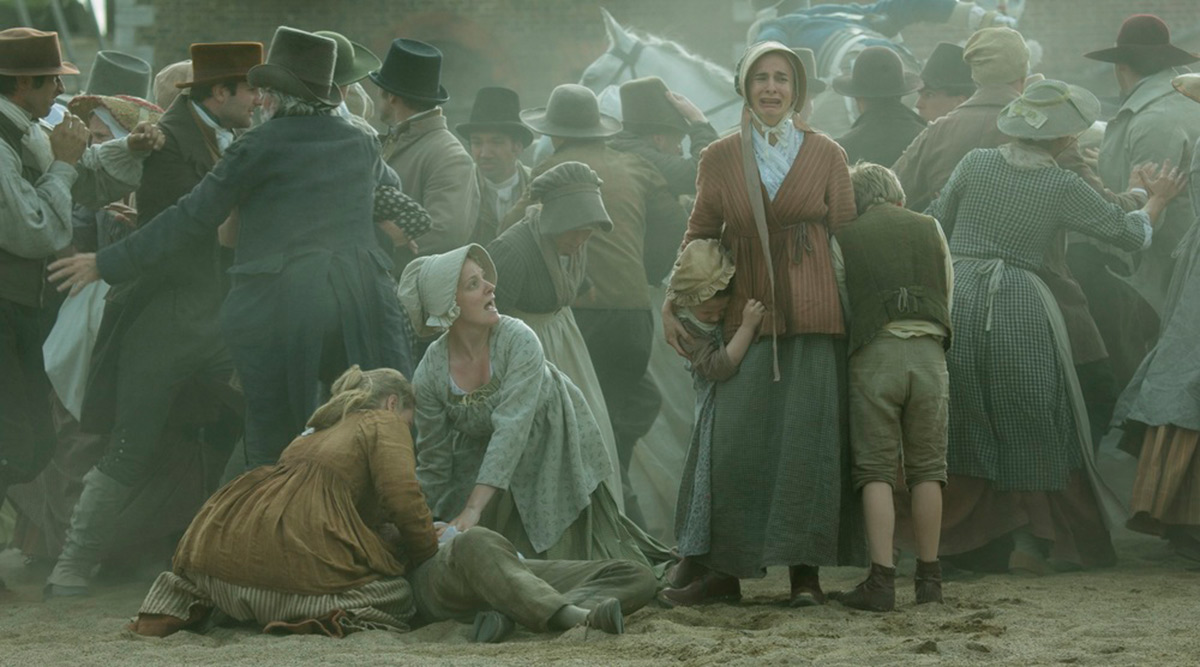
It should be a match made in heaven: British director Mike Leigh channeling an uprising that pitted reactionary government leaders against a working-class population with radical demands for reform.

And for a historical drama that revolves around grain tariffs as a pretty important plot point, Leigh succeeds on one key front: Peterloo abounds with righteous indignation, from start to finish. This comes at the cost of Leigh’s usual nuanced character sketches, though.

The radical reformers, journalists and magistrates inhabiting 1819 Manchester still benefit from Leigh’s verbal fireworks. On one side, there are the aristocrats and rulers living in real fear that even the British triumph at Waterloo might not be enough to quell the spirit of the French Revolution. And then there is the unruly mob: disparate factory workers, reformers and women’s groups seeking a number of Parliamentary reforms and representation.

Agitators are literally read the Riot Act. Harrumphs and harangues come in equal measure. There’s even an impassioned debate about the merits of centrism vs. proto-Antifa at political rallies. Peterloo isn’t wanting for passion, but where the whole thing falls short isn’t that it’s a polemic—Leigh is still a formidable talent when it comes to making a period piece feel relevant, even urgent.

Which makes it all the more frustrating to see the film so weighed down by its singular, bluntly fired message that much of the cast doesn’t get a chance to inhabit their roles as much as they mostly bluster through them. Real-life figures Henry Hunt (Rory Kinnear) and Samuel Bamford (Neil Bell) are among the more memorable orators, but it is Karl Johnson who looks like he’s having the most fun as the cruelly indifferent Lord Sidmouth, the Home Secretary.

The cast of characters to keep straight is large but they’re drawn in absurdly broad strokes so you can easily track who’s under the boot and who’s wearing it. For all the impassioned speeches, it’s ironic that Peterloo winds up feeling far less humane than Leigh’s other historical masterpieces, especially 2014’s Mr. Turner. (That film owes much to Timothy Spahl’s tour de force lead, but Leigh’s generous script also balanced grace with uncompromising characters in a way that’s sorely missed in Peterloo.)

Long-time Leigh cinematographer Dick Pope comes back along for the ride, but his presence is also missed for much of the 150-minute runtime. I assume the working-class Manchester milieus are sufficiently gritty, but it doesn’t really matter. Most of the (copious) meeting scenes feel as perfunctory as the characters themselves.

Thankfully, the film at least delivers on the rage that has been set to a nonstop boil for so long. Leigh captures the confusion and senselessness of the tragedy. It’s just a shame that the massacre itself is the only thing in the film that ever really takes on any dimension.