Loss, regret and redemption permeate people’s lives. We all have those things we wish we could “do over” — a life mulligan, if you will. It’s a universal fantasy that binds us together as human beings. This idea of redemption, or at least the understanding of one’s mistakes, is right at the muddled heart of I’m Not Here.
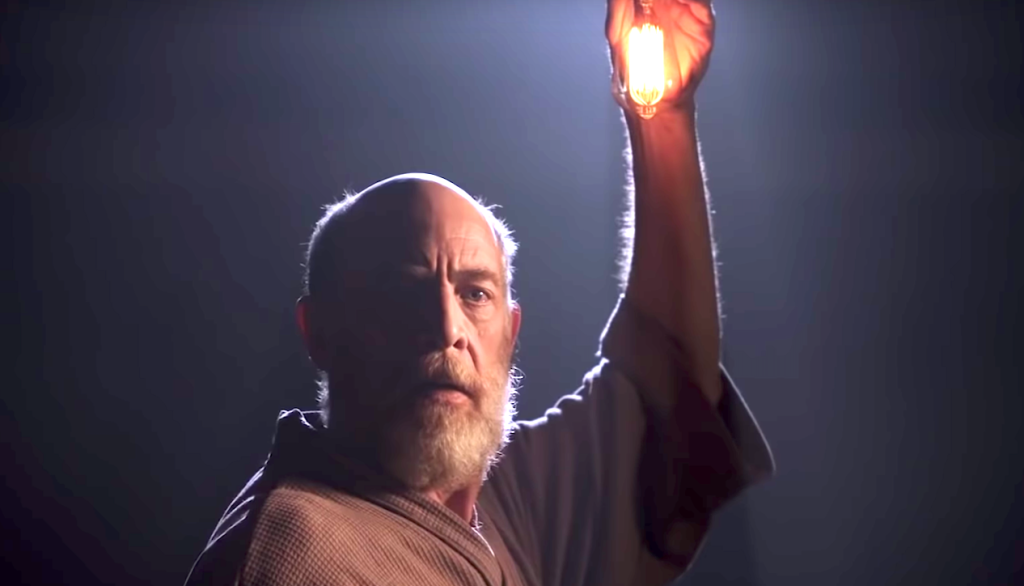
Steven (J.K. Simmons) is a shell of a man. He drinks too much, lives in squalor and has distanced himself from his remaining family. Through a rotating series of flashbacks, we’re introduced to Steven as a boy dealing with the complexities of his parents’ divorce, and also as a young man (Sebastian Stan) who has just started to make his own life-altering missteps. For present-day Steven, a phone call delivering upsetting news brings all of his past trauma to the surface.
I’m Not Here is frustrating. Its cast is more than capable of knocking this kind of material out of the park, but they are hobbled by a poor script and weak direction. Simmons fares best as his segments are solo and allow him to channel the intensity that’s he’s so well known for. The rest of the cast, including Stan, Maika Monroe and Mandy Moore, get bogged down by the cliche-ridden script. The lack of subtlety, especially in the flashback segments, undermines the emotional wallop of grief and loss that director Michelle Schumacher is trying to convey.
Schumacher’s handling of the material is scattershot. The present day scenes involving Simmons show a confidence that isn’t replicated in the flashbacks. The present day material has a more natural flow that lets the audience settle into Steven’s world of loneliness and self-pity. The darkness of his home mirrors the darkness of his life. On the other hand, the flashbacks offer hazy, overlit scenes that wouldn’t be out of place on CBS’s prime time schedule.
Casting Steven as the ultimate Unreliable Narrator is perhaps I’m Not Here’s greatest strength. His unwillingness to come to terms with his choices have clouded his memories with excuses. Steven’s memories cast him as a victim with only slivers of truth peeking through.
I’m Not Here has the foundation for a complex look at how tragedy and grief shape us, but it doesn’t have the follow-through. This one is not worth remembering.
Dayumm there are a lot of movies available for home viewing this week! Oscar winners, foreign gems, underseen treasures, underappreciated family films, and also Aquaman. So much! Let us help you sort through it all.
“I want to sue my parents!” a defiant pre-teen child exclaims inside of a crowded courtroom. Everyone – his parents, the judge, the attorneys – appears stunned. As his initial outburst lingers in the air, the boy explains further:
“Because I was born.”
Our world can be a horrific place. Unfortunately, children aren’t spared from these horrors. Capernaum follows one child as he tries to make sense of his place in a world that’s constantly placing greater and greater hurdles in front of him.
The streets of Beirut are the playground for headstrong Zain (Zain Al Rafeea). When not selling cheap cups of juice in the gutter, Zain spends his days working in a small shop to appease his parent’s landlord. Even at such a young age, Zain has been tasked with providing for his large family. The abrasiveness of Zain’s demeanor is quickly overshadowed by his need to take care of his siblings and keep them all together.
Capernaum isn’t subtle about where it lays blame. The neglect from adults is directly responsible for the misery these children endure. Zain and his siblings are only valuable to their parents because of what they can provide for them; not because they’re human beings. Even the lone caring adult in Zain’s life puts him in a situation that no child should be in.
The movie isn’t a miserable experience by any means, but it doesn’t shy away from the hardships these characters suffer. In fact, that honesty is what makes Capernaum so compelling. Knowing there are real children like Zain who live this kind of bleak existence helps give the story weight.
Al Rafeea is a revelation in his acting debut. A real life Syrian refugee, Al Rafeea conveys a weariness that cannot be faked. He plays Zain as a hardened, street-smart kid, but allows the cracks in that facade to show. Zain wants the chance to be a regular kid, and those few moments when he is truly happy are simultaneously joyous and heartbreaking.
The honesty of the story and the lead performance make Capernaum a riveting experience.
That phrase kept popping up in my mind while watching An Acceptable Loss. Unfortunately, the subject of morals mixed with politics was something the film was only concerned with on a surface level.
Libby Lamm (Tika Sumpter) has just started a teaching position at a prestigious Chicago area university. Although she’s excited about this fresh start after leaving a position at the White House, many staff and students are less than enthused with her presence on campus. One of Libby’s pupils (Ben Tavassoli), in particular, is fixated on the new professor and begins tracking her every move around campus and her home. Through a series of flashbacks, we learn about the devastating decision that led Libby out of politics, and into being one of the country’s most hated pariahs.
The most frustrating aspect of An Acceptable Loss is how it sets up a central conflict that could have made for a spellbinding thriller. It instead settles for a Cinemax-level B-movie.
One of the earlier scenes between Libby and her student, Martin, is a tense clash between two people who couldn’t be further apart, and it makes you wish for the movie that might’ve been. Instead, character motivations change on a dime, and that early sense of dread is replaced with a sense of “been there, done that.”
The majority of the cast doesn’t make the material any easier to swallow. Sumpter’s wooden delivery of political jargon is more reminiscent of a freshman PoliSci major than a beltway professional. Tavassol spends the first half of the film brooding at every other character (I honestly expected him to start giving extras the Stink Eye), and the second half doing his best (worst?) Shia Labeouf on cough medicine impression.
Jamie Lee Curtis, in her small role as vice president and president, fares somewhat better. Her natural gravitas lends itself well to being the leader of the free world; unfortunately, the dialogue she’s delivering is almost 100 percent clunky exposition.
It’s unclear what director Joe Chappelle’s (Halloween: The Curse of Michael Myers) original intentions were. Did he envision a taught political thriller in the vain of Three Days of the Condor or was a low-rent Pelican Brief always the plan?
Chappelle’s mishandling of the film’s focus and pacing hobbles the An Acceptable Loss early on and it’s never able to recover.
Maybe this movie was never going to be anything other than cheap Tom Clancy. The promise of that first act, however, hangs over the rest of the film, and in the back of this viewer’s brain, like a giant “What If?”
Physical comedy is as important to the history of cinema as the cameras themselves. Charlie Chaplin, The 3 Stooges, Jim Carrey and the cast of Jackass all kept the time-honored tradition of taking a blow for the sake of a laugh. Even everyday folk got into the act by sending their accident-filled home movies to TV’s America’s Funniest Home Videos.
For many fans, historians and critics, Buster Keaton was the best of them all.
Keaton started in the biz by performing alongside his parents in their traveling vaudevillian show. His adept ability to sell a pratfall like no one else made their act enormously popular. A fortuitous meeting with Fatty Arbuckle introduced Buster to the art of filmmaking, and by the time Keaton reached his mid-30s, he’d directed, starred in and produced multiple feature and short films.
With The Great Buster, director Peter Bogdanovich (The Last Picture Show, Paper Moon) delivers an absolute love letter to Keaton and his career. The film not only touches on Keaton’s highs in the 1920s, but also on his low points when he lost all creative and financial control of his projects. Alcoholism, infidelity, divorce and family estrangement all plagued Keaton during the downturn in his career.
Bogdanovich wisely spends most of the time discussing and reveling over Keaton’s work. Bogdanovich himself narrates the film, and his adoration of Keaton is evident in his voice as he touches on everything from Keaton’s masterworks in the 1920s to his commercial work in the 1960s. Filmmakers and actors such as Mel Brooks, James Karen, Quentin Tarantino and Johnny Knoxville also share how their affinity for Keaton helped shape their careers.
The film really takes hold when the more “film geek” elements are at play. Specific scenes and/or gags from Keaton’s work are broken down, analyzed and fawned over by Bogdanovich and fellow filmmakers. The film even backtracks to spend the last third pouring over the classics that Buster created in the 20s, leading right up to the invention of talkies.
Like recent documentaries De Palma and Milius, the love and affection for the subject and their creations is all over The Great Buster. Bogdanovich has crafted a precise and professional movie, but, more importantly, he’s infused the film with respect and admiration.
Confession: I’ve never seen an entire Japanese animated film.
Spirited Away? Nope.
Howl’s Moving Castle? Sorry.
Akira? Not even a single frame.
I don’t have any kind of unreasonable hatred for this type of film, but I’ve never had much interest either. Thankfully, Mirai was a nice introduction for this anime novice.
Kun is a typical toddler. He enjoys playing with his toys, looking at books, and being the center of attention to his mom and dad. That changes when his baby sister, Mirai, is brought home. Confused by the changes happening around him, Kun retreats to a world where he is able to meet family members at different periods of their lives.
What struck me first about Mamoru Hosoda’s Mirai is how the film doesn’t shy away from letting Kun behave like a real kid. He’s selfish, loud and cannot control his emotions. He’s not the easiest protagonist to like at first. The delightful part is seeing Kun grow, and learn to put these bad behaviors to bed.
Mirai is interested in looking at how difficult it is to be a family. It’s tough for parents to bring home another baby when they already have one at home. Cleaning still needs to be done, dinner still needs cooking, life still happens… and that can cause friction. Likewise, it’s hard to be a kid in this kind of dynamic. One minute, you’re the center of mom and dad’s universe, and the next – you’re not.
Kun’s travels through time via the garden never feel like cutesy spectacle, as each of his meetings is rooted in character. Kun learns about empathy, and that his own parents struggled with things when they were younger. By becoming more in touch with previous generations, Kun is able to fully realize his place in his own family.
Emotional yes, but there’s still plenty of fun to be had with Mirai. Kun finds himself turned into a half-boy half-dog at one point, and takes an exciting motorcycle ride with his great-grandfather at another. There’s a joyfulness to Kun’s interactions with this fantastical world that’s perfectly childlike.
Mirai might lack the belly laughs that accompany a Pixar movie, but the message is just as potent. Once the credits start to roll, that message is what sticks with us.
1998 was a good year to be a fan of Jennifer Lopez. She had just come off of a great turn as Selena Quintanilla in Selena, and her performance as Karen Sisco in Out of Sight made even more people stand up and take notice. Unfortunately, in the following years, movies like The Wedding Planner, Maid in Manhattan and Gigli showed that the promise of 1998 was an outlier. Second Act continues that storied tradition of mediocrity.
On the surface, life looks pretty good for Maya (Lopez). She has a job she excels at and enjoys; has a great partner (Milo Ventimiglia); and is surrounded by supportive family and friends. After she’s passed over for a promotion due to her lack of a college education, Maya’s confidence in her life choices start to crumble. When her genius nephew spruces up her resume with a few white lies, Maya lands an opportunity that allows her to use her natural skills, but also forces her to pretend to be someone she’s not.
Second Act is a confusing mix of several different kinds of comedies. There’s the romance straight out of the romantic comedy, pratfalls and potty humor from the Apatow camp, and a gee-whiz camaraderie angle that left me wondering if magic pants were about to come into play.
None of these approaches works.
Lopez is completely out of her element with the physical comedy. She sells tripping over a barrier about as convincingly as Denise Richards did playing a nuclear physicist in The World Is Not Enough. Not helping is her complete lack of comedic chemistry with co-stars Leah Remini, Treat Williams and Dave Foley. When the top comedic performance of the movie is delivered by Charlyne Yi… there’s a problem.
The film’s entire structure is supported by the worst kind of cliches: Maya’s lie and the hoops she has to jump through to keep the lie alive; the workplace competition that was tired in 2013 when The Internship did it; and a lazy second act reveal so bad it’d feel out of place in a Hallmark Christmas movie. Second Act is a Frankenstein’s monster of plot points from already terrible movies.
This is a movie that your mom who sees one movie a year will probably love. For the rest of us, it’s the worst movie of 2002 that somehow got released in 2018.
Films like M, Vertigo and Chinatown have spent decades taking audiences on twisty narrative rides. These classic mysteries raise thrilling questions, and payoff with satisfying answers. But what if a great mystery wasn’t at all concerned with answering the questions it raised? Chang-dong Lee’s Burning is more interested in the journey than it is the destination.
Jong-Su (Ah-In Yoo) spends his days doing odd jobs and taking care of his family’s dilapidated farm on the outskirts of town. A chance encounter brings Hae-mi (Jong-seo Jeon), a childhood neighbor, back into his life. Through Hae-mi, Jong-Su also meets Ben (Steven Yeun of The Walking Dead), a wealthy, good-looking and mysterious young man. While having drinks one evening, Ben confides to Jong-Su that he occasionally enjoys burning abandoned greenhouses. Jong-Su begins to think that burning greenhouses isn’t Ben’s only secret.
Burning unravels slowly. Two and a half hours seems daunting at first glance, but the twinge of unease hanging over the film keeps you involved the entire time. There’s a sense of dread that is hard to pinpoint, but is also intoxicating.
The film comes alive through the character work. Jong-Su is an open book. He’s miserable, lonely, disappointed and bored. And we get to see it all. He tells Hae-mi and Ben that he’s a writer, but he’s never actually shown writing. He spends hours working his monotonous jobs and pretending to be invested in taking care of the family farm. Jong-Su is a phony, and Ben sees that immediately.
Hae-mi and Ben, on the other hand, are complete enigmas to Jong-Su and the audience. Hae-mi tells Jong-Su stories from their childhood that he doesn’t remember, and eventually finds out aren’t true. Ben’s wealth, job and true motivation are complete mysteries. Knowing next to nothing about these two people that he so admires frustrates Jong-Su to the point of obsession.
For nearly 20 years, South Korean cinema has cemented itself as the industry to beat, creatively. Burning is absolutely no exception. The film owes more to Memories of Murder than it does Oldboy, slowly oozing into your psyche with its methodical and unconventional approach.
It’s easy to be frustrated by Burning as the credits start to role. It offers zero easy answers, and even refuses to acknowledge Jong-Su as an unreliable narrator. By defying genre conventions and expectations, Burning provides an alternative mystery that pops with just as much excitement.
Look at all these movies! What do you want, cartoons? Drama? Indie rom com? Horror? Unhinged Nic Cage? You know you want unhinged Nic Cage, and lucky for you, he’s here! We’ll shed some insight on what else is worth a look.