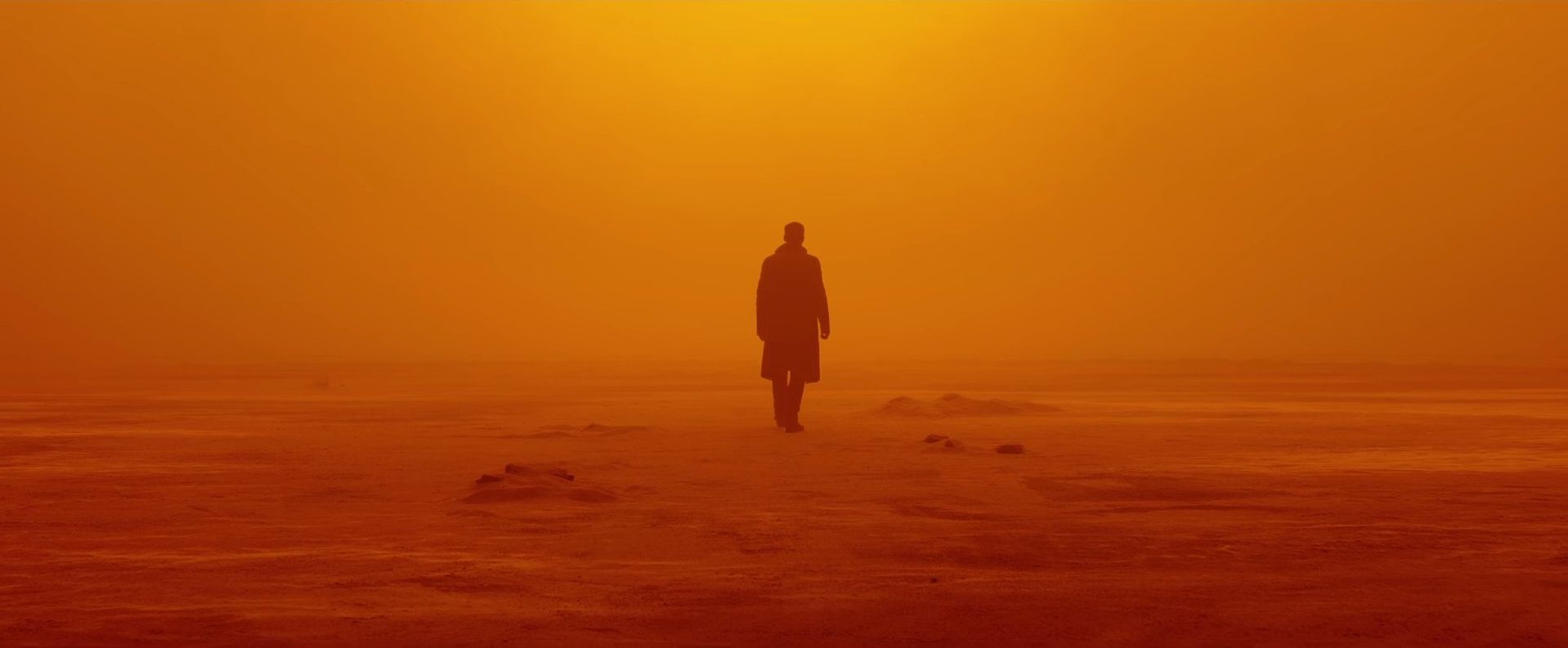
No gigawatts necessary. With Blade Runner 2049, director Denis Villeneuve returns us to the hulking, rain-streaked metropolis of another generation’s LA. We ride with K (Ryan Gosling), a blade runner charged, as always, with tracking down rogue replicants and retiring them.
Things get more complicated this time around.
Gosling’s the perfect choice to play dutiful sad sack LAPD blade runner K. Few actors can be simultaneously expressionless and expressive, but Gosling’s blank slate face and long distance stare seem to say something mournful, defeated and rebellious without giving anything away.
It’s no spoiler to mention that Harrison Ford returns. He’s a welcome presence, and not simply for nostalgia. The film toys with the “is he or isn’t he?” debate that has raged for 35 years, and gives the veteran ample opportunity to contribute.
God complexes, sentience and existence, clones – Ridley Scott saw his own longtime preoccupations playing out in Philip K. Dick’s prose and now, with returning screenwriter Hampton Fancher and new teammate Michael Green (Logan), Villeneuve gets his chance.
Their take is engrossing, satisfying and impressive, though the group stumbles over a few of their ideas—particularly those that consider the female in this particular universe.
As enamored of the original as we are, Villeneuve weaves intoxicating threads and callbacks throughout—most welcome is Hans Zimmer’s periodic moaning and sighing echoes of Vangelis’s original score.
In fact, the echoes from the Ridley Scott (now executive producing) ‘82 classic almost threaten to overrun the film. There are plenty of differences, though.
Villeneuve carves out a much larger corner of author Phillip K. Dick’s universe—not quite taking us off-world, but far beyond the teeming streets, towering buildings and oppressive rain of Scott’s retro-futuristic noir. The expansive story fills the screen with breathtaking frames and immediately iconic imagery, thanks in large part to acclaimed cinematographer Roger Deakins, at the top of his game.
Few if any have delivered the kind of crumbling, dilapidating futurescape Ridley Scott gave us with his original. But between the stunning visual experience and meticulous sound design, Blade Runner 2049 offers an immersive experience perfectly suited to its fantasy.
Picking at ideas of love among the soulless, of souls among the manmade, of unicorns versus sheep, Villeneuve channels Dick by way of Scott as well as a bit of James Cameron and more than a little Spike Jonze. There’s even a splash of Dickens in there.
Sounds like a hot mess, but damn if it doesn’t work.
Two of the best and most criminally underseen films of the summer are now available for your home viewing pleasure. Watch them! And also, there are a couple we think you might want to skip.
Click HERE to join us in The Screening Room where we talk through Battle of the Sexes, American Made, Super Dark Times, Woodshock and all that’s new in home entertainment.
In their debut feature, Trevor and Tim Ryan welcome us to the backwoods of Northern California where the weed, meth and aliens are bountiful and the yokels are creepy. The town of Willits—known as the Gateway to the Redwoods—attracts a young group of hikers looking to enjoy a weekend in the woods, who only get lost and spend the night near a cabin shared by a pair of strung-out conspiracy theorists.
Brock (Bill Sage) and Peggy (Sabina Gadeki) believe aliens are after the powerful batch of crystal meth the two have been cooking and smoking. “Emerald Ice,” as the locals call it, brings on intense hallucinations, exposing the user to the nefarious creatures visiting Earth, and in some cases, inhabiting human bodies.
Brock has no other option than to stand his ground and fend off the aliens he can only see through meth-tinted glasses. This proves problematic for our unsuspecting hikers when they eventually find themselves in Brock’s crosshairs.
The comedy of the film mainly relies on lazy stoner-humor courtesy of Possum, played by Rory Culkin. A Willits local who tags along with the hikers, Possum also provides the explanation for the UFO sightings and other spooky happenings around the town. Except his “explanation” is more of a half-assed paraphrasing of an Ancient Aliens episode.
The central question of the film: Does “Emerald Ice” actually expose the hidden truth about aliens, or are these visions part of a drug-induced psychosis? The narrative attempts to answer this by setting characters on a collision course with butchery. It’s a nice idea that just doesn’t work out since scenes with lost hikers or a homicidal Brock are too short for us to feel invested.
Given the cavalcade of circumstances, the premise seems promising for a science-fiction/horror romp. But the lack of tension and careless writing cripple a film that could have been frightening and fun.
If you’re looking for something with scares and laughs, try watching conspiracy theories on YouTube before watching this movie.
In the late 1970s, Barry Seal traded in his gig as a TWA pilot for something more colorful. What began as missions taking aerial photographs of “enemies of democracy” in Central America turned into money laundering, arming the Contras, and cocaine smuggling for Pablo Escobar and the Medellin cartel. Among other things.
Seal’s is a resume that stands out, and American Made tells his story with just enough charm and swagger to keep it from being totally bogged down in the swamp of exposition necessary to sort it all out.
Much of that charm belongs to Tom Cruise, digging into a role perfectly suited to that roguish charisma he can deliver on autopilot. Whether keeping his CIA boss (an excellent Domhnall Gleeson) in the dark about his side hustles, spoiling his family with cash or buddying up to murderous drug lords, Cruise effortlessly carries the film.
Director Doug Liman (Edge of Tomorrow, Go, Swingers) brings the swagger, surrounding his star with enough lively pacing and entertaining presentation to avoid the usual trappings of Cruise vanity projects.
Landing somewhere between Wolf of War Street and War Dogs, American Made is a film that certainly could have dug for a deeper message, but delivers plenty of fun while it romps in the shallow end.
Super Dark Times opens ominously enough: a broken schoolroom window, a trail of blood running through empty classrooms and into a cafeteria. Though the outcome is not what you may expect, it sets an eerie stage for the 90s-set coming of age thriller.
Zach (Owen Campbell) and Josh (Charlie Tahan) are best friends, not yet driving, not yet dating, not yet determined if they are permanently dorks or just “awkward stage” dorks. They both like Allison (Elizabeth Cappuccino), both tolerate Daryl (Max Talisman).
Thanks in large part to a weirdly believable cast, writing that dances past clichés and confident direction, Super Dark Times creates the kind of charming but clumsy authenticity rarely seen in a coming-of-age indie.
Eighties high school flicks, mainly of the John Hughes variety, focused on right- versus wrong-side-of-the-tracks, popularity and the pressures parents can put on us. That is to say, they focused in most ways on the same worries that had plagued adolescent-focused films since the Fifties.
Contemporary films dealing with high schoolers require the ubiquitous presence of social media. But there is a particular darkness that entered the global consciousness about adolescents in the 90s, and Super Dark Times tries to tap that, using it to color the tone of its nostalgia and cusp-of-adulthood energy.
Kevin Phillips, making his feature debut, leans on his experience as a cinematographer to ensure the film looks as appealing and authentically nostalgic-90s-coming-of-age as possible. Writers Ben Collins and Luke Piotrowski are unafraid to drop contextual clues without burdening characters with too much backstory, just to go on to upend expectations now and again to keep you on your toes.
Super Dark Times develops a thriller atmosphere fueled by the paranoid, confused logic of an adolescent. It’s all a fascinating and realistic journey—until it isn’t.
At a certain point in Super Dark Times, the film settles. It becomes something it didn’t have to become—like the teen who’s cool to hang onto that Subway job when he really needs to ditch town and make something of himself.
It’s an enormous credit to Philips and his young cast that this unnecessary cop-out doesn’t ruin the film. Together they have drawn so much investment in these characters and their futures that you can’t help but stay tuned and attentive.
A fight for equality playing out inside sports arenas. Sound familiar? Battle of the Sexes isn’t just an effortlessly engaging piece of entertainment, it’s a compelling reminder that the sporting world has long been intertwined with the social and political movements of the day.
In 1973, Billie Jean King was 29 years old and the leading name in women’s tennis. Bobby Riggs was a 55 year-old former champion who missed the spotlight. As the “women’s lib” movement grew, they met for three sets of tennis that was watched by ninety million people.
Directors Jonathan Dayton and Valerie Faris (Little Miss Sunshine, Ruby Sparks) choose wisely in running the soul of the film through King. Bolstered by Emma Stone’s gracefully layered performance, the film’s emotional connection comes from King’s dueling inner conflicts: the responsibility of carrying the women’s game forward and her growing attraction to the tour hairdresser (an excellent Andrea Riseborough).
A taut script from the Oscar-winning Simon Beaufoy finds marks that often speak directly to today’s “stick to sports” crowd. In one particularly biting scene, a defiant King argues for equal prize money on the women’s circuit, telling the condescending director of the tour (Bill Pullman) that he’s a constant gentleman “until we want a bit of what you’ve got.”
As he was in the actual ’73 event, Riggs is the film’s camera-loving ringmaster, a born huckster who tells a recovery group they don’t need to stop gambling – they just need to get better at it. Steve Carell nails the role, and not just because he has the look and the attitude. In the quieter moments away from the cheering crowds, Carell gives us a faded star in search of purpose, finding the authenticity that Riggs leaned on to remain endearing.
The period details are just right and, thanks to some nifty work by two athletic body doubles, so is the tennis. Faulting only with some fleeting moments of flippancy, Battle of the Sexes wins by serving up both a crowd-pleasing spectacle and the human drama than ultimately made it so much more.
For some, it’s a profound and moving meditation. For others, it is the longest, most unendurably boring song on earth. It figures prominently in one scene in the film Woodshock, becoming maybe the strongest (perhaps unintentionally as well as intentionally) metaphor in the picture.
The film, written and directed by Kate and Laura Mulleavy—better known as fashion icons Rodarte than as filmmakers—follows one woman as she descends from melancholy to full-blown madness.
Theresa (Kirsten Dunst, doing much with very little) works part-time at a legal pot dispenser somewhere in California’s logging country. Marijuana is legal; assisted suicide is not, but many of the shop’s clients are suffering greatly—including Theresa’s terminally ill mother.
The film opens on Theresa dripping some kind of liquid into the contents of a joint, then holding her mother as she passes painlessly from this life.
Painless hardly describes the future Theresa has found.
Hers is a slow—very slow—downward spiral. Woodshock is a character study. Unfortunately, Theresa’s conflict and chaos happen internally, so we spend an enormous amount of time watching her do basically nothing. At the one hour 29 minute mark, she does something. That’s a long wait.
The Mulleavys attempt to offer glimpses into Theresa’s psyche with dreamlike imagery. Their lawless style is equal parts mesmerizing and frustrating. For the power they infuse in their visual presentation they deserve praise. They need to stop ignoring story, though.
Terrence Malick films can sometimes become a confoundingly beautiful amalgam of free-form imagery, episodes disguised as story providing the whisper of a plot. The reason Woodshock doesn’t hold together as well is that the few plot points provided are each of profound importance to character development. Rather than a meditation, the film becomes a highlights reel padded with hallucinatory imagery.
The sisters’ work is formally confident, and rightfully so, but their investment in story is too weak to hold attention. Woodshock offers style to spare, but it’s too shy with substance.
Remember the unbelievable bounty in home entertainment last week? Well, it can’t be Christmas every day, kids. Things are a little slower this week, but making its way to DVD/BluRay is a decent horror flick and swimming to your screen for the first time is a shark attack flick that’s not nearly as bad as you think it is. Also, a 17-hour long movie about kids toys dating back to medieval times or some such bullshit.
So, there’s this one set of movies you may or may not be aware of about a guy with a William Shatner fixation just trying to get home in time for Halloween. You may have heard of it.
Here’s the thing, there are also other Halloween-themed movies you could watch this holiday if you’re so inclined. Loads of them. And while we feel like you probably know which Michael Meyers movies to skip (5 & 8), which to love (1, duh), and which to watch for the ironic enjoyment (6—we’re looking at you, Paul Rudd!), you might need some direction outside that series. So, here are our five favorite non-franchise Halloween horror movies.
5. Night of the Demons (1988)
It’s Halloween night in the late Eighties and a bunch of high school kids decides to go hang out at Angela’s party because, as the resident goth girl, “Halloween is like Christmas to Angela.”
Where’s the party? At the old, abandoned funeral parlor built over sacred land above some kind of demonic water source. Natch.
Do not be confused – Night of the Demons is not exactly recommended viewing. It’s terrible. Once you get past its dirt-cheap sets and TV-level staging, you’ll notice that the film boasts among the most stilted and cardboard dialogue of any film from the Aquanet decade.
But Angela (Amelia “Mimi” Kinkade) looks cool. Every goth chick— Fairuza Balk’s Nancy Downs from The Craft in particular—owes Angela a little respect. And professional dancer Kinkade does the demonic transformation justice. The acting is atrocious—all of it— but the film boasts a campy, nostalgic, oh-so-80s quality, and we never disagree with Bauhaus on a soundtrack.
4. Murder Party (2007)
Jeremy Saulnier is a filmmaker worth watching. Murder Party is not the near-masterpiece of Blue Ruin or Green Room, but it is a savvy, funny, fun change of pace.
Chris Sharp plays lonesome loser Christopher. Alone with his selfish cat on Halloween night, he decides to follow a whim and hit the party advertised on a flier. A “Murder Party.”
Fun!
What Saulnier pieces together could have dripped with condescending judgment, as a group of insecure art students plot to kill the poor guy as a piece of art that will impress Alexander (Sandy Barnett) enough to nab them the grant Alexander keeps lording over them.
The comedy is more self-referential and human than snide, simultaneously mocking and empathizing with the group of artists as well as their would-be victim.
Funny, tender, biting and often quite bloody and energetic, Murder Party does not suggest the style of film to come from Saulnier, but it predicts a filmmaker who knows what he’s doing.
https://www.youtube.com/watch?v=qI_DqgxNR7U
3. Ginger Snaps (2007)
Ginger and Bridget, outcasts in the wasteland of Canadian suburbia, cling to each other and reject/loathe high school (a feeling that high school in general returns).
On the evening of Ginger’s first period, she’s bitten by a werewolf. Writer Karen Walton cares not for subtlety: the curse, get it? It turns out, lycanthropy makes for a pretty vivid metaphor for puberty.
This turn of events proves especially provocative and appropriate for a film that upends many mainstay female cliches. Walton’s wickedly humorous script stays in your face with the metaphors, successfully building an entire film on clever turns of phrase, puns, and analogies, stirring up the kind of hysteria that surrounds puberty, sex, reputations, body hair, and one’s own helplessness to these very elements.
A well-timed Halloween party allows Ginger to display her new look and skills in as insightful a high school horror film as you’ll find, peppered equally with dark humor and gore.
https://www.youtube.com/watch?v=Zoa1A987A_k
2. May (2002)
Who wants a little romance? How about the tale of a wallflower, the blossom of new love, the efficient use of veterinary surgical equipment, and a good sized freezer?
Lucky McKee’s 2002 breakout is a showcase for his own talent as both writer and director, as well as his gift for casting. The entire ensemble surprises with individualized, fully realized, flawed but lovable characters, and McKee’s pacing allows each of his talented performers the room to breathe, grow, get to know each other, and develop a rapport.
More than anything, though, May is a gift from Angela Bettis to you.
May’s vulnerability is painful yet beautiful to watch, and it’s impossible not to hope that cool outsider Adam is telling the truth when he reassures her, “I like weird.”
McKee’s film pulls no punches, mining awkward moments until they’re almost unendurable and spilling plenty of blood when the time is right—on Halloween night, of course.
He deftly leads us from the sunny “anything could happen” first act through a darker, edgier coming of age middle, and finally to a carnage-laden climax that feels sad, satisfying, and somehow inevitable.
1. Trick ‘r Treat (2007)
Columbus native Michael Dougherty outdid himself as writer/director of this anthology of interconnected Halloween shorts. Every brief tale compels attention with sinister storytelling, the occasional wicked bit of humor and great performances, but it’s the look of the film that sets it far above the others of its ilk.
Dougherty takes the “scary” comic approach to the film—the kind you find in Creepshow and other Tales from the Crypt types—but nothing looks as macabrely gorgeous as this movie. The lighting, the color, the costumes and the way live action bleeds into the perfectly placed and articulated moments of graphic artwork—all of it creates a giddy holiday mood that benefits the film immeasurably.
Dylan Baker (returning to the uptight and evil bastard he perfected for his fearless performance in Happiness) leads a whip-smart cast that includes impressive turns from Brian Cox, Anna Pacquin, Leslie Bibb and Brett Kelly (Thurman Merman, everybody!).
And it’s all connected with that adorable menace, Sam. Perfect.