Category Archives: Slider

For the homepage slider

All That Jazz

Soul

by George Wolf

Pete Docter has written, directed, or been a part of the story team for some of Pixar’s greatest achievements. From Up to Inside Out, WALL-E to Toy Story, he’s helped set the standard that each new Pixar film competes with.

For Soul, Docter and co-writer/co-director Kemp Powers sense the time is right to tweak the winning formula a bit, creating a deceptively simple, beautifully constructed ode to happiness.

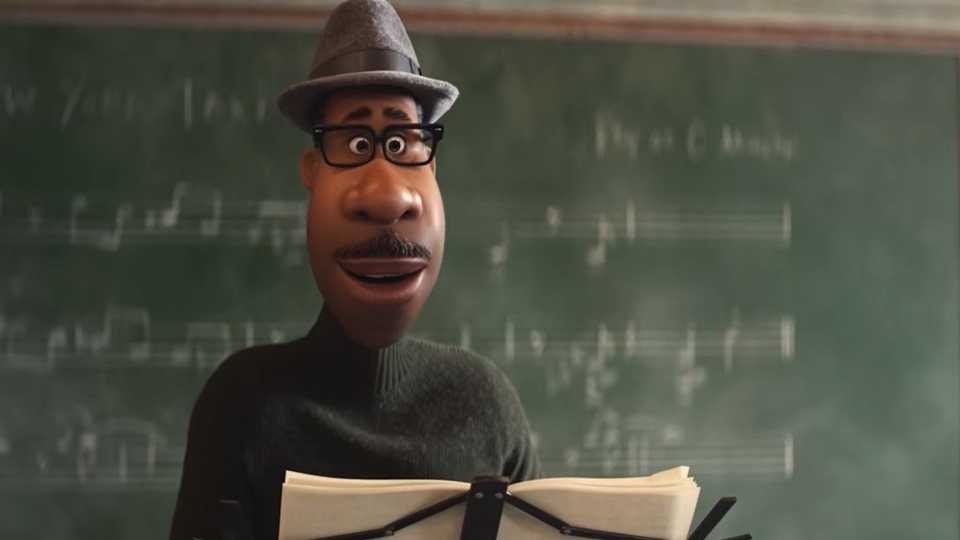
The updated blueprint starts with an African-American lead, Joe (voiced by Jamie Foxx), a middle-aged music teacher who still harbors dreams of stardom in a jazz combo. Just when Joe gets that long-awaited chance to play with one of his favorite artists, an out-of-body experience finds him fighting to get back to the life he’d been living.

Hence, the “soul” here may be not what you’re expecting. The music is all that jazz, but once Joe meets up with a wandering infant soul named 22 (Tina Fey), the film becomes a funny, surprising and truly touching journey toward becoming a fulfilled human being.

And what a beautiful, big screen-begging journey it is. Soul looks like no Pixar film before it, with wonderfully layered and personality-laden animation for Joe’s daily life that morphs into an apt Picasso vibe for our time in the before and after worlds. In those other worlds, Joe and 22 are gently pushed toward their destinies by the reassuring voice of the cubist Counselor Jerry (Alice Braga) amid a madcap series of detours carrying the emotional highs and lows of an inspired jazz trumpeter’s solo.

Foxx and Fey are joyfully harmonious, backed by jazzy arrangements from Jonathan Batiste, an ethereal score from Trent Reznor and Atticus Ross and a stellar supporting group of voice actors that includes Phylicia Rashad, Daveed Diggs, June Squibb, Rachel House, Wes Studi and a perfectly nutty Graham Norton. 

And though Soul delivers plenty of whimsical fun, it’s anchored by the existential yearning Docter hinted at with Inside Out’s “Bing Bong” character five years ago. 

But just when you think you know where the film will leave you, it has other plans, and that’s okay. Because while the best of Pixar has always touched us with family adventures that speak to what it means to be human, Soul leaves plenty of room for our own improvisations, producing a heartfelt composition that may be Pixar’s most profound statement to date.

Upstairs, Downstairs

Ma Rainey’s Black Bottom

by George Wolf

In 1927 Chicago, four musicians – three vets and a brash youngster – gather in the basement of a downtown recording studio. They tune up and rib each other, waiting for the star vocalist to arrive.

That would be one Gertrude “Ma” Rainey, legendary “Mother of the Blues” and one of the first blues singers to make records. And in the late 1920s, those records sold, which meant Ma didn’t waste her time in studio basements.

That spatial divide becomes the metaphorical anchor in director George C. Wolfe and screenwriter Ruben Santiago-Hudson’s adaptation of August Wilson’s Tony Award-winning play. And thanks to the blistering adversarial performances by Chadwick Boseman and Viola Davis, the film has a show-stopping pillar on each floor.

Boseman is electric as Levee, the ambitious trumpet player who’s not only ready to give Ma’s tunes some new swing, but also to break away and record some of his own compositions.

Ma ain’t having any of that, or anything else that doesn’t smell the least bit right to Ma. And Davis, surprising no one, effortlessly embodies the blues legend with a smoldering, defiant ferocity.

Early on, the rehearsal conversations still carry the aura of the stage, but this is Wolfe reinforcing the different worlds co-existing here, a difference that will be pivotal as events escalate.

Wilson’s source work is another compelling example of his ability to explore the Black experience in America through the piercing intimacy of his characters. Ma’s records are selling, which gives her leverage over the white record producers. She exploits that leverage at every turn, but it only takes one cold, world-weary stare from the transcendent Davis to remind you how little illusions Ma has about any of it.

Boseman’s work will undoubtedly earn an Oscar nomination, which will be nothing but well-deserved. Labeling Boseman’s final performance as his finest may smack of sentimentality – at least until you experience it. Then you realize how gracefully Boseman claims this story for Levee, and for the countless real life souls he represents.

It is Levee’s arc that carries this film’s very soul, and Boseman’s chemistry with the stellar ensemble of Glynn Turman, Coleman Domingo and Michael Potts is a thing of beauty. As Levee moves from the cocky enthusiasm of the gifted to the painful cry of the oppressed, Boseman’s bittersweet goodbye becomes doubly heartbreaking.

This is an elegant, artful salute to great art, and a sobering reminder of a shameful legacy marked by exploitation and appropriation. And it is thanks to a collection of great artists that Ma Rainey comes to the screen with all of its joy and pain intact.

Fright Club: Psychotic Planners

We want to thank Cory Metcalf of the Rewatch Podcast for joining us today to look into those meticulous planners who cause so much trouble! They’ve thought of everything! Here are our 5 favorites, but listen in because Cory brought his own list.

5. Muffy, April Fool’s Day (1986)

Evil twins, Eighties icons, chicanery—this movie has it all. The pseudo-slasher was panned when it came out. Horror fans felt mocked (plus there’s no gore—not really), and the general public didn’t seem to get the joke.

But Danilo Bach’s screenplay is a clever dose of slasher desconstruction. Deborah Foreman (Valley Girl, Waxwork, My Chauffeur, Grizzly II) is Muffy and/or Buffy, a little weirdo who’s having some coed guests out to the island for spring break. Amy Steel (Friday the 13th Part 2) will be there, along with a lot of feathered hair and Biff from Back to the Future, to see what the hostess has planned.

She has definitely done some planning.

4. Ann, Happy Birthday to Me (1981)

OK, no one’s saying it’s a good movie. But Ann has a real knack for planning.

This is one of those Eighties horror gems that involves a traumatic head injury, black outs, and serial murder. And a latex face!

Director J. Lee Thompson had made classics like Cape Fear and Guns of Navarone (for which he earned an Oscar nomination), but the Eighties were hard on everyone. Here he is ushering Little House on the Prairie star Melissa Sue Anderson into scream queen stardom with a ridiculous slasher.

And yet, when the big reveal comes, audiences couldn’t have guessed it. They really couldn’t have because the team of screenwriters hadn’t finished the script until it was time to shoot the end. So they were not good planners.

That Ann, though…

3. Howard, 10 Cloverfield Lane (2016)

First of all, John Goodman. He’s always good, absolutely always, but in this film he is stone cold terrifying.

Not right off the bat, though. Howard (Goodman) had things all figured out, but then Emmett (John Gallagher Jr.) threw a monkey in the wrench and now there are three people down in Howard’s bunker waiting out the alien invasion.

Emmett was not part of the plan.

The plan has Howard living out the end of days alone with Michelle (Mary Elizabeth Winstead), whether she wanted to or not. And so unfolds a fascinating series of well-constructed events that fray your nerves.

2. Ji-Tae Yoo, Oldboy (2003)

Yes, we’ve included this movie on another list. And why not? How many horror movie characters have the patience to plot out this 15-year-long revenge? Who else has figured out how exactly to manipulate his foe, to wear him down, to put him into a situation that makes him realize just how wrong he might have been?

Only Yoo Ji-Tae (Woo-jin Lee). We’ve given credit many times over the years to Choi Min-sik (the man can take a beating). But the elegant and controlled counterpart to Oldboy’s disheveled eruption of humanity is just as important. He is an eerie calm. His character represents every opposite thing.

And he’s been planning every detail of this revenge for 15 years.

1. John Doe, Seven (1995)

Who else? He had everything and everyone figured out. He knew his calling, understood his victims, knew his own weakness, and knew how to become immortal.

And David Fincher knew how to surprise an audience. We should have seen it coming. We should have known. But we did not. Sure, that means we enjoyed the film, its creativity and cleverness startled us and stayed with  us. (Just like those different crime scenes did. Don’t tell me Sloth didn’t make you jump!)

But it also means that John Doe isn’t the only meticulous planner. Andrew Kevin Walker knew how to create a character who’s meticulous nature allowed him to outthink the police, but David Fincher’s eye for detail and instinct for mood is the reason Se7en still compels attention and horror 25 years later.

Tilting At Windmills

Mank

by George Wolf

Since its release in 1941, Citizen Kane has earned such a prodigious place in film and popular culture that the utterance of merely one word can summon it.

And as much as Orson Welles’s masterwork has been dissected over the years, Mank reveals its essence in unique and wondrous ways.

Director/co-writer David Fincher (who honors his late father Jack’s script by listing him as the sole writer) takes us into Citizen Kane through the shadowy side entrance of screenwriter Herman “Mank” Mankiewicz. Officially, Mank and Welles shared the Kane writing credit, though just who did the heavy lifting is still a source of debate for film historians.

Fincher’s view is clear. But even the dissenters may feel powerless to the seductive pull of Mank‘s immersion into Kane‘s creation, and to the stupendous lead performance that drives it.

As Mankiewicz (“and then out of nowhere, a ‘Z’!”), Gary Oldman is out-of-this world-good. His Mank is a charmer, a gambler and a frequent drunk, bedridden by injuries from a car accident and under the gun to deliver Welles a script in just 90…no make that 60 days. And no drinking!

Tick. Tock.

The first few pages bring a critique that “none of it sings,” which is funny, because all of this sings.

Fincher’s rapid-fire dialogue is beautifully layered and lyrically precise, more like the final draft of a script than authentic conversations, which only reinforces the film’s commitment to honoring the power of writing. Onscreen typeface and script direction transition the flashbacks to Mank’s years in the Hollywood studio system of the 1930s, running in social circles with power brokers such as Louis B. Mayer (Arliss Howard), Irving Thalberg (Ferdinand Kingsley), Kane inspiration William Randolph Hearst (Charles Dance), and Hearst’s not-so-dumb blonde mistress Marion Davies (a terrific Amanda Seyfried).

Oldman expertly sells Mank’s truth-to-power rebellion as a sly reaction to his own feelings of powerlessness. His charm as a “court jester” belies a growing angst about America’s power structure that Welles (Tom Burke) is eager to illustrate.

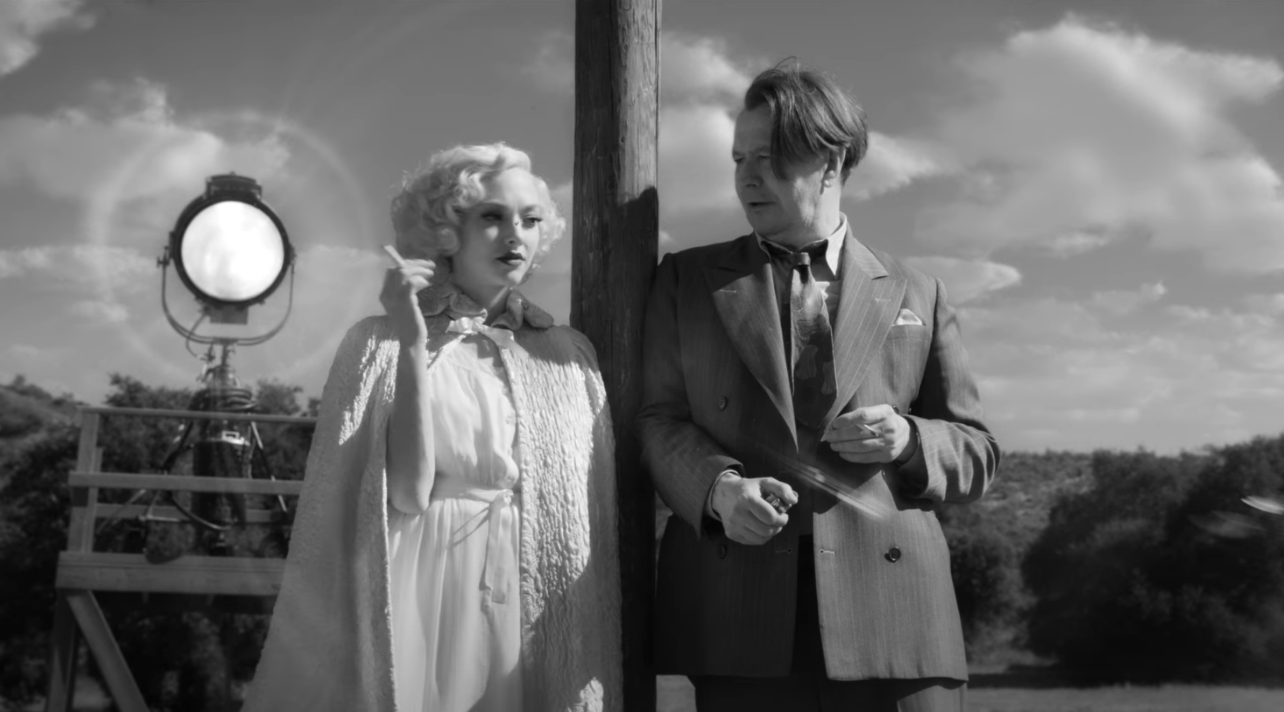
And though much of Mank‘s power is verbal (just try to catch a breath during Oldman’s drunken Don Quixote speech), Fincher crafts a luscious visual landscape. Buoyed by Erik Messerschmidt’s gorgeous B&W cinematography, Fincher recreates the era with sharp period detail and tips his hat to Welles with Kane-esque uses of shadow, forced perspective and one falling glass of booze.

Talk of “getting people back to the theaters” and manufactured news will feel especially relevant, but Mank provides a nearly endless peeling of satisfying layers. So much more than a story about how a classic story was told, it’s a sweeping ode to the power of courageous art, no matter how flawed the artist.

Who’s Afraid of Virginia Bear?

Black Bear

by George Wolf

As slippery as it is inviting, Lawrence Michael Levine’s Black Bear is an intoxicating trip through the inspirations and indulgences that take root in creative minds.

It feels intensely personal, and yet – once Levine delivers his midstream shape shift – malleable enough to bend to myriad perspectives and interpretations.

We first meet Allison (Aubrey Plaza) as an actress and director facing a crisis of inspiration. She’s hoping to ignite the creative spark at a remote lakeside property overseen by Gabe (Christopher Abbott) and his pregnant girlfriend, Blair (Sarah Gadon).

As the three get to know each other, we learn that Gabe inherited the property from his family. Beyond that, there isn’t much Blair and Gabe seem to agree on. The couple’s little barbs become more intense, as does the attraction between Allison and Gabe, and we think we have a pretty good handle on what’s soon to be up.

And then we don’t.

The opening scene repeats, but Allison and Blair are co-stars on the set of the new film directed by Gabe, who is also married to Allison. The shoot is chaotic, Gabe’s motivational methods are questionable and now Allison is the one jealous of Gabe and Blair’s cozy relationship.

Knowing that Levine’s own history includes films with his wife (actress/director Sophia Takal) adds a layer of intimate intrigue, and knowing even a little about the workings of a movie set will add relatable humor.

But Black Bear isn’t a comedy – except when it’s funny. It’s also dramatic and slightly horrific, depending on your viewpoint.

Most of all, it’s emotional, propelled by career high performances from Abbott, Gadon, and Plaza. The glee each performer takes in upending character expectations is evident, with Plaza seamlessly moving from a cool, casual customer to the emotionally frayed flashpoint of a volatile triangle.

After such fireworks play out, Levine’s payoff may seem a bit underwhelming, but his film is more about the trail than where it ends. Black Bear‘s got plenty to say – about creativity, ego, insecurity, sexual politics and more – but its resonance comes from not demanding you take a side.

Action Jackson

Anything for Jackson

by Hope Madden

Writer Keith Cooper and director Justin G. Dyck collaborate often, but nothing either one of them has done will properly prepare you for the reverse-exorcism horror Anything for Jackson.

Not Christmas with a View, or Christmas Catch, or Christmas with a Prince, or A Very Country Christmas, or Hometown Holiday, or Baby in a Manger, or A Christmas Exchange, or Dyck’s forthcoming Christmas in the Rockies and Christmas in the Wild.

It’s as if somewhere in the dead center of all that holiday hoopla, the duo decided they needed to just sit down and write something about the absolute opposite experience. And this is how they made a good movie.

Steeped in grief and boasting a small handful of beautiful performances, the film follows Dr. and Mrs. Walsh (Julian Richings and Sheila McCarthy), grandparents willing to do anything to bring their little Jackson back to them.

The opening sequence beautifully situates you in this particular brand of domestic bliss. The aging couple has a lived-in authenticity about them, even as they are embarking on a very new phase in their relationship.

The details of their little plot cause two simultaneous sets of complications, one legal and one supernatural. Where the filmmakers take this utterly lovely couple making incredibly ugly decisions is fascinating, primarily because of McCarthy and Richings’s performances.

They’re not alone. As their involuntary helpmate,  Konstantina Mantelos creates a character in a role that rarely offers that opportunity.

There’s a clean simplicity in the storytelling that’s appealing, although Act 3 is not nearly as clearly defined or interesting as the balance of the film. But maybe it’s not the resolution the film is after, or really the audience. It’s the story of this sweet couple, mad with grief, that’ll get you.

Voice of Rage and Ruin

Werewolf

by Hope Madden

Liberation isn’t always the good time it’s cracked up to be. In his strangely hopeful tale Werewolf, writer/director Adrian Panek offers a different image of social rebuilding.

His film follows a handful of orphans of the Nazi occupation. Eight children liberated from a concentration camp are dropped off at a makeshift orphanage—really a deserted mansion, long bereft of food, no running water, no electricity. The possibility of aid comes by way of rare visits from Russian guards who may or may not bring rations, may or may not bring their own danger.

Still, little by little the children begin to shake off the horrors of the camp. They explore the woods around them, find berries, even play. But Nazi danger is everywhere—maybe in the bunkers dug deep into the surrounding mountains. Definitely in the woods.

Lurking figures and echoing growls haunt the film from the children’s first steps outside the ruined mansion. Then there’s a body, then more bodies. When Panek reveals the source of the terror, Werewolf could easily turn to pulpy horror. It does not.

At times the film conjures the same magic and dread of Monos, but Panek may see more resilience than Lord of the Flies in children. The filmmaker shows restraint and a forgiving nature when it comes to the barbarity of childhood. He reveals strong instincts with his young cast, understating sentiment and avoiding either the maudlin or the saccharine.

Werewolf is beautifully shot, inside the crumbling castle, out in the woods, even in the early, jarring nonchalance of the concentration camp’s brutality. Panek hints at supernatural elements afoot, but the magic in his film is less metaphorical than that. 

The film is creepy and tense. It speaks of the unspeakable – the level of evil that can only really be understood through images of Nazi horror—but it sees a path back to something unspoiled.

Search for Tomorrow

The Croods: A New Age

by George Wolf

At least two things have happened since we met The Croods seven years ago. One, we’ve forgotten about the Croods, and two, Dreamworks has plotted their return.

A New Age gets the caveman clan back together with some talented new voices and a hipper approach for a sequel that easily ups the fun factor from part one.

The orphaned Guy (voiced by Ryan Reynolds) has become part of pack Crood, which is fine with everyone except papa Grug (Nicolas Cage), who isn’t wild about the teen hormones raging between Guy and Eep (Emma Stone).

The nomadic gang is continuing their search for the elusive “tomorrow” when they stumble onto the Stone Age paradise of Phil and Hope Betterman (Peter Dinklage and Leslie Mann, both priceless). The Betterman’s lifestyle puts the “New Age” in this tale, and they hatch a plan to send the barbaric Croods on their way while keeping Guy for their daughter Dawn (Kelly Marie Tran).

But a funny thing happens along the way. Check that, many things happen, and plenty of them funny, in a film that nearly gets derailed by the sheer number of characters and convolutions it throws at us.

The new writing team of Kevin Hageman, Dan Hageman and Paul Fisher keeps the adventure consistently madcap with some frequent LOLs (those Punch Monkeys are a riot) and even topical lessons on conservation, individuality and girl power.

Or maybe that should read Granny Power, since it is Gran’s (Cloris Leachman) warrior past that inspires the ladies to don facepaint, take nicknames and crank up a theme song from Haim as they take a stand against some imposing marauders.

Director Joel Crawford – an animation vet – keeps his feature debut fast moving and stylish, drawing performances from his talented cast (which also includes Catherine Keener and Clark Duke) that consistently remind you how important the “acting” can be in voice acting.

By the time Tenacious D drops in to see what condition the Partridge Family’s “I Think I Love You” is in, the whole affair starts to feel like some sort of animated head trip.

Yeah, a little sharper focus wouldn’t hurt, but A New Age delivers the good time you forgot to remember to wonder where it’s been.