Category Archives: New In Theaters

Reviews of what’s out now

Belief Systems

After the Hunt

by Hope Madden and George Wolf

Luca Guadagnino likes a provocative tale of challenging relationships, opportunists and lovers. With lush visuals. And sometimes peaches. His fruit free triangle of sorts, After the Hunt, considers and reconsiders a “he said/she said” in the ever-fluctuating moral landscape of higher education.

Julia Roberts is Yale philosophy professor Alma Imhoff. She and her husband, Frederik (Michael Stuhlbarg), are awaiting word on Alma’s tenure, alongside her very close colleague, Hank (Andrew Garfield). But when star student Maggie (Ayo Edebiri) makes an accusation, Alma faces a conundrum. She should believe Maggie, but does she? She should come to her aid, but will that be a risk to her tenure?

That barely scratches the surface of all the pathos and conniving, manipulation and secrecy, and above all, opportunism afoot in this fascinating but cumbersome thriller.

First time screenwriter Nora Garrett bites off more than she can chew, but her commitment to looking at every angle is both laudable and often fascinating. It’s rarely satisfying, but the densely textured characters provide rich opportunities for this talented cast.

Sure, these are caricatures of academia – like those dinner party people on South Park who like to smell their own farts – but Guadagnino, Garrett and cast are so entrenched in the melodrama you can’t help but be sucked in.

Roberts is an effective mix of conflict and entitlement, and Garfield is especially good as a man so sure of his superiority that an accusation against him seems like an affront to human evolution itself. Stuhlbarg finds his usual ways to make a supporting role memorable, especially when Frederik takes offense to Maggie’s suggestion that he may be a wee bit out of touch.

And ironically, that’s as issue that dogs the film. It wants to lead and provoke, but the worthy issues it raises are so malleable that much of verbal sparring already feels a half step behind the conversation. An epilogue that shrugs at the whole affair only neuters the search for clarity.

Like Ari Aster’s Eddington, After the Hunt is bound to offend people because of its absolute refusal to take sides or tidy up motivations. Like Aster’s film, Guadagnino’s latest is far more interested in philosophy and the muddy concept of morality in the context of success—particularly when everyone involved is damaged in one way or another.

Nothing Permanent in This Wicked World

Tron: Ares

by Hope Madden

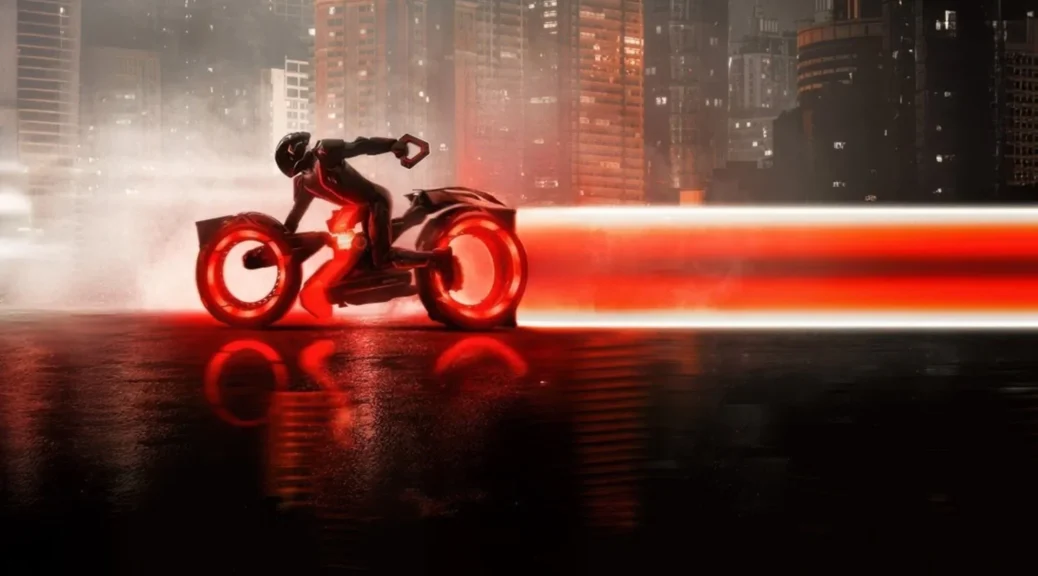
Tron was a fun idea in 1982. What director Joachim Rønning’s Tron: Ares gets very right is its commitment to simplicity, impressive yet simple visual effects, and soundtrack.

Greta Lee is Eve Kim, head of ENCOM, a tech industry whose whiz kid founder vanished back in the 80s. Kim’s been working on AI that can materialize into something concrete—like an orange tree. But she’s missing the string of code that will make the thing permanent, helping her eradicate hunger and do so many other good things AI will clearly never actually be used to do.

Meanwhile, megatech competitor Julian Dillinger (Evan Peters) is materializing soldiers, of course. But their impermanence is a stickler for him as well.

The race is one to own the permanence code! Natch, Dillinger sends one of his soldiers (Ares, played by Jared Leto) to nab Kim, leading to adventures inside and out of “the grid”.

Is it dumb? Of course it is. Is it fun? Sometimes it really is! There’s a motorcycle chase that looks amazing, a gorgeous opening sequence, and visuals that manage to be both forward thinking and adorably retro—kind of a highly polished version of a tech world as imagined in the early 1980s.

Supporting turns from effortless badass Jodie Turner-Smith and ever glorious Gillian Anderson class up the joint. And did I mention the characteristically jarring, distorted and sorely missed sounds of Nine Inch Nails?

Jared Leto does his best Jared Leto, handsome and wise and weirdly stiff. Whatever. But Greta Lee is clearly better than the material, which can’t help but elevate the few scenes requiring true acting. She runs well too. And Peters is a bit of fun as our favorite punching bag, the spoiled, entitled, weak tech billionaire playboy. (He’s no Nicholas Hoult, but the performance is still solid.)

Is Tron: Ares great? It is not. But it doesn’t suck, either.

Tale of Three Pretties

Kiss of the Spider Woman

by George Wolf

Trusting Bill Condon to bring the Kiss of the Spider Woman stage musical to the big screen is an understandable choice. With Dreamgirls, Chicago and even Beauty and the Beast, the man has shown he knows how to write and/or direct the necessary pop and pizazz.

He brings both again this time, just enough to offset what’s lacking on the political intrigue side of the ledger.

Based on the 1993 Tony Award-winning adaptation of Manuel Piug’s 1976 novel (which also spawned the 1985 film version), Condon’s Kiss keeps the core story intact. It’s set after Argentina’s coup d’état in the late 70s, when the military dictatorship began rounding up scores of political opponents.

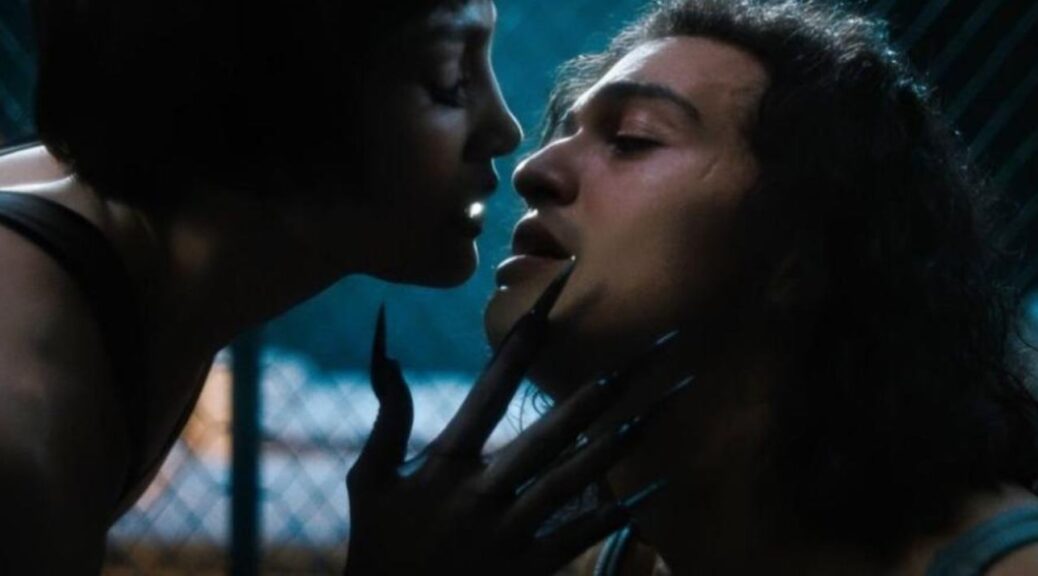
One of these activists, Valentín (Diego Luna), is sharing a jail cell with Molina (Tonatiuh), a window dresser who has been convicted of “public indecency” with another man. To brighten their spirits, Molina begins regaling Valentín with the plot of one of his favorite movie musicals starring the glamorous Ingrid Luna (Jennifer Lopez).

All three actors impress in multiple roles, as Condon crafts the fantasy song-and-dance numbers with the staging, visual panache and aspect ratio to recall the golden age of Hollywood. Shifting often from lavish sequence to jail cell squalor, the film’s two plot lines begin to mirror each other, and some layers of love, loss, and sacrifice grow stronger than others.

The fantasy throwbacks, queer and Latin influences pull each other along nicely, but Condon never quite establishes the prison as a setting with real grit or tangible danger. Granted, it’s tricky to walk this line without recalling too much Man of La Mancha. But the lengths which Condon goes to differentiate the worlds visually only makes those slippery tone shifts more curious.

Is it entertaining? It is, even at just over two hours. JLo is award-worthy yet again, Luna is quietly heroic and Tonatiuh (Carry-On) delivers a smashing and star-making breakout turn. Give in to them all, and Kiss of the Spider Woman can get you lost in the fantasy.

Don’t Wanna Grow Up

Roofman

by Hope Madden

It’s been nine years since Derek Cianfrance directed a feature, but he’s still drawn to beautifully impossible tenderness and insurmountable longing. This time, though, the story is true.

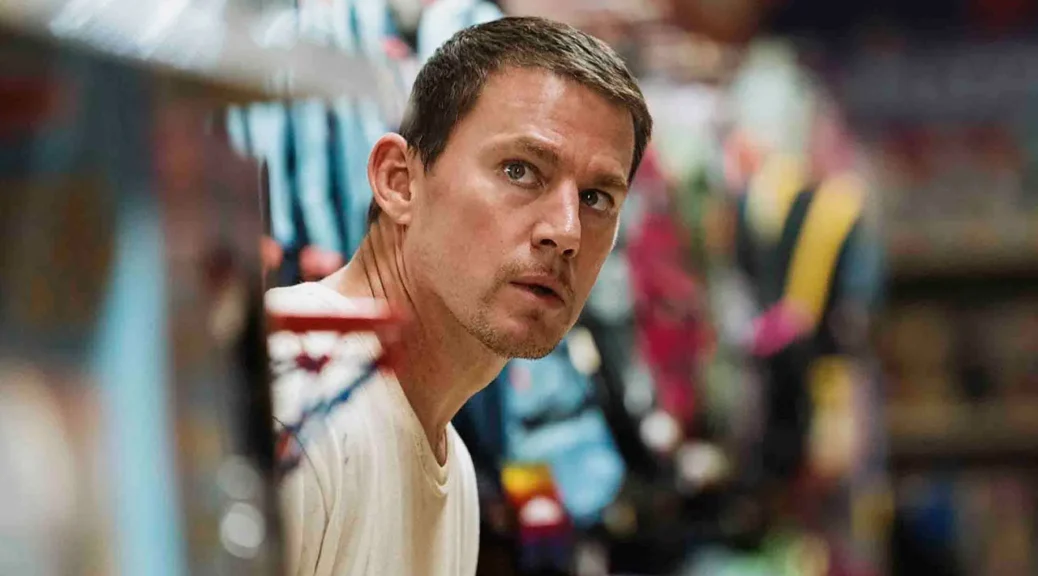
Roofman, which Cianfrance co-wrote with Kirk Gunn, tells the somehow delightful story of Jeffrey Manchester (Channing Tatum). In 2000, Manchester was convicted of breaking into a series of McDonald’s locations by drilling through the roof. Like the gentlemanly true-life bandit of Old Man and the Gun, Manchester is remembered by his victims exclusively as a good guy.

That didn’t lighten his sentence, but no matter, because by the beginning of Act 2, the real story begins with Manchester on the run and living inside a Toys-r-Us.

Cianfrance and Gunn keep pretty close to the real details of the case, perhaps because the story’s nutty enough as is, or maybe because it’s not the story beats they’re looking to explore. Roofman is a film more fascinated by the human than the criminal, and Tatum’s characterization brims with humanity.

Channing Tatum can be hit or miss, but his strongest performances are those that allow him to find both vulnerability and humor in a character. He’s never been better than in Zoë Kravitz’s Blink Twice, where he tinged his techbro narcissist with just enough amiable doofus to be truly terrifying. But his turn in Fly Me to the Moon sank because he was the handsome, brilliant straight man—not funny, not dumb, not broken.

Luckily, Cianfrance understands Tatum’s strengths and Roofman offers the actor ample opportunity to be all three of those things. The result is an affable, broken sweetheart of a crook you can’t help but root for, even though you know he’ll probably shoot himself in the foot.

Tatum’s not alone. Kirsten Dunst is steal-the-show wonderful as Leigh, the Toys-r-Us employee Jeffrey falls for. Peter Dinklage is a ton of fun as Mitch, unfeeling store manager with a weakness for No Doubt. Ben Mendelsohn turns up in a small but entertainingly off-brand character. And as Jeffrey’s army buddy Steve, LaKeith Stanfield’s weary, wiry performance offsets Tatum’s lovable dumbassedness as a stark reminder of the type of person who can survive as a criminal.

Like Blue Valentine and A Place Beyond the Pines, Roofman is another romantic look at good dads who make bad decisions. Cianfrance may be preoccupied with one story, but he does tell it well.

Machinations of the Gods

Deathstalker

by Hope Madden

From the Saturday morning lunacy of Psycho Goreman to the puppet chaos of Frankie Freako, Steven Kostanski has mastered the art of recreating the most ridiculous entertainments of Eighties youngsters. He wasn’t always this way. His 2016 film The Void was an outright, non-satirical horror, and it was great, kind of Halloween 2 by way of H.P. Lovecraft.

But Manborg (2011) and Father’s Day (also 2011) suggested early that Kostanski’s heart is with silly, juvenile retoolings of the crap we watched as kids in the 80s.

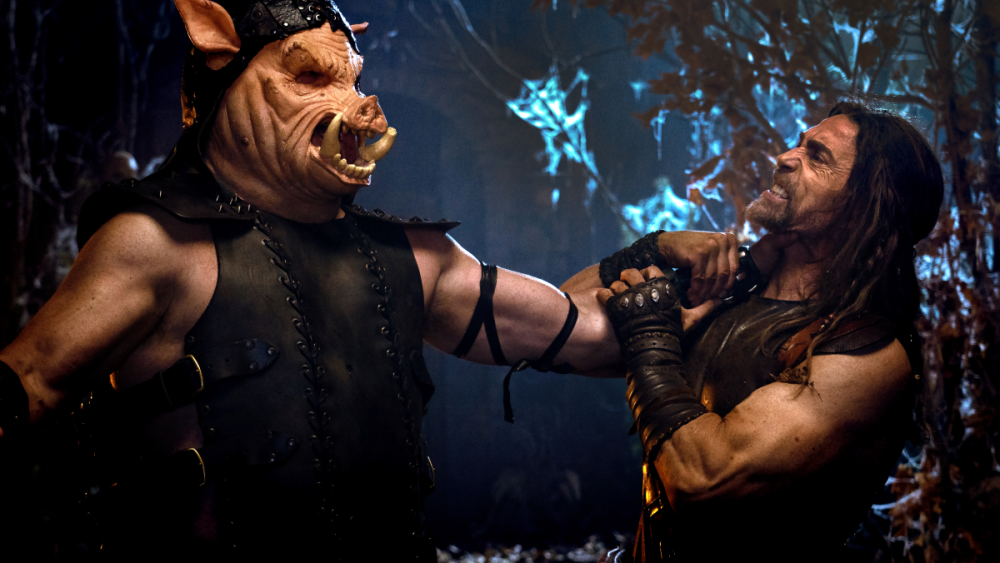
His latest, Deathstalker, is another reminder of how we wasted our mornings, middays and late nights. A loose and intentionally silly remake of the 1983 Barbi Benton vehicle, Deathstalker returns to a time when special fx were ludicrous, costumes were Spirit Halloween level authentic, and drama was high.

Like any of those earnest swords and sorcery fantasies, there’s a barely clothed and begrudging hero, a magical sidekick mainly there for exposition and comic relief, and a young one to mentor and learn from.

And, again, really bad masks and Halloween decorations.

Our reluctant hero is the titular Deathstalker, played by longtime action character actor Daniel Bernhardt, who’s played a soldier/assassin/villainous athlete in everything from Bloodsport 2 throughand Nobody 1 & 2.

His soldiering behind him, Deathstalker contents himself with scavenging from dead knights fighting an unholy army. But an amulet he takes from one not-quite-dead knight compels him on a journey to save the universe from endless darkness and torment.

Naturally, he’ll need the help of a wizard who can translate the runes on the amulet and explain long lost history and curses and what not. Doodad’s the name, voiced by Patton Oswalt and performed by Laurie Field. The diminutive wizard is a perfect ode, but two wheels is hardly enough. A brash young upstart is required, and Brisbayne (Christina Orjalo) fits the bill.

Kostanski’s touch is so spot on, and his chosen subgenre is so ridiculous to begin with, that you may forget this is a spoof, or at least a fun romp. His work is too loving to be truly spoof, but there’s little room in this type of film to go over-the-top with anything. There’s no top. Even for all its wild nonsense, Deathstalker could pass for an honest reboot rather than a comedic retooling.

Nothing will ever match Psycho Goreman for inspired lunacy. Deathstalker certainly doesn’t, but it definitely offers a bit of fun.

Windflower

Anemone

by Hope Madden

As a young filmmaker, would having arguably the most revered actor of his generation—perhaps of all time—as a father be a blessing or a curse? For Ronan Day-Lewis, directing his first feature with co-writer and lead actor (and dad) Daniel Day-Lewis, it seems to be working out.

Anemone is a tale of fathers and sons, of one generation of men inflicting damage upon the next, and the tenderness that either dies, finds an outlet, or runs to madness.

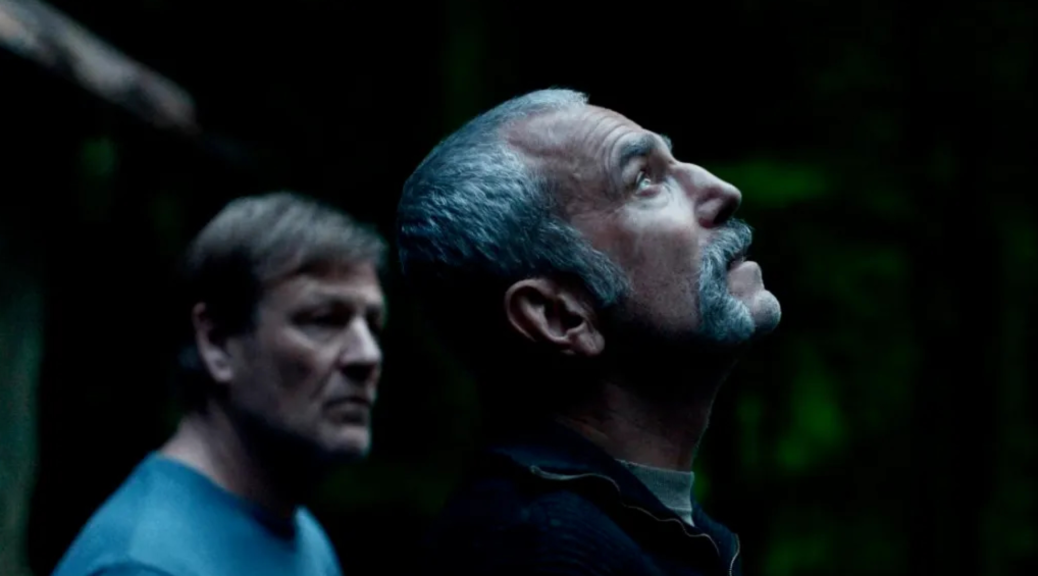
Sean Bean a is Jem, a good man who strikes out from his dodgy neighborhood in Northern England to the woods, led by the navigational coordinates on the back of a page that reads: Anemone: In Case of Emergency, Break Glass.

The coordinates lead him to his brother, Ray (DDL), a hermit since his time fighting against the IRA. Ray is wanted at home.

Like many of Day-Lewis’s greatest performances, his work here impresses with lengthy stretches of silence punctuated by a couple of brilliantly executed monologues. His lean and scrappy physicality belie the character’s vulnerability in ways that expertly match Ray’s reticent then vulgar speech.

Ray’s a man off the rails, while Bean deftly crafts a character who’s found comfort and strength in structure. Neither actor overplays the brothers’ differences, rather falling into a tenuous if lived-in familiarity.

The great Samantha Morton and an impressive Samuel Bottomley round out the cast, but as usual, all eyes are on Day-Lewis.

RDL knows it, not only providing memorable lines, but crafting an atmosphere that evokes Ray’s troubling inner landscape. Bobby Krlic’s (Eddington, Beau Is Afraid, Midsommar) score conjures an angry melancholy while moments of painterly surrealism deliver flashes of beautiful, hopeful madness. Even when lensing the natural elegance of Ray’s isolated world, RDL and cinematographer Ben Fordesman (Love Lies Bleeding, Saint Maud) evoke a magical splendor.

Anemone feels uncertain of how to resolve itself, to bridge the two worlds it creates. Structure failed Ray, and it nearly fails Anemone. But the film offers more than enough reason to believe in filmmaker Ronan Day-Lewis. And if you needed another reason to believe in actor Daniel Day-Lewis, well, here you go.

Tall Tales and Fiction

Killing Faith

by Hope Madden

A raucous opening sequence eventually settles into a classic old Western vibe that keeps you guessing in Ned Crowley’s latest, Killing Faith.

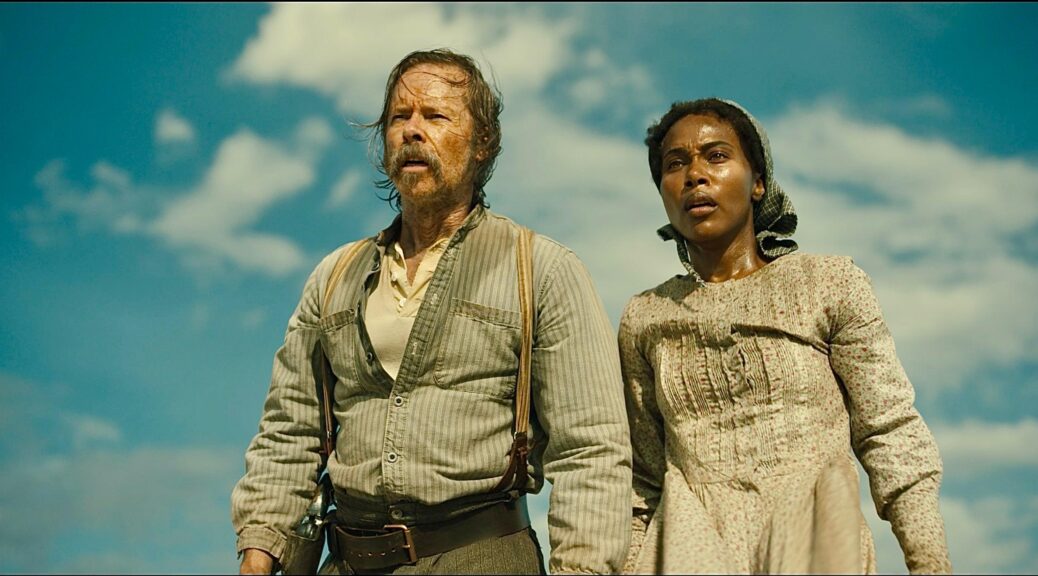
Like Mary Bee Cuddy in The Homesman and Joanna in News of the World, Sarah (DeWanda Wise) is in need of a traveling companion. Her daughter (Emily Ford) needs help that the town doctor (Guy Pearce) can’t offer. Not that the ether-sniffing doc has been much help to his patients of late.

Dr. Steelbender is an ether addict on account of a plague of sorts. Voiceover tells us of a sickness ravaging the countryside almost as savagely as a notorious group of bounty hunters. But Sarah is determined to take her daughter to see Dr. Ross (Bill Pullman) because he deals not just in medicine, but in holy healing.

Crowley’s shot making, particularly in the opening act, is equal parts stunning and unnerving. At his best, he tells the tale like a picture book, images sharing as much of the story as dialog. There’s a grim poetry to the shots that creates an beautifully brutal atmosphere as it delivers information.

Pearce has made a lot of movies, many of them horrible, most mediocre, but he does have a pretty good track record with Westerns. John Hillcoat’s The Proposition is one of the most affecting Westerns of the 21st century. Killing Faith doesn’t nearly reach that high water mark, but it has its moments.

I like the more contemporary Westerns, where no one’s to be trusted and everyone’s a weirdo. Killing Faith is at its most compelling when our little band of travelers finds themselves among unexplained carnage or unexplainable fellow wayfarers. Joanna Cassidy is especially delightful in a macabre way.

But a couple of obvious turns and the general simplicity of the story keep Killing Faith from reaching classic status.

The film loses steam whenever it clings too tightly to its main themes, its hero’s journey. But Crowley elevates that well-worn road with ideas of being haunted by the sight of innocence corrupted, something that connects the Western with dystopian tales, like John Hillcoat’s other Pearce-starring fable, The Road.

All Westerns are about redemption. The best Westerns, new or old, are about hope. Can you allow yourself a flicker of hope? The answer is often what differentiates the classic Western from the contemporary one. Killing Faith toys with those mighty big struggles, sometimes provocatively. The solutions aren’t as interesting as the journey, though.

Poison Pen

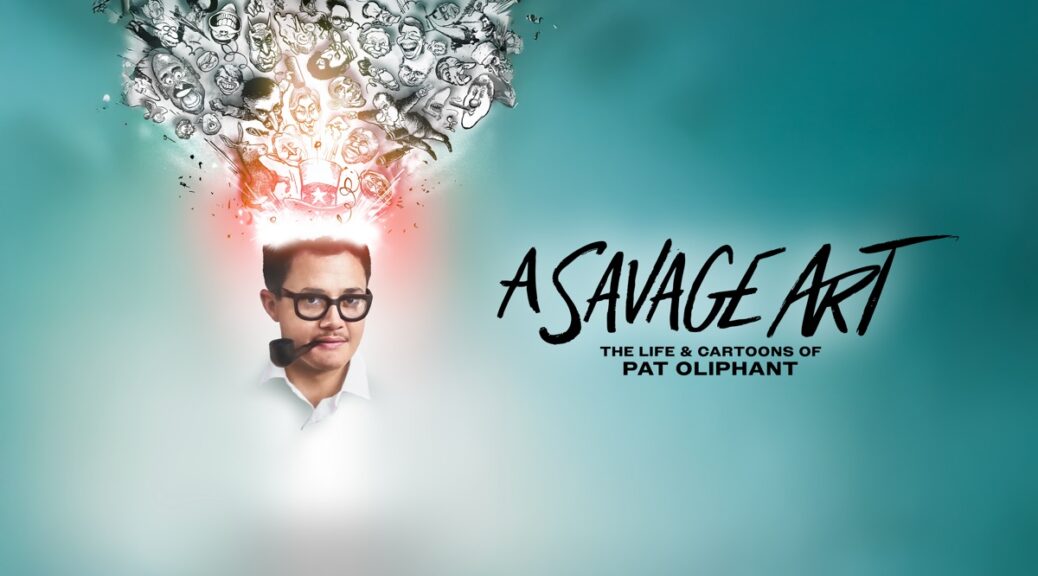
A Savage Art: The Life & Cartoons of Pat Oliphant

by George Wolf

“If Pat Oliphant couldn’t draw, he’d be an assassin.”

That quote gets your attention, even if you don’t know the name Pat Oliphant. Either way, you’ve probably seen some of his work, and A Savage Art: The Life & Cartoons of Pat Oliphant is a broadly effective intro to a legend of political cartooning.

Oliphant wielded a revolutionary artistic style and the kind of cynical mind that had him rebelling against the very committee that awarded him the Pulitzer Prize in 1967. Aided by his alter ego “Punk” the Penguin, Oliphant skewered the political landscape through five decades and ten U.S. Presidents.

In his feature debut, director Bill Banowsky keeps things pretty standard, rolling out a succession of Oliphant’s best cartoons, and chatting with family members and colleagues to provide some personal details that Oliphant himself seems averse to.

And though today’s political and social climate carries some issues that are very relevant to Oliphant’s legacy, Banowsky doesn’t dig in. We do get mentions of the increased threats to a free press, and to the rise of internet memes as a shallow imitation of cartoon commentary, but those seem to be conversations for another day.

Banowsky’s aim is to give a legend his due and maybe spur some interest in learning more. A Savage Art hits that target square.

Slippery

The Ice Tower

by George Wolf

Fifteen-year-old Jeanne doesn’t want to build a snowman. What she wants is an escape, but finds plenty more than she expected in The Ice Tower, Lucile Emina Hadzihalilovic’s dreamlike re-imaging of “The Snow Queen.”

In 1970s France, Jeanne (a wonderful feature debut for Clara Pacini) is among the oldest children in a foster home, where she comforts the younger ones and silently longs for a better life. She finally leaves one evening, taking refuge in an empty warehouse to sleep.

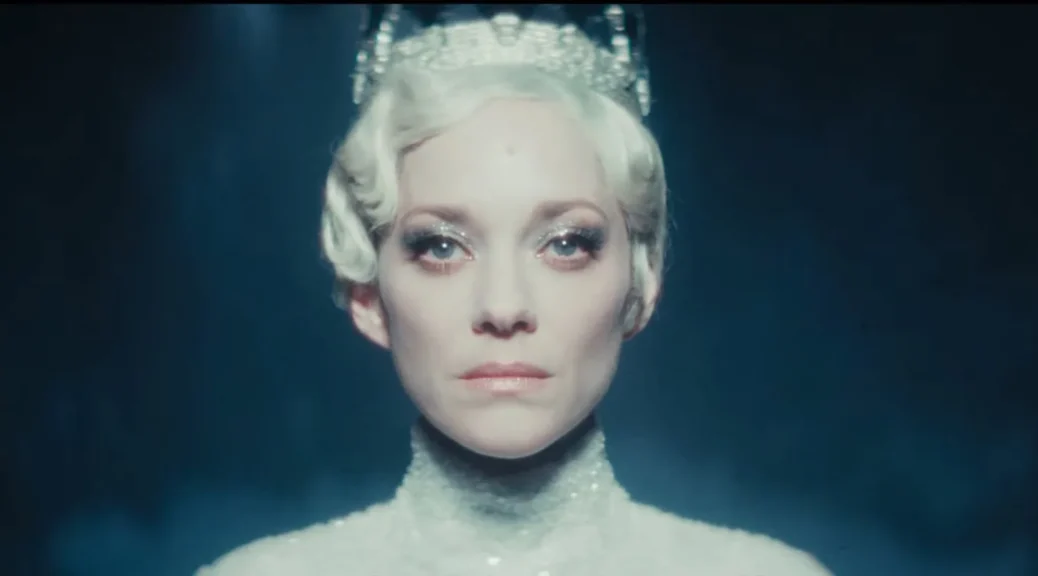
But in the morning, Jeanne finds the warehouse is home to a movie crew, with director Dino (Gaspar Noé, Hadzihalilovic’s husband) filming a new adaptation of the Hans Christian Anderson classic. Mistaken for an extra, Jeanne becomes part of the production and is instantly captivated by the star of the show, Christina (Marion Cotillard).

The Oscar-winning Cotillard is, of course, perfect as the detached and demanding diva who begins to take an equally strong interest in the young Jeanne. But to what end? Hadzihalilovic explores that question with a cold, barren beauty. The aesthetic is tactile and intoxicating, a perfect playground to envelope the film in strange fascination.

The Ice Tower casts an undeniable spell. Despite lingering a bit too long in some dry spots, it crafts an enriching trip to the darker floors of a fairy tale.

No Wake Zone

Bone Lake

by George Wolf

Not long after we meet Sage and Diego, they’re talking about his idea for a novel, debating about what qualifies as “gratuitous” and lamenting that cancel culture has neutered artistic expression.

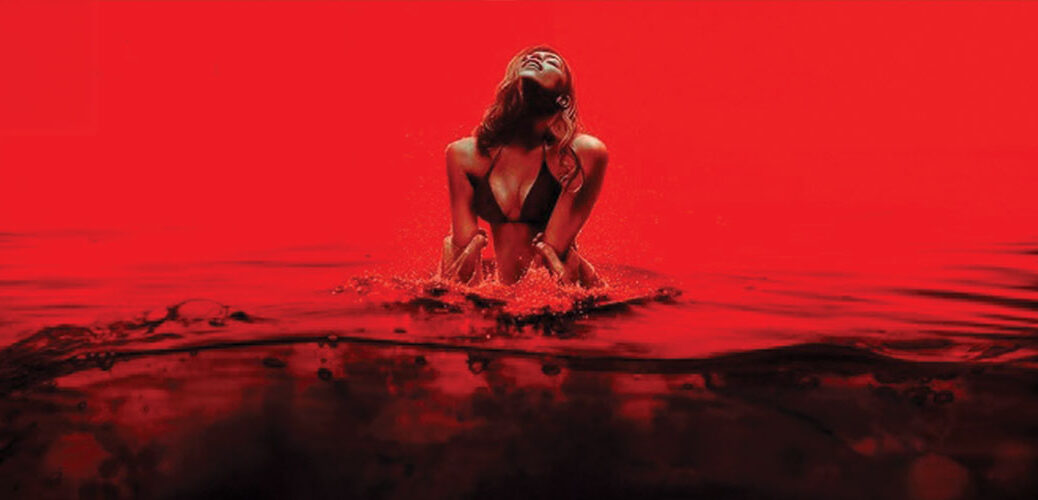
Okay, intriguing. And then you remember that one poster for Bone Lake features the strategically large “R” rating positioned right after the first word in the title.

Alrighty, then, we’re gonna push some limits with both blood and lust, are we? Have some devilish fun with hot button topics and take no prisoners?

No, we are not. We’re going to play it safe and predictable, borrow heavily from better projects and hope some late stage blood splatter stops the questions about why that poster doesn’t read BonePG-13 Lake.

Sage (Maddie Hasson) and Diego (Marco Pigossi) have booked an incredible lakeside mansion for the weekend. Diego’s even brought a ring along to pop the question, but there are two very big complications. Will (Alex Roe) and Cin (Andra Nechita) have also booked the mansion for the weekend! What are four good-lookings gonna do except share the space and really get to know each other?

The character development is rushed but adequate. Will and Cin are openly sexy free spirits, Diego is more buttoned-up and Sage seems to be settling for the comfy life while missing some walks on the wild side. But more than anything, Diego and Sage both seem like a couple of first class idiots.

Writer Joshua Friedlander and director Mercedes Bryce Morgan want to sprinkle some White Lotus sensibilities over a mashup of Funny Games and A Perfect Getaway. But the inspirations are painfully evident, the revelations overly telegraphed, the internal logic gets shaky and the frolicking more silly than sexy.

None of it goes anywhere worth caring about. The marketing angle, an attention-getting prologue and that early art debate make some promises that are never kept, and this trip to the lake is more bore than bone.