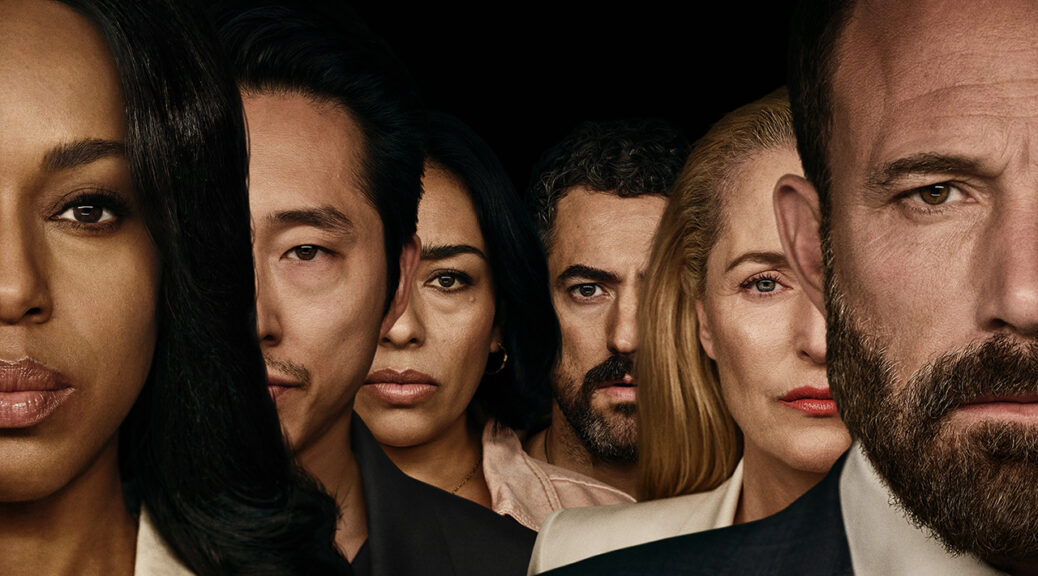
Director/co-writer/star Ben Affleck continues his Netflix partnership with a serviceable thriller that is curious in its timid approach to being thrilling.
Affleck stars as a Los Angeles mayoral candidate who is mulling a big decision to get the funds for one last campaign push. Then his young son is kidnapped, throwing his candidacy and his sputtering relationship with his wife (Kerry Washington) into chaos.
With Steven Yeun as the campaign manager and Gillian Anderson popping in as a high-end fixer, the cast alone is enough to keep you watching. But after borrowing a twist from a similar classic, the film settles into a comfort zone that is just too comfortable.
The editing is choppy, and the narrative feels like it’s been re-shaped by too many producers and focus groups, leading to an unsatisfying final act more in line with a morality play.
There are moments of substance here, but just like too many campaign promises, Animals is a pretty smile without much behind it.
Don’t make the mistake of assuming Jane Schoenbrun’s new feature Teenage Sex and Death at Camp Miasma is a slasher. Or a slasher spoof. Or a satire about slashers.
It’s a sexual awakening brought about by Gillian Anderson. Obviously.
Up-and-coming (pun intended) queer filmmaker Kris (a wondrously vulnerable Hannah Einbinder) has been tapped to reboot a problematic slasher IP. She hopes to convince the Final Girl of the first installment, Billy (Anderson the Great), to return to cinema and star in the film. Turns out, Billy’s a recluse who bought and now lives in the camp from the original film. She hosts Kris for several days of movies, junk food, pot, and deeply sensuous slasher nerdery.
This is—and I say this with as much delight as possible—the nerdiest horror movie ever. How nerdy? The very second you hear yourself saying “that’s a split diopter,” Schoenbrun stand-in Kris says it out loud. When Kris apologizes for asking too personal a question of Billy, fearing it could be a #metoo violation, Billy replies, “I auditioned for The Burning. You know who made that, right?”
Nerds! And the best kind of nerds. Horror movie nerds! Sleepaway Camp trivia meets Friday the 13th nostalgia in a gloriously queer, brazenly shameless, wonderfully horny new horror film.
Like their last two features, We’re All Going to the World’s Fair and I Saw the TV Glow, Teenage Sex and Death at Camp Miasma concerns itself with transformation, identity, and horror. But Schoenbrun’s latest drops the dreamy melancholy of the previous films in favor of something tender, beautiful, and accepting.
The gender iconography littered across every scene finds its zenith in Little Death (that name!), the transgender marauder with a double-blade spear and an air vent helmet. (Honestly, if you haven’t read Carol J. Clover’s Men, Women, and Chain Saws, you should. Schoenbrun certainly has.)
TSADACM, like Schoenbrun’s last two films, is a gorgeous watercolor fever dream. It’s funny, incredibly bloody, and unabashedly in love with the aggressively sexual and sexually ambiguous slasher, no matter how problematic. Perhaps because it’s problematic.
The film is not just a wonderful walk through another person’s psyche, although it is that. It’s also a fascinating, deeply satisfying kick of a horror movie. You should go.
Tron was a fun idea in 1982. What director Joachim Rønning’s Tron: Ares gets very right is its commitment to simplicity, impressive yet simple visual effects, and soundtrack.
Greta Lee is Eve Kim, head of ENCOM, a tech industry whose whiz kid founder vanished back in the 80s. Kim’s been working on AI that can materialize into something concrete—like an orange tree. But she’s missing the string of code that will make the thing permanent, helping her eradicate hunger and do so many other good things AI will clearly never actually be used to do.
Meanwhile, megatech competitor Julian Dillinger (Evan Peters) is materializing soldiers, of course. But their impermanence is a stickler for him as well.
The race is one to own the permanence code! Natch, Dillinger sends one of his soldiers (Ares, played by Jared Leto) to nab Kim, leading to adventures inside and out of “the grid”.
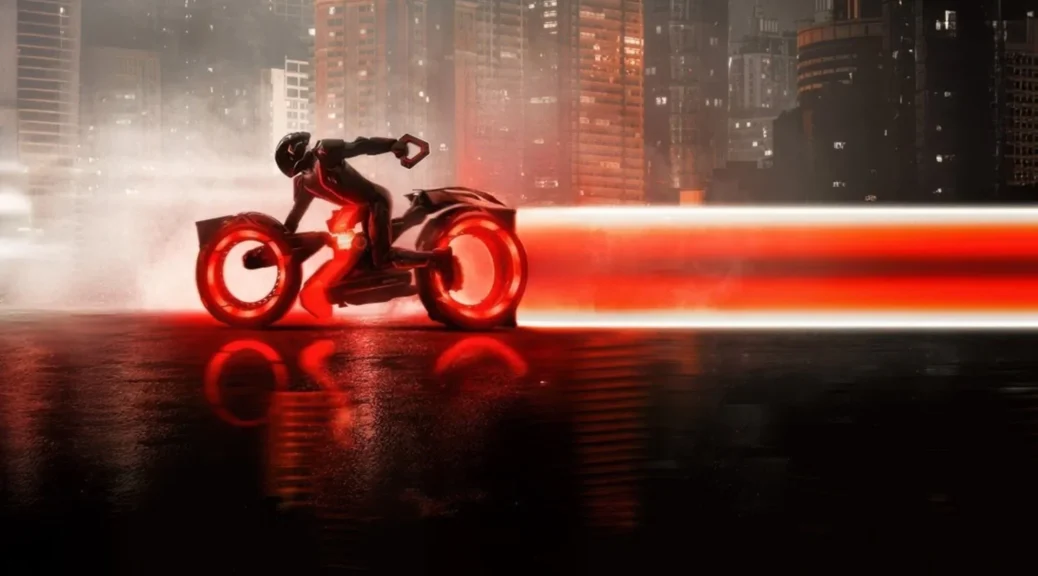
Is it dumb? Of course it is. Is it fun? Sometimes it really is! There’s a motorcycle chase that looks amazing, a gorgeous opening sequence, and visuals that manage to be both forward thinking and adorably retro—kind of a highly polished version of a tech world as imagined in the early 1980s.
Supporting turns from effortless badass Jodie Turner-Smith and ever glorious Gillian Anderson class up the joint. And did I mention the characteristically jarring, distorted and sorely missed sounds of Nine Inch Nails?
Jared Leto does his best Jared Leto, handsome and wise and weirdly stiff. Whatever. But Greta Lee is clearly better than the material, which can’t help but elevate the few scenes requiring true acting. She runs well too. And Peters is a bit of fun as our favorite punching bag, the spoiled, entitled, weak tech billionaire playboy. (He’s no Nicholas Hoult, but the performance is still solid.)
Is Tron: Ares great? It is not. But it doesn’t suck, either.
So begins Gurinder Chadha’s Viceroy’s House, a film that focuses on the transition of power from England to India and the partition of India into two countries. It’s an interesting sentiment as the film seeks to show that in the transition of power, there are no victors.
With a history such as India’s, Chadha makes the wise decision to focus the bulk of the story within the confines of the viceroy’s house and grounds. The film opens with the arrival of India’s last viceroy from England, Lord Mountbatten, with his family. Because of the intimacy of the setting, the audience is privy to the negotiations between the British and the leaders of India. Many will recognize Mahatma Gandhi, but may not be familiar with the other leaders, including the head of the All-Indian Muslim League Muhammad Ali Jinnah, who led the charge to partition India with the creation of Pakistan.
In addition to the wider story focused on this transition of power, a more personal tale is woven behind the scenes through the love affair of Aalia and Jeet. Aalia is a Muslim woman in love with Jeet, a Hindu. As tensions between Hindu, Sikh, and Muslims rise, the two are pulled in different directions as family and religion come between them. Their story provides the audience with a more personal connection to the conflicts that arise as Lord Mountbatten tries to negotiate a peaceful transition of power.
As Lord Mountbatten, Hugh Bonneville plays a familiar role, as those who have seen him in Downton Abbey will recognize the similarities between characters. Gillian Anderson is his wife Edwina Mountbatten. Flawless as always, Anderson is almost underutilized in her role. However, the scenes in which she does appear are riveting. The two are sympathetic as they try to avoid a violent passage of power.
However, the film truly belongs to Huma Qureshi and Manish Dayal. As Aalia and Jeet, they bring life and hope to a movie racked with conflict. As tensions rise, their love is a light in the dark. Though the history of India may be written by the victors, it’s the stories of the people who live through it that connect us to the past.
As a love story, as a history, Viceroy’s House is a moving examination of a tumultuous moment in India’s history.