Category Archives: New In Theaters

Reviews of what’s out now

Love…Exciting and (Not So) New

The Second Best Exotic Marigold Hotel

by George Wolf

The efforts of a talented, veteran cast, coupled with a refreshing attitude toward the love lives of senior citizens, enabled The Best Exotic Marigold Hotel to rise above a tendency for silly contrivance.

The Second Best Exotic Marigold Hotel can’t quite measure up.

Director John Madden and screenwriter Ol Parker return, along with most of the original cast, for a trip back to India where things are busy at the eccentric hotel which caters to “the elderly and beautiful.”

Hotel proprietor Sonny (Dev Patel) and girlfriend Sunaina (Tina Desai) are planning their wedding, but Sunny is distracted by business. He wants to expand, and has reached out to a U.S. firm for financial backing. When American “writer” Guy Chambers (Richard Gere) checks in to the hotel, Sonny is convinced he’s actually a spy sent by the prospective business partners.

Guy has barely gotten his room key before Madge (Celia Imrie) has the hots for him, he has his eye on Sonny’s mom (Lillette Dubey), Sonny is jealous of Sunaina’s childhood friend “Kush” (Shazad Latif), and Norman (Ronald Pickup) is afraid he accidentally took out a hit on his girlfriend Carol (Diana Hardcastle). Plus, Douglas (Bill Nighy) and Evelyn (Judi Dench) still haven’t gotten together!

Maybe Captain Stubing can talk some sense into everyone!

It doesn’t take long to realize how much this installment misses the dear departed Graham, as played by Tom Wilkinson. Beyond Wilkinson’s immeasurable talent, Graham’s thoughtful storyline grounded part one in a graceful humanity that the sequel sorely needs. Gere is a fine addition for sheer star power, but his character only serves as a means to add more empty conflict to all the sit-comery.

It’s too bad, because even with Wilkinson gone, this cast features a vast wealth of talent that can instantly improve most any flailing script. The odd man out again is Patel, whose exaggerated histrionics serve as an annoying distraction from his sublime co-stars.

Despite a few charming moments, this sequel is overlong, overdone, and easily Second Best.


Verdict-2-5-Stars


Hatin’ on Hollywood

Maps to the Stars

by Hope Madden

Who but David Cronenberg could take the bubbling Hollywood cesspool that is Maps to the Stars and create from it a chilly but fascinating snapshot of industry dysfunction?

The truth is that Bruce Wagner’s screenplay requires Cronenberg’s anthropological approach and perverse sense of humor. Without it, he’s written a vulgar soap opera. With it, he’s written a revoltingly compelling, oddly austere essay on the self-indulgent, self-congratulatory, fraudulent, repugnant, insecure insanity that is Hollywood.

The story itself couldn’t be more lurid, which is why Cronenberg’s peculiarly distant style is so effective. Some elements of his direction have changed little since he was bursting heads in Scanners.

What has changed over the decades is his ability to draw talent to his projects, and few of his casts have been as stocked as this one. The great (and finally Academy-acknowledged) Julianne Moore steals every scene as the prototypical damaged, aging starlet. Needy, vulnerable, charming and venomous – Moore hits every note on time and in tune.

The versatile Mia Wasikowska – who played Moore’s daughter in The Kids are All Right – here plays her newly hired personal assistant, or “chore whore” as she so delightfully puts it. Wasikowska’s Agatha is the vehicle for chaos in the film, although given the temperament and predilections of the characters involved, chaos is probably never far away.

Agatha wants to make amends for something she did to her family (Olivia Williams, Evan Bird and a gleefully toxic John Cusack) – something related, we assume, to the scarring on her face and neck. Meanwhile, she falls for a sweet but opportunistic limo driver (Cronenberg favorite Robert Pattinson).

Though the actions, reactions and eventualities are never entirely clear, there’s nothing convoluted about this film. Behaviors and reactions feel insane but never ridiculous, as if every self-serving act – no matter how vile – feels natural in this hotbed.

Maps to the Stars is unforgiving, yet somehow weirdly watchable. Cronenberg’s films can be a challenge – not that they’re necessarily tough to understand, just sometimes tough to stomach. Maps to the Stars is certainly not his most violent, although the violence here is tough and surprising. What makes his latest so startling is that, though these characters are as horrid as those found in his best horror and SciFi, they belong right here in our own world.

No wonder he makes independent films.


Verdict-4-0-Stars


Lazy Lazarus

The Lazarus Effect

by Hope Madden

Four years ago filmmaker David Gelb directed the lovely, layered, joyous documentary Jiro Dreams of Sushi. This weekend we see his newest effort, The Lazarus Effect. What the hell happened?

Gelb abandons novelty and nuance for a by-the-numbers Frankenstein horror. Medical researchers work on a cure for death. Big Pharm is looking to steal their ideas for nefarious gain. Think Splice.

The scientists test their process on animal subjects, but make the leap to human trials a tad prematurely when one of the team-Zoe (Olivia Wilde) – is electrocuted. Things do not go well. Think Pet Sematary.

The serum super-powers Zoe’s brain. Think Lucy.

But Zoe may have been brought back from hell, and may have brought some of hell back with her. Think Event Horizon. Or Flatliners.

It appears screenwriters Luke Dawson and Jeremy Slater have seen enough movies to be able to cobble together plenty of stale ideas to fill 83 minutes, although you will swear the film runs two full hours.

Part of the problem is the blandness of the set. For most of the running time we’re trapped in the hospital’s sub-basement with the doomed scientists. This should create anxiety, develop claustrophobic dread, but the dull set and uninspired direction do little but breed tedium.

Gelb can generate tension now and again, but he doesn’t know how to deliver the payoff. The film is so paint-by-numbers – from the greedy chemical company to the dream sequence, from the dog to the unrequited love to the twist ending – there’s nary a surprise to be found.

Wilde and cast (Mark Duplass, Evan Peters, Sarah Bolger and Donald Glover) can’t bring depth to their characters, though Wilde does give it a shot. There’s more to Zoe than what’s on the page, but not nearly enough to keep the film interesting.

There are plenty of awful horror movies, and The Lazarus Effect is not one of them. It’s succinct, tidy, offers a jolt or two, and it’s held together workmanlike-fashion with enough logic and borrowed ideas to remain lucid for as long as it needs to. But horror also has some great films to offer, and this is certainly not one of those. It’s a disposable February flick and a genuine disappointment from Gelb.

Verdict-2-0-Stars

Pros at Cons

Focus

by George Wolf

There’s something inherently cool about heist movies, isn’t there? Exotic locales, beautiful people, and outlandish schemes to steal lots of cash often play well together. Focus has all the ingredients to be a solid entry to the genre – as long as you don’t mind a certain irony in the film’s title.

Will Smith is Nicky, a veteran con man operating a well-oiled group of sophisticated thieves. He isn’t looking for any new recruits, until young Jess (Margot Robbie) impresses him with her grifting skills and her eagerness to move into the big leagues. So, she joins the team, but after a big score and some quality alone time, Nicky leaves Jess disappointed and hurt.

Fast forward three years, and Nicky is hired to help a Formula One racing hotshot pull a con, only to discover that hotshot’s longtime girlfriend is his own former flame Jess. With old wounds reopened, Nicky is thrown off his game as we try to keep up with just who is conning whom.

The irony is, a film that points out how people are conned with misdirection can’t keep you from noticing the ridiculous age difference in the romantic leads. Older man/much younger woman casting may be a Hollywood tradition, but that doesn’t mean it’s a good one.

That’s not a knock on the actors. Smith is ultra smooth and remains in great shape, and Robbie’s sexy, spunky mix nearly steals the show, but he’s farther past 40 than she is past 19, and the romantic chemistry between them never feels quite true.

The writing/directing team of Glenn Ficarra and John Requa, already with fine credits including I Love You, Phillip Morris, Crazy, Stupid Love and Bad Santa, exhibit a nice feel for the basics that make a heist film tick. It’s often confident, clever and stylish, especially during an early segment which finds Nicky’s crew wandering through a crowd of Bourbon Street revelers and systemically pilfering at will.

Though the final con is a bit underwhelming and the few nods to character development are rushed enough to be unnecessary, Focus delivers some high-gloss fun. It’s fast-paced and sure to keep you guessing, which is good. You don’t want to look too hard for substance.


Verdict-3-0-Stars


Dead and Loving It

What We Do in the Shadows

by Hope Madden

Which sounds more stale, a fake documentary or a vampire movie? Maybe it’s a tie, but don’t let that dissuade you. What We Do in the Shadows – a fake documentary about vampires – is a droll gem of a film, and it feels like a gift during this dreary cinematic season.

That’s right! Believe it or not, filmmakers are still doing something interesting with vampires. It’s as if the collective artistic mind decided to retrieve the once-worthy villain from the shame of Twilight. The great Jim Jarmusch made them cool again last year with Only Lovers Left Alive. That same year, newcomer Ana Lily Amirpour made them mysterious again with A Girl Walks Home Alone at Night. And now What We Do in the Shadows makes them ridiculous – but in a good way.

In the weeks leading up to the Unholy Masquerade – a celebration for Wellington, New Zealand’s surprisingly numerous undead population – a documentary crew begins following four vampire flatmates.

Viago (co-writer/co-director Taika Waititi) – derided by the local werewolf pack as Count Fagula – acts as our guide. He’s joined by Vladislav (co-writer/co-director Jemaine Clement), who describes his look as “dead but delicious.” There’s also Deacon (Jonathan Brugh) – the newbie at only 187 years old – and Petyr. Styled meticulously and delightfully on the old Nosferatu Count Orlock, Petyr is 8000 years old and does whatever he wants.

Besides regular flatmate spats about who is and is not doing their share of dishes and laying down towels before ruining an antique fainting couch with blood stains, we witness some of the modern tribulations of the vampire. It’s hard to get into the good clubs (they have to be invited in) or find a virgin. Forget about tolerating the local pack of werewolves (led by the utterly hilarious alpha Rhys Darby).

The reliably hysterical Clement is best known for his outstanding comic work in the series Flight of the Conchords, and the film benefits from the same silly, clever humor. Together he and Waititi spawned the underappreciated 2007 comedy Eagle vs Shark. Their work here is more charming and good natured, so likely more crowd pleasing.

The filmmakers know how to mine the absurd just as well as they handle the hum drum minutia. The balance generates easily the best mock doc since Christopher Guest. It’s also the first great comedy of 2015.

Verdict-4-0-Stars


Of Whales and Men

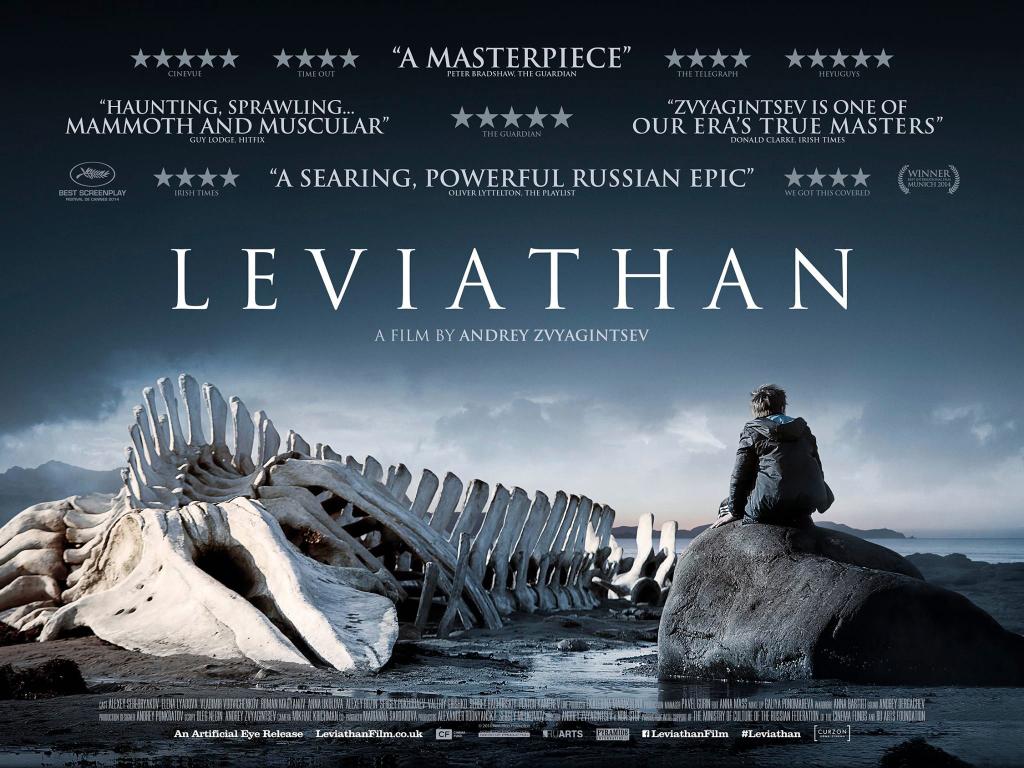
Russia’s contender for the Oscar last week is the devastating everyman struggle Leviathan.

The film is so intimate, so generously detailed yet provocatively ambiguous that you can almost overlook the larger metaphorical drama.

Hard drinking hothead Kolya (Aleksey Serebryakov) finds himself in a losing battle for his own property, a prime piece of beachfront real estate the town’s corrupt mayor wants for his own purposes. Still bullishly optimistic, Kolya calls in a favor from an old army buddy, now a high powered Moscow lawyer. The lawyer has dirt on the mayor, but justice is complicated in Russia.

Director Andrey Zvyaginstev draws wonderfully understated performances from his entire cast. Serebryakov is an aggravatingly empathetic center, profoundly flawed but deeply human. Equal to him is Elena Lyadova as Kolya’s world-wearied, enigmatic wife. And Roman Madyanov is sloppy perfection as the old school Russian thug/politician.

Zvyaginstev’s vision is one of Russia in transition. Old World practices mesh with a current sense of entitlement from the Orthodox Church, and the newly democratic Russia seems to find its footing in the same old place – the throat of the people.

The film is richly allegorical from start to finish. The visual metaphors, in particular, are sometimes heavy but never unintentionally so. Zvyagintsev means to slap the audience now and again with both the overwhelming plight of the Russian everyman, and with his fighting spirit – boozy and bruised, but hard to extinguish.

Cinematographer Mikhail Krishman’s astonishing photography connects the viewer to the rugged beauty of the Russian land, the very earthliness that holds Kolya so firmly. He can trace his attachment to this plot of oceanside property for generations and without it, he’s terrifyingly untethered – a lost soul.

Leviathan is not without humor, and though Kolya’s plight grows overwhelming in biblical proportions, Zvyaginstev refuses to lose sight of the intimate, personal battle that grounds his epic metaphor.

It’s a breathtaking feat of filmmaking.


Verdict-4-0-Stars


Brilliant Disguise

Force Majeure

by George Wolf

“Well If I would have been there I would’ve…”

You’ve heard it, and said it, so many times that the meaning is often lost. Force Majeure (Turist) studies the phrase like a social experiment, and brilliantly exposes the folly in convincing ourselves of our own righteous intentions.

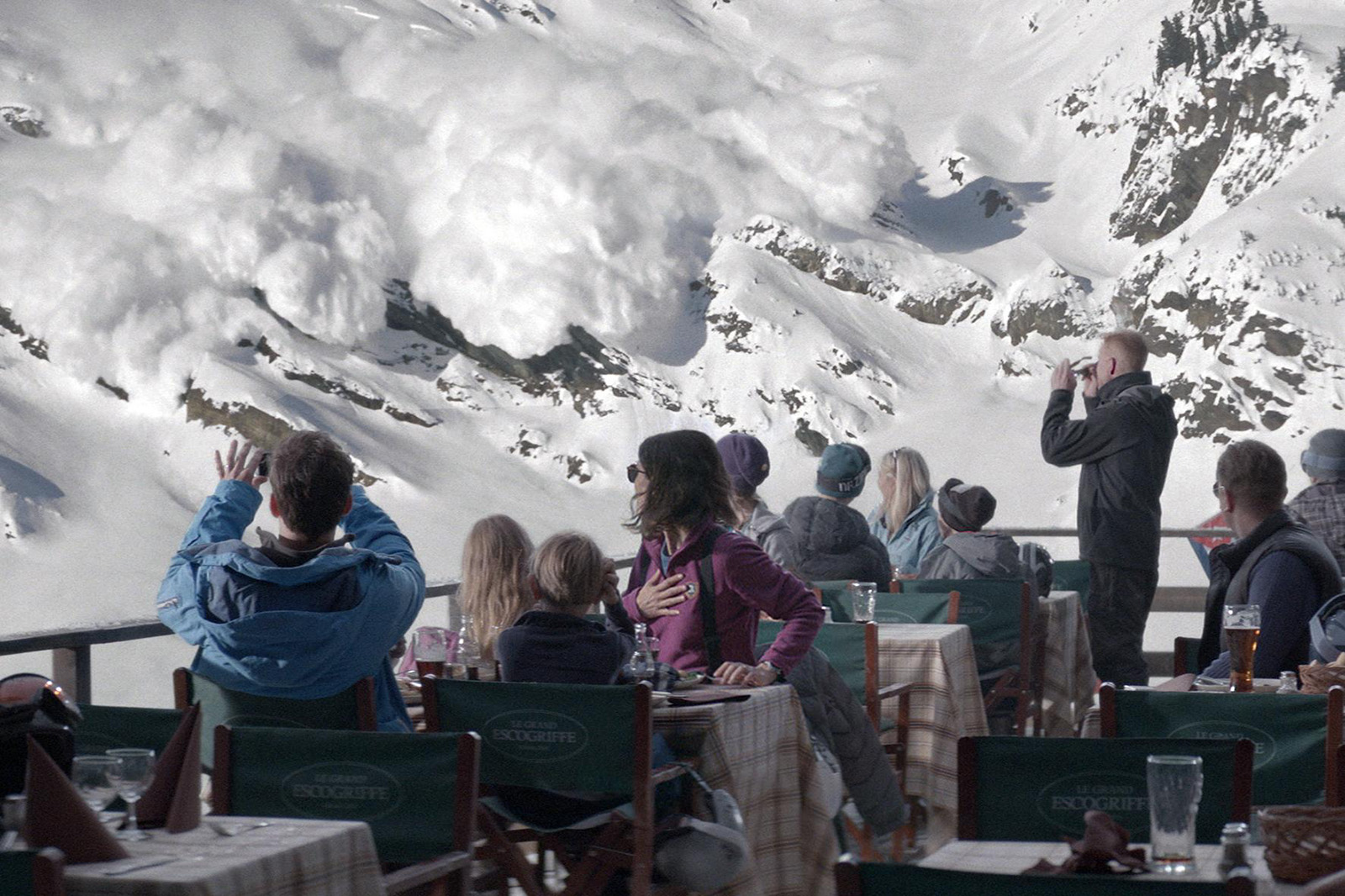
Tomas (Johannes Kuhnke), Ebba (Lisa Loven Kongsli), and their two children are enjoying a ski holiday in the French Alps. Things are fine until they take lunch on an outside patio. Suddenly, an avalanche strike seems imminent, and the danger elicits very different reactions from husband and wife. Though the scare becomes a false alarm and everyone chuckles at their fear, the family dynamic has been rocked to the core.

Writer/director Ruben Ostlund pulls a terrific cinematic sleight of hand, employing a pleasant aesthetic while he cooly rips away at a host of societal assumptions. As Tomas and Ebba drop the pretense and begin to bluntly confront each other about what happened, Ostlund raises hefty questions about gender, class, and relationships.

Bruce Springsteen once sang, “God have mercy on the man who doubts what he’s sure of,” and Force Majeure, a Critics Choice Award winner and Golden Globe nominee for best foreign language film of 2014, illustrates the waves that can stir from just a few ripples of such doubt.

When Tomas and Ebba reveal their situation to another couple, the male friend is clearly thrown off balance, and not just for Tomas and Ebba. He transfers their predicament into his own relationship, keeping his girlfriend awake for hours of discussion until he can again feel confident in his own skin. It is a clever way to mirror the audience’s inevitable projection of themselves into the situation.

With all the internal conflict, it’s also worth noting that the film looks great, and it’s clear Ostlund’s mountainous setting was no accident. On the ski slopes, there can be plenty of rough spots among the beautiful terrain, and this backdrop remains a nicely subtle parallel to marriage itself.

Much like the conversations you may have after the film, Force Majeure can be uncomfortable in the way it shines a light on aspects of ourselves often kept under wraps. But Ostlund ultimately leaves any judgements up to us, along with the urge to question any we might make too quickly.

Verdict-4-0-Stars


A Pretty Fun Neighborhood

The DUFF

by George Wolf

The DUFF may not be the best teen movie ever made, but after the string of If I Stay‘s and Fault in Our Stars‘s the last few years, it feels like Citizen Kane. Characters, humor, smarts, acting…what a nice change.

It’s based on a “young adult” novel by Kody Keplinger and centers on Bianca (Mae Whitman) a high school senior who is aghast to learn she is known in social circles as a DUFF – the Designated Ugly Fat Friend. Ouch. Even though she is assured the label doesn’t mean she’s ugly and/or fat – just the one people use to get to her hotter, more popular friends – Bianca feels some changes are in order.

First, she breaks up with her longtime besties, then turns to her neighbor Wesley (Robbie Amell) – who just happens to be the football captain and a certified Mr. Popular – for advice on how to shed her DUFFness and catch the eye of her big crush, Toby.

So, yes, it’s a white suburban makeover movie with an outcome that’s never in doubt, but The DUFF is saved by winning performances and a confident self- awareness that trusts its audience enough to aim higher than YA melodramatic angst.

Josh A. Cagan’s script serves up all the teen movie staples, but does so with a lovable wink that never becomes outright parody, while it also manages to touch on some serious issues (cyber-bullying, hurtful stereotypes) with an amusing subtly. Even the overused devices of narration and lessons-I’ve-learned essay writing don’t seem quite so tired here.

Director Ari Sandel provides a lively pace and plenty of visual flair, surrounding Bianca with flashbacks, fantasy sequences and on-screen graphics. Think Mean Girls meets Scott Pilgrim, and you’re in the neighborhood, a pretty fun neighborhood.

Whitman (one of the few bright spots in The Perks of Being a Wallflower) is a treat, and she carries the film with a winning performance that shows a real flair for comic timing. Amell (TV’s The Tomorrow People and The Flash) is just as good, creating a genuine chemistry with Whitman that is perfectly endearing. Rather than the one-note fawning hot boy and the girl with hidden specialness, The DUFF gives us main characters that seem human, and both Whitman and Amell take advantage.

Okay, so maybe it does dip a toe in sentimental waters once or twice, but The DUFF has enough going for it to make it a breezy charmer. And I didn’t even mention the great Alison Janney as Bianca’s mom!


Verdict-3-0-Stars


Let’s Not Do the Timewarp Again

Hot Tub Time Machine 2

by Hope Madden

Every year or so there’s a film that simply should not work, but does. Machete. Kick-Ass. Hot Tub Time Machine. And every year or so, Hollywood leeches what it can from the fresh, silly, undemanding body of that film with a lifeless and inexplicably mean-spirited sequel. I give you: Hot Tub Time Machine 2.

Lou (Rob Corddry) turned his miserable life around at that ski resort in 2010/1986. Or not. Turns out, Lou is still a big problem in that he’s a toxic asshole, so someone shoots him and it’s up to his remaining friends (Craig Robinson, Clark Duke – John Cusack is noticeably, wisely absent) to fire up the hot tub and stop the murder before it happens.

The fact that the hot tub sends them to the future hardly matters in this lazily scripted semen joke of a film.

Gone entirely, along with Cusack, are the charm and good nature of the original, the light heartedness that offset the darker edges and made the toilet humor and sex jokes almost endearing. It was a nostalgiafest, complete with “I want my two dollars!” shouted at John Cusack from a ski slope. Priceless.

With no such built in fondness for 2025, and Corddry in the lead, the sequel is just a smattering of self-referential gags held together with homophobia and misogyny.

Corddry is a magnificent, unseemly talent, but he’s not a lead. With Lou in the center of the film, rather than the charming, curmudgeonly everyman of Cusack, the movie substitutes an anchor for flailing misanthropy. That’s hard to build on.

The lack of a lead is one of the film’s larger concerns. Corddry, returning time-tripper Craig Robinson, and new 4th wheel Adam Scott are all comic talents, but also all side characters.

With Steve Pink returning to direct another script from Josh Heald, you might think lightning could strike twice, right? No. Let’s be honest, no one thought this film would be any good. We’re all still stunned that the lightweight goofiness of the original was as entertaining as it was. Who knows how that worked, but whatever ingenious, low-brow magic put Crispin Glover (two arms or one) at that ski lodge, it’s missing from the sequel.

But rape jokes are always funny, right?

Verdict-1-5-Stars

Running Down a Dream

McFarland, USA

by George Wolf

Once, during one of my high school cross country meets years ago, a teammate and I were running together when we came upon a runner from another school who had collapsed in pain. As we passed our rival, my teammate looked down at him and unleashed a string of expletives meant to wish him anything but well.

The point is, I wanted to tell that story and reviewing a film about high school cross country seemed the best time to do it.

McFarland, USA, is the latest from Disney’s division of inspiring sports stories, and it’s a perfectly pleasant if unremarkable take on… an inspirational sports story.

In the late 1980s, a high school teacher and coach named Jim White started a cross country team in the small, mostly Hispanic town of McFarland, California. Despite very humble beginnings, the team won the state championship in its very first year and didn’t look back, ultimately becoming a powerhouse program.

It really is a nice underdog tale, and I’m surprised it took this long to get a film adaptation. It comes complete with the “white savior” angle, and an understandable logic in telling it from his point of view. Coach White’s (even his name is tailor made for suburbia!) status as the main character doesn’t hit you like a blind side (pun very much intended) of manipulation, and there are ample opportunities to make salient points about the changing fabric of America.

Though the script isn’t as serious about these issues as it could have been, at least the effort is there, buoyed by some graceful direction from Niki Caro (Whale Rider, North Country). We learn, as the coach does, about a segment of the country that’s often out of sight and out of mind. But as the team comes together and lessons are learned, the film is content to keep the cultural issues broadly drawn, toeing an awkward line between awareness and pandering.

As Coach White, Kevin Costner gives the film exactly the type of rock solid anchor you would expect. Through the periods when the narrative seems less than believable and his supporting cast wavers, Costner’s earnest authenticity provides constant forward momentum. And though Maria Bello’s role is reduced to the obligatory supportive helpmate, she and Costner do manage a sweet chemistry.

A touching introduction to the real people of McFarland, USA ensures the film hits the finish line on a high note, even if the result isn’t quite one for the record books.


Verdict-3-0-Stars


https://www.youtube.com/watch?v=j-VAOlHGE6Q