Category Archives: New In Theaters

Reviews of what’s out now

The Spirit Rooms

Winchester

by George Wolf

Helen Mirren in a haunted house? Could be fun.

But let’s be honest, Helen Mirren in a bouncy house sounds fun, too, but we come to Winchester looking for some solid frights as well. Instead, we get a mostly nonsensical mishmash of jump scares and music stabs.

Directors/co-writers the Spierig Brothers (Daybreakers, Jigsaw) dive into the legend of the Winchester house, the mysterious mansion in California with endless oddities and rumors of spirits restless after meeting death at the barrel of a Winchester rifle.

Mirren is family matriarch Sarah Winchester, still grieving from the losses of her husband and child in 1906. She orders constant construction on the house, building room after room for the wandering spirits, and the Winchester company board sees an opening.

Dr. Eric Price (Jason Clarke), battling demons of his own, is hired to stay at the mansion and evaluate Sarah’s sanity, hopefully returning a verdict that would force her out.

Bumps in the night ensue.

Mirren and Clarke both rise above the material, which is pretty weak. The Spierigs can build no simmering tension or creepy atmospherics on the order of say, The Woman in Black (a very effective PG-13 haunter). Winchester is built only from standard “boo!s” and lazy red herrings.

Boo indeed.

Three’s Company

In Between

by Rachel Willis

For women stuck between tradition and modernity, the choices presented to them can mean happiness or alienation from friends, family, and society. In Between explores these choices through the eyes of three women living as roommates in Tel Aviv.

The women are wildly different. There’s attractive, social Laila, who parties with her friends at night while working as a lawyer during the day. Salma is a tattooed, pierced chef whose parents are determined to find her a suitable husband. Nour, a conservative Muslim, is already engaged, but living in Tel Aviv to complete her degree in computer science.

Writer/director Maysaloun Hamoud, in her debut as a feature filmmaker, builds her narrative first from the perspective of each woman on her own, before drawing the stories together into a larger commentary on the world they inhabit.

The roommates connect over shared desires, as well as shared heartache. A particularly touching scene links Laila and Nour, as they prepare a dinner for Laila’s boyfriend. Laila is nervous, as she’s not cooked for anyone in some time, but Nour, who’s doing most of the cooking, reassures her that she does it for her betrothed all the time. It’s an intimate moment and details the different lives the two women lead.

There are additional intimate scenes between the women, and each is touching in uniquely different ways. A particular moment in which the roommates rally around Nour is both heartbreaking and poignant. It further reiterates the connection between women in a world that can be difficult to navigate, especially as it changes.

As Laila, Mouna Hawa is especially dynamic. She is the embodiment of a woman who knows who she is and what she wants, even if the world around her isn’t ready to accept that. However, Nour, magnificently portrayed by Shaden Kanboura, is perhaps the most interesting character as she is the one who changes most over the course of the film.

Salma’s (Sana Jammelieh) story feels the least explored. Though it carries its own emotional weight, when compared to the others it sometimes feels more like an afterthought.

Hamoud doesn’t shy away from forcing her characters into difficult, sometimes scary situations. Nor does she pull any punches in showing how those situations can leave a lasting impact. It’s often a rather bleak examination of the world women are forced to occupy.

These women have choices ahead of them, but the question is what they’ll have to give up to make them.

The Running Dead

Maze Runner: The Death Cure

by George Wolf

As if the YA heroes in The Maze Runner films haven’t been through enough, here come the zombies!

OK, they’re really zombie-like, after catching the “Flare Virus” that is quickly sweeping the dystopian future world of the trilogy’s finale, The Death CureBut some young adults seem immune, and when Minho (Ki Hong Lee) is among those rounded up for research purposes, Thomas (Dylan O’Brien) and the rest of his maze-running friends hatch a rescue plan.

Director Wes Ball is back to finish what he started with the first two MR films, and he flashes a well-developed eye for the composition of an effective action sequence. From the train-robbing prologue through the exploding finale in the “Last City,” the set pieces from Ball (a former visual effects supervisor) hold up. It’s what fills the time between the action, and how long it takes to reach that finale, that makes The Death Cure such a slog.

The themes are familiar and borrowed from any number of similar films, but it feels like there is a taut and tense action thriller buried somewhere beneath the two hour and twenty minute bloat.

While Will Pouter’s return gives the YA ensemble an impressive talent boost, Patricia Clarkson, playing little more than Standing Around Kate Winslet from the Insurgent series, is unnecessarily wasted. The connective drama here lacks the substance for all the mining it’s given, and the emotional depth the film is trying so hard to reach never materializes.

Still Searching

Hostiles

by Hope Madden

Hey, Christian Bale and Ben Foster are in another Western. Remember how fun 3:10 to Yuma was?!

Well, writer/director Scott Cooper is a very serious man. If there is one thing you won’t call his films—Crazy Heart, Out of the Furnace, Black Mass and his latest, Hostiles—it’s a laugh riot.

Hostiles is a morose Western with too-obvious intentions. Thanks to Bale and cinematographer Mesanobu Takayanagi, though, the result is a graceful if revisionist image. With Takayanagi’s help, Cooper recalls the best of John Ford’s The Searchers, and with Bale’s help he rectifies its worst.

Facing retirement from a lifetime of warring with Native Americans across the West, Capt. Joseph Blocker (Bale) has one final assignment: escort the ailing Chief Yellow Hawk (Wes Studi) and his family back to Montana so he can die with his people.

After many years of hatred and resentment toward Native Americans in general and Yellow Hawk in particular, Blocker wants no part in this “parade.” But he is a good soldier.

The journey offers opportunities for many an adventure, the first of which is the meeting of homesteader Rosalie Quaid (Rosamund Pike). Blocker’s party finds her in her burned-out home, but we already know what happened thanks to the profoundly brutal attack that opened the film.

Over the course of the film’s 133-minute running time, lessons are learned, each one coming at a very bloody cost. Though Bale and most of the supporting players deliver quietly devastating performances, their arcs feel more than forced. They feel patronizing.

Mainly that’s because the Native American actors have no such arcs. Studi, along with Adam Beach, Tanaya Beatty, Q’orianka Kilcher and Xavier Horsechief—the prisoners—are one-dimensional beings of pure wisdom, compassion and nobility.

Which is no doubt preferable to the being nameless, bloodthirsty monsters that stand in for Apache characters.

Cooper sets his tale at a bitter transition in American history when civilization was beginning to overtake the Wild West and people like Blocker were no longer sure of their purpose, no longer comfortable with their past. Like Blocker, Cooper seems determined to right a wrong but, again like his character, he doesn’t seem to know quite how to do it.

There Will Be Stickpins

Phantom Thread

by Hope Madden

Reynolds Woodcock (Daniel Day-Lewis) sews little treasures into the gowns he makes for the most upper of crusts in 1950s London: little notes, wishes, secrets. It is a connection between the creator and the creation, existing regardless of the audience.

In many ways, Woodcock could be a stand-in for writer/director Paul Thomas Anderson, a filmmaker whose work is genius (few would argue) even if there are things about each creation we may not entirely grasp.

Phantom Thread may be his most exquisite and least accessible film. Every frame, every elegant sweep of the camera, every jaunty note from Johnny Greenwood’s score says classic glamour. And at the center of this controlled, rhythmic beauty is Daniel Day-Lewis.

Hard to go wrong there.

Day-Lewis entirely inhabits this character, as you, of course, expect. His Woodcock oscillates between childlike charm and parental dismissiveness, and it’s a beguiling creation: narcissistic but tender, spoiled and selfish but dignified, the epicenter of his universe and yet frighteningly dependent.

The conflict here is subtle. While your eyes will not leave Woodcock and his glorious gowns, the remarkable Lesley Manville refuses to escape your notice. Manville plays Woodcock’s sister Cyril, the business brains to balance Reynolds’s creative genius, yin to his yang, Alpha to his Omega.

Manville is chilly perfection, her every gesture and expression a conundrum of thoughts and emotions. She keeps this man, this art, this world working. There is one scene in particular—Reynolds loses his temper when his breakfast solitude is broken and Cyril reminds him with clarity and authority exactly who is in charge here.

Which brings us, slowly and quietly, to the film’s actual conflict. Woodcock tires of the muse/model/girlfriend living with him, leaves Cyril to remove the problem and heads into the country for a rest. There he meets his next muse, the lovely German waitress Alma (Vicky Krieps).

What follows is an interesting, deeply human, beautifully acted and quite surprising battle for Alpha. And of course, it’s a great deal more than that. Namely, it is a meditation on creation and recreation, on the tricky nature of inspiration, on an artist’s obsession, on the surprising intimacy between creator and creation.

End the Fed

Den of Thieves

by George Wolf

They’re back, baby! The star and one of the five writers from London Has Fallen are reunited, and it feels…so much better than you are thinking right now.

This time, writer Christian Gudegast also takes the director’s chair for his debut feature, an ambitious mix of Heat and The Town and maybe a few other heist flicks I’ll bring up later.

Gerard Butler is Big Nick, an L.A. County sheriff who’s a very bad lieutenant. Some cops just got killed in an armored car job, and Nick is pretty sure it’s the work of Merriman (Pablo Schreiber).

He’s right, but the big score is still to come: a master plan to rob the L.A. branch of the Federal Reserve. Amid some surprisingly engaging dialog, Gudegast effectively contrasts the good bad guys and the bad bad guys, slowly laying the groundwork for a final confrontation while getaway driver Donnie (O’Shea Jackson, Jr.) openly works both sides.

At 140 minutes, it’s at least half an hour too long, bloated with some futile attempts at character development, and a bit tone deaf on police brutality and some other current events. But there is well-plotted tension, some inventive turns among gaps in logic and an Ocean’s/Logan Lucky inspired wrap-up that will bring a chuckle.


Mission Control

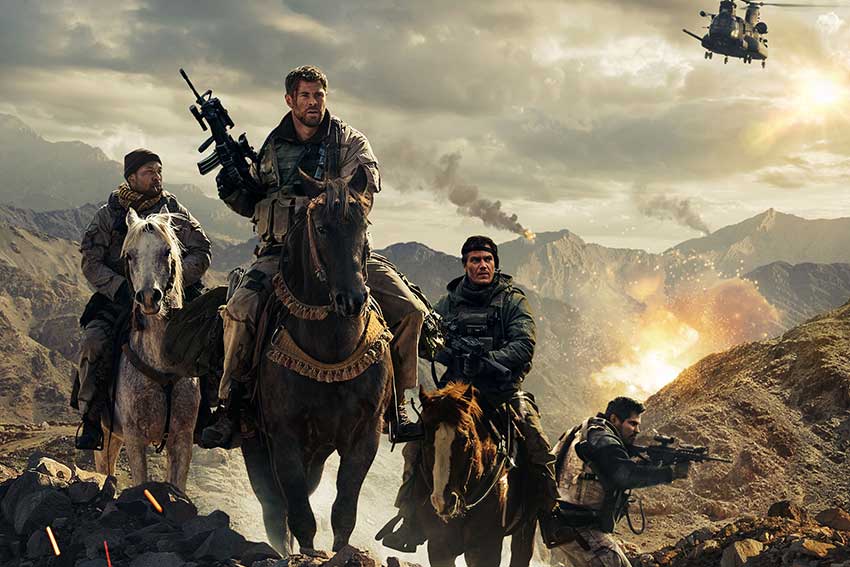
12 Strong

by George Wolf

12 Strong tells a tale of extreme courage and heroism carried out by extremely courageous and heroic men. Like many films on a similar path, it sometimes struggles to navigate the overly familiar tropes that come with this territory.

In the weeks immediately after 9/11, the special forces team now known as the “Horse Soldiers” were the first deployed into Afghanistan. A dozen men, led by Captain Mitch Nelson (Chris Hemsworth, charismatic as usual), joined the soldiers under Afghan warlord General Dostum (Navid Negahban) in an attempt to take back a Taliban stronghold.

Director Nicolai Fuglsig, helming just his second feature, teams with experienced screenwriters Ted Tally (Silence of the Lambs) and Peter Craig (The Town) to adapt Doug Stanton’s book with alternating layers of nuance and shallow cliche.

The men are tough, stoic, and bound by the brotherhood of battle. Their women and children back home must stiffen their lips and hold heads high while they long for their husbands and fathers to return. These traits are not weaknesses in the real world, far from it, but incorporating them into a big screen narrative without the essence of checking off obligatory character-building boxes has become a common obstacle that 12 Strong can’t overcome.

But almost every time you’re ready to give up on it, the film rebounds with a surprise. While there’s far too much exposition dialog, with the characters explaining things to the audience rather than talking realistically, there are also quiet moments that resonate. Dostum’s reminder to Nelson that he may already have a life “better than the afterlife” underscores the film’s success in showcasing the effective teamwork and diplomacy that emerged in the mission, despite the culture clash.

The ensemble supporting cast is loaded with strength (Michael Shannon, Michael Pena, William Fichtner, Moonlight‘s Trevante Rhodes), and Fuglsig finds his footing after a by-the-numbers start, rolling out some tense, gritty, and well-plotted battle scenes for a rousing finale.

The Horse Soldiers earned their statue at the 9/11 Memorial site, and 12 Strong is a well-deserved salute. It’s always watchable but also muddled, and too often chooses broad strokes over finer, more memorable points.

Sowing the Seeds of Love

Call Me by Your Name

by Hope Madden

It’s a languid Italian summer circa 1983 and everything is just so ripe.

Call Me by Your Name, the coming-of-age drama from Luca Guadagnino (I Am Love, A Bigger Splash), swoons. Precocious seventeen-year-old Elio (an utterly astonishing Timothée Chalamet) is surrounded with luscious fruit from the trees, lovely girls from the village, books and music to fill the hours spent with his parents (Amira Casar, Michael Stuhlbarg) in the rural villa where they research Greco-Roman culture.

Then their seasonal research assistant Oliver (Armie Hammer) arrives.

Awash in sensuality, Guadagnino’s love story is unafraid to explore, circling Oliver and Elio as they irritate each other, then test each other, and finally submit to and fully embrace their feelings for one another. Theirs is a remarkable dance, intimately told and flawlessly performed.

Enough cannot be said for Chalamet’s work. He is astonishingly in control of this character, and were that not the case, the age difference between the two characters (Oliver is meant to be 24, though Hammer is 31 which makes the gap seem more disturbing) would have left things feeling too predatory.

Hammer has never been better. Though the young Chalamet’s performance is Oscar-caliber, Hammer matches him step for step, creating a character both vulnerable and authoritative.

A standout in a solid ensemble, Stuhlbarg, looking almost alarmingly like Robin Williams, brings a quiet tenderness to the proceedings, a tone he elevates in a late-film monologue that could not have been delivered with more compassion or love. It’s breathtaking, perfectly punctuating the themes of acceptance and self-acceptance that permeate the film.

But even before Hammer or Chalamet can seduce you, Sayombhu Mukdeeprom does, lensing a feast for the senses. Together he and Guadagnino immerse you in this heady love story, developing a dreamy cadence and alluring palette that invites you to taste.


The Year of Living Politically

The Final Year

by George Wolf

It may be an often misused phrase, but if you’d like an example of someone literally at a loss for words, you’ll find it in The Final Year.

Ben Rhodes, senior advisor to President Barack Obama, is trying to come to grips with the fact that Donald J. Trump had just become President-Elect of the United States. Rhodes tries several times to process a comment, and cannot.

It’s a striking sequence of an entire administration caught by horrific surprise, one of many indelible moments in director Greg Barker’s compelling look inside the final twelve months of the Obama presidency. Beyond the press conferences and photo ops, the film celebrates the daily grind of governing, and builds an ironic vibrancy from the slow and often frustrating march of persistence.

The goal is Obama’s vision of a “global common humanity,” and as the months wind down, we get close to the key players on his foreign policy team: Secretary of State John Kerry, UN Ambassador Samantha Power, National Security Advisor Susan Rice, and Rhodes.

It’s The West Wing with very real, incredibly high stakes, and from the Iranian nuclear treaty to the Syrian conflict, from the Paris climate accords to Boko Haram, we witness a commitment to progress that might be…steady…”harder to dismantle if we take a different turn.”

Which, of course, we did, a fact that lays bare the anchor in this film that’s as bittersweet as it is inescapable. Government needs people this committed, this intelligent, this qualified, this decent, and right now they seem in damn short supply.

Is Barker selective about what sides of his subjects we’re permitted to see? For sure, as that’s what a director does. But whether your political lean is left or right, the suspicion that Barker’s sitting on video of Obama bragging about sexual assault or calling some country a “shithole” would occur only to the most rabid of Hannitys.

It adds up to a fascinating, fly-on-the-wall account of 2016 that arrives already feeling like a freshly opened time capsule from some faraway yesteryear, a magical time when Presidents might have actually cared about other people.


My Roof, My Rules

Mom and Dad

by Hope Madden

I brought you into this world, I can take you out of it.

It’s a joke, of course, an idle threat. Right?

Maybe so, but deep down, it does speak to the unspeakable tumult of emotions and desires that come with parenting. Wisely, a humorous tumult is exactly the approach writer/director Brian Taylor  brings to his horror comedy Mom and Dad.

Horror films have been coming up with excuses to exorcise our forbidden desire to kill our own children for decades, mostly with little-seen cult films like It’s Alive or The Children or Cooties. In those films, the children themselves become monsters and the adults have no choice, you see.

Taylor (co-director of the Crank series) has a different take. In what is basically a long and very bloody metaphor for a mid-life crisis, parents the world over simply give in to an unspecified but urgent need to kill their own offspring.

It’s an epidemic picture, a zombie film without the zombies. Which doesn’t sound that funny, I’ll grant you, but Taylor and a game cast indulge in many of the same family tensions that fuel most sitcoms. They just take it one or two or three demented steps further.

So why do you want to see it? Because of the unhinged Nicolas Cage. Not just any Nic Cage—the kind who can convincingly sing the Hokey Pokey while demolishing furniture with a sledge hammer.

This is one of those Nic Cage roles: Face/Off meets Wild at Heart meets Vampire’s Kiss. He’s weird, he’s explosive and he is clearly enjoying himself.

Selma Blair lands the unenviable role of sharing the screen with Cage, but she doesn’t try to match him as much as keep him focused: they do have a job to accomplish, you know. The result is a fascinating picture of marital teamwork, actually. Good for them.

Taylor’s frantic pace and hiccupping camera mirror Cage’s lunatic energy, and clever writing toys with our expectations while delivering a surprisingly transgressive film.

Others have done it better. (I’m looking at you, Babadook.) But this may be the most amusing way to spend 90 minutes watching people try to murder their own children.