
Category Archives: New In Theaters

Reviews of what’s out now

Like the Beat from a Tambourine

Mamma Mia! Here We Go Again

by Hope Madden

You may be asking yourself, is Mamma Mia! Here We Go Again just 90 minutes of second-rate, b-side Abba songs? All those weird songs that no sensible story about unplanned pregnancy could call for? Songs like Waterloo?

Nope. It is nearly two full hours of it.

Sophie (Amanda Seyfried) wants to open her mother’s crumbling Greek hotel as an upscale island resort. She’s so terribly angsty about it! Will anyone come to the grand opening? Will her mom be proud of her? Can she handle the pressure if her husband’s traveling and two of her three dads can’t make it?

Transition to a simpler time, a time when her mom Donna was young (played by Lily James), bohemian and striking out on her own. She has chutzpah. She has friends who love her. She has great hair.

The majority of the sequel to Phillida Lloyd’s 2008 smash looks back on the romantic voyage that created the three dad business of the first film.

James is a fresh and interesting a young version of the character Meryl Streep brought to life in the original. Likewise, Jessica Keenan Wynn and Alexa Davies make wonderful younger selves for Tanya (Christine Baranski) and Rosie (Julie Walters).

The three dads have young counterparts as well, though only Harry (Colin Firth/Hugh Skinner) lands a memorable characterization. Firth is reliably adorable while Skinner’s socially awkward young man is as embarrassing and earnest as we might have imagined.

Also, Cher.

Expect an awful lot of needless angst and long stretches without humor. Whether present-time or flashback, the film desperately misses the funny friends. Desperately. But when they are onscreen, Here We Go Again cannot help but charm and entertain.

The story is weaker, although there is a reason for that. While the original gift-wrapped an origin story to plumb, the plumbing is slow going when you still have to abide by the Abba songtacular gimmick.

The sequel’s musical numbers rely too heavily on slow tunes and stretch too far to make the odder Abba songs work, but in a way, that is, in fact, the movie’s magic.

Your best bet is to abandon yourself to the sheer ridiculousness of it. There is literally no other way to enjoy it.

I’m On a Boat

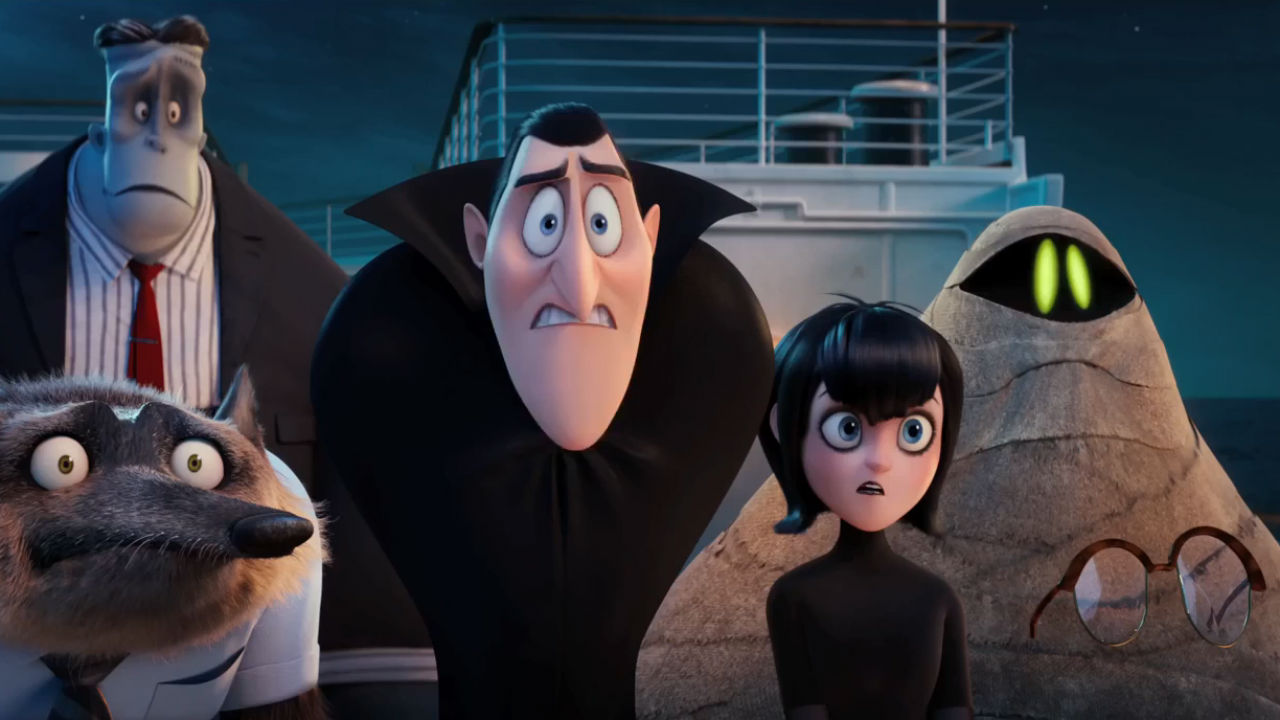
Hotel Transylvania 3: Summer Vacation

by Rachel Willis

These days, whenever an animated movie is released, it’s a near guarantee it will become a franchise. A few of these sequels are as good or better than the originals that spawned them, but most of them aren’t.

There’s nothing inherently problematic with milking successful movies for more material, provided the new stories are able to stand alone. Hotel Transylvania 3 manages to do so, but there are areas of the film that suffer from the same problems as other sequels.

The latest installment in the Hotel Transylvania series introduces us to the centuries-long feud between Dracula and the Van Helsing family. A brief montage shows the audience Abraham Van Helsing’s many failed attempts to destroy Dracula. When it finally seems Van Helsing will no longer be a threat, we’re brought to the present day Hotel Transylvania to catch up with Dracula, his daughter Mavis and their clan of family and friends.

Deciding her dad needs his own vacation based on his more-spastic-than-usual behavior, Mavis books a family trip on a monster cruise. Along for the ride are a number of characters from the previous films, but the new film would have been better served if they’d been left behind in favor of fleshing out the new faces. Aside from Mavis and Dracula, none of the previous films’ characters seem to have been given much thought.

As Dracula, Adam Sandler brings a new aspect to a centuries-old character. Instead of menacing, Dracula is a spaz. While trying to woo the captain of the monster cruise, Ericka, he’s a nervous wreck. It’s an interpretation that serves the franchise well as it provides moments of humor for both children and adults.

Kathryn Hahn as Ericka is a good addition to the series, though her character’s animation is reminiscent of Tweety Bird. She’s a humorous character, and her scenes are among the movie’s best. Hahn plays well against Sandler, and together, they’re the glue that binds the film.

Director Genndy Tartakovsky has helmed all three films in the Hotel Transylvania series, and he’s done well with the material. The latest film will likely appeal to children of all ages, though their parents may surreptitiously check their phones once or twice.

Feel the Burn

Sorry to Bother You

by Hope Madden

The stars are aligning for Boots Riley. The vocalist and songwriter for The Coup—the funkiest radical socialist band you’re likely to find—has managed to produce a wild and relevant satire of capitalism that might possibly find a mainstream audience.

And that’s not because he whitewashed his message.

Sorry to Bother You uses splashes of absurdity and surrealism to enliven the first act “pull yourself up by your bootstraps” tale of a weary young man’s ascension through the ranks of telemarketing. It is a funny and pointed send-up of cubical hell that—unlike most office comedies—focuses quickly on a system that benefits very few while it exploits very many.

There is so much untidiness and depth to relationships, characterizations, comedy, horror, style, message and execution of this film that you could overlook Riley’s directorial approach. He expertly uses the havoc and excess, first lulling you into familiar territory before upending all expectations and taking you on one headtrip of an indictment of capitalism.

Led by Lakeith Stanfield (Get Out, Atlanta) and Tessa Thompson (star of Creed, Thor: Ragnarock and her own gleaming awesomeness), Sorry to Bother You finds an emotional center that sets the friction between community and individual on understandable ground.

Thompson offers bursts of energy that nicely offset Stanfield’s slower, more necessarily muddled performance as the “everyman” central character for a new generation.

And who better to embody everything a capitalist system convinces you is ideal than living Ken doll Armie Hammer? He is perfect—an actor who entirely comprehends his physical perfection and how loathsome it can be. He is a hoot.

Riley’s film could not be more timely. Though he wrote it nearly a dozen years ago, and it certainly reflects a trajectory our nation has been on for eons, it feels so of-the-moment you expect to see a baby Trump balloon floating above the labor union picket line.

Bursting with thoughts, images and ideas, the film never feels like it wanders into tangents. Instead, Riley’s alarmingly relevant directorial debut creates a new cinematic form to accommodate its abundance of insight and number of comments.

Does it careen off the rails by Act 3? Oh, yes, and gloriously so. A tidy or in any way predictable conclusion would have been a far greater disaster, though. Riley set us on a course that dismantles the structure we’ve grown used to as moviegoers and we may not be ready for what that kind of change means for us. Isn’t it about goddamn time?

Pleased to Meet Me

Three Identical Strangers

by Hope Madden

The first time I saw Desperately Seeking Susan, I remember being unnerved by the image of three identical men, all dressed the same and leaning up against a building to ogle Madonna as she exited a cab.

Weird, I thought.

Little did I know that those three brothers were the center of a global media hubbub at the time.

Back in 1980, as Robert Shafran moved into college, he was greeted warmly by many as “Eddy.” The 19-year-old would soon meet his doppleganger.

Eddy Gallan—also adopted, also born July 12, 1961—and Bobby became inseparable friends. Brothers, actually, and their story attracted the attention of several newspapers as well as another young man born July 12, 1961.

When David Kellman joined the crew, three brothers separated at birth held the world’s attention. This story itself, told warmly and with great compassion by documentarian Tim Wardle, is endlessly charming based on the contagious joy the brothers felt to be reunited.

And you coast along on that charm for a while until this nagging idea creeps into the party atmosphere: why were they separated in the first place?

Even those who remember the brothers’ tale will find this recounting fresh and fun. Footage and photos of their time together as young men paired with their own lively recounting of the story creates an energy that entertains. Wardle expertly moves the story forward, offering new, often funny and sometimes touching reminiscences of certain events from those closest to the action.

Wardle’s less a master of visual storytelling. Stylistically, the film struggles. Some painful musical choices, stagy reenactments and otherwise uninspired visual representations give the film an amateurish appearance. Late-film montages of earlier revelations and quotes feel like information force-feeding. But, thanks to the truly fascinating story and the charm of its leads, these missteps don’t derail the effort.

The filmmaker’s strictly sequential chronology relies on your assumptions about documentary and ensures consistent surprises. What begins as a zanier-than-life story slowly turns into a dark tale of conspiracy colored by larger themes of nature versus nurture.

As Wardle pieces together a frustrating puzzle, he’s left with more questions than answers. Constantly revealing a new piece of information, a new source and more complications, the investigation itself becomes as much a character in the film as the triplets.

If nothing else, it is quite a story.

The Sounds of Silence

Leave No Trace

by George Wolf

In her first feature since 2010’s gripping Winter’s Bone, writer/director Debra Granik is again focused on souls living on the rural fringes and scraping out a hardscrabble, under-the-radar existence.

But with Leave No Trace, any sinister, menacing layers have been replaced by a tender, sympathetic grace that feels achingly authentic, and often heartbreaking.

The film is driven by two haunting lead performances.

Ben Foster, surely one of the most underrated actors around, plays Will, a committed single father living deep within a massive state park in Portland. Will and his teenage daughter Tom (Thomasin Harcourt McKenzie) get all they need from their illegal homemade camp in the forest, taking constant measures to avoid being spotted.

One mistake later, Will is desperate to break free from the bureaucratic pressure to adapt, while Tom begins to feel the pull of a “normal” she has never known.

Granik adapts Peter Rock’s novel with a subtlety that stuns, speaking volumes in the silences that would cripple lesser films. Sketches of Will’s backstory are casually provided, allowing the two main performers to let us into the touching bond they create with each other.

Though Foster’s tremendous turn is not exactly surprising, the little-known McKenzie delivers a statement performance full of wonder and quiet power. “Tom,” torn by the love of her father and the need to follow her own heart, becomes our window into this private world, and McKenzie comes nowhere close to any false notes.

Leave No Trace follows its own titular advice, broaching a variety of relevant social concerns without ever raising its voice, yet cutting so deeply you may not get out of the theater with dry eyes.

Less is so often more, and Leave No Trace emits a profoundly minimalistic beauty.

Do Not Open

The Devil’s Doorway

by Hope Madden

So many horror films delve into those murky holy waters of Catholicism. So many horror movies are clearly made by lifelong non-Catholics. If Aislinn Clarke’s The Devil’s Doorway gets extra points, it’s for knowing the religion it is lambasting.

Two priests—one young, one a veteran—head into dangerous spiritual territory in a film that fully understands that you will compare it to The Exorcist. How can you not?

The Devil’s Doorway follows Fr. Thomas Riley (Lalor Roddy) and Fr. John Thornton (Ciaran Flynn) to a Magdalene Laundry, one of Ireland’s infamous workhouses populated by women the country wanted to hide and exploit.

The setting itself is a way of inverting the gravitas of The Exorcist, which saw two priests—one firm in his belief, the other confronting a crisis of faith—come to the aid of an innocent girl facing the corruption of her purity from something demonic.

Here, Fr. Riley, the elder priest, has to face his own crisis of faith. But his belief has been stretched to breaking by the corruption of the church itself, as manifest by this place.

So, they go to investigate a miracle but find something more predictably menacing is afoot.

There is an earnestness in the battle between faith and cynicism in this film. The Exorcist and films like it, those that saw the wayward horror of man as only correctable with help from above, have long given way to something else. A demonic possession now feels like it happens within holy walls because that’s where the devil lives in the first place.

While most films of this ilk simply take potshots, The Devil’s Doorway mourns the corrosion of something worthwhile and holy. Applause for finding an honest statement to make within this over-worked subgenre, although the congratulations belong primarily to Roddy.

The Irish actor finds truth in Fr. Riley—Doubting Thomas’s—struggle. He stands out as the only sane person, the only responsible adult in the house. And though the Mother Superior role is written with evil relish (as per usual), Helena Bereen’s delivery stings in a way that is eerily authentic.

Until it’s not.

We get it. Nuns are creepy. Twelve years of Catholic school clarified that.

The film gets a bit caught in genre trappings, and what starts as an indictment of the church becomes so punchdrunk on jump scares it loses its focus entirely. The found-footage gimmick works well enough for a while, but devolves in the end into something so familiar it’s almost sad.

The Devil’s Doorway started out with promise, but like so many lapsed Catholics, it lost its way.

Rock and a High Place

Skyscraper

by George Wolf

My wife says if I can’t get through this without mentioning Die Hard, I owe her ten bucks.

So how much will The Towering Inferno cost me?

Get over it, right? Those are decades old.

Fair enough. Ideas are born to be borrowed, and the real question is how well Skyscraper assembles its inspirations. The answers come without apology, cranked up to full tilt boogie until the rubble-strewn, crowd pleasing finale.

Of course Dwayne Johnson stars as Will Seymour, a former Marine and FBI hostage negotiator now working as a security expert. A tragedy on his former job cost Will his left lower leg, but it led him to a perfect new life with his surgeon wife Sarah (Neve Campbell) and their two cute kids.

Will’s hired to assess the security measures at The Pearl in Hong Kong, the world’s new tallest building that is ready to open its luxurious residential upper half. Will’s intimidated by such a large assignment for his small firm, but there’s a specific reason he got the call.

There’s something in The Pearl’s vault that is very valuable to international terrorist Kores Botha (Roland Moller), and Will is part of the plan to take it from the skyscraper’s visionary designer (Chin Han).

Who’s the fly in that high rise ointment? The monkey in the wrench? It’s The F. Rock

Writer/director Rawson Marshall Thurber (Dodgeball, We’re the Millers, Central Intelligence) trades comedy for disaster thrills with the tangible relish of a kid trading flashcards for the latest XNintendoBox 64 in 3D.

The heroics are grand in scale, engulfed in flames and often unveiled with gasp-inducing effects that consistently poke at our fear of heights. The pace is quick, Johnson serves up his usual good guy charisma and Campbell gets to be more than just a loving bystander.

And it all could only be more ridiculous if Will and Botha got in the Face/Off machine and switched identities.

The film’s plot turns and callbacks get so shameless it nearly pauses for applause, but the commitment is so unabashed and the spectacle so summer-ready, Skyscraper wins you over with pure “are you not entertained?” tenacity.

Yippee Ki….psych!

Heroes in Distress

Damsel

by Hope Madden

A lot of people headed west for a new start. Damsel, the latest quirky comedy from David and Nathan Zellner, doesn’t believe a fresh start is in store for any of us.

“Things are going to be shitty in new and fascinating ways.”

Like Kumiko, the Treasure Hunter —the filmmakers’ high water mark—Damsel is a gorgeous film marked with visual absurdity that emphasizes the uniquely bizarre nature of the human being.

Unlike Kumiko, Damsel is a Western.

A dandy stranger named Samuel (Robert Pattinson) arrives at your traditional, sorry-ass Western town to find the parson (David Zellner). He has a deal set with the parson. But an amazing opening sequence brimming with the beauty, brutality and existential angst of the Wild West means that we know something about the parson that Samuel doesn’t.

Of course, Samuel knows some things he’s not sharing with the parson as well. Soon enough, the two are off, along with the miniature horse Butterscotch, to find and marry Samuel’s beloved Penelope (Mia Wasikowska).

Into the utterly typical Western architecture ride characters entirely lacking that nobility and destiny of the Hollywood classic. The result is not a spoof, it isn’t wacky in the Mel Brooks fashion. It’s thoughtful and humorous, deliberately gorgeous and just a tad melancholy.

Recent years have seen their fair share of revisionist Westerns, but few truly tinker with that romantic nobility associated with every character in quite the way Damsel does.

Pattinson, continuing his streak, is a wonder. He steals every scene and scenes without him suffer from the loss.

Wasikowska is solid as not just the traditional butt-kickin’ Western woman, but a revelation of the status quo. It will be her character that carries us through most of the film, and that is both an intriguing and thematically strong decision. It’s just not as funny.

The film turns on a bullet from silly misadventure to something more profound: a glimpse into the historical constant of toxic masculinity.

As much as the second half of the film scores points for insight, the humor is more depressing and scenes lack the bright, shiny idiocy of Pattinson’s Samuel.

This is not a dooming flaw. The film’s deceptively whimsical comedy offers a biting criticism of traditional, romantically-masculine storytelling.

So Emotional

Whitney

by George Wolf

Midway though Whitney, record business mogul “L.A.” Reid sternly tells the camera,”You laughing at Whitney Houston? Fuck you!”

An animated sitcom gag came just before that scolding, and I was laughing. The well-placed sequence gets to the heart of Kevin Macdonald’s emotional look at a troubled life. Behind every famous public image are truths untold, and Whitney becomes a bittersweet labor of love.

The persistent force behind the film is executive producer Nicole David. A longtime talent agent (and, interestingly enough, the original voice of Scooby Doo’s “Velma”) David represented Houston for almost three decades, and was committed to finding someone who would do justice to the Whitney she knew.

David’s sincerity convinced a skeptical Macdonald, the veteran director with sharp instincts for narrative features (The Last King of Scotland, State of Play) and as well as docs (Touching the Void, Marley). He gets beneath this tabloid fodder with necessary determination.

Houston wasn’t a soul-baring songwriter like Amy Winehouse, and her recorded interviews were scarce and seldom revealing. Macdonald digs hard into interviews with family members and inner circle friends, layering them all with intimate home movie and archival footage to build a sad and sympathetic timeline.

The cycle of talent/fame/money/drugs may be cliched by now, but Whitney succeeds in making this rise and fall more personal. We see Houston’s two personas: The vulnerable “Nippy” to those close to her, and the confident “Whitney” to an obsessive public.

The whispers that come from her closeness to assistant Robyn Crawford, the trauma of sexual abuse from a family member, her volatile marriage to Bobby Brown, the Diane Sawyer “crack is wack” debacle and the tragic legacy passed down to daughter Bobbi Kristina are all addressed in necessary, but thoughtful ways.

Near the end, fan-made concert video shows a once powerful voice destroyed by drugs and demons. That downward spiral is indeed no laughing matter, and Whitney is an emotional ride, a thorough and respectful take on a mysterious, superstar life.


Great Again

The First Purge

by Hope Madden

Is it me, or does Independence Day feel a little tough to celebrate this year? Is there a downward spiral going on that seems like the backstory of a dystopian SciFi novel? One where the Supreme Court finally crumbles to an administration that embraces white supremacy, gun violence and toxic masculinity?

Oh, it’s not just me, then?

You want to see a movie?

Five years ago, writer/director James DeMonaco spun a tale of a government-sanctioned, pseudo-religious night of violence meant to purge us of our evil. The Purge turned out to be a cautionary tale: if we’re not careful, this could happen.

Three films later, allegories are cast aside. From tiki torches to pussy grabbers, this is Trump’s America.

The First Purge takes us back to the experiment that set off the once-annual night of mayhem. A test, funded by the NRA and backed by the far-right government, is carried out on Staten Island.

DeMonaco returns to write the latest installment, but for the first time he hands off directing duties. Gerard McMurray makes his feature directing debut with a film that does not mix messages.

The African American director and his primarily African American cast take us inside a film that, if it’s not America today, it’s America of like three weeks from now.

DeMonaco didn’t have to work too hard for his script. From robed Klansmen to unrepentant, officially-sanctioned police officers with badges and billy clubs, to doughy white political mouthpieces altering facts to further their agenda, DeMonaco pulls nightmares from reality and pastes them together in a world that’s almost more comforting in that it’s supposed to be fantasy.

McMurray struggles a bit with action sequences, although, as he follows one misguided young man, he does manage a funhouse atmosphere that creates a giddy tension.

His cast, including Lex Scott Davis, Y’lan Noel and Marisa Tomei, offer entirely solid performances in fairly underwritten roles. Meanwhile, Rotimi Paul cuts an impressive figure as Skeletor, one of the few citizens of Staten Island genuinely interested in participating in the experiment.

McMurray and DeMonaco are not all gloom and doom. Mercifully, they root their story in a realistic optimism that we, the citizens of the United States—potential voters, all—are not as easily manipulated as the powerful may think. We are not sheep. Not one of us is expendable and we outnumber them.

God bless America.

https://www.youtube.com/watch?v=25yzf1V9cTY


