Tag Archives: Boots Riley

Fashion Forward

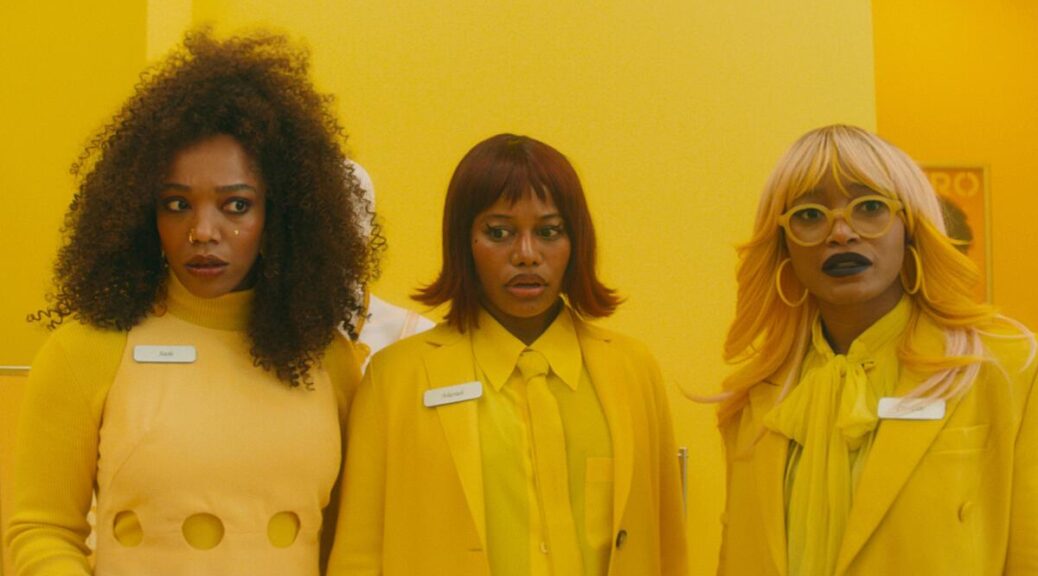
I Love Boosters

by Hope Madden

For anyone bemoaning the state of the film industry, claiming that there are no original films, only sequels and superheroes, may I introduce you to Boots Riley?

There is no more original voice in cinema today. And what’s extra great is that the voice is actually saying something worth hearing. His second feature, I Love Boosters, certainly proves that there’s talent looking to work with a visionary filmmaker. Look at this cast: Keke Palmer, Naomi Ackie, Taylour Paige, Don Cheadle, LaKeith Stanfield, Demi Moore, Eiza González, Will Poulter. Damn.

They tell a wild, boldly colorful, sometimes Claymation, often surreal, occasionally demonic, fantastical, consistently smart, regularly hilarious, and shockingly personal tale about the individual’s need for community. And, of course, the inescapable evils of capitalism.

Thanks to Palmer and Ackie, there’s a crackling emotional center that sets the friction between community and the individual on understandable ground. Stanfield is a hoot as an emotionally naked suitor (that storyline takes a turn!), Moore is great as the brash talking “innovator,” and it may take a moment to recognize Cheadle, but you won’t forget him.

If you saw Riley’s 2018 jaw-dropper Sorry to Bother You, you know to go in with no expectations. Predictability is not one of the tools this filmmaker wields. And though there are no horse men in I Love Boosters, the movie goes in wild directions.

But excess is Riley’s joyous medium. And no one paints revolution with such glorious color.

Underneath the metaphysical science fiction banter, beneath the scathingly comical evisceration of fast fashion, at the heart of the wacky heist flick, is a lonesome story that resonates. It’s all one struggle.

If that doesn’t sound entertaining, then I’m not doing my job correctly. Brazenly original, ridiculously entertaining, with relevance and immediacy to spare, Boots Riley’s second feature film I Love Boosters is the adventure of the summer.

Feel the Burn

Sorry to Bother You

by Hope Madden

The stars are aligning for Boots Riley. The vocalist and songwriter for The Coup—the funkiest radical socialist band you’re likely to find—has managed to produce a wild and relevant satire of capitalism that might possibly find a mainstream audience.

And that’s not because he whitewashed his message.

Sorry to Bother You uses splashes of absurdity and surrealism to enliven the first act “pull yourself up by your bootstraps” tale of a weary young man’s ascension through the ranks of telemarketing. It is a funny and pointed send-up of cubical hell that—unlike most office comedies—focuses quickly on a system that benefits very few while it exploits very many.

There is so much untidiness and depth to relationships, characterizations, comedy, horror, style, message and execution of this film that you could overlook Riley’s directorial approach. He expertly uses the havoc and excess, first lulling you into familiar territory before upending all expectations and taking you on one headtrip of an indictment of capitalism.

Led by Lakeith Stanfield (Get Out, Atlanta) and Tessa Thompson (star of Creed, Thor: Ragnarock and her own gleaming awesomeness), Sorry to Bother You finds an emotional center that sets the friction between community and individual on understandable ground.

Thompson offers bursts of energy that nicely offset Stanfield’s slower, more necessarily muddled performance as the “everyman” central character for a new generation.

And who better to embody everything a capitalist system convinces you is ideal than living Ken doll Armie Hammer? He is perfect—an actor who entirely comprehends his physical perfection and how loathsome it can be. He is a hoot.

Riley’s film could not be more timely. Though he wrote it nearly a dozen years ago, and it certainly reflects a trajectory our nation has been on for eons, it feels so of-the-moment you expect to see a baby Trump balloon floating above the labor union picket line.

Bursting with thoughts, images and ideas, the film never feels like it wanders into tangents. Instead, Riley’s alarmingly relevant directorial debut creates a new cinematic form to accommodate its abundance of insight and number of comments.

Does it careen off the rails by Act 3? Oh, yes, and gloriously so. A tidy or in any way predictable conclusion would have been a far greater disaster, though. Riley set us on a course that dismantles the structure we’ve grown used to as moviegoers and we may not be ready for what that kind of change means for us. Isn’t it about goddamn time?