Category Archives: New In Theaters

Reviews of what’s out now

Be Loud

Marlee Matlin: Not Alone Anymore

by Rachel Willis

In 1986, Marlee Matlin won the Academy Award for her performance in the film Children of a Lesser God. Nearly three decades later, she remained the only Deaf actor to win an Oscar. This, as well as Matlin’s trailblazing career, is the focus of director Shoshannah Stern’s documentary, Marlee Matlin: Not Alone Anymore.

Stern herself is also Deaf, and there are many wonderful moments when she and Matlin (as well as Stern with other Deaf actors) converse on screen without sound. The film makes extensive use of subtitles and closed captioning, but if a hearing audience member were to simply watch the two communicate on screen it’s a good example of how a Deaf person may feel when surrounded by hearing people who may forget to include them in conversation.

This is something Matlin addresses, as she was the only Deaf member of her family. It is also a reminder that this sort of exclusion can lead to significant language deprivation for individuals with hearing impairment. This is a critical issue that the documentary touches on when speaking to Matlin about some of the situations in which she was unable to name her experiences.

Like the 2000 documentary, Sound and Fury, Matlin and others are quick to point out that they are not limited in their abilities. It’s the world around them that tries to force them into a box where their “disability” is a problem to be solved not a difference to be celebrated.

The bulk of the documentary focuses on Matlin’s career and role as an advocate for the Deaf community. Closed captioning, something modern audiences may take for granted, was once a rarity. Matlin’s efforts, including a hearing before Congress, ensured that closed captioning would be a given moving forward.

There isn’t a dull moment in this documentary. Stern expertly weaves Matlin’s career and activism into an overall conversation about the needs of Deaf people, and the ways in which we can all do better moving forward. It’s certainly a film worth watching.

Undocumented Alien Thrashes Billionaire

Superman

by Hope Madden and George Wolf

James Gunn’s brand of humor is so sincere—never snarky, never brooding and mysterious—that he seemed a good fit for Superman, the most sincere of all the superheroes. Still, we were skeptical. Can something as wholesome as Superman be relevant in a time more rife with corruption and swampy with cynicism than any in modern history? And he has a dog?!

Yes, it turns out Superman (David Corenswet) and Gunn’s brand of sincerity is exactly what we need in the face of all this ugliness. And honest to God, by Act 3, we even loved Crypto the dog.

Gunn ‘s script wisely skips the origin story, quickly catching us up via onscreen text and dropping us in the snow with a superhero already battling his toughest opponent. That foe may look like a supervillain, but really Superman’s enemy is every human being’s enemy: greed.

Carving out yet another fine performance in a career littered with them, Nicholas Hoult delivers a searing, self-aware turn as Lex Luthor, the billionaire tech blowhard and would-be king. Though the character is clearly patterned after some real-life supervillainy, Hoult’s performance is all the more unnerving for its believability. And even when Gunn saddles him with some overwritten speeches, Hoult’s talent elevates the moment beyond cartoon theatrics.

Corenswet is a delightfully earnest Big Blue, offset nicely by a more cynical and wonderfully physical Lois Lane (Rachel Brosnahan) and a trio of metahuman helpers, the Justice Gang: Guy Gardner (Nathan Fillion), Hawkgirl (Cleveland’s own Isabela Merced), and Mr. Terrific (a scene stealing Edi Gathegi and his statement-making jacket).

Act 1 takes a little while to find its groove, but the slow start is easy to forget once the story elements begin to gel. The social commentary is in your face, pointed and matter-of-fact relatable, but doesn’t sink to preachiness or finger wagging. And while it is consistently funny, the film never makes humor as much of a focus as Gunn’s Guardians of the Galaxy series, opting instead for smaller, more organic asides.

Of course, there’s an added bonus for those of us here in Ohio, as Cleveland makes a pretty spectacular Metropolis, even when it’s taking a beating. Filming specifically for IMAX, Gunn and cinematographer Henry Braham make the upgrade a worthy and welcome piece of the immersive world-building.

The biggest weakness here – other than kryptonite – is Gunn’s comfort with some unnatural dialog and overly detailed speeches of exposition. And ironically, it’s the level of entertainment that surrounds these moments that causes them to land as unnecessary and curious.

But more often than not, Gunn’s storytelling choices pay off. We know the character pretty well by now, but this Superman/Clark Kent is unlike any we’ve seen before. Gunn and Corenswet make him more vulnerable and more human than ever, sometimes doubting himself but never doubting his mission to do good.

Remember the hero’s motto of “truth, justice and the American way?” Superman does. And even though those words are never spoken, the film finds a cinematic joy in reminding us how those ideals can be twisted until they’re barely recognizable.

Lord knows humanity needs a win right now. Thanks to a man and his dog, we get one.

More Teeth

Jurassic World: Rebirth

by Hope Madden

Every great creature feature from King Kong to Godzilla to Jaws to Jurassic Park and on and on understands one basic principle. The monster is not the problem. Human greed is the problem. Some monster movies are just better than others at telling that story.

It’s not a new notion to director Gareth Edwards, who riffed on it in Monsters (2010), Godzilla (2014), and The Creator (2023). For Jurassic World: Rebirth, he teams with writer David Koepp, who adapted Michael Crichton’s novel for Spielberg’s 1993 original. Given the sheer volume of callbacks in Rebirth, I’d say Koepp is pretty pleased with how that first one turned out.

Scarlett Johansson is an extraction specialist hired by Big Pharma in white linen, Martin Krebs (Rupert Friend) to gather DNA samples from three living dinosaurs: the biggest on the sea, land, and air. Mahershala Ali is the ship’s captain who’ll get crew and scientist Henry Loomis (Jonathan Bailey) to the island no one is allowed to visit, they’ll gather some samples and get home. Zip in, zip out.

But wait! Naked alpha zombies!

Just kidding. But seriously, why can’t someone write a proper film for Mahershala Ali and Scarlett Johanssen? Because these are talented individuals (hell, one of them has two Oscars), and they are better than this retread.

To be fair, Edwards crafts some eyepopping set pieces early in the film as two different boats—Ali’s, and that of the cloying B-story family—run afoul of the swimming beasties. These action sequences set you up for thrills, but once both A and B story hit dry land, Gareth is more interested in recycled ideas and images, not just from this franchise but from the Alien series as well. Just get a look at the monster they kept hidden away on that island. I think I know what they were cross breeding that with.

The B-story about a shipwrecked family (Manuel Garcia-Rulfo, Luna Blaise, David Iacono, and Audrina Miranda) is cliché straight from the family friendly action movie playbook, complete with a comically adorable (and tonally discordant) baby dinosaur stowing away in the littlest daughter’s backpack.

The presence of the family softens the best members of the elite team and amplifies the villainy in the worst. Of course it does because Jurassic World: Rebirth is nothing if not obvious. It obviously knows the story it’s supposed to tell, it just doesn’t tell it especially well.

Promised Land

40 Acres

by Hope Madden

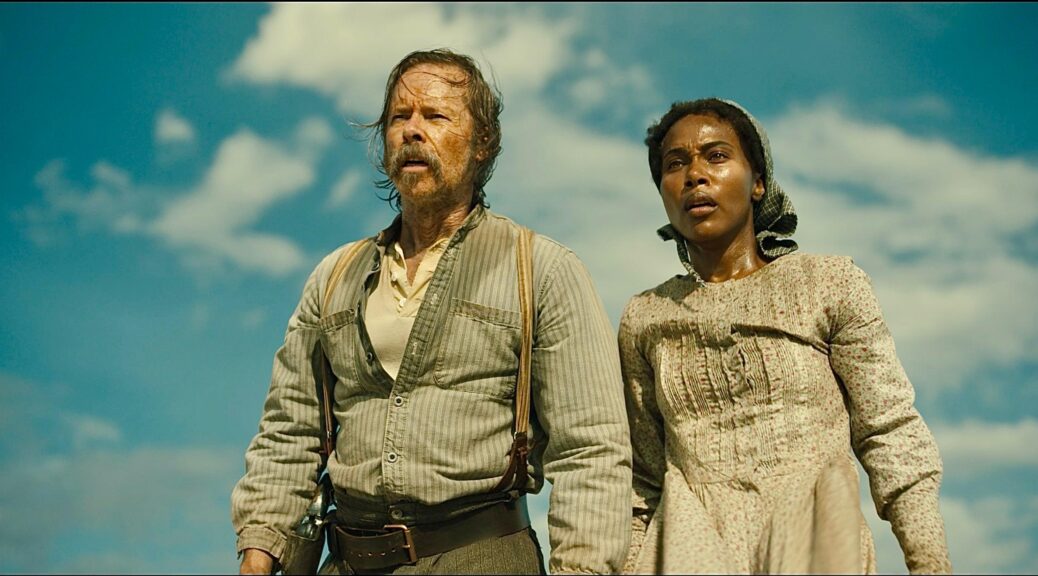
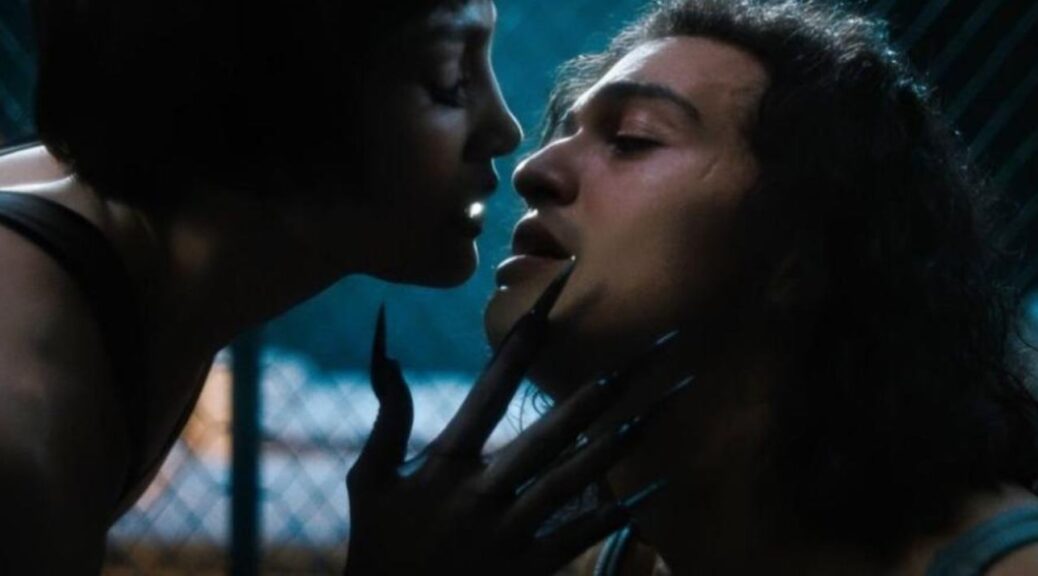
At one time, a lot of people were promised 40 acres and a mule. It was a lie. But Hailey Freeman’s ancestor had freed himself, left his family behind, and walked to Canada to make his own promises. Generations later, Hailey (Danielle Deadwyler, a force of nature) will be damned if the apocalypse, wandering cannibals, or a teenage boy’s hormonal behavior is going to jeopardize that farm.

Co-writer/director R.T. Thorne’s post-apocalyptic horror/thriller feature debut 40 Acres benefits early and often from inspired framing, gorgeous shot making, and one remarkable performance. Indeed, Deadwyler is so good that sometimes the cast around her can’t keep up.

She’s the matriarch of the Freeman farm and she’s a hard woman. She has to be, but the land is providing for the family, and the family is protecting it from those outside the electric fence and barbed wire who might want to come inside.

The bigger problem might be Hailey’s oldest, Manny (Kataem O’Connor), whose restlessness and desires put the family at risk.

Thorne uses flashbacks sparingly, which gives them some weight. Wisely, these serve less to explain the apocalypse than to hint at relationships and character, because, naturally, the real story here is not the flesh eaters moving from farm to farm, but the strains of coming of age within this pressure cooker.

Many films—horror movies, in particular—rely on terrible decision making to move the plot forward. 40 Acres weakens as it moves from Act 2 to Act 3 with wildly bad character choices. But something has to trip this family up so Thorne can show off remarkable instincts for action cinematography, as well as his lead’s range.

Yes, we know Danielle Deadwyler—snubbed by Oscar for her searing performances in The Piano Lesson (2024) and Till (2022)—is a magnificent actor. One of the best working today. But you might not realize (unless you’ve seen her fantastic 2019 thriller Devi to Pay) that she’s also quite at home in genre films. The degree to which she brings authenticity to her role as an Army veteran annihilating redneck cannibals with machetes is breathtaking.

Michael Greyeyes (Wild Indian, Blood Quantum) delivers needed warmth and humor, and he and Deadwyler share a touching chemistry. A full slate of nasty marauders impresses, especially veteran genre actor Patrick Garrow.

The writing periodically drags 40 Acres backwards, particularly the budding romance and related choices. But for thrills-aplenty action with something on its mind, you could do worse than this.

Doll Parts

M3GAN 2.0

by Hope Madden

Sometimes a fun horror movie needs to become a fun action movie if you really hope to have a franchise. At least, a PG13 franchise. That’s clearly Gerard Johnstone’s thinking with M3GAN 2.0

Co-writing this time with M3GAN scribes Akela Cooper and James Wan, Johnstone imagines a future where the tech that fueled a bloodthirsty doll has been stolen and put to use as a weapon called Amelia (Ivanna Sakhno).

Amelia sets her murderous sights on the architect of her AI, Gemma (Allison Williams)—which, in turn, puts young Cady (Violet McGraw) in peril. Guess it’s time to dust off last year’s model.

So, in the same way that the old T-800 helped John and Sarah Connor save the world from Terminator 2, M3GAN (Jenna Davis voice, Amie Donald body) has to help humanity survive Amelia.

Johnstone and team do abandon the horror in favor of action, but the comic tone remains, thankfully. Even before we’re graced with M3GAN’s gallows wit, Johnstone’s fellow Kiwi and comedic treasure Jemaine Clement joins the cast as a billionaire philanthro-capitalist and easy mark.

Clement is a hoot, and soon enough, the dark wit that made M3GAN so much fun is back, and secured safely in the body of a child’s toy. But if they really are going to do battle with hew new model, upgrades will be needed.

Plenty of self-aware dialog inches the film more clearly toward comedy than the original, which wore its own dark humor with a little more nuance. 2.0 is definitely going for laughs alongside its thrills, helping to elevate scenes burdened with exposition.

The plot gets convoluted and silly, the message about AI holds no water at all, and Amelia’s true purpose is always beside the point, never driving the narrative. And abandoning horror entirely is a bit of a disappointment.

Still, M3GAN 2.0 delivers some summer fun.

Formula Won

F1: The Movie

by George Wolf

With Top Gun: Maverick, director Joseph Kosinski understood the assignment better than any director in recent years. Talent, swagger, airborne thrills and pinpoint vibe control made that film better than we could have imagined.

Now Kosinski brings a very similar blueprint to F1: The Movie, right down to that punctuation in the title.

Brad Pitt effortlessly assumes the role of a rogue mentor flying by his own rules, this time on the racetrack. Thirty years ago, Sonny Hayes (Pitt) had a promising career as a Grand Prix driver. A nasty crash derailed that, sending him to decades of minor league racing, professional gambling and even some cab driving.

But now, Sonny is the Hail Mary called by his old racing partner. Ruben Cervantes (Javier Bardem) is a desperate team owner with a cocky young driver named Joshua Pearce (Damson Idris) and a losing streak about to bring the whole thing down.

If Sonny’s “maverick” approach to driving can somehow get Ruben one win before the season ends, he can save the whole APX team.

Can Sonny be the Crash Davis to Joshua’s Nuke LaLoosh? Is he up for taking one more shot at glory and maybe some sexy time with APX tech director Kate McKenna (Kerry Condon)?

It doesn’t matter if you already know, just like it doesn’t matter that much of the dialog is cheesy, many reaction shots deliver sitcom-worthy mugging and the TV commentators narrate straight from “Racing for Dummies.”

Pitt, Bardem, Condon and Idris might as well be winking through it all. They’re clearly having a ball, and elevate material that – like Maverick -would have been insufferable in lesser hands. F1 may not have nostalgia in its cockpit, but the swagger and the vibe are too fun to resist, while Kosinski (also a co-writer this time) delivers the pinpoint control.

Filmed for IMAX, F1‘s racing sequences are as thrilling on the track as Top Gun is in the air. The camerawork and pacing, the editing and some rockin’ needle drops keep the adrenaline pumping, and even that two and a half hour run time doesn’t feel as bloated as it probably should.

F1: The Movie won’t keep you guessing. And it won’t challenge your brain. But that isn’t the mission of this race team. The goal here is (really) big screen entertainment, movie star glamour, plenty of speed-fueled visceral thrills and maybe even a fist pump or two.

Ground control to victory lane: get the champagne ready.

Original Gangster

The G

by Hope Madden

Get to know Dale Dickey. There is nobody else like her in film or TV, and what she brings to a role is grit and authenticity that can be heartbreaking or frightening. In the case of filmmaker Karl R. Hearne’s The G, it’s a bit of both.

Dickey plays Ann, known to her step-granddaughter Emma (Romane Denis, Slaxx) as The G. She smokes a lot, drinks vodka by the bottle, and has a tough time returning her invalid husband’s affection. Until a sketchy doctor tells a scheming judge the couple can’t care for themselves, and before either can change out of their PJs, their new custodian has them locked in a cheerless room with no access to the outside world.

It’s like I Care a Lot, J Blakeson’s 2020 thriller about the organized, legal business of preying on the elderly. Except The G takes place in a depressed small town where the stakes are lower and the lives considerably less glamorous. But the fantasy is still the same.

Because The G has connections and skills her new facility leadership doesn’t expect.

Dickey is, characteristically, understated, gravely perfection as the wrong granny to cross, but Hearne is not in this for comedy. This is no Thelma. The G mines a horrifying reality of disposable people for indie thrills without abandoning the tragedy at the film’s center.

A plucky Denis and the balance of the supporting cast populates this bleak town with low-rent hoods, smalltown gangsters, sleazy opportunists, and cowards. Hearne complicates the slow boiler without losing the threads or the sense of realism.

There are one or two lapses in logic, but at least as many welcome surprises. The G boasts a tight script and a director who knows how to showcase a lead. And Dickey takes advantage, from the drunken joy of Ann’s face bathed in the artificial light of a bulb she managed to change, to her pitiless growl, “He might last a day out here. Maybe less.”

Dickey’s a treasure, and one filmmakers are finally, truly recognizing. Her finest moment might have been Max Walker-Silverman’s lyrical A Love Song, but Dale Dickey delivers no matter the role.

Boldly Gone

Elio

by Hope Madden

Few films, animated or otherwise, breathe the rarified air of Pixar’s best. The animation giant has turned out an alarming number of outright masterpieces: Toy Story, WALL-E, Up!, Toy Story 3, Inside Out. Their second tier is better than nearly every other animated film you’ll come across. The originality, humanity, and visual magic on display in these films is so superior to anything else out there, it becomes an almost impossible standard to bear.

Pixar’s latest effort, Elio, tells the sweet story of a lonesome orphan who wants desperately to believe that “we are not alone.” Elio inadvertently casts himself as leader of earth and invites aliens to abduct him. They accept.

Elio’s writing team includes Julia Cho, who penned the charming Turning Red, and Mike Jones, whose Soul rightfully took 2021’s Oscar for Best Animated Feature. The directing team includes Turning Red’s Domee Shi and Coco’s Adrian Molina. That’s a solid team, one fully aware of the wondrous possibilities of animation and family friendly storytelling.

And they do tell a lovely story. As Elio (Yonas Kibreab) finally finds a friend in galactic warlord Grigon’s (Brad Garrett) son Glordon (Remy Edgerly), he also realizes that he might have liked his Auntie (Zoe Saldaña) more than he thought.

Once Elio is space bound, the film brightens. The inhabitants of the Communiverse are delightfully oddball. There’s brightly colored fun to be had. But Act I doesn’t dig deep enough into Elio’s relationship with his auntie to give the film real stakes, so the emotional center that creates the Pixar gravitational pull is never as strong as it is in their best efforts.

The story beats also lack the freshness of the best Pixar has to offer. Still, a first-contact film that retails a childlike wonder about what lies beyond the stars without resenting what waits at home is a rare thing.

Still Crazy After All These Years

28 Years Later

by Hope Madden

Nearly a quarter century ago (!!), director Danny Boyle and writer Alex Garland unleashed the genre masterpiece 28 Days Later. Smart, prescient, with a broken human heart and 113 minutes of sheer terror, it changed the “zombie” genre forever with living, breathing, running, rampaging humans infected by a rage virus.

Original as it was, there was still a little Romero in there. You might not have seen it with the racing beasts, but Boyle and Garland understood what Romero knew all along—it’s organized human authority you need to really worry about.

Boyle’s film was followed in 2003 with a fine, if mean spirited, sequel, but the Oscar winning director returns for 28 Years Later. So does Garland (Ex Machina, Annihilation, Men, Civil War), who’s gone on to be one of the most interesting filmmakers of our time.

They pick up the story 28 years after the rage virus hits London. Onscreen text tells us that continental Europe was able to turn back the virus and keep it from spreading globally, but the islands that were once the UK are, and will forevermore be, quarantined. No one leaves. Not ever.

We’re dropped into a small Scottish highland community where 12-year-old Spike (Alfie Williams) is about to go on his first mainland hunt with his father, Jamie (Aaron Taylor-Johnson). They’ll cross a bridge only passable during low tide, which means 4 hours to get back or it’s an overnighter on the big island full of the infected—which includes some mutations we didn’t worry about 28 years back—and the uninfected, who can be worse.

Wisely, Garland and Boyle anchor the film with family drama. Plucky Williams makes for a great hero, his arc from innocent to survivor both heartbreaking and impressive. A supporting cast including Jodie Comer and the great Ralph Feinnes enhances that tender drama. But what’s missing are the scares.

As Romero’s zombie films developed, so did his monsters. By Land of the Dead, they had their own leaders, their own families, their own kind of consciousness. The zombies were evolving around and without us. It was interesting, but it wasn’t scary. Likewise, 28 Years Later conjures beasts that have evolved into their own kind of society, and while it’s clever, it lacks the visceral terror of both previous installments. There’s also a lot of dubious science afoot.

The film’s opening and closing segments promise something meaner and more mischievous in upcoming sequels. (There are three films in this second part of the series, and the next installment—28 Years Later: The Bone Temple, directed by Nia DaCosta—is in post-production now.)

Maybe the bar set by the original is simply too high for any sequel to meet. 28 Days Later remains one of the scariest films ever made. Circling back to see how humanity’s getting along a generation later is interesting, sometimes gorgeous, awfully bloody, and frequently very sweet. It’s just not very scary.

God Defend New Zealand

Prime Minister

by Rachel Willis

New Zealand’s former prime minister, Jacinda Ardern, is the subject of directors Lindsay Utz and Michelle Walshe’s documentary, Prime Minister.

The film starts with Ardern’s election as leader for her country’s Labour Party, seeking to rescue it from gloomy poll numbers. That she actually wins the position of Prime Minister just a few weeks later comes as a bit of a shock, most of all to Ardern.

Ardern is an interesting central figure for the film. She was only 37 when elected, and even more fascinatingly, was pregnant at the time. She becomes the second woman in history to give birth while in a position of government leadership at that level.

But the documentary leans into the personal over the political, seeking to humanize Ardern and understand her approach to governance. It captures intimate moments in which Ardern gives voice to those emotions that leaders often have to hide from public view.

However, Utz and Walshe never dig too deeply into any one subject. Prime Minister neither focuses long enough on her political leadership nor her family life. At times, it even drags as it hops from one event to the next.

That’s not to say that the events that took place during Ardern’s time in office were without consequence. While leaders may always experience tumultuous events over the course of their tenure, Ardern’s seems especially marked by tragedy.

The film picks up speed in the second half, as Ardern faces an unprecedented event with the arrival of Covid-19 virus to New Zealand. The filmmakers devote the most time and attention here, rightfully, as it becomes Ardern’s biggest challenge as Prime Minister.

If the point of the documentary is to humanize those we elect to power, then it hits the nail on the head. Ardern herself opens the film with a plea to humanize those with whom we disagree. It’s a poignant message in a world that seems increasingly fraught with political turmoil.

It’s unfortunate that message will likely be lost to those who most need to hear it.