Category Archives: New In Theaters

Reviews of what’s out now

Secret Garden

The Garden Left Behind

by Hope Madden

Newcomer Charlie Guevara charms in Flavio Alves’s drama The Garden Left Behind with a bittersweet performance as Tina, an undocumented Mexican trans woman getting by in NYC. Her performance is simultaneously optimistic, wearied, frightened and strong.

Wisely, filmmaker Alves focuses his tale unblinkingly on Tina—her day to day, her loving if prickly relationship with her grandmother (Miriam Cruz), her warm and supportive community of friends, her struggle with an insecure boyfriend, her tentative steps toward transition. In a real way, every movement in the film is about transition, about claiming something that belongs to Tina, whether it’s her voice or her financial independence, her emotional health or her political power.

The rawness of Guevara’s turn sometimes makes way for self-consciousness that brings certain scenes to an awkward halt. Still, Guevara and Cruz share a lovely, lived-in chemistry. It’s their relationship that both buoys the film and makes the it ache all the more.

The story around the periphery crystallizes the ways in which the lives of trans people—especially trans women of color—differ from your garden variety New Yorkers’. Alves’s hand is not heavy; the fact that so many of Tina’s interactions could be taken as potentially menacing speaks volumes without an overt narrative. It’s actually in this B-story that the filmmaker may make the most salient and heartbreaking points.

If the film feels authentic, that’s unsurprising. Alves not only cast trans actors for each trans role, but he also employed a staff of transgender filmmakers in creative and crew roles. This after several years of research within the NYC transgender community to develop the insightful and poignant storyline.

It’s no surprise The Garden Left Behind became the 2019 SXSW audience award winner. The film breaks through as not only an admirable artistic vision produced with integrity, but a beautiful human tale of perseverance and love.  

On the Road Again

Alone

by Hope Madden

“Do you think you’re the first one to say that?”

That is a good, sinister question when posed by the mustachioed traveler responding to his captive’s promise to remain silent if he lets her go. It’s good because it clarifies to her and us that this is not his first prisoner rodeo, an unsettling fact that increases tensions and moves the story forward.

It’s also a good question to ask director John Hyams as his road trip horror Alone serves up a very familiar premise.

Jessica (Jules Wilcox), her beat Volvo station wagon and hitched U-Haul trailer are making a cross-country trip. Nobody else, just them. Sure, Mom keeps calling, but Jessica just can’t right now.

It’s beautiful, wooded country, but a little treacherous—more so once that black SUV starts following her around.

You know where this is going from the opening scene, so the only hope is that the execution delivers some thrills. Drone shots of trees may be a little tired by this time, but they are pretty and they give the sense of isolation. Screenwriter Mattias Olsson makes subtle changes to the predictable story, giving each character an unexpected layer or two to keep you guessing.

Wilcox’s no-thrills performance suits the project beautifully. Though frustrating in the early going (don’t pretend you wouldn’t do some stupid things in that situation, too), Jessica’s resolve and tenacity are proven with a focused, physical performance.

Marc Menchaca, known only as Man, is a delight in the role of the villain. That ‘stache! Nary a false note creeps into his menacing demeanor. His is the saucier of the two characters and the hateful chemistry between the actors drives the thrills and commands attention.

Anthony Heald also makes a welcome appearance at about the halfway point, and the action takes an effective turn with him. But mainly, Alone benefits from two truly savvy performances. It just doesn’t have much to say that we haven’t already heard.

https://www.youtube.com/watch?v=NoP2mJiCzWQ

Secret Garden

The Secrets We Keep

by George Wolf

Anyone who saw the original The Girl With the Dragon Tattoo knows if you get on the wrong side of a score with Noomi Rapace, she’ll have no problem settling it.

As Maja in The Secrets We Keep, Rapace has a similar mindset. Settled into post-war Suburbia in an unnamed town, Maja and her physician husband Lewis (Chris Messina) run the local medical clinic while raising their young son, Patrick.

On one fateful afternoon, the Romanian-born Maja is shaken to her core by the sight of a man (Joel Kinnaman) she believes committed heinous war crimes against her and her family years before. After setting a successful trap, Maja kidnaps the man and holds him captive in her basement, finally detailing to Lewis the horrifying ordeal she has never spoken of.

Director and co-writer Yuval Adler sets an effective hook despite some forced visual cues (a literal bubble bursting, North by Northwest on a theater marquee). Rapace delivers the right mix of confused trauma, making Maja’s indecision between murder and interrogation ring true (much more so than the petite Rapace’s ability to maneuver the dead weight of Kinnaman).

Is the suburban hostage a Swiss immigrant named Thomas, as he claims, or is he the former Nazi Karl, whose war crimes haunt Maja’s dreams?

Adler seems to sense the need to distance the film from Death and the Maiden (and, to a lesser extent, Big Bad Wolves), but as events move further from the basement, an air of B-movie pulp emerges.

A visit from the neighborhood cop seems to exist only for contrived tension, while Maja’s burgeoning friendship with her captive’s wife (Amy Seimetz) and daughter can never quite move the shadow of secrets over the entirety of picket-fence Americana the way Adler intends.

And despite a terrific performance from Messina, Lewis lands as a frustrating and sometimes distracting presence. While Lewis’s struggle to believe Maja – even without a confession – is one of the film’s most resonant strengths, the bigger struggle concerns the film’s commitment to defining Maja on her own terms.

When it does commit, The Secrets We Keep rewards the investment. But when it cops out, there’s little here we haven’t already been told.

A Darkness in the Light

Luz: The Flower of Evil

by Hope Madden

As colorful as a dream, Juan Diego Escobar Alzate’s feature film debut Luz: The Flower of Evil looks like magic and brims with the casual brutality of faith.

Set inside a religious community in the mountains of Colombia, the film drops us into ongoing struggles with the group’s religious leader, El Señor (Conrad Osorio). No one knows the devil as he does, he reminds his daughter Laila (Andrea Esquivel).

She lives contentedly, devoutly, along with her two adopted sisters. El Señor and the villagers consider the trio angels—just as they believe the little boy chained up out back is the Messiah who will deliver the community from its recent calamities.

Though never entirely detailed, the internal logic of the film and the community is clear enough to feel simultaneously familiar and horrifying. The way the filmmaker wrestles with what is and is not real, with forgiveness and the morally ambiguous nature of man, and with our tendency to blame God or the devil for our own shortcomings is frustrating and intoxicating.

Alzate gets maximum impact for minimum budget thanks in large part to Nicolas Caballero Arenas’s cinematography. His breathtaking visuals add spooky richness, turning this Western of sorts into a beautiful, lyrical, macabre Columbian folktale.

Lovely as it is, the film echoes of loss. The title itself conjures what is absent. As time wears on and the “angels” lose confidence in their father figure, remembered stories of the late mother figure Luz (Spanish for light) take the space for them that El Señor’s tales of God take for the rest of the community.

Luz: The Flower of Evil surprises as often as it relies on expectations to deliver its message. The film is more atmospheric than cautionary, its resolution a fitting end for characters’ whose own logic doesn’t likely reflect that of the audience. It is a vision, from its opening musical notes to its closing image, though, that marks a filmmaker worth discovering.

Gone Catfishin’

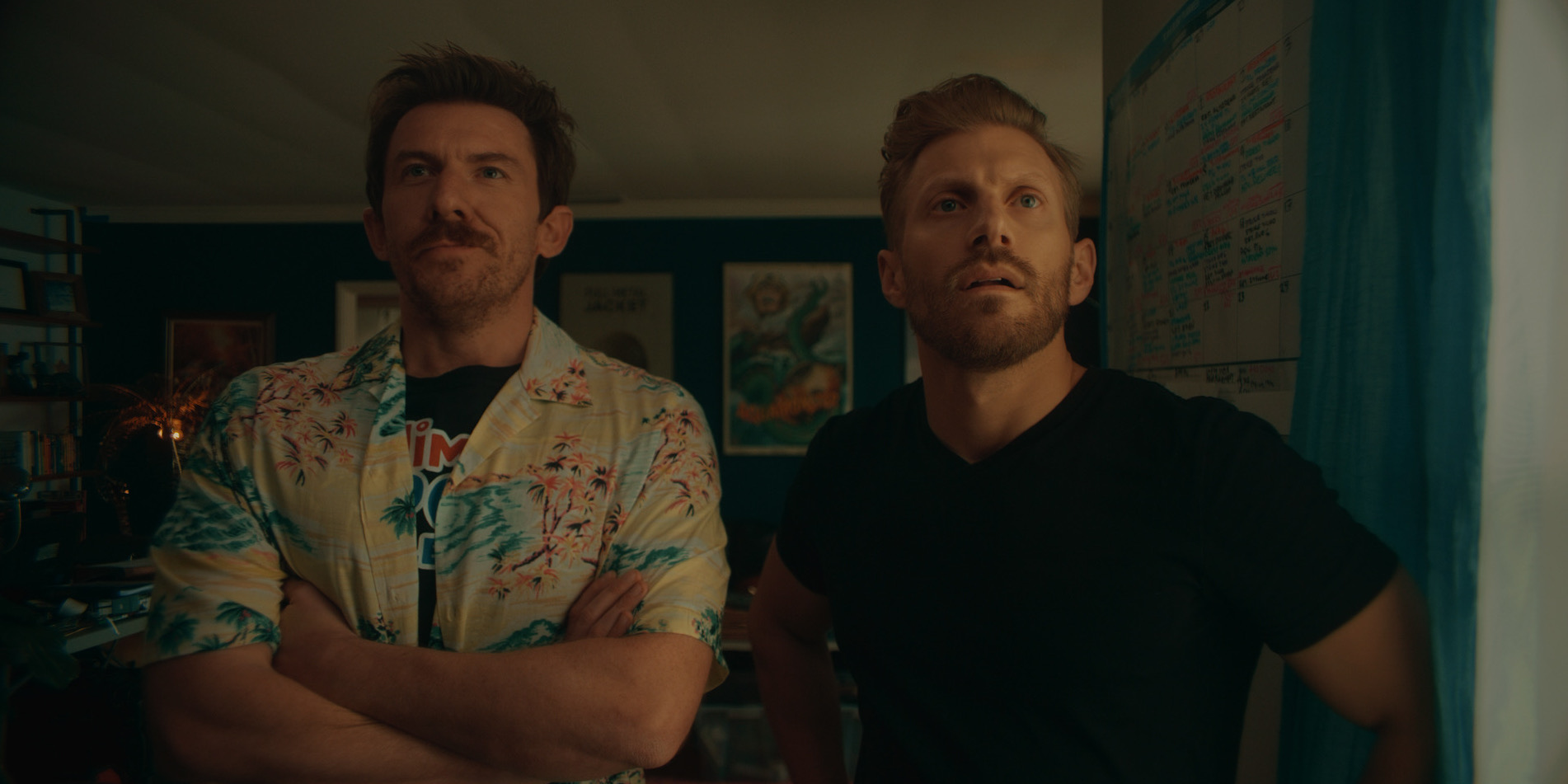
Summerland

by Rachel Willis

It’s hard to sympathize with a catfish – someone who pretends to be someone else online to develop a misleading relationship.

Yet, in the film, Summerland, directed by Lankyboy (the nickname for directing duo Kurtis David Harder and Noah Kentis), we’re asked to do just that.

Bray (Chris Ball), who is pretending to be Victoria online, has made a connection with Shawn (Dylan Playfair) via a Christian dating site. Bray/Victoria has plans to meet Shawn at the music festival, Summerland.

Along for the road trip to Summerland is Oliver, Bray’s best friend, and Oliver’s girlfriend, Stacey. The problem? Bray has been using Stacey’s pictures to construct Victoria online. Once the trio gets to Summerland, will Bray be able to find Shawn before he finds Stacey?

Miraculously, as the film progresses, we do begin to sympathize with Bray. As a gay teenager, he is not accepted by his parents and struggles with his identity. He wants to meet someone, to have a relationship, and be himself. Despite the fact he has lied about his identity, he’s managed to be as open with Shawn as he has with anyone.

However, the film doesn’t let Bray off the hook entirely. We’re repeatedly reminded that he’s constructed a relationship around a lie. We must ask ourselves if some lies are forgivable when the liar struggles with what it means to be himself.

Most of the film is centered around the road trip to Summerland. Bray is anxious to get there so he can finally meet Shawn in person. Oliver wants to enjoy the journey. Stacey is rebelling against a stepdad she doesn’t like.

Lankyboy wants their movie to be quirky, but it’s a conventional road trip/relationship movie with some weird extras thrown in. Those weird moments are forced, don’t contribute much, and end up making a short movie feel intolerably long.

There are also far too many montages for such a short film.

The actors aren’t terrible in their roles. They’re not the worst trio to spend time with on a road trip movie, and the film does have one or two funny moments. But too much of the movie is focused on what it wants to be rather than effectively embracing what it is.

Unfortunately, what is ends up being is an unmemorable experience.

H is for Hopeful

H is for Happiness

by Cat McAlpine

H is for Happiness navigates grownup tensions and trauma from the perspective of an optimistic 12 year-old named Candice (Daisy Axon). Candice’s class is given an assignment to recount their life via a narrative based on the letters of the alphabet. On the same day, a new student arrives.

“Can you keep a secret?” newcomer Douglas asks her.

“No.” Candice chirps back with cheerful honesty.

Douglas (Wesley Patten) claims he’s from another dimension, but it doesn’t faze Candice. Little bits of mystery and magical realism like this make Candice’s world deeper and more fantastical, even when the magic ends up being rooted in reality.

Brightly colored and fun, exaggerated moments make the film’s world seem vibrant and alive in a storybook kind of way. But it has its dark moments too. Candice may be hopelessly optimistic but everyone around her is miserable. Her grieving, depressed mother stays in a room deeply saturated in blue. Her father and uncle, at odds, exist in opposite landscapes. Her father works in a tiny garage office. Her rich uncle sails a picturesque sailboat on a bright blue sea.

While H is for Happiness is told through Candice’s eyes, it’s not just a watered-down children’s story. The way it unfolds is enjoyable to all ages. Instead of going for easy laughs, the film explores the frustration of trying to fix a broken family with silly hijinks that simply don’t work. The heavy dose of realism creates continued tension throughout and motivates Candice to continue exploring what her role in the world might be as she turns 13.

Director John Sheedy frames his shots with whimsy and beauty, showing adults struggling through Candice’s eyes. Bright colors are always caught just off in the corner to show how the world continues beyond the screen. Candice’s broken-spirited father is perfectly framed by pastel balloons at a fateful birthday party. Its images like these that meld nostalgic memories with the realities behind them.

Making her film debut, Axon is fantastic as Candice, showing a precocious can-do attitude will make you fall in love with her immediately. Her partner in crime, Patten, is charming and equally likable as Douglas from Another Dimension.

H is for Happiness is a beautifully crafted coming-of-age movie that teeters on the edge of childhood innocence and the next step beyond it.

Family Matters

Blackbird

by Darren Tilby

Based on his own Danish-language film Silent Heart, writer Christian Torpe partners with director Roger Michell for the Anglo-American remake, Blackbird. You likely know the story already: an ailing matriarch invites her fractured family around to stay for one last weekend of joy and festivities before she plans to end her life through euthanasia. But, as is so often the case in films like this, everyone’s a long way from even pretending to play happy family.

Susan Sarandon stars as Lily, the head of the family unit. Sam Neill puts in a career-high as Paul, Lily’s husband, who proceeds with a stoic, removed air about his wife’s illness and impending self-death.

Kate Winslet’s Jennifer is the first to arrive, early, along with husband Michael (Rainn Wilson) and son Johnathan (Anson Boon). Straight-laced and proud, Jennifer is the polar opposite of her younger sister, Anna (Mia Wasikowska); a flighty young woman who traipses in late, “looking like shit,” with girlfriend Chris (Bex Taylor-Klaus) in tow.

Completing the family unit is Liz (Lindsay Duncan), Lily’s oldest and dearest friend.

As you can probably tell, the film’s main attraction is its star-studded cast. A sea of riveting performances is what awaits us and Torpe’s well-written, character-establishing (and building) dialogue make these people come alive and feel genuine—even if some of their actions don’t. Indeed, Michell relies heavily on the strength of his actors to deliver the emotional clout the movie promises. There’s no denying the cast is up to the task, although other aspects of the film feeling like an afterthought.

The plot mechanics are hackneyed and unoriginal, while Peter Gregson’s score feels generic and uninspired. Mike Ely’s crystalline visuals, though, are an absolute delight, and effortlessly reflect the beauty and tragedy of both life and death.

It’s unoriginal, and it’s certainly not perfect, but this is a beautiful piece of filmmaking about the celebration of life, love and family, rather than the sadness of death and loss. And it brought tears to my eyes on more than one occasion.

Save a Prayer

The Devil All the Time

by Hope Madden and George Wolf

“Lord knows where a person who ain’t saved might end up.”

Indeed. The constant fight to overcome the worst in ourselves lies at the heart of The Devil All the Time, director Antonio Campos’s darkly riveting realization of Donald Ray Pollock’s best-selling novel.

Bookended by the close of World War II and the escalation in Vietnam, the film connects the fates of various characters living in the small rural towns of Southern Ohio and West Virginia.

Arvin (Tom Holland), the son of a disturbed WWII vet (Bill Skarsgård), fights to protect his sister (Eliza Scanlen) while he ponders his future. Husband and wife serial killers (Jason Clarke and Riley Keough) look for hitchhikers to degrade, photograph and murder. A new small town preacher (Robert Pattinson) displays a special interest in the young girls of his congregation.

It’s a star studded affair—Mia Wasikowska, Haley Bennett and Sebastian Stan joining as well—but every actor blends into the woodsy atmosphere with a sense of unease that permeates the air. No stars here, all character actors in service of the film’s unsettling calling.

Pollock’s prose created a dizzyingly bleak landscape where Flannery O’Connor and Cormac McCarthy might meet to quietly ponder man’s inhumanity to man. Campos unlocks that world courtesy of Pollock himself, who narrates the film’s depravity with a backwoods folksiness that makes it all the more chilling.

As rays of light are constantly snuffed out by darkness, Campos (who also co-wrote the screenplay) uses Pollock’s voice and contrasting soundtrack song choices to create a perverse air of comfort.

Redemption is a slippery aim in and around Knockemstiff, Ohio, and grace is even harder to come by. With a heavier hand, this film would have been a savage beating or a backwoods horror of the most grotesque kind. Campos and his formidable ensemble deliver Pollock’s tale with enough understatement and integrity to cut deeply, unnerving your soul and leaving a well-earned scar.

How Firm Thy Friendship

TBDBITL 141

by George Wolf

It might be more fair for someone who wasn’t an Ohio State graduate and/or rabid Buckeye fan to review TBDBITL 141.

But no one fitting that description lives in my house, so…

For the sadly unwashed, “TBDBITL” stands for The Best Damn Band in the Land. 2018 brought the Ohio State Marching Band’s 141st edition, and director Joe Camoriano takes us inside that memorable season with unprecedented access. (Camoriano’s role as the University Communication Director of National Broadcast Media might have helped.)

From summer practice to tryouts, headline-grabbing halftime shows to the Macys Thanksgiving Day Parade, Rose Bowl and Disneyland, we get a captivating look at how hard Band Director Dr. Christopher Hoch, his staff and band members work to achieve a status that is – in the words of former football coach Urban Meyer – “elite.”

Camoriano is wise to humanize the experience via three engaging band members. There’s Konner, who is realizing a lifelong dream as Drum Major; Sydney, a charming trombone player with boundless enthusiasm; and Thomas, the lucky sousaphonist who gets the honor of dotting the “I” in the incomparable Script Ohio.

These three are likable personalities and easy to root for, which naturally increases our investment in the entire process, and is especially helpful for anyone coming to this film wondering what the hype is all about.

Despite an over-reliance on video fades and some rough patches in the background sound mix, Camoriano’s footage is always informative and engaging, even occasionally thrilling.

And for those of us always ready to answer a cry of “O-H!” there might be a goosebump or three.

TBDBITL 141 is available now on Vimeo.

Just Do It

All In: The Fight for Democracy

by Hope Madden

Documentaries can be frustrating, especially political documentaries. They warn you about coming disasters you hadn’t predicted, show you the brutality and ugliness in parts of the world you hadn’t seen, reinforce that ulcerous dread in your gut about humanity on the whole. You can basically only hope they also show you a way out.

Mercifully, All In: The Fight for Democracy does that. But first it upbraids your apathy about voting by detailing the harrowing history of Americans who had to take a beating, even die, just to exercise that right. Then it details the meticulously detailed strategy in place and being executed right now to keep you from exercising your right, now that you understand its value.

Filmmakers Lisa Cortes and Liz Garbus wisely anchor their facts to Georgia’s gubernatorial race of 2018. The core storyline, narrated by the Democratic candidate in that race, Stacey Abrams, is of that election’s rampant and open-to-pubic-view suppression of Georgia votes. Abrams’s opponent, Brian Kemp, had been an architect of voter suppression as Georgia’s Secretary of State: closing polling places, purging voting rolls and instituting legislation that made voting more difficult.

It was incredibly successful for him. Expect to see more of it.

If that sounds cynical, it is. It’s also a major point of the film. But Cortes and Garbus (and Abrams) have a more idealistic goal, which is to point out something important to every American citizen regardless of party: Democracies only work when citizens decide what politicians do, not vice versa. When citizens vote, we can make the decisions. We can determine who is in office and what they need to fight for and against. And if they don’t do it? We can vote them out.

But we can only do that if we can actually vote, which is why politicians who don’t want to do their jobs enacting the will of the people work tirelessly to make it harder and harder for Americans to cast their ballots.

The history is well told between effective speakers and illustrative animations, but it’s the insidious nature of voter suppression and its modern execution that is equal parts enlightening, terrifying and frustrating.

So make a plan. Verify your polling location. Double check that you are still on the rolls. (Ohio is especially guilty of stifling the vote.) Vote early.

Just vote.

And watch this movie.