I smell an intriguing trend in indie horror: embracing the
apocalypse.
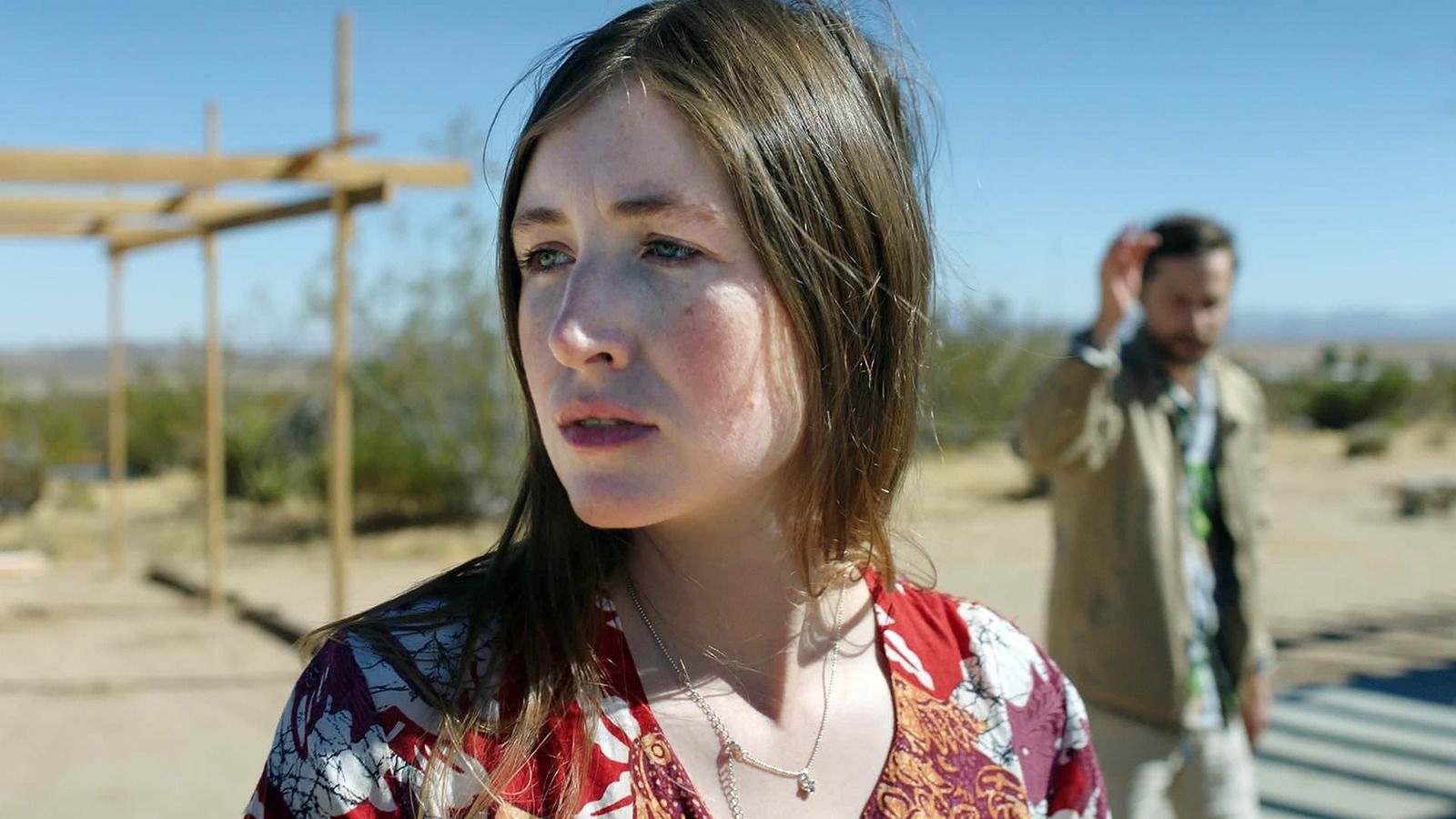
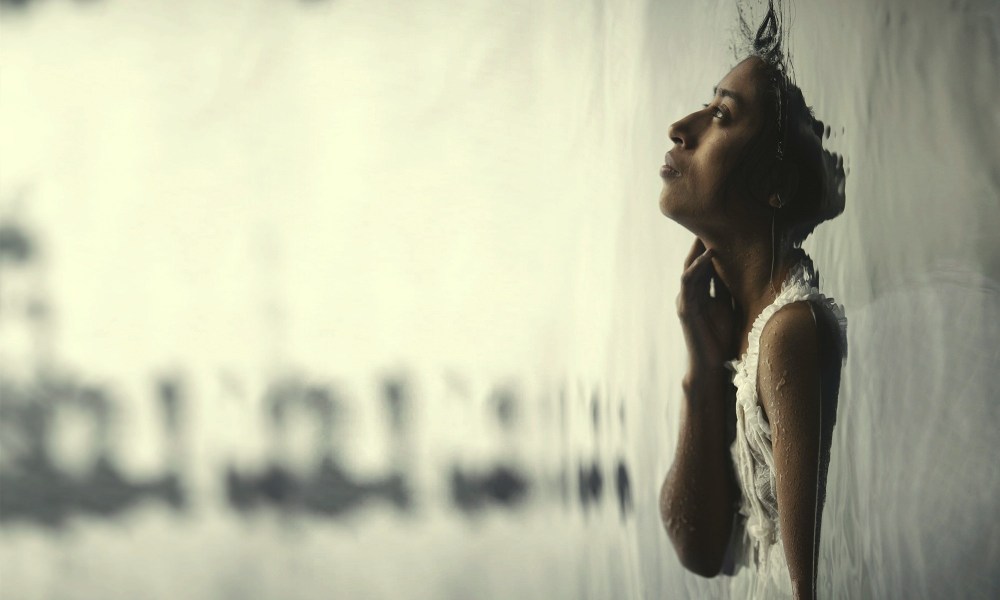
She Dies Tomorrow is a horror film that’s one part Coherence, one part The Beach House, one part The Signal (2007, not 2014) and yet somehow entirely its own. It helps that so few people have seen any of those other movies, but the truth is that writer/director Amy Seimetz (creator of The Girlfriend Experience) is simply braiding together themes that have quietly influenced SciFi horror hybrids of late. What she does with these themes is pretty remarkable.
Her film weaves in and out of the current moment, delivering
a dreamlike structure that suits its trippy premise. Amy (Kate Lyn Sheil)
believes she is going to die tomorrow. She knows it. She’s sure.
She calls her friend Jane (the always amazing Jane Adams), who senses that Amy is not OK but has this obligation to go to her sister-in-law’s party…whatever, she’ll stop over on her way.
By the time Jane gets to the party, she’s also quite certain
she will die tomorrow. It isn’t long before the partygoers sense their own
imminent deaths; meanwhile, Amy is spreading her perception contagion
elsewhere.
Seimetz’s horror is really only existential, although like The Signal (and The Crazies before it), She Dies Tomorrow is more than slightly interested in what individuals do with this disheartening information. What a superb way to cut directly to character development.
This gives the film an episodic quality, allowing even characters
in minor roles to express their individuality. Adams is characteristically
wonderful, both logical and a bit batty, lonely and strangely optimistic. Chris
Messina and Katie Aselton impress with a lived-in couplehood, and both Josh
Lucas and Adam Wingard are used deftly to bring an almost melancholy comic
relief to a couple scenes.
Sheil anchors the film. With the most time to get
comfortable with her lot, Amy drifts through the stages of grief and fear,
ending on a resigned kind of anticipation that feels comfortable with the tone
Seimetz creates.
From beginning to end, the film transmits a quiet, creeping dread. Seimetz can’t entirely capitalize on the intoxicating world she’s created, but hers is a unique voice and beguiling vision.
Another timely Shudder original plays upon the madness that can creep into a period of lockdown. The righteous anger of a population, the chanting and signs, corruption in the government—that all seems pretty of-the-moment, too, but this isn’t Portland. This is Guatemala, and if you think the context seems familiar, you should hear the title: La Llorona.
But co-writer/director Jayro Bustamante’s indigenous horror bears little resemblance to Michael Chaves’s middling 2019 effort (which was partly salvaged by a solid-as-always turn from Linda Cardellini). Instead, Bustamante retools the Latin American ghost story of the weeping woman to spin a yarn of righteous vengeance.
La Llorona takes us inside the home of a war criminal
(Julio Diaz). El General’s home is on lockdown since his conviction was
overturned. Angry Guatemalan citizens, and especially members of the Kaqchikel
people most terrorized by his bloodlust, protest outside the door all hours of
the day and night.
Inside, the General, his bitter wife (Margarita Kenéfic),
their doctor daughter (Sabrina De La Hoz), her daughter (Ayla-Elea Hurtado),
and two female servants (María Mercedes Coroy and María Telón) begin to crumble
under the tensions.
Bustamante’s film is a slow boil as interested in those who’ve tacitly accepted evil as it is in those who’ve committed it. What goes unsaid weighs as heavily as what happens in front of us. Impressively, this is also the first horror film in decades to make truly effective use of a dream sequence.
The fact that justice, however slowly, comes in the form of
generations of women is understated perfection.
Justice springs from compassion, which requires empathy—which sometimes depends upon courage and selflessness. No tears necessary.
We want to thank Cati Glidewell, also know as The Blonde in Front, for joining us to talk through some of the best blond(e)s in horror. There’s a lot of names here, but I think we may have proved that—with a few really bloody exceptions—blondes do seem to have more fun in these movies.
The Dudes
6. Francis Dollarhyde (Tom Noonan), Manhunter (1986)
Tom Noonan’s entire career is defined by a mixture of tenderness and menace. It begins with his unusual physical appearance, including his almost colorless locks, and ends with performances that realize everything broken and horrifying about a character—especially Francis Dollarhyde. The terrifying chemistry between Dollarhyde and a blind Joan Allen’s is heartbreaking perfection.
5. Mark Lewis (Carl Boehm), Peeping Tom (1960)
Like Norman Bates across the pond, England’s Mark Lewis (Carl Boehm) is an innocent. Boehm’s blank stare, his frightened mouse reflexes, his blond locks all contribute to a character so tender you can’t help but root for him—although it would be great if he’d stop murdering women.
4. Kakihara (Tadanobu Asano), Ichi the Killer (2001)
A bleach blond in a Japanese film will automatically draw the eye, but Kakihara’s not just here to catch your attention. Genius filmmaker Takashi Miike and Tadanobu Asano created this badass to upend your expectations. He’s the baddie, right? And man-child Ichi is the innocent? Or is Miike toying with you?
3. Gage (Miko Hughs), Pet Sematary (1989)
Get the Kleenex ready because the ridiculously cute Mike Hughs has a date with a semi. A toddler when he filmed this movie, Hughs really turns in a remarkable performance, whether he’s tugging your heart strings or slicing through Fred Gwynne’s Achilles tendon.
2. David (Keiffer Sutherland), The Lost Boys (1987)
Hubba hubba. The rock star duds. The homoerotic relationship with Jason Patrick. The mullett! Keiffer Sutherland’s bad boy David was so cool you couldn’t help wanting to hang out with him. Eating maggots seems like a small price to pay, really. Nobody said the cool kids’ table would be tasty.
1. John Ryder (Rutger Hauer), The Hitcher (1986)
There are those with a thing for bad boys, and then there are those with a thing for Rutger Hauer. He’s not a bad boy—he’s not even in the same zip code. His John Ryder will make you feel all kinds of weird things because he’s not your garden variety dangerous character. What he will do to you, to that nice family in the station wagon, to your new girlfriend, is more awful than anything you can think of.
The Women
6. Chris Hargeson (Nancy Allen), Carrie (1976)
When De Palma launched the ultimate in mean girl cinema, Nancy Allen delivered the ultimate mean girl. Chris Hargeson’s bloodthirsty princess energy has to convey something horrifying if she is to properly offset what poor Carrie White has to content with at home. Luckily for us (not so much for Carrie), she does.
5. Tomasin (Anya Taylor Joy), The Witch (2015)
Watching The Witch, you realize that writer/director Robert Eggers chose everything: every sound, every image, every color. And while Tomasin’s family looked like gaunt, hard working, colorless cogs in God’s wilderness wheel, Thomasin did not. Even as we open on Anya Taylor Joy, confessing her sins and begging forgiveness, she is lit from within. A beacon. It’s just that her light has caught the wrong kind of attention.
4. Casey (Drew Barrymore), Scream (1996)
The genius Wes Craven and his producer Drew Barrymore pulled an incredible and soon-to-be endlessly copied sleight of hand with Casey—the spunky female played by the biggest star in the cast. With this character, Craven introduces the meta-movie-commentary that defines this film while simultaneously upending our own unconscious investment in those tropes by killing Casey off in Act 1.
3. Carol (Catherine Deneuve), Repulsion (1965)
We went back and forth. Would it be Deneuve as gorgeous seductress Miriam in Tony Scott’s 1983 vampire film The Hunger, or innocent driven to madness Carol in Polanski’s Repulsion? (He does know how to torture innocent young women, doesn’t he?) Deneuve’s performance in Repulsion is so compelling and difficult—playing primarily alone for about half the film—that it won out, but either way, she’s a blonde to be reckoned with.
2. Pamela Voorhees (Betsy Palmer), Friday the 13th (1980)
The OG Karen (to steal a phrase from this episode’s co-host The Blonde in Front), Pamela Voorhees has a plan and she’s sticking to it. This funny business among the camp counselors needs to be addressed, corrected. Enough is enough. Betsy Palmer’s performance is spot-on, so comforting and in control before it goes completely batshit. Jason may get all the love, but Mrs. Voorhees took care of business first.
1. Carrie White (Sissy Spacek), Carrie (1976)
Like his idol Hitchcock, Brian De Palma had a thing about blondes—what that fair hair represented, what it could mean. For De Palma, it might be the bombshell of Angie Dickson’s character in Dressed to Kill, or the innocence of Carrie White. Of course, Sissy Spacek’s Oscar nominated performance in the film was what really sold this sheltered, shell-shocked little lamb, but you can’t deny she had that look.
Co-writer/director Kelly Blatz announces his presence with
authority, creating a minor cinematic miracle with his feature debut, Senior
Love Triangle.
Inspired by co-writer Isadora Kosofsky’s remarkable longterm photo essay
of the same name, the film delivers a candid look into the intimate relationship
among three elderly characters: William (Tom Bower), Adina (Anne Gee Byrd) and
Jeanie (Marlyn Mason).
The film is equal parts charming, frustrating and
heartbreaking. More importantly, it takes its characters seriously. In an era
where veteran actors entertain us via “those crazy old people!” vehicles (watching
Diane Keaton become a cheerleader in Poms
sapped my will to live), Senior Love Triangle feels gloriously anarchic.
The magic of Blatz’s film is that it offers a character study of the sort we
simply never see.
Thanks to thoughtful writing and breathtaking performances—neither
of which rely for a moment on shorthand—we get to know three unique
individuals. William is an irascible, arrogant, 84-year-old charmer. His
sophisticated lady love Adina indulges his ego, but when her son has him kicked
out of Adina’s posh retirement high rise, William finds himself in a
lower-quality establishment.
Not to worry! He’s just finishing a lucrative deal that will
set him up so he can buy a mansion and get Adele away from those Nazis in her
building. (That is to say, he’s being routinely scammed.) In the meantime, over
at his new digs he meets exuberant flirt Jeanie. (Mason’s performance is a
particular triumph.)
Blatz, with an incredible assist from Kosofsky’s work, sees
the characters’ humanity, their sexuality, their courage and weakness. He sees
their loneliness, their vulnerability to outside forces and to each other,
their need. These are complicated characters, vibrant and alive.
Senior Love Triangle offers an underseen perspective
on aging (the perspective of the aged themselves) without romanticizing. Dangerous
misconceptions about masculinity weigh as heavily on their safety and happiness
as their own physical deterioration.
The film is a heartbreaker that just does what it wants to do. Just like William.
In the forty years since J.M. Coetzee’s Waiting for the Barbarians was first published, world events have continued to re-frame its thematic relevance.
Now, the novel finally has a big screen adaptation, amid a tumultuous political climate that again makes Coetzee’s tale feel especially prescient.
In a vaguely historical era within an unnamed “Empire,” the Magistrate (Mark Rylance) governs his desert outpost population through moral conviction and a delicate harmony with the land’s indigenous peoples.
Conversely, Colonel Joll (Johnny Depp) – the soft spoken and sadistic head of state security – believes “pain is truth.” Joll arrives at the outpost to carry out random interrogations of the nomadic “barbarians” and learn the truth about an attack that he feels is imminent.
The Magistrate protests this view of the natives and the Empire’s directives, drawing the ire of Joll and later, his more overtly cruel lieutenant, officer Mandel (Robert Pattinson).
Coetzee’s debut screenplay adapts his own novel with delicate grace and an understated foreboding. But as relevant as the theme of creeping fascism remains, its bite is dulled by ambiguity and broadly-drawn metaphors.
The urge to speak more universally via an unspecified name, time and place is understandable, but it hampers the intimacy required to feel this warning in your gut.
The Oscar-winning Rylance (Bridge of Spies) almost makes up for this by himself, with a tremendous performance of quiet soul-searching. The film’s summer-to-the-following-autumn chapter headings paint the Magistrate as an obvious man for all seasons, and Rylance makes the Magistrate’s journey of fortitude and redemption feel almost biblical.
Depp and Pattinson provide worthy adversarial bookends. As Joll, Depp’s only eccentricity is a pair of sunglasses, but again he requires minimal screen time to carve an indelible figure.
Mandel is an even smaller role, but Pattinson makes him the eager realization of the ugliness Joll keeps bottled up. It’s another interesting choice for the gifted Pattinson, and another film that’s better for it.
Director Ciro Guerra utilizes exquisite cinematography from Chris Menges for a wonderful array of visuals, from beautifully expansive landscapes to artfully orchestrated interior stills. Though the film’s first act feels particularly forced, Guerra (Birds of Passage, Embrace of the Serpent) gives the remaining narrative – especially the Magistrate’s attempts at penance with the tortured Girl (Gana Bayarsaikhan) – the room to effectively breathe.
Waiting for the Barbarians is not a film that will leave you guessing. But the decades-old message remains painfully vital, and in its quietest moments of subtlety, the film gives that message sufficient power.
No disrespect to taut legal thrillers, but after watching The Fight it’s safe to say nothing will stack up to the real thing during the Trump administration. What began outside a New York court just days after the inauguration in 2017—the night the ACLU scored an early victory against the administration’s first version of what would become the “Muslim ban”—inspired documentary filmmaker Elyse Steinberg (Weiner) to follow the legal organization’s urgent and frequent races against the clock to challenge the administration’s advances on just about every key issue the group defends.
Surprisingly, given the marquee cases the group has been
involved in over the years, this is the first time they allowed access inside
their offices. Much less surprisingly, that turned out to be a smart move under
this administration: the filmmakers (Steinberg, along with co-directors Eli
Despres and Josh Kriegman) have no shortage of legal battles to follow.
Steinberg knows how to humanize her subjects. (She made Anthony Weiner almost sympathetic, after all.) The ACLU lawyers followed in the film are big names in their practice area, and recognizable faces to cable news watchers or the kind of person who has a favorite vice president. But it’s the less guarded moments that reveal the full gravity of this work: Dale Ho flubbing the lines in front of a mirror that he’ll later deliver to the Supreme Court, or Brigitte Amiri celebrating a major win with “train wine” on the Northeast Corridor. It’s equal parts grim and joyful.
To both the filmmakers’ and the ACLU’s credit, there’s
acknowledgement that the headline wins are tempered by the reality of the
American legal system. Even the wins might only be temporary, as the
administration endlessly finds ways to retool the laws in ways that pass muster
with a sympathetic Supreme Court.
In these moments, the film’s main players seem to tiptoe up
to a line of nihilism. But only just up to that line. We hear lawyers sigh that
arguing the merits of a case doesn’t always matter in front of the nation’s
highest court. And then there’s the criticism from those within the
organization itself over their role in Charlottesville, and what free speech
and democracy look like in this era.
Ultimately though, this cri de coeur isn’t looking to dismantle the entire system… yet. (Let’s see how disheveled they look if there’s another four years of this.) The film’s subjects refuse to jettison small-d democratic values, or a belief in the foundation on which these laws are built. It’s inspiring, in the way that Charlie Brown thinking he’s going to get that football this time is also a testament to the human spirit or something.
The filmmakers are aware of this contradiction too, though. It’s why the most powerful moments don’t take place in august courtrooms like the generic biopics these cases are bound to spawn some day. Instead, it’s with the individual people at the heart of the cases—the lawyers, eschewing private practice to go from airport to airport forever in search of a phone charger, but especially the anonymous people who found themselves in life or death situations with their fate hanging on the decision of a handful of judges.
For one of these cases, “Ms. L” v. ICE, the camera crew is present
when the asylum-seeking mother reunites with her daughter after being separated
by the government. She sheds tears of joy, but also lets out a shocking,
endless wail. These cases might have good endings, but not happy ones.
In our current era of memes and wikipedia
summaries, the true power of a figure like Bob Marley can become diminished. To
many in the US, Marley is simply known as “that reggae guy, who smoked weed and
thought peace was cool.” Dorm room posters, white kids with dreadlocks, and
Marley related drug paraphernalia can sometimes threaten to make us forget what
it was that made Marley a legend in the first place.
Kevin Macdonald’s in-depth documentary from 2012 seeks to jog the world’s memory about the revolutionary king of reggae. Marley is epic in scale and creates an experience that will be eye opening for long time fans and newcomers alike.
Re-released for what would have been Marley’s 75th birthday, the film has a two and a half hour runtime, but I can’t stress enough for audiences to not be daunted by the film’s length. The story here feels instantly essential and engrossing. It simply opts for a thoughtful, methodical pace that seems perfectly in sync with the reggae movement.
Even the editing of the film seems to be in reverence of its subject. For instance, a scene that introduces a popular song like “Natty Dread” in less mature hands may have been used as an excuse to showcase wild camera work and the ADD rapid cut editing. Instead we are given a slow motion aerial shot of Marley’s home country of Jamaica. We are granted a quiet moment where we listen to the music and gaze out at the beauty that helped inspire it.
The length also allows interviews with Marley’s band mates and family members to be more than just cut up sound bites. Macdonald is in no hurry and his patience elevates the film. The interviewees are given time to articulate their thoughts, and have genuine moments of joy and heartbreak as they offer their recollections.
The film is clearly a love letter to the man and his music, but unlike many celebrity documentaries, it does not shy away from some of the more difficult truths about its subject. Those who were closest to him are often painfully honest in the film when it comes to his egotistical tendencies and shortcomings as a family man.
Its comprehensive honesty makes Marley much more than a simple fan rock doc. It is an honest portrait, a celebration of a man who helped open the eyes of the world to a new era of music.
It might be a different type of faith-based flick, but Dare to Dream most definitely earns my usual disclaimer: judging these films is less about what they are preaching, and more about how well they tell a story.
Here, the gospel is the Law of Attraction, and the storytelling is unattractively dreadful.
The Secret first arrived nearly 15 years ago as a documentary and self-help book, both written by Rhonda Byrne, and each detailing how positive thinking can directly influence your life and bring you whatever it is you visualize.
Director/co-writer Andy Tennant (Hitch, Fool’s Gold) visualizes a narrative treatment that finds Vanderbilt professor Bray Johnson (Josh Lucas) ignoring hurricane warnings and driving down to New Orleans with an important message for one Miranda Wells (Katie Holmes).
Miranda is a widow with three kids, a boyfriend (Jerry O’Connell), and character development consisting of a succession of old graphic tees. She finds Bray before he finds her, by rear-ending him in traffic. Bray’s original mission is quickly sidetracked, and soon he’s fixing Miranda’s car, the hole in her roof, and whatever else his laid-back, dimpled philosophizing can help with.
Even before this handsome stranger effortlessly fascinates the wide-eyed Wells children with an example of how magnets work, not a lick of this bears any resemblance to real life.
Paper-thin characters recite banal dialogue carrying all the depth of a pop-up greeting card. Family strife about storm damage and money trouble is only dire enough to be a manufactured setup for Holmes to give a cute sigh and wonder, “What now??” while her kids pine for a computer or a pony.
Bray’s mission is never in doubt, and the film’s ultimate resolution becomes a tidy, manipulative pinch from the Nicholas Sparks playbook, right down to the throwing of a shameless trump card.
Whether you think The Secret is nothing but entitlement masquerading as feel good drivel, or a truly uplifting approach to finding happiness, a resonant film needs an attraction beyond preaching to the converted.
Or does it? Dare to Dream doesn’t really seem interested in finding out.
It’s an indisputable truth that we’re living at a time when the effects of human civilization are having a massive impact on the environment. Climate change is all around us. From stronger hurricanes and cyclones in our oceans, to half of Australia burning, the catastrophic change we’ve caused is something that’s become impossible to ignore.
While climate change and humans’ impact on it continues to be a political lightning rod, there are real people all over the world suffering the effects. Rebuilding Paradise tells the story of one such town and its residents.
On November 8th, 2018, an enormous wildfire overtook the small northern California town of Paradise. The Camp Fire, as it became known, destroyed most of Paradise and much of the surrounding area. Many residents were left without homes and jobs. Most of the city’s schools were either destroyed entirely or severely damaged. Eighty-five residents lost their lives that day.
A lot of people would’ve left and never looked back. For many of the residents of Paradise, turning their backs on their community wasn’t an option.
Finding Paradise opens with a harrowing series of videos shot by Paradise residents. As they flee, the footage shows nothing short of an absolute hellscape. Propane tanks explode in the distance as panicked families try to decide the safest route. At one point a resident asks another, “Are we going to die?” As a viewer, this devastating footage makes it all the easier to understand the PTSD that residents felt in the weeks and months following.
In the last decade, director Ron Howard (Apollo 13, A Beautiful Mind) has started to dabble more and more in the documentary field. His first two efforts, Made In America and Pavarotti, showed an already confident filmmaker finding his groove in a new genre. With Rebuilding Paradise, Howard’s confidence is solidified.
It would’ve been easy to make Rebuilding Paradise an exercise in tragedy porn. Instead, Howard builds the film as a tribute to the strength and the resiliency of the people of Paradise. The utter devastation at the beginning of the film is beautifully bookended by extraordinary acts of kindness. A community bends over backwards to make sure the few graduating Paradise seniors get to walk across the football field at their own high school. People open their doors to estranged family members who lost everything in the conflagration.
Howard’s insistence on focusing on the people of Paradise allows the film to stay deeply personal. Some of the worst that nature has to offer allows us to see just how decent, hardy, and inspiring people can be when pushed.
It was bound to happen, and no doubt the inanely titled Host
is the first in a succession of films to tap into quarantine and pandemic
frustrations to fuel horror. The fact that co-writer/director Rob Savage
employs found footage for his of-the-moment horror show seems even more
obvious.
Sometimes, though, it’s the most obvious choices that work
out. Savage taps into the real emotional gap between face-to-face and virtual
relationships as a handful of mates jump on a Zoom meeting for a bit if fun.
Separated because of lockdown, the buddies decide to create an event: an online séance. Haley (Haley Bishop) is hoping her friends will be respectful of the medium Seylan (Seylan Baxter), but those hopes are dashed when Teddy (Edward Linard) convinces the group to do a shot every time Seylan says “astro plane.”
“It’s astral plane,” Haley sighs.
Naturally, their irreverence is repaid.
Savage treads the same aesthetic as The Den or Unfriended:
Dark Web, but in many ways his effort is even more successful—perhaps
because it speaks so articulately to our immediate condition. Host is
incredibly simple and spooky in the way that it exploits our isolation and the
vulnerability that comes with that.
And while the medium itself is hardly groundbreaking and is
sometimes irritating, Savage takes advantage of the limitations of found
footage horror. The likability of the characters help you suspend disbelief during
the portions where they’d clearly have put down the damn computer, and because the
film manages to keep your interest, you get to enjoy the spook house effects. A
lot of these jump scares are old school fun.
Lean and mean, running a brisk 56 minutes, the film doesn’t busy itself too much with why or how or really even what. Instead it quickly upends our new normal with old fashioned scares.